Agroforestry for Carbon Credits in Kenya: What Farmers Actually Sign Up To
Agroforestry is the most established route into carbon markets for Kenyan smallholders, and there are real projects with real farmers being paid. In Embu and Tharaka Nithi, more than 21,500 farmers have reduced nearly 25,000 tonnes of carbon dioxide across 14,175 hectares and earned income from the sale of Carbon Removal Units.
That is genuine, and it is worth taking seriously. But there is a structural feature of these schemes that promoters rarely lead with, and it is documented in peer-reviewed research: the payments and the obligations do not last the same length of time. Money arrives early. The commitment to keep those trees standing runs for decades afterwards.
This guide covers what Kenyan agroforestry carbon projects actually pay, which trees they use, why agroforestry measures better than soil carbon — and what you are committing to before you sign. Read it with our Carbon Farming in Kenya pillar guide.
Agrosocial Services is an independent agricultural certification and compliance consultancy. We are not a carbon project developer and we do not buy or sell credits.
⚡ Key Facts — Agroforestry Carbon
- 💶 Recent Acorn CRU transactions: €20–€31 (roughly KSh 3,000–4,650) per tonne removed.
- 👨🌾 Over 21,500 farmers in Embu & Tharaka Nithi, 14,175 ha, 24,945 tonnes CO₂ reduced.
- ⚠️ Contracts run ~25 years — and obligations continue after payments stop.
- 📊 East African agroforestry stores ~24.2 t C/ha in biomass, ~98.8 t C/ha in soil.
- 🏡 Homegardens store the most carbon of any agroforestry system studied.
Sources: Farm Africa reporting on the Acorn (Rabobank) project; ScienceDirect systematic review of agroforestry in East Africa; peer-reviewed survey of smallholder carbon programmes; Misitu and GrowGrounds project documentation. Verified August 2026.
In This Guide
On the Ground
What’s Actually Running in Kenya
Unlike much carbon talk, agroforestry in Kenya has projects with names, counties and numbers attached:
| Where | Scale | Approach |
|---|---|---|
| Embu & Tharaka Nithi | 21,500+ farmers, 14,175 ha | Acorn CRUs; avocado, mango & nitrogen-fixing species |
| Mt Kenya region | Targeting 60,000+ farmers | 14 agroforestry models; trees intercropped with tea, coffee, annual crops |
| Nyeri County | 3 coffee co-ops, 5,800 farmers, 3,500 ha | 1.1 million trees into coffee systems |
| Bungoma, Kisumu, Siaya | Long-running western Kenya work | Tree intercropping, woodlots, nitrogen-fixing plants |
Note the pattern: these are aggregated schemes. Thousands of smallholders grouped under one project. As our MRV guide explains, that is not accidental — measurement costs and uncertainty deductions both fall sharply with scale, so individual smallholder carbon projects are rarely viable.
The Money
What Agroforestry Carbon Actually Pays
A Carbon Removal Unit (CRU) represents one tonne of carbon removed from the atmosphere. Recent Acorn CRU transactions have ranged between €20 and €31 per unit — roughly KSh 3,000 to KSh 4,650.
What reaches an individual farmer depends on how much biomass their trees add each year, which turns on the number, size and species of trees on their land. Payments frequently combine cash with in-kind benefits such as seedlings or beehives.
📌 Be wary of anyone who quotes you a confident per-farmer figure. A coordinator on one of Kenya’s largest agroforestry carbon projects put it plainly: given the unique circumstances of every farmer and plot, no specific numbers can be given. That is the honest position. A recruiter promising a precise annual income per acre is either guessing or selling.
For the wider picture on how carbon payments are structured and where value gets captured before it reaches the farm, see how farmers actually get paid.
Species Choice
Which Trees — and the Logic Behind Them
Kenyan projects consistently favour multipurpose species — trees that pay you something even if the carbon does not:
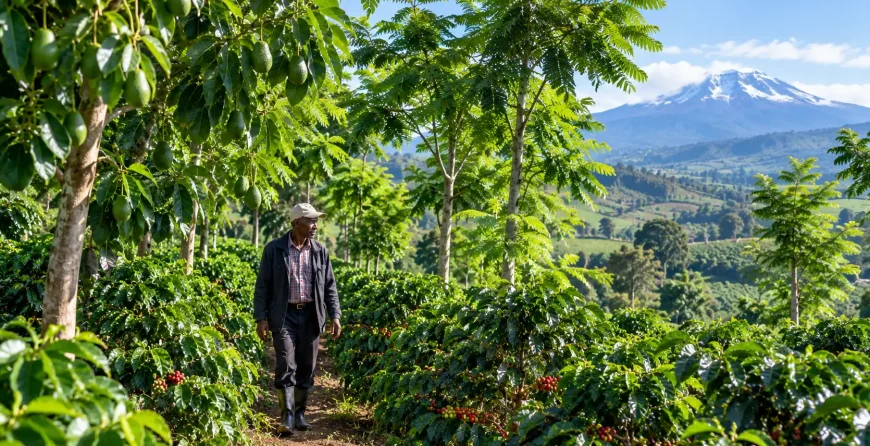
- Fruit trees — avocado and mango feature prominently, giving a saleable harvest alongside sequestration. Both have established export markets.
- Nitrogen-fixing species — these improve soil fertility directly, reducing fertiliser need.
- Shade and timber trees — intercropped with tea, coffee, annual crops and grassland.
The reasoning is sound and worth adopting yourself: choose trees you would want on the farm regardless of carbon. Carbon revenue is uncertain and modest. Fruit, fodder, firewood, timber and shade are certain. If the scheme underdelivers, you still have an asset — and that is the single best protection against a disappointing carbon contract.
One research finding supports this strongly: across East Africa, homegardens store the largest amount of carbon of any agroforestry system studied, in both biomass and soil. Mixed, intensively managed plots close to the homestead outperform formal plantation-style planting.
Free Download
Carbon schemes run on records — and so do audits
Plot maps, planting dates and field histories serve both. Our free guide covers the 25 record-keeping gaps that cost Kenyan farms money.
The Technical Advantage
Why Agroforestry Measures Better Than Soil Carbon
Research across East Africa puts agroforestry storage at an average of 24.2 ± 2.8 tonnes of carbon per hectare in biomass, alongside 98.8 ± 12.2 tonnes per hectare in soil.
The soil figure is larger — but the biomass figure is the one that gets credited most readily, because trees can be counted, measured and monitored remotely. Soil carbon changes are small, slow and vary enormously across a single field, which is why they attract heavier uncertainty deductions.
There is also a permanence advantage. Soil carbon gains can be reversed by a single season of ploughing. A standing tree is harder to lose accidentally — which is precisely why the contract binds you to keep it standing.
Read This Before You Sign
⚠️ The Contract Catch: Obligations Outlast the Payments
Peer-reviewed analysis of one of the most widely cited smallholder agroforestry carbon programmes makes an uncomfortable observation: it appears successful when viewed through project documentation and credit issuance records, but looks very different when examined from the perspective of participating farmers.
Here is the structure that creates that gap:
1 · You sign a long contract — typically around 25 years — dedicating part of your land to trees.
2 · Expected carbon revenue is discounted and paid in instalments, contingent on tree survival and periodic verification.
3 · Payments concentrate in the early years, then reduce or stop.
4 · You remain bound to maintain the trees for the rest of the contract period — with the income behind you and the obligation still ahead.
This is not fraud, and it is not hidden — it is in the contract. But it is rarely what a farmer hears at the recruitment meeting, and it changes the arithmetic considerably. You are not selling carbon for twenty-five years of income. You are receiving several years of income for twenty-five years of land commitment.
Ask directly: in which years do payments occur, and in which years do my obligations continue? If those two answers differ, you now know the real shape of the deal.
An Honest Structural Problem
Who Actually Benefits — and Who Gets Left Out
The same research found a consistent participation pattern: households with larger landholdings are more likely to join. Two reasons drive it, and both are worth understanding.
- Minimum plot-size requirements exclude the smallest farms outright.
- The opportunity cost of diverting cropland to trees is far heavier for a household farming under an acre. Land given to trees is land not growing food, and a poorer household cannot absorb that.
The result is that schemes intended to support the most climate-vulnerable often deter and disadvantage smaller and poorer farmers. If you run a cooperative, this matters practically: your members will not participate equally, and pretending otherwise creates resentment. Design your internal benefit-sharing with that in mind.
There is a workaround worth exploring: the homegarden finding suggests that intensively managed mixed plots near the homestead store carbon effectively without requiring a smallholder to surrender productive cropland. That is a better fit for small farms than dedicated woodlots, and worth raising with any developer approaching your group.
Legal Ground
Tree Tenure and Carbon Rights
Systematic review of East African agroforestry identifies a genuine gap in the science and the law around carbon rights, land tenure and tree tenure rights. That gap is not academic — it decides who is entitled to the money.
Three questions follow directly:
- Who owns the land, and is that documented? Contracts spanning 25 years on undocumented or family-held land are a dispute waiting to happen.
- Who owns the trees? Land ownership and tree ownership are not always the same thing in practice.
- Who owns the carbon? Under Kenya’s carbon markets regulations, benefit-sharing obligations differ by land category — see our guide to Regulation 29 and the 40% rule.
If you farm land you do not hold title to, resolve that before signing anything. A 25-year commitment on contested land is a serious exposure.
Due Diligence
Agroforestry-Specific Questions to Ask
- How long is the contract, and in which years am I paid? Map payments against obligations year by year.
- What happens if trees die from drought, disease or fire — do I repay, or simply stop earning?
- Can I harvest fruit, prune, or take timber, and does that reduce my payment?
- Is there a minimum plot size, and how much of my land must be committed?
- Which species, and would I want them on my farm regardless of carbon?
- How is the payment split between cash and in-kind, and can I choose?
- What happens if I sell the land, or when it passes to my children?
- Who verifies tree survival, how often, and what happens if I fail a verification?
Been approached about an agroforestry carbon scheme?
We review developer terms independently for cooperatives and farmer groups, and build the plot records and field histories these projects require. We earn nothing from your credits — so our reading of the contract is not influenced by whether you sign it.
Quick Answers
Frequently Asked Questions
How much do agroforestry carbon credits pay in Kenya?
Recent Acorn CRU transactions have ranged between about €20 and €31 per unit — roughly KSh 3,000 to KSh 4,650 — where one unit is one tonne of carbon removed. What an individual farmer receives depends on the number, size and type of trees, and payments often combine cash with in-kind benefits such as seedlings or beehives. Project coordinators are reluctant to quote per-farmer figures because circumstances vary so widely.
How long do these contracts last?
Around 25 years is typical. The critical detail is that payments and obligations do not run for the same period — revenues are discounted and paid in instalments over the early years, but once payments reduce or stop, the farmer remains bound to maintain tree cover for the remainder of the contract.
Which trees are used?
Multipurpose species that pay beyond carbon. Kenyan projects use avocado, mango and nitrogen-fixing species, intercropped with tea, coffee, annual crops and grassland. The logic matters: a tree that also yields fruit, fodder, firewood or timber stays worth keeping even if carbon payments disappoint.
Is agroforestry better than soil carbon?
For measurement, generally yes. Tree biomass can be measured directly and monitored remotely, whereas soil carbon changes are small, slow and spatially variable, attracting larger uncertainty deductions. East African agroforestry stores roughly 24.2 t C/ha in biomass alongside about 98.8 t C/ha in soil — and biomass is the part easiest to verify.
Key Takeaways
- Payments come early; obligations run ~25 years. Map one against the other before signing.
- Choose trees you’d want anyway — fruit, fodder and timber pay whether carbon does or not.
- CRUs recently traded at €20–31; treat confident per-farmer promises with suspicion.
- Smaller farms are structurally disadvantaged — plot minimums and opportunity cost bite hardest.
- Settle land and tree tenure first. A 25-year contract on contested land is a serious exposure.
Related Guides & Resources
Carbon & Climate
Carbon Farming in Kenya (pillar)
How Farmers Actually Get Paid
What Is MRV?
Biochar for Smallholders
Groups & Records
Work With Us
Last reviewed: August 2026 by Agrosocial Services. Compiled from Farm Africa reporting on the Acorn (Rabobank) agroforestry project, published documentation from Kenyan agroforestry carbon projects, a systematic review of agroforestry’s contribution to livelihoods and carbon sequestration in East Africa, and peer-reviewed analysis of smallholder agroforestry carbon programmes. Credit prices reflect transactions reported at the time of publication and fluctuate. Contract terms vary by project — obtain and read the actual agreement, and seek independent advice, before signing. Agrosocial Services is an independent consultancy; we are not a carbon project developer or credit buyer.