GLOBALG.A.P Certification in Kenya — The Complete Guide to Costs, Process & Requirements
🌍 Standard: GLOBALG.A.P IFA v6 | 📦 Crops: Avocado, French Beans, Mango, Passion Fruit, Flowers & more | ✅ Valid: 1 Year (Annual Renewal) | 💰 From: KES 15,000/farmer (group) | 📅 Last reviewed: June 2026
In This Guide
- Key Facts — Read This First
- What is GLOBALG.A.P Certification?
- Why Kenyan Farms Need GLOBALG.A.P
- Requirements — The 8 Audit Areas
- The Certification Process
- Costs in Kenya — 2026 Summary
- Is It Worth It? ROI by Crop
- Certification Bodies in Kenya
- Group Certification for Cooperatives
- Certification by Crop
- Frequently Asked Questions
- How Agrosocial Services Supports You
⚡ Key Facts — Read This First
- GLOBALG.A.P is the entry ticket to EU and UK fresh-produce supply. Every major European supermarket requires it from every farm in their supply chain — no certificate, no contract, regardless of quality.
- Cost: KES 150,000–490,000 in year one for an individual farm; KES 15,000–60,000 per farmer through cooperative group certification. Full budget breakdown →
- Timeline: 9–18 months for most Kenyan farms, from gap assessment to GGN issuance. Step-by-step process →
- Return: certified export prices run 150–400% above local middlemen prices across Kenya’s main export crops. Real 2026 ROI data →
- The pass bar: 100% of Major Must control points and 95% of Minor Must points. The audit is passed in the months of preparation, not on the day. How to pass the audit →
- Validity: 1 year. Renewal requires a full re-audit, so compliance systems must run year-round — a proportion of IFA v6 re-audits are unannounced.
GLOBALG.A.P certification is the most widely recognised agricultural certification standard in the world — and the primary market access requirement for Kenyan farms supplying fresh produce to European buyers. Over 200,000 producers in more than 135 countries hold it. In Kenya, GLOBALG.A.P certified farms supply supermarket chains across the UK, Netherlands, Germany, France and beyond — accessing export prices consistently two to four times higher than domestic prices for the same produce.
Yet certification remains out of reach for most Kenyan farmers — not because their farms cannot meet the requirements, but because the process is complex, the documentation is demanding, and professional guidance is not always accessible. This guide is the complete map: what the standard requires, how the process works, what it costs, whether it pays, and how to achieve it — with detailed guides linked at every step.
📩 Free: Farm Audit Sample Checklist — see what auditors check before you spend a shilling
The quick-reference sample of the checklist our consultants use on every Kenyan farm visit. Understand your compliance gaps before you commit to certification. Free, instant delivery.
What is GLOBALG.A.P Certification?
GLOBALG.A.P — Global Good Agricultural Practice — is an internationally recognised certification standard developed by a global partnership of retailers, producers and food supply chain stakeholders. The standard defines requirements for safe, sustainable and responsible agricultural production, covering food safety, worker welfare, environmental protection and traceability. The current version is Integrated Farm Assurance (IFA) v6 — if your farm last certified under v5, the changes matter.
Certification is issued by independent accredited certification bodies after a physical audit of the farm against the IFA standard. Certified producers receive a unique GGN — GLOBALG.A.P Number — that identifies them in the global database and can be verified by buyers anywhere in the world. In Kenya, the most commonly certified products are fresh vegetables (French beans, snow peas, baby vegetables), fresh fruits (avocado, mango, passion fruit) and cut flowers.
Why Kenyan Farms Need GLOBALG.A.P Certification
For Kenyan farms targeting European export markets, GLOBALG.A.P is not optional — it is the non-negotiable baseline for supply chain entry. Every major European supermarket retailer — Tesco, Waitrose, Sainsbury’s, Carrefour, Metro, Lidl, Aldi — requires it from every farm in their fresh produce supply chain. Without certification, a Kenyan farm cannot supply these buyers regardless of quality, price competitiveness or relationship history.
Beyond Europe, certification is increasingly required by Middle Eastern importers, Asian buyers and domestic premium retailers who treat it as the global benchmark for farm food safety. And the commercial return is consistently positive for farms that certify and establish direct export relationships — price premiums of KES 40 to KES 100 per kilogram above middlemen prices are typical for certified Kenyan fresh produce.
The Commercial Case in One Comparison
An uncertified Kenyan avocado farmer selling to a middleman earns KES 5–20/kg. A certified farmer selling to a European buyer earns KES 40–80/kg.
Same avocado. Same farm. Same work. The difference is a certificate that costs KES 15,000–25,000 per farmer in a cooperative group — and typically recovers within the first export season. See the full ROI data by crop →
GLOBALG.A.P Requirements — The 8 Audit Areas
The IFA v6 standard covers eight main areas with over 200 individual control points, each classified Major Must, Minor Must or Recommended. All Major Must points must be fully met; at least 95% of Minor Must points must be met. Here is what each area demands of a Kenyan farm — and where farms most often slip.
| Audit Area | What It Requires | Where Kenyan Farms Slip |
|---|---|---|
| 1. Site Management | Farm history records, site risk assessment, field maps and boundaries | Missing risk assessment |
| 2. Worker Health, Safety & Welfare | Trained first aiders, sanitation, PPE, training records, grievance procedure, private worker interviews | Workers can’t recall training in interviews |
| 3. Pesticide Management | Bunded chemical store, complete spray records, operator training, MRL compliance for the export market | Prohibited compounds still in the store |
| 4. Produce Handling & Storage | Hygienic post-harvest facilities, pest control, cleaning records, contamination prevention | No documented cleaning records |
| 5. Environmental Management | Water efficiency, waste management, soil health, Biodiversity Action Plan, energy monitoring | No Biodiversity Action Plan (new in v6) |
| 6. Traceability | Trace any lot from consumer back to specific field; consistent field coding; harvest records with lot numbers | Field called different names in different records |
| 7. Food Safety | MRL compliance, produce testing, water quality testing from accredited labs | Water test commissioned too late |
| 8. Quality Management & Records | All 7 record categories kept contemporaneously, internal audit conducted, corrective actions documented | Internal audit skipped — an automatic failure |
📖 Go deeper: How to Pass a Farm Audit in Kenya walks all 8 areas in detail with the step-by-step preparation system. For the records side, see the farm record keeping guide; for pesticides, the MRL compliance guide.
The Certification Process — From Gap Assessment to GGN
The path to certification runs through nine stages over 9–18 months for most Kenyan farms. In summary:
- Baseline gap assessment — assess the farm against every applicable IFA v6 control point before implementing anything.
- Corrective action implementation — fix the pesticide programme first, then infrastructure; commission water testing early (2–3 week lab lead time).
- Records system establishment — all seven record categories, kept contemporaneously from day one. Auditors reliably detect back-filling.
- Worker training and welfare — genuine year-round training; auditors privately interview workers.
- Quality Management System — recall, traceability, corrective action and complaint procedures with named responsible persons.
- Certification body selection and application — get quotes from at least two; audits are typically scheduled 4–6 weeks from application.
- The mandatory internal audit — a Major Must, conducted 6–8 weeks before the external audit so every finding can be fixed in time.
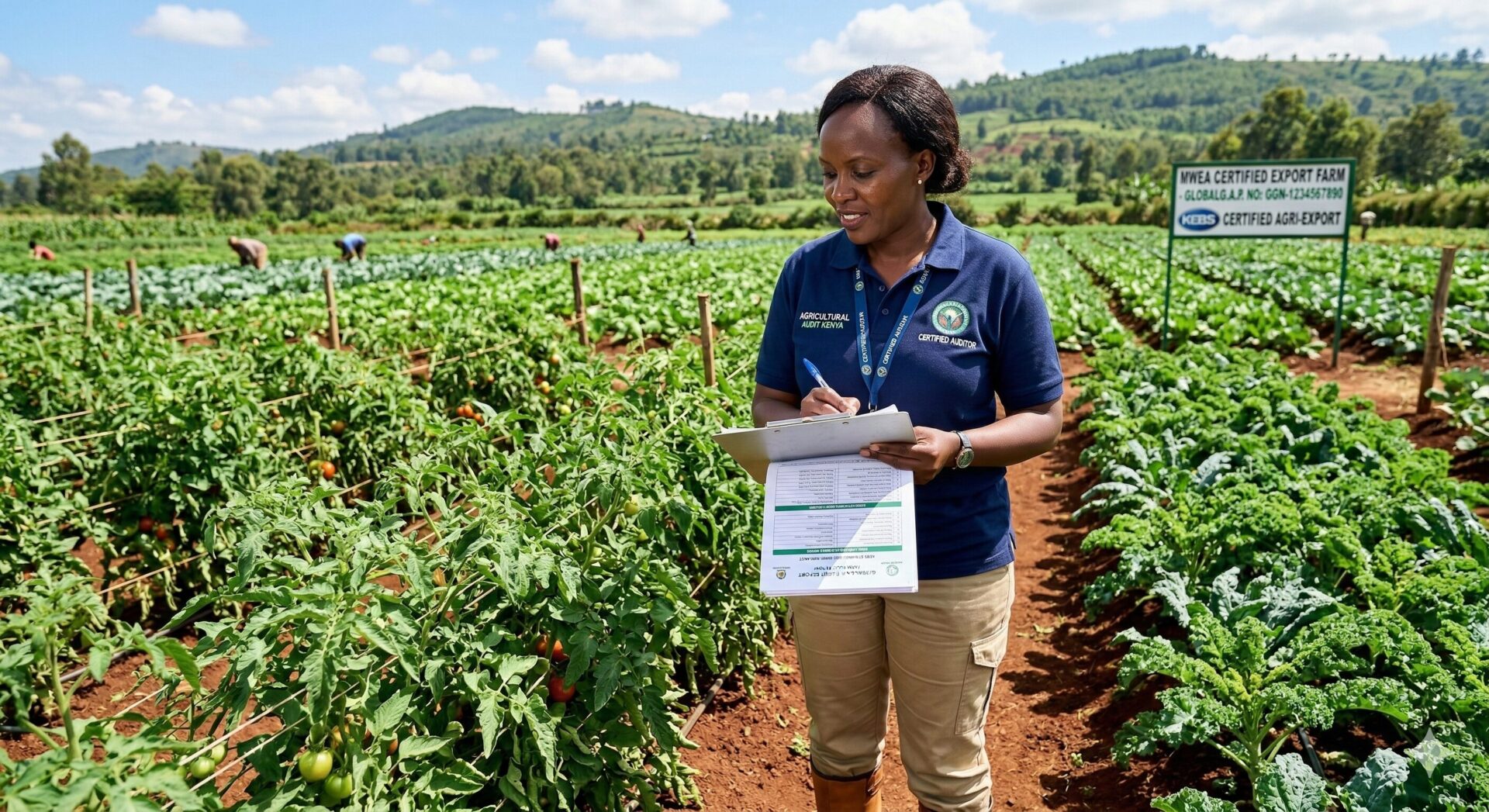
- The external certification audit — a 6–8 hour on-farm assessment: document review, farm walk, worker interviews, mock recall, closing meeting.
- Certification and GGN issuance — resolve any non-conformances, receive your certificate and GGN, and quote it in all buyer communications.
📖 The full guides: How to Get GLOBALG.A.P Certified in Kenya covers every step with the month-by-month timeline and certification body comparison. Then How to Pass a Farm Audit in Kenya is the deep preparation system, and Farm Audit Day in Kenya covers how to conduct yourself when the auditor arrives.
GLOBALG.A.P Certification Costs in Kenya — 2026 Summary
Certification Cost Calculator
Estimate the cost and timeline to get your Kenyan farm or cooperative certified — in under a minute.
Get your detailed breakdown + a tailored quote
We'll email your full cost breakdown and the exact steps for your situation. No spam — just your result and how to get started.
Total first-year investment for an individual Kenyan farm typically runs KES 150,000 to KES 490,000, depending on farm size, crop, starting compliance level and whether professional support is used. Group certification through a cooperative reduces this to KES 15,000 to KES 60,000 per farmer member. The main components:
| Cost Component | Individual Farm (Year 1) | Group (per farmer, Year 1) |
|---|---|---|
| Preparation & consultancy support | KES 80,000–200,000 | KES 15,000–60,000 all-in (shared QMS, internal audit and CB costs) |
| Certification body audit fee | KES 45,000–150,000 | |
| Laboratory testing (water, soil, residues) | KES 20,000–60,000 | |
| Annual GLOBALG.A.P registration | ~USD 100–200 (set by GLOBALG.A.P) |
Those are the headline figures. The numbers that surprise farms are elsewhere: annual renewal costs, the hidden costs nobody budgets for, and the re-audit fee if the first audit fails (KES 45,000–100,000 — usually more than proper preparation would have cost). The full breakdown lives in two dedicated guides:
📖 The money guides: The GLOBALG.A.P Certification Budget Guide 2026 — all four cost categories, individual vs group tables, renewal costs, hidden costs, and six ways to fund your certification. And Is GLOBALG.A.P Certification Worth the Cost? — the real 2026 ROI data by crop.
Is It Worth It? ROI by Crop — The Short Version
For group-certified smallholders with a credible buyer pathway, the answer is almost always yes — payback typically lands within 2–6 months of the first export season. The certified-vs-uncertified price gap by crop:
| Crop | Uncertified / Local | Certified Export | Crop Guide |
|---|---|---|---|
| 🥑 Avocado (Hass) | KES 5–20/kg | KES 40–80/kg | Avocado Export Kenya |
| 🫘 French Beans (fine) | KES 20–40/kg | KES 80–140/kg | French Beans Export Kenya |
| 🥭 Mango | KES 8–25/kg | KES 60–120/kg | Mango Export Kenya |
| 🌿 Passion Fruit | KES 15–35/kg | KES 80–120/kg | Passion Fruit Export Kenya |
| 🌹 Cut Flowers (Rose) | KES 8–15/stem | KES 25–60/stem | Roses Export Kenya |
The honest caveat: a certificate without a buyer relationship does not generate income — it is a market access tool, not a revenue stream. The full ROI analysis includes per-crop payback calculations, the cooperative vs individual ROI gap, and the situations where certification is genuinely not worth it.
Accredited GLOBALG.A.P Certification Bodies in Kenya
The main accredited certification bodies active in Kenya are SGS Kenya, Bureau Veritas Kenya, Kiwa, and Intertek. All audit against the same GLOBALG.A.P standard and issue equivalent certificates — your choice of body does not affect market access. Fees, scheduling flexibility and auditor crop expertise differ, so get quotes from at least two before committing; a KES 30,000–60,000 difference on the same scope is common. Our step-by-step certification guide includes the full certification body comparison and how to choose.
Group Certification for Kenyan Cooperatives — The Smallholder Route
GLOBALG.A.P Option 2 group certification allows producer organisations — cooperatives, farmer groups, outgrower schemes — to certify all member farms under a single Quality Management System. The organisation runs internal inspections across member farms; the certification body audits the QMS plus a representative sample. This is the standard route for Kenyan smallholders: it cuts per-farmer costs by 80–90% versus individual certification while delivering the collective volumes export buyers require.
The requirements are real, though: a registered cooperative (Co-operative Societies Act Cap 490), a functioning QMS, and trained internal auditors who inspect member farms annually. Training your own internal auditors — rather than outsourcing every year — saves a cooperative KES 60,000–180,000 over a 3-year cycle; our farm audit guide covers the internal auditor system, and Agrosocial runs the training. For the complete group route, see the group certification guide for Kenyan cooperatives.
📩 Planning certification for your farm or cooperative?
Get the free Farm Audit Sample Checklist and see exactly what the auditor will check — before you spend anything. Free, instant delivery.
GLOBALG.A.P Certification by Crop
Certification requirements are the same standard across crops, but the compliance pressure points, buyer expectations and add-on requirements differ. French beans face the strictest MRL scrutiny of any Kenyan export crop and UK buyers typically require GRASP alongside GLOBALG.A.P. Avocado is Kenya’s fastest-growing export crop with new duty-free access to China. Flowers add MPS-ABC and KFC requirements. Each crop guide covers the full picture:
Avocado Export Kenya · French Beans Export Kenya · Mango Export Kenya · Passion Fruit Export Kenya · Roses Export Kenya · Coffee Export Kenya · Macadamia Export Kenya
Start With the Tools Our Consultants Use on Every Kenyan Farm
Run your own gap assessment before spending on consultancy or certification body fees. Instant download. M-Pesa, Visa and Mastercard accepted.
Frequently Asked Questions
How long is GLOBALG.A.P certification valid in Kenya?
One year from the date of issue. Annual re-certification requires a full re-audit by the certification body, and farms must maintain compliance systems and records throughout the year. Certification can be suspended or withdrawn if non-compliance is found between audits — and under IFA v6 a proportion of re-audits are unannounced.
Can a Kenyan farm lose GLOBALG.A.P certification?
Yes. Certification can be suspended or withdrawn if a certified farm fails to maintain compliance — for example if a pesticide MRL exceedance is detected on exported produce, if a surveillance or unannounced audit reveals major non-conformances, or if the farm fails its annual re-audit. Year-round compliance management is what protects the certificate.
Does GLOBALG.A.P certification guarantee a buyer will purchase my produce?
No — certification is the market access requirement, not a guarantee of sales. Certified farms still need to identify buyers, develop supplier profiles, make commercial approaches and negotiate supply agreements. Agrosocial Services provides market linkage support to help certified Kenyan farms connect with international buyers.
Is GLOBALG.A.P certification the same as organic certification?
No. GLOBALG.A.P certifies Good Agricultural Practices covering food safety, worker welfare and environmental management — it does not prohibit synthetic pesticides or fertilisers. Organic certification additionally requires eliminating synthetic inputs and a conversion period. Some buyers require both for organic market supply.
What crops can be GLOBALG.A.P certified in Kenya?
The standard covers fresh vegetables (French beans, snow peas, baby vegetables), fresh fruits (avocado, mango, passion fruit, citrus), cut flowers and ornamentals, and combinable crops. See our crop guides for avocado, French beans, mango, and passion fruit.
How do I verify if a Kenyan farm is GLOBALG.A.P certified?
Any farm’s certification status can be verified through the GLOBALG.A.P database at database.globalgap.org using the farm’s GGN producer number. Buyers routinely verify certification before placing orders — keep your GGN accurate and your certificate current.
Key Takeaways
- GLOBALG.A.P is the entry requirement for EU/UK fresh-produce supply — every major European retailer requires it from every farm.
- Group certification is the smallholder route: KES 15,000–60,000 per farmer versus KES 150,000–490,000 individually — an 80–90% saving through a registered cooperative.
- Budget 9–18 months from gap assessment to certificate, and start water testing and the pesticide programme first — they have the longest lead times.
- The audit is passed in preparation, not on the day. The internal audit is mandatory; records must be contemporaneous; workers are interviewed privately.
- The premium is real: certified export prices run 150–400% above local middlemen prices — but only with a buyer pathway, so line up your market channel as you certify.
- Get at least two certification body quotes — a KES 30,000–60,000 difference on identical scope is common in Kenya.
Agrosocial Services — GLOBALG.A.P Certification Support
Gap Assessment · Full Certification Preparation · Group Certification & Internal Auditor Training · Market Linkage
Agrosocial Services Limited is Kenya’s specialist GLOBALG.A.P consultancy. Since 2018 we have prepared 150+ farms and cooperatives across 12 counties for certification — gap assessment, compliance systems, pesticide programmes, records, worker welfare, internal audits and certification body liaison — and connected certified producers with buyers in the UK, Netherlands and beyond. We respond within 2 hours, Monday–Saturday, 7am–7pm EAT.
Serving: Nairobi · Kiambu · Nakuru · Meru · Machakos · Murang’a · Embu · Kisii · Kirinyaga · Kakamega · Uasin Gishu · Nyandarua · Taita Taveta
The Complete GLOBALG.A.P Library from Agrosocial Services
Costs and ROI: Certification Budget Guide 2026 · Is Certification Worth the Cost? ROI Data
Process and audits: How to Get Certified — Step by Step · How to Pass a Farm Audit · Farm Audit Day — What Auditors Check
Compliance deep dives: Farm Record Keeping · MRL Compliance Guide · IFA v6 vs v5 — Every Change · Group Certification for Cooperatives
Crop guides: Avocado · French Beans · Mango · Passion Fruit · Roses · Coffee · Macadamia
Tools: Farm Audit Checklist (KES 3,500) · Farm Records Pack (KES 500) · Complete Starter Kit (KES 6,000)
Agrosocial Services Certification Team
Kenya Agricultural Certification Consultancy — Since 2018
Agrosocial Services Limited is Kenya’s specialist agricultural certification and export market consultancy. Our certification team has worked with 150+ Kenyan farms and cooperatives across 12 counties since 2018, preparing them for GLOBALG.A.P, GRASP, Rainforest Alliance, FairTrade, and Kenya GAP certifications. Our consultants are trained to certification body auditor standard with practical experience across avocado, French bean, mango, passion fruit, rose, and coffee value chains.
📧 info@agrosocialservices.co.ke · 📲 WhatsApp +254 713 935 361 · 📅 Last reviewed: June 2026
Certifications covered:
✅ GLOBALG.A.P IFA v6
✅ GRASP v2
✅ Rainforest Alliance 2020
✅ FairTrade Kenya
✅ Kenya GAP
✅ SMETA / EUDR Ready
✅ KS 1758 Code of Practice