Agricultural Export from Kenya — The Complete Guide 2026
🌍 Markets: EU · UK · China · Middle East | 📦 Crops: Avocado, French Beans, Mango, Passion Fruit, Flowers, Macadamia, Coffee | ✅ Gateway: GLOBALG.A.P + KEPHIS + HCD | 📅 Last reviewed: June 2026
In This Guide
- Key Facts — Read This First
- Kenya as an Export Nation
- Top Export Crops — Prices & Markets
- Destination Markets
- Step 1: GLOBALG.A.P Certification
- Step 2: KEPHIS Registration
- Step 3: HCD Export Licence
- Step 4: Packhouse & Cold Chain
- Step 5: Finding Buyers
- Step 6: Your First Shipment
- GRASP v2 & EUDR — New Rules
- Export Documentation Checklist
- Air vs Sea Freight
- Group Certification for Smallholders
- Frequently Asked Questions
⚡ Key Facts — Read This First
- Four gates to export: GLOBALG.A.P certification (buyer requirement), KEPHIS registration + phytosanitary certificate, HCD export licence, and a registered packhouse with cold chain. Miss any one and the consignment cannot ship.
- The premium is the whole point: certified export prices run 150–400% above local middlemen prices across Kenya’s main crops. See ROI by crop →
- Smallholders export through cooperatives — group certification cuts per-farmer cost to ~KES 15,000–25,000. Group certification guide →
- Every consignment needs a KEPHIS phytosanitary certificate — apply for pre-export inspection at least 48 hours before shipping.
- Two new compliance pressures in 2026: GRASP v2 (now expected by UK supermarkets) and EUDR (deforestation due-diligence, critical for coffee). EUDR guide →
- A certificate is not a buyer. Export income needs both certification and a buyer relationship — plan your market channel as you certify.
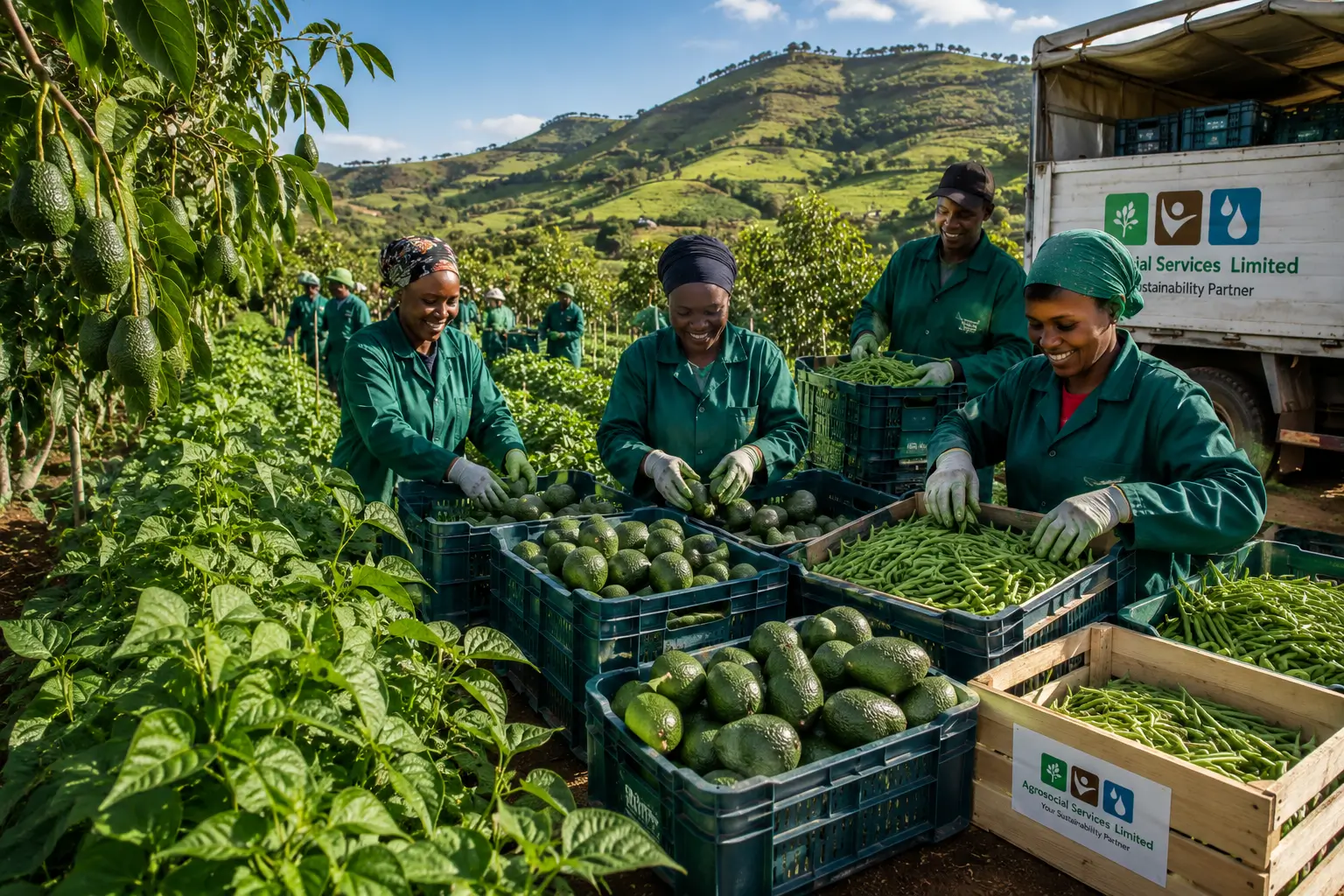
Kenya’s agricultural export sector is one of the most dynamic in sub-Saharan Africa, exporting over USD 1 billion of horticultural produce annually — primarily to the European Union, United Kingdom, and increasingly the Middle East and China. For Kenyan farms and cooperatives, the export market means prices two to four times higher than the domestic market for the same produce. But accessing it requires meeting a defined set of certification, regulatory and logistics requirements — and this guide maps every one of them, with detailed guides linked at each step.
Whether you grow avocado, French beans, mango, passion fruit, flowers, coffee or macadamia,or chilli the path to the export market runs through the same four gates — certification, KEPHIS, HCD and a compliant packhouse — covered step by step below.
📩 Free: Export Readiness Checklist — the 4 gates, mapped
Our one-page checklist covering certification, KEPHIS, HCD and packhouse requirements — see exactly where your farm stands before you invest. Free, instant delivery.
Kenya as an Agricultural Export Nation
Agriculture is the backbone of Kenya’s economy, contributing around a fifth of GDP and the bulk of foreign exchange earnings. Horticulture — fresh fruits, vegetables and cut flowers — is the standout export performer, with Kenya among the world’s leading exporters of cut flowers and a major supplier of fresh vegetables and avocados to Europe. The sector’s strength rests on Kenya’s climate, altitude range and established air-freight links through Jomo Kenyatta International Airport, alongside growing sea-freight capacity through Mombasa for crops like avocado.
For an individual farm or cooperative, the opportunity is concrete: a certified Kenyan farm supplying a European buyer earns dramatically more per kilogram than one selling to local brokers — and demand from EU, UK, Middle Eastern and Chinese buyers continues to grow for reliably certified, traceable produce.
Top Agricultural Export Crops — Prices, Markets & Certification
The certification and export process is the same across crops, but the economics, seasons and add-on requirements differ. Here is the snapshot — each crop has a dedicated guide with the full detail.
| Crop | Certified Export Price | Main Markets | Full Guide |
|---|---|---|---|
| 🥑 Avocado (Hass) | KES 40–80/kg | EU, UK, Middle East, China | Avocado Export Kenya |
| 🫘 French Beans | KES 80–140/kg | UK, EU (strict MRL + GRASP) | French Beans Export Kenya |
| 🥭 Mango | KES 60–120/kg | Middle East, EU | Mango Export Kenya |
| 🌹 Roses / Cut Flowers | KES 25–60/stem | EU (Netherlands auctions), UK | Roses Export Kenya |
| 🌿 Passion Fruit | KES 80–120/kg | EU, UK, Middle East | Passion Fruit Export Kenya |
| 🌰 Macadamia | Premium nut markets | EU, US, China | Macadamia Export Kenya |
| ☕ Coffee | Specialty premiums | EU (EUDR applies), US | Coffee Export Kenya |
| 🌶️ Chilli | Premium fresh & dried | EU, UK, Middle East, Asia | Chilli Export Kenya |
Kenya’s Top Agricultural Export Destination Markets
European Union — the largest market for Kenyan fresh produce and flowers. Requires GLOBALG.A.P, strict EU MRL compliance, and EUDR due diligence for in-scope products. United Kingdom — a major buyer of Kenyan vegetables and flowers; supermarkets typically require GLOBALG.A.P plus GRASP. China — a fast-growing market, with duty-free access secured for Kenyan avocado and interest in macadamia and coffee. Middle East (UAE, Saudi Arabia, Qatar) — strong demand for Kenyan mango, avocado and vegetables, often with less stringent certification requirements than the EU, making it a useful entry market.
Matching your crop to the right market is a commercial decision as much as a compliance one — the guide to finding international buyers covers how to approach each.
Step 1: GLOBALG.A.P Certification — The Commercial Gateway
GLOBALG.A.P certification is the foundation of agricultural export from Kenya — the baseline requirement every serious EU and UK buyer demands before any commercial conversation. It certifies food safety, traceability, worker welfare and environmental practice to IFA v6 standard, and issues a GGN that buyers verify in the global database. Without it, the EU and UK markets are closed regardless of produce quality.
Certification costs KES 150,000–490,000 for an individual farm, or KES 15,000–60,000 per farmer through a cooperative group, and takes 9–18 months. This pillar’s companion guides cover every angle:
📖 The certification cluster: GLOBALG.A.P Certification Kenya (overview) · How to Get Certified — Step by Step · How to Pass a Farm Audit · Certification Budget Guide · Is It Worth It? ROI Data
📋 Start With the Farm Audit Checklist
Run your own export-readiness gap assessment against every IFA v6 control point before spending on consultancy. Instant download, M-Pesa accepted.
Farm Audit Checklist — KES 3,500 →
Complete Starter Kit — KES 6,000
Step 2: KEPHIS Registration and Phytosanitary Certificates
The Kenya Plant Health Inspectorate Service (KEPHIS) ensures all agricultural products exported from Kenya meet the phytosanitary import requirements of destination countries. Every agricultural export from Kenya — without exception — requires a KEPHIS phytosanitary certificate accompanying the consignment, confirming it has been inspected and found free from regulated pests and diseases.
KEPHIS registration — step by step
- Create an account on the KEPHIS e-certification portal (ieics.kephis.org) — you’ll need your company/cooperative name, KRA PIN, registered business address, and the crop types you intend to export.
- Submit farm registration details. Every production site supplying the consignment must be KEPHIS-registered, including field location, crop type and area under production.
- Register your packhouse — it must pass a KEPHIS hygiene and traceability inspection.
- Apply for pre-export inspection at least 48 hours before the planned export date; inspectors check pest and disease status, label accuracy, produce identity and packing hygiene.
- Receive the phytosanitary certificate — typically issued same day or within 24 hours of a passed inspection, to accompany the consignment to the destination border.
KEPHIS offices operate at JKIA Cargo (air freight), Mombasa Port (sea freight), and regionally in Nairobi, Nakuru, Meru and other counties. The inspection fee for a standard fresh-produce consignment is typically KES 2,000–8,000 depending on size and crop.
📖 Important: a KEPHIS pass does not guarantee EU MRL compliance — that’s a separate testing programme for EU-destined fresh produce. See the MRL compliance guide.
Step 3: HCD Export Licence — Registering as a Kenyan Exporter
The Horticultural Crops Directorate (HCD), under the Agriculture and Food Authority, regulates all horticultural exports from Kenya. Any entity commercially exporting fresh fruits, vegetables or flowers must hold an HCD export licence, renewed annually. Registration requires your incorporation or cooperative registration documents, KRA PIN, evidence of produce sourcing, and the licence fee. For cooperatives, this is held at the organisation level and covers member produce — one of the efficiencies of the group route.
📖 For cooperatives: the full registration path — Cap 490, KRA PIN, HCD licence and KEPHIS registration — is covered in How to Register a Cooperative in Kenya for Agricultural Export.
Step 4: Packhouse Registration and Cold Chain
Fresh produce exports require a registered packhouse with adequate cold chain — the facility where produce is received, graded, packed and pre-cooled before dispatch. Minimum requirements include hygienic cleanable surfaces, pest exclusion, separation of produce from chemicals, handwashing and sanitation, traceability from intake to dispatch, and temperature-controlled storage appropriate to the crop. The packhouse must be KEPHIS-registered and, for many buyers, covered by the farm’s GLOBALG.A.P scope or a complementary standard such as BRCGS for larger operations.
Cold chain is crop-specific: avocado, French beans, flowers and passion fruit each have distinct temperature and handling needs from harvest through transit. Breaking the cold chain is one of the most common causes of rejected or downgraded consignments.
Step 5: Building Buyer Relationships and Supply Agreements
Certification opens the door; a buyer relationship is what generates income. Buyers verify your GGN, assess your volumes and consistency, and want a professional, reliable supply partner. Routes to buyers include direct approaches to importers and supermarket supply chains, established Kenyan exporters and consolidators, trade fairs (such as Fruit Logistica), and market-linkage support. A certificate sitting idle without a buyer is the single most common reason certification fails to pay back.
📖 Finding buyers: How to Find International Buyers for Kenyan Agricultural Products · Linking Farmers to Buyers & Exporters
Step 6: Executing Your First Export Shipment
With certification, KEPHIS registration, an HCD licence, a packhouse and a buyer in place, the first shipment brings it together: harvest to specification, pack and pre-cool, book freight (air via JKIA or sea via Mombasa), pass KEPHIS pre-export inspection, assemble the documentation set, and dispatch. The first shipment is where preparation meets reality — most first-time issues are documentation gaps or cold-chain slips, both avoidable with a checklist.
GRASP v2 and EUDR — The New Compliance Requirements
GRASP v2 — the GLOBALG.A.P Risk Assessment on Social Practice — is now expected by UK supermarkets alongside GLOBALG.A.P for Kenyan suppliers. It assesses worker wages, hours, representation and grievance procedures, and is conducted during the same audit visit when records are ready. See the GRASP certification guide.
EUDR — the EU Deforestation Regulation — is an existential issue for coffee cooperatives, requiring GPS geolocation of plots and due-diligence statements for in-scope products entering the EU. Kenyan coffee and other affected exporters are working against real deadlines. See the EUDR compliance guide.
📩 Planning your route to export?
Get the free Export Readiness Checklist — certification, KEPHIS, HCD and packhouse, on one page. Free, instant delivery.
Which Certification Do You Need?
Answer four quick questions and we'll tell you exactly which certification fits your farm, what it costs, and how long it takes.
Get your free personalized certification roadmap
We'll email the exact steps, costs and timeline for your situation — and answer any questions. No spam.
Export Documentation — The Complete Checklist
Every Kenyan agricultural shipment travels with a documentation set. Missing or inconsistent paperwork is a leading cause of consignments being held at destination. The core documents:
- KEPHIS phytosanitary certificate — confirms pest/disease-free status
- Commercial invoice — buyer, value, terms
- Packing list — contents, weights, lot numbers
- Certificate of origin — for preferential tariff access where applicable
- Bill of lading (sea) or air waybill (air) — the transport contract
- GLOBALG.A.P certificate / GGN — buyer verification
- EUR.1 / origin declaration — for EU preferential access where applicable
- EUDR due-diligence statement — for in-scope products to the EU
Air Freight vs Sea Freight — A Decision Framework
High-value, perishable or time-sensitive produce — French beans, flowers, premium passion fruit — typically moves by air via JKIA: fast (produce in Europe within a day or two) but expensive. Hardier, higher-volume crops — increasingly avocado — move by sea via Mombasa in refrigerated containers: far cheaper per kilogram but requiring robust cold chain and a longer transit (several weeks), so only suitable for produce that holds up. The right choice depends on crop shelf life, margin and volume — and shapes your whole logistics plan.
Group Certification — How Smallholders Access Export Markets
For smallholder farmers, individual certification is rarely economic — but group certification under GLOBALG.A.P Option 2 changes the equation. A registered cooperative certifies all member farms under one Quality Management System and a shared internal audit, cutting per-farmer cost by 80–90% to roughly KES 15,000–25,000 while aggregating the volumes buyers need. It requires cooperative registration under Cap 490, a functioning QMS and trained internal auditors.
📖 The smallholder route: GLOBALG.A.P Group Certification for Cooperatives · How to Register a Cooperative for Export · Agricultural Funding Sources
Frequently Asked Questions — Agricultural Export from Kenya
What are the requirements to export agricultural products from Kenya?
Four core requirements: GLOBALG.A.P certification (the buyer requirement for EU/UK markets), KEPHIS registration with a phytosanitary certificate for every consignment, an HCD export licence to operate as a horticultural exporter, and a registered packhouse with adequate cold chain. EU-destined fresh produce also needs an MRL compliance programme. See the certification overview to begin.
What is the most exported agricultural product from Kenya?
By value, cut flowers and fresh vegetables (led by French beans) have long been Kenya’s largest horticultural exports, with Hass avocado now among the fastest-growing. Tea and coffee remain major agricultural exports overall. The best opportunity for a given farm depends on its location, climate and the market it can reach.
What is a KEPHIS phytosanitary certificate and how do I get one?
It is the official document confirming a consignment was inspected and found free of regulated pests and diseases — required for every Kenyan agricultural export. Register on the KEPHIS e-certification portal, register your farm and packhouse, then apply for pre-export inspection at least 48 hours before shipment. The inspection fee is typically KES 2,000–8,000 by consignment size and crop.
Do I need GLOBALG.A.P certification to export from Kenya?
For EU and UK supermarket buyers, yes — it is effectively mandatory. Some Middle Eastern buyers accept produce without it, which can make the region a useful entry market. But for the largest, highest-value markets, GLOBALG.A.P is the non-negotiable gateway. See how to get certified.
Which countries are Kenya’s top agricultural export markets?
The European Union (largest, especially Netherlands, Germany, France), the United Kingdom, the Middle East (UAE, Saudi Arabia, Qatar), and increasingly China, which has granted duty-free access for Kenyan avocado. Each market has different certification and documentation expectations covered above.
Can smallholder farmers in Kenya export directly?
Through a cooperative, yes. Group certification under GLOBALG.A.P Option 2 lets a registered cooperative certify all members under one system, cutting per-farmer cost to roughly KES 15,000–25,000 and aggregating export volumes. See group certification for cooperatives.
What is the EUDR and does it affect Kenyan coffee exporters?
The EU Deforestation Regulation requires proof that in-scope products — including coffee — are not linked to deforestation, via GPS geolocation of plots and due-diligence statements. It is a significant compliance requirement for Kenyan coffee cooperatives exporting to the EU. See the EUDR compliance guide.
Key Takeaways
- Four gates to export: GLOBALG.A.P certification, KEPHIS registration, HCD licence, and a registered packhouse with cold chain.
- Certification is the gateway — budget 9–18 months and KES 150,000–490,000 individually, or KES 15,000–60,000 per farmer through a cooperative.
- Every consignment needs a KEPHIS phytosanitary certificate — apply for inspection at least 48 hours before shipping.
- GRASP v2 and EUDR are the new 2026 pressures — GRASP for UK supermarkets, EUDR for coffee to the EU.
- Match crop to market and freight mode — air for high-value perishables, sea for hardy high-volume crops like avocado.
- A certificate is not a buyer — line up your market channel as you certify, or the investment won’t pay back.
Agrosocial Services — Agricultural Export Consulting, Nationwide
From certification to your first shipment — we handle the whole path.
Agrosocial Services Limited prepares Kenyan farms and cooperatives for export — GLOBALG.A.P certification, KEPHIS and HCD registration, packhouse and cold chain, export documentation, and buyer linkage. Since 2018 we’ve supported 150+ farms and cooperatives across 12 counties and helped clients access EU, UK and Middle East buyers. We respond within 2 hours, Monday–Saturday, 7am–7pm EAT.
Serving: Nairobi · Kiambu · Nakuru · Meru · Machakos · Murang’a · Embu · Kisii · Kirinyaga · Kakamega · Uasin Gishu · Nyandarua · Taita Taveta
The Complete Agricultural Export Library from Agrosocial Services
Certification: GLOBALG.A.P Certification Kenya · How to Get Certified · How to Pass a Farm Audit · Group Certification
Costs & compliance: Certification Budget Guide · ROI Data · MRL Compliance · EUDR Compliance · GRASP Certification
Markets & setup: Find International Buyers · Link Farmers to Buyers · Register a Cooperative for Export
Crop guides: Avocado · French Beans · Mango · Passion Fruit · Roses · Coffee · Macadamia· Chilli
Tools: Farm Audit Checklist (KES 3,500) · Farm Records Pack (KES 500) · Complete Starter Kit (KES 6,000)
Agrosocial Services Export Team
Kenya Agricultural Export & Certification Consultancy — Since 2018
Agrosocial Services Limited prepares Kenyan farms and cooperatives for agricultural export — certification, regulatory registration, packhouse and cold chain, documentation and buyer linkage. Since 2018 we’ve worked with 150+ farms and cooperatives across 12 counties, with practical experience across avocado, French bean, mango, passion fruit, rose, macadamia and coffee value chains and the EU, UK and Middle East markets.
📧 info@agrosocialservices.co.ke · 📲 WhatsApp +254 713 935 361 · 📅 Last reviewed: June 2026
Export support covers:
✅ GLOBALG.A.P IFA v6
✅ KEPHIS & HCD registration
✅ Packhouse & cold chain
✅ Export documentation
✅ GRASP v2 / EUDR
✅ Buyer linkage