Macadamia Export Kenya 2026 — Complete Guide to AFA Rules, GLOBALG.A.P Certification, China Market & Processor Requirements
🥜 Crop: Macadamia | 📋 Type: Complete Export & Certification Guide | 🇰🇪 Applies to: Farmers, Cooperatives & Processors | ⏱ Read time: 18 minutes | 📅 Updated: May 2026
⚠️ THREE URGENT DEVELOPMENTS FOR KENYAN MACADAMIA EXPORTERS IN 2026
AFA raw nut export ban reinstated July 2025 — only processed kernel can be exported. Raw NIS export = immediate AFA licence suspension. · EU aflatoxin limits tightening specifically for macadamia — binding limits targeting 2026 adoption, application 2027. Processors must prepare supply chain testing now. · China zero-tariff from May 1, 2026 — but accessing it requires KEPHIS certification, traceability, and food safety documentation. The window is open; not every exporter is positioned to use it. Contact Agrosocial to assess your position →
In This Guide
- Kenya’s Macadamia Industry — Scale, Counties & Varieties
- AFA Macadamia Export Rules 2026 — Raw Nut Ban & Seasonal Closure
- Export Licences & Registration — Step by Step
- Export Markets & Prices — Europe, China & Middle East
- GLOBALG.A.P Certification for Macadamia Farms
- Post-Harvest Handling — Moisture, Aflatoxin & Quality
- What Processors Require from Farmers & Cooperatives
- Meru & Embu — Kenya’s Macadamia Heartland
- How Agrosocial Services Helps Cooperatives Get Certified
- Frequently Asked Questions
⚡ Key Facts — Macadamia Export Kenya 2026
- Raw in-shell export ban is in force. AFA reinstated the ban in July 2025. Only processed kernel can be exported. Expected through at least 2027. Selling to informal brokers for raw NIS export puts your cooperative’s AFA licence at risk.
- China zero-tariff from May 1, 2026. Macadamia enters China at 0% duty under the Early Harvest Agreement. First shipment confirmed at Xiamen Port, May 12, 2026. Accessing the zero-tariff requires KEPHIS certification, Certificate of Origin referencing the Early Harvest Agreement, and food safety documentation.
- GLOBALG.A.P is not a legal requirement — but it is a commercial one. EU and premium processor buyers increasingly require it. Cooperatives certify under Option 2 (group certification) at KES 15,000–25,000 per farmer. Without it, your cooperative cannot access the price tier earning €8.50–11.50/kg FOB.
- EU aflatoxin rules are tightening specifically for macadamia. EU Regulation 2023/915 sets binding limits (B1: 5 ppb, total: 10 ppb). New macadamia-specific limits target 2026 adoption, 2027 application. Test every lot with a KENAS-accredited laboratory — before delivery to the processor, not after rejection at the EU border.
- The price gap is enormous. KES 50–80/kg (informal broker, farm gate) vs €8.50–11.50/kg FOB (certified, EU processor). The difference is not nut quality. It is certification and documentation.
Kenya is the world’s third-largest macadamia producer, with over 51,200 tonnes produced annually and up to 500,000 smallholder farmers growing the crop across more than 33 counties. Central Kenya — particularly Meru, Embu, Murang’a, and Kiambu — accounts for the majority of national production.
In 2026, the macadamia export landscape has been reshaped by three critical developments: AFA’s reinstated raw nut export ban, a China zero-tariff agreement effective May 1, 2026, and growing EU buyer demands for GLOBALG.A.P certification and traceability. For farmers and cooperatives who want to command prices of €8.50–11.50/kg FOB rather than KES 50–80/kg farm gate, understanding these changes is not optional.
This guide covers everything Kenyan macadamia farmers, cooperatives, and processors need to know about export requirements in 2026 — including AFA licensing, GLOBALG.A.P certification, post-harvest quality standards, processor requirements, the China market opportunity, and how Agrosocial Services helps cooperatives become export-ready.
Agrosocial provides macadamia certification support across Kenya: Meru · Embu · Murang’a · Kiambu · Kirinyaga. Full Kenya export overview: Agricultural Export Kenya — Complete Guide 2026.
📩 Free: Macadamia Export Compliance Checklist 2026 — straight to your inbox
AFA licence steps, aflatoxin testing protocol, GLOBALG.A.P group certification cost breakdown, and the 8 audit areas your cooperative must prepare. Free, instant delivery.
The Single Most Important Commercial Fact About Macadamia Export in Kenya
KES 50–80/kg — informal broker, farm gate.
€8.50–11.50/kg FOB — certified, EU-market processor.
The difference is not the nut. It is documentation and certification.
For a Meru cooperative with 100 member farmers each producing 500 kilograms per season: selling at KES 80/kg through an informal broker = KES 4 million total. Selling through a Tier 1 EU processor at the equivalent of €8.50/kg FOB = approximately KES 1,400/kg equivalent. GLOBALG.A.P group certification at KES 15,000–25,000 per farmer is the bridge. Every season without certification is a season at the wrong price tier.
1. Kenya’s Macadamia Industry — Scale, Counties & Varieties
Kenya’s macadamia sector has grown from a niche highland crop into the country’s third most valuable tree crop after tea and coffee, generating export earnings of over USD 100 million annually. The global macadamia market is valued at USD 1.79 billion in 2025 and is projected to reach USD 3.02 billion by 2031, growing at a 9.08% CAGR — making it one of the fastest-growing nut markets globally.
Leading Macadamia Counties in Kenya
| County | Production Importance | Key Areas | Altitude | Agrosocial Coverage |
|---|---|---|---|---|
| Embu | Highest volume in central Kenya | Mbeere, Runyenjes, Siakago | 1,000–1,800m | ✅ Active |
| Meru | Major cooperative production base | Tigania, Igembe, Imenti | 1,200–2,000m | ✅ Active |
| Murang’a | High-value highland production | Kangema, Kigumo, Mathioya | 1,400–2,100m | ✅ Active |
| Kiambu | Commercial estates + smallholders | Limuru, Lari, Githunguri | 1,600–2,200m | ✅ Active |
| Kirinyaga | Growing production area | Kirinyaga Central, Gichugu | 1,100–1,800m | ✅ Active |
Macadamia Varieties in Kenya — What Buyers Look For
| Variety | Common Name | Recovery Rate | Market Preference | Notes |
|---|---|---|---|---|
| HAES 816 | Beaumont | 28–35% | EU, China, Middle East | Most widely grown in Kenya; high NIS volume |
| HAES 741 | Mauka | 32–38% | EU premium, roasting | Higher kernel recovery; preferred by confectionery buyers |
| HAES 660 | Keauhou | 30–36% | EU, cosmetics-grade oil | High oil content — valued for cosmetics processing |
| KARI/KEPHIS selections | Local selections | 25–32% | Domestic & regional | Adapted to Kenyan conditions; yields vary |
2. AFA Macadamia Export Rules 2026 — Raw Nut Ban & Seasonal Closure
The Agriculture and Food Authority (AFA) regulates macadamia exports under the Crops Act 2013 through its Nuts and Oil Crops Directorate (NOCD). Two AFA decisions directly affect macadamia exports in 2025/2026 and both remain in force.
Raw In-Shell Export Ban — Reinstated July 2025
AFA reinstated the ban on raw, in-shell macadamia exports in July 2025, following the disruption caused when the ban was temporarily lifted in 2023. When the ban was lifted, brokers redirected product from processors to export as nut-in-shell (NIS) to China — causing a shortage of processed kernel supply precisely when global prices recovered. Processors have welcomed the return of the ban.
⚠️ What this means for your cooperative
Only processed macadamia kernel products can be exported from Kenya. You must either sell to a licensed processor or become a licensed processor. Most smallholder cooperatives sell to processors — understanding what processors require determines your farm-gate price. The ban is expected to remain through at least 2027. A minimum farm-gate price mechanism now accompanies the ban to protect growers from processor price suppression.
Seasonal Harvest Closure — 2025/2026 Season
AFA implements an annual seasonal closure on macadamia harvesting and trading to prevent immature nut exports, which have damaged Kenya’s global market reputation. For 2025/2026, the closure ran from December 1, 2025 to February 15, 2026. Harvesting or trading outside this window risks AFA licence suspension. Plan all shipment schedules around this window.
AFA Minimum Price Mechanism
Alongside the raw nut export ban, AFA implemented a minimum farm-gate price mechanism to protect smallholder farmers from processor price suppression. Processors are required to pay at or above the AFA-set minimum price per kilogram. Farmers and cooperatives should confirm the current season’s minimum price directly with AFA’s NOCD before entering into purchase agreements with processors.
📖 Also read: Agricultural Export Kenya — Complete Guide 2026 — covers AFA licensing across all crop categories, KEPHIS registration, cold chain, and all export documentation requirements. · How to Pass a Farm Audit in Kenya — 12-week preparation guide applicable to macadamia cooperatives preparing for GLOBALG.A.P.
3. Export Licences & Registration — Step by Step
Any Kenyan entity exporting macadamia kernel products must hold the following four licences and documents. These apply to both processors exporting directly and cooperatives that have applied for export status:
Step 1
AFA NOCD Processing & Export Licence
Register with AFA’s Nuts and Oil Crops Directorate. Valid July 1 – June 30 annually. Required before applying for individual consignment export permits. Each shipment needs a separate NOCD export permit. Renew annually before July 1.
Step 2
KEPHIS Phytosanitary Certificate
Required per consignment. KEPHIS certifies nuts are pest-free and meet the importing country’s phytosanitary requirements. Requirements differ by market — China, EU, and Middle East each have specific requirements. Apply at least 5 working days before shipment.
Step 3
Certificate of Origin
Issued by KEBS or KNCCI. Required for customs clearance and to access preferential tariff rates — including the Kenya-China zero-tariff arrangement. For China, CoO must reference the Early Harvest Agreement to claim the 0% duty rate.
Step 4
Food Business Licence
Issued by Port Health Services or county Public Health Officers. Valid one calendar year. Required for any premises handling macadamia for export — including cooperative drying and grading facilities.
4. Export Markets & Prices — Europe, China & Middle East
| Market | Price Range (2025/2026) | Tariff | Certification Required | Key Requirement |
|---|---|---|---|---|
| European Union | €8.50–11.50/kg FOB | 0% (EPA) | GLOBALG.A.P, HACCP | Aflatoxin <8ppb, ISO lab testing |
| China | USD 8–14/kg (growing) | 0% from May 1, 2026 | HACCP, food safety docs | KEPHIS cert, CoO, traceability |
| Middle East | USD 7–11/kg | Varies by country | Halal, food safety | Halal certification, KEPHIS |
| Regional (Africa) | USD 3–6/kg | Varies | Basic food safety | AFA permit, CoO |
| Informal broker (domestic) | KES 50–80/kg | N/A | None | No certification benefit |
China — The Zero-Tariff Opportunity
Kenya–China Early Harvest Agreement — In Force May 1, 2026
0% China duty on Kenyan macadamia from May 1, 2026.
First shipment confirmed: Xiamen Port, May 12, 2026.
Asia-Pacific = 46% of global macadamia market. USD 3.02B global market by 2031.
Macadamia nuts from Kenya now enter China at zero duty under the Early Harvest Agreement covering 98.2% of Kenyan exports. China’s Asia-Pacific region held 46% of global macadamia market value in 2025, driven by confectionery, premium snacks, and cosmetics. The agreement runs until April 30, 2028 — a two-year window for Kenyan processors and cooperatives to establish commercial Chinese buyer relationships.
For the full China market access guide covering KEPHIS registration costs (KES 39,553), timelines (27–93 days), and how to qualify: Kenya China Duty-Free Agricultural Exports 2026 →
Europe — Premium Prices, Strict Requirements
Europe remains the most valuable destination. Kenya FOB prices for H1 2025 ranged from €6.60/kg to €12.80/kg, with most volumes trading at €8.50–11.50/kg. EU buyers increasingly require GLOBALG.A.P certification, HACCP at the processing stage, and ISO/IEC 17025:2017 accredited laboratory testing for aflatoxin. The EU is also finalising binding maximum levels for mineral oil hydrocarbons in food, targeting 2026 adoption with 2027 application.
📖 Also read: Kenya China Duty-Free Exports 2026 — Full KEPHIS & Registration Guide — complete China market entry process including KEPHIS registration, required documents, and timelines. · How to Find International Buyers for Kenyan Agricultural Products
5. GLOBALG.A.P Certification for Macadamia Farms in Kenya
GLOBALG.A.P is not a legal requirement for macadamia export — but it is increasingly a commercial requirement for EU and premium processor buyers. Companies like Kakuzi PLC hold GLOBALG.A.P certification across their macadamia operations to satisfy European buyer requirements. For cooperatives supplying processors serving EU retailers, GLOBALG.A.P is the gate to the premium price tier.
Most macadamia smallholder cooperatives in Meru, Embu, and Murang’a certify under GLOBALG.A.P Option 2 — group certification through a Quality Management System (QMS). This is far more cost-effective than individual farm certification, with costs ranging from KES 15,000–25,000 per farmer depending on group size.
GLOBALG.A.P Group Certification — The Most Cost-Effective Path for Kenyan Macadamia Cooperatives
KES 15,000–25,000 per farmer under Option 2 group certification.
94% first-attempt pass rate with Agrosocial Services preparation.
Payback period: typically within the first export season at Tier 1 processor pricing.
GLOBALG.A.P Option 2 group certification through a cooperative Quality Management System spreads all costs across member farmers. For a 100-member cooperative in Meru or Embu, total certification preparation typically runs KES 1.5–2.5 million, averaging KES 15,000–25,000 per farmer. One season at Tier 1 EU processor pricing (€8.50–11.50/kg FOB equivalent) versus informal broker pricing (KES 50–80/kg) recoups the full investment with substantial surplus. Agrosocial achieves a 94% first-attempt pass rate for Kenyan cooperatives we prepare — across macadamia, avocado, and horticulture operations in Meru, Embu, Murang’a, Kiambu, and Kirinyaga.
📋 Complete Guide to Group Certification
For the full step-by-step process, QMS requirements, internal audit procedures, certification body options, and cost breakdowns: GLOBALG.A.P Group Certification for Kenyan Cooperatives — Complete 2026 Guide →
The 8 GLOBALG.A.P Audit Areas for Macadamia Farms
Farm Base
Site risk assessment, health & safety, worker welfare, training records
Soil Management
Soil maps, erosion control, cover crops, nutrient management records
Water Management
Water source documentation, irrigation records, water quality testing — KENAS-accredited lab
Plant Protection Products
Spray records with 9 mandatory fields, PPE, MRL compliance, chemical storage
Harvest & Post-Harvest
Maturity testing, harvest hygiene, drying procedures, moisture monitoring, storage records
Worker Health, Safety & Welfare
First aid kit, sanitation facilities (1:15 workers), worker contracts, PPE register
Environment & Biodiversity
Biodiversity Action Plan, waste management plan, energy monitoring, open burning prohibited
Traceability
Batch records, harvest-to-delivery chain, product recall procedures — mock recall in 15 minutes
📋 Kenya Farm Audit Checklist — Built on IFA v6 Framework
200+ checklist items across all 8 audit areas with Critical, Major and Minor classifications. Used by cooperatives in Meru, Embu, and Kiambu preparing for GLOBALG.A.P. Instant download.
📖 Also read: GLOBALG.A.P Group Certification for Kenyan Cooperatives — Complete 2026 Guide — full QMS requirements, internal audit procedure, certification body selection, cost breakdown. · GLOBALG.A.P Certification Kenya — Full Guide
Certification Cost Calculator
Estimate the cost and timeline to get your Kenyan farm or cooperative certified — in under a minute.
Get your detailed breakdown + a tailored quote
We'll email your full cost breakdown and the exact steps for your situation. No spam — just your result and how to get started.
6. Post-Harvest Handling — Moisture, Aflatoxin & Quality Standards
Post-harvest handling is where most Kenyan macadamia cooperatives lose value — and where most EU and Chinese rejection incidents originate. The two most critical parameters are moisture content and aflatoxin levels, both of which are directly determined by post-harvest management decisions on the farm and at the cooperative.
Moisture Content Standards
| Stage | Target Moisture | Risk if Exceeded | Recommended Action |
|---|---|---|---|
| NIS at intake | <10% | Mould, aflatoxin, rejection | Reject or re-dry before acceptance |
| Dry NIS (export) | 1.5–3.5% | Oil oxidation, rancidity | Measure with calibrated moisture meter |
| Processed kernel (EU) | <2% | Rancidity, mould at destination | Moisture certificate from accredited lab |
| Storage (pre-shipment) | Relative humidity <65% | Moisture re-absorption, aflatoxin | Temperature-controlled store if possible |
Aflatoxin Standards — The EU’s Tightening Position
Aflatoxin contamination is the single most common reason for Kenyan macadamia consignments being rejected at European ports. EU Regulation 2023/915 sets maximum levels for aflatoxin B1 at 5 ppb and total aflatoxins (B1+B2+G1+G2) at 10 ppb for tree nuts including macadamia destined for direct human consumption. The EU is currently developing binding maximum levels specifically for macadamia, targeting adoption in 2026 with application from 2027.
⚠️ What cooperatives must do now on aflatoxin
Test every lot before delivery to a processor using an ISO/IEC 17025:2017 accredited laboratory — KEBS or a KENAS-accredited private lab. Maintain the test certificate in your batch records. Processors doing their own testing may reject your lot without paying — having your own test certificate protects you and demonstrates traceability to EU buyers. The EU’s tightening macadamia-specific limits (2026 adoption, 2027 application) mean cooperatives that have not established routine testing now will face rejection incidents when the new limits take effect.
Harvest Maturity — The Immature Nut Problem
AFA’s seasonal closure exists because immature macadamia exports have repeatedly damaged Kenya’s market reputation. Mature nuts have a kernel recovery rate (KR%) of at least 25% — processors use KR% to determine price tiers. Harvesting from fallen nuts only (the recommended practice) rather than stripping trees gives significantly higher KR% and dramatically lower aflatoxin risk. Cooperatives should train member farmers on maturity signs and implement a harvest intake KR% testing protocol before accepting nuts.
📖 Also read: Farm Record Keeping for GLOBALG.A.P Certification Kenya — the complete records system covering spray registers, harvest records, batch tracking, and traceability documentation. · MRL Compliance Guide for Kenyan Export Farms
7. What Macadamia Processors in Kenya Require from Farmers & Cooperatives
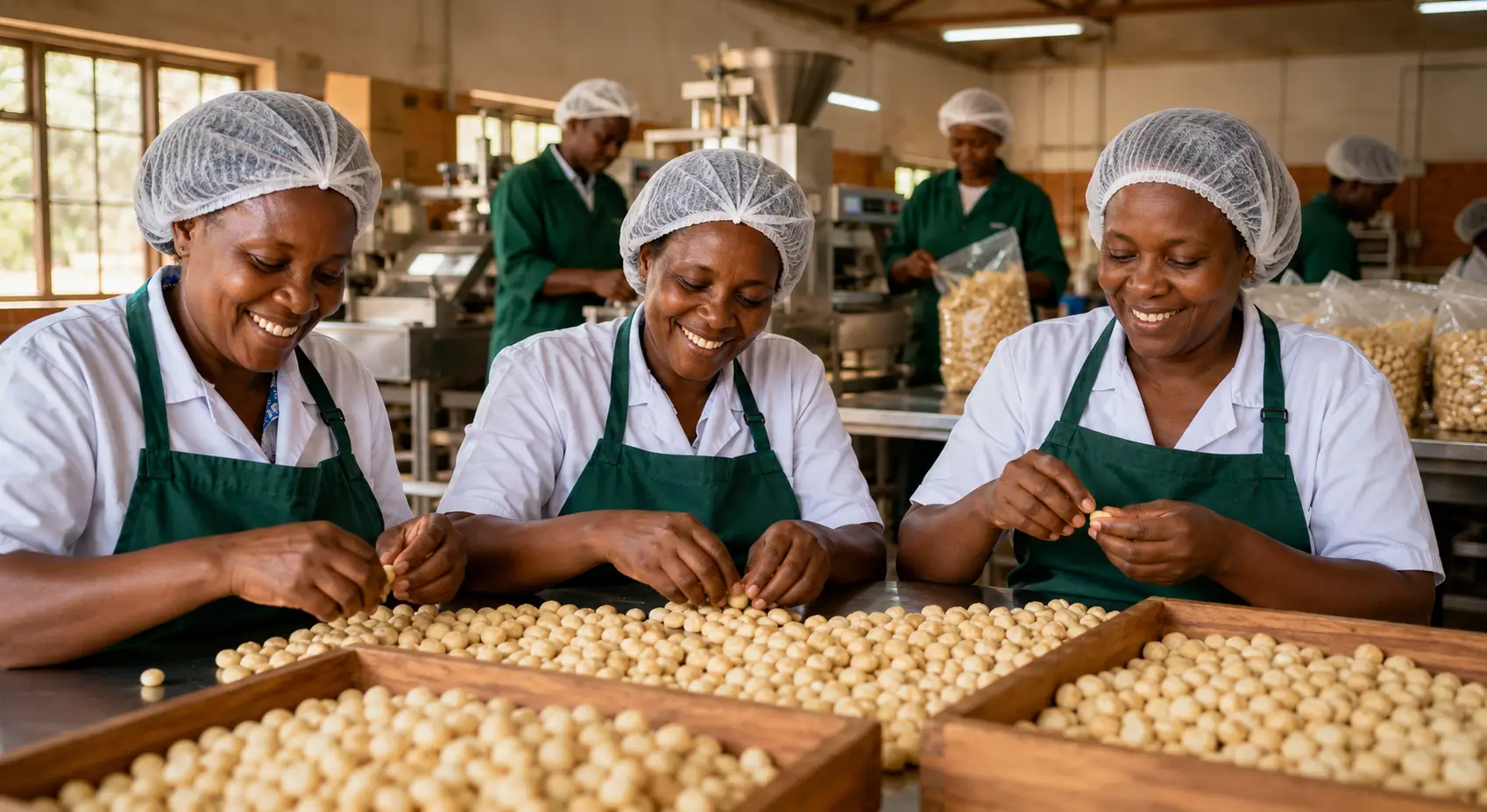
Because raw in-shell export is banned, the vast majority of Kenyan macadamia smallholders sell to licensed processors who crack, grade, and export kernel. The price you receive — and whether a processor will buy from you — is increasingly dependent on your compliance credentials.
Tier 1 — EU Market Processors
Require: GLOBALG.A.P or equivalent, farm-level traceability, spray records, harvest batch records, worker safety documentation, aflatoxin test certificates.
Price: €8.50–11.50/kg FOB equivalent
Tier 2 — China/Regional Processors
Require: AFA minimum price compliance, maturity standards (KR% threshold), basic harvest and intake records. GLOBALG.A.P preferred but not always mandatory.
Price: Mid-tier, growing with China demand
Informal Brokers
Require: Volume only. No certification. No traceability. Price suppression common — AFA minimum price not always enforced at this level.
Price: KES 50–80/kg farm gate
Major commercial processors serving EU markets hold their own GLOBALG.A.P certification across their contracted outgrower networks. When they buy from your cooperative, they need to include your volume in their certified supply chain. Without cooperative-level GLOBALG.A.P, they cannot do this — and you cannot access their premium price tier.
Smaller cooperatives also face the blockchain traceability trend: companies like Marquis Macadamias have implemented blockchain systems to verify product origins. While cooperatives cannot be expected to adopt blockchain immediately, they must provide paper-based batch records and farm-to-gate traceability documentation — which GLOBALG.A.P requires as standard. Meeting GLOBALG.A.P now future-proofs your cooperative for digital traceability requirements as they become standard.
📖 Also read: How to Link Farmers to Buyers and Exporters in Kenya — how cooperative aggregation models work in practice. · Agricultural Funding Sources Kenya 2026 — AFC loans, KCSA grants, and international programmes available to macadamia cooperatives pursuing certification.
8. Meru & Embu — Kenya’s Macadamia Heartland
Meru and Embu counties together form the most important macadamia production zone in Kenya. The altitude (1,000–2,000m), volcanic soils, and reliable rainfall across both counties create near-ideal growing conditions. Both counties host significant concentrations of smallholder cooperative macadamia production — and both face the same structural challenge: individual farms are too small for individual certification, but as a group the certification cost per farmer is affordable and the collective volume makes cooperatives attractive to processor buyers.
Meru County
Major cooperative production base
Tigania, Igembe, and Imenti are the primary macadamia growing sub-counties. Meru cooperatives often have larger group sizes (50–200 members) making Option 2 group certification particularly cost-effective. View Agrosocial Meru →
Embu County
Highest volume production area
Mbeere, Runyenjes, and Siakago produce the highest macadamia volumes in central Kenya. Embu’s lower altitude zones (1,000–1,400m) suit Beaumont variety production particularly well. View Agrosocial Embu →
Agrosocial Services — On the Ground in Meru & Embu
Agrosocial provides on-site audit preparation, farmer training, and QMS documentation support for macadamia cooperatives across Meru and Embu counties. We mobilise within 48–72 hours of engagement. Our 94% first-attempt pass rate reflects seven years of preparing Kenyan cooperatives for certification — in Kenyan conditions, with Kenyan farmers, using documentation built for the realities of smallholder cooperative production.
9. How Agrosocial Services Helps Macadamia Cooperatives Get Certified
Agrosocial Services is Kenya’s agricultural compliance consultancy. We are not a certification body — we are the preparation specialists who ensure your cooperative is ready when the certifier arrives. 94% of our clients pass on the first attempt.
Gap Assessment
We assess your cooperative against the full GLOBALG.A.P IFA v6 checklist. Every gap classified as Critical, Major, or Minor with a corrective action plan and realistic deadlines.
QMS & Documentation
We build your cooperative’s Quality Management System — farm records, internal inspection procedures, corrective action protocols, and all documentation GLOBALG.A.P Option 2 requires.
Farmer & Inspector Training
We train member farmers in GAP compliance, pesticide safety, post-harvest handling, and record keeping — and train your internal inspectors on the audit process required under Option 2.
Full Certification Retainer
3-month end-to-end engagement: gap assessment → documentation → training → mock audit → certification day support. 94% first-attempt pass rate.
Agrosocial Services — Macadamia Certification & Export Compliance Kenya
Ready to Get Your Macadamia Cooperative Certified?
Talk to our team today. We work with macadamia cooperatives across Meru, Embu, Murang’a, and Kiambu — from gap assessment to certification day. 94% first-attempt pass rate. We respond within 24 hours and mobilise on-site within 48–72 hours.
Digital Tool — Instant Download
GAP Training Manual — KES 800
Complete Good Agricultural Practices guide covering all 8 GLOBALG.A.P audit areas in practical Kenyan language — including macadamia-specific post-harvest handling, harvest maturity testing, and record keeping. Train your cooperative members before the auditor arrives.
10. Frequently Asked Questions — Macadamia Export Kenya 2026
Can I export raw in-shell macadamia nuts from Kenya?
No. AFA reinstated the ban on raw in-shell macadamia exports in July 2025 and it remains in force. Only processed kernel macadamia products can be exported. The ban is expected to remain through at least 2027, with a minimum farm-gate price mechanism protecting growers. Exporting raw NIS in violation of the ban risks immediate AFA licence suspension.
Do macadamia farmers need GLOBALG.A.P certification in Kenya?
It is not a legal requirement but is increasingly a commercial requirement for EU processor buyers and the Tier 1 price tier (€8.50–11.50/kg FOB equivalent). Cooperatives certify under Option 2 (group certification) at KES 15,000–25,000 per farmer. Without it, cooperatives cannot access Tier 1 processor pricing. Read our complete guide to GLOBALG.A.P group certification →
What is the China zero-tariff opportunity for Kenyan macadamia?
Under the Kenya-China Early Harvest Agreement effective May 1, 2026, macadamia nuts from Kenya enter China at zero duty. The deal covers 98.2% of Kenyan exports and runs until April 30, 2028. First shipment: Xiamen Port, May 12, 2026. Exporters need KEPHIS phytosanitary certificate, Certificate of Origin referencing the Early Harvest Agreement, and food safety documentation. Full guide: Kenya China Duty-Free Agricultural Exports 2026 →
What licences do I need to export macadamia from Kenya?
You need: (1) AFA NOCD Processing and Export Licence (valid July 1–June 30 annually); (2) KEPHIS phytosanitary certificate per consignment (apply at least 5 working days before shipment); (3) Certificate of Origin from KEBS or KNCCI; (4) Food Business Licence from Port Health Services or county Public Health Officers. Contact us for step-by-step guidance →
When is the macadamia harvest season in Kenya?
AFA implements a seasonal closure to prevent immature nut harvesting. For 2025/2026 the closure ran December 1, 2025 to February 15, 2026. The main harvest window is typically March–November, varying by county and altitude. Harvesting or trading outside the approved window risks AFA licence suspension. Confirm the current season’s closure dates with AFA’s NOCD before each season.
What aflatoxin standards apply to Kenyan macadamia exports to Europe?
EU Regulation 2023/915 sets maximum aflatoxin B1 at 5 ppb and total aflatoxins at 10 ppb for tree nuts including macadamia. The EU is finalising macadamia-specific limits targeting 2026 adoption with 2027 application. Test every lot with a KENAS-accredited laboratory before delivery. Aflatoxin risk rises sharply above 10% NIS moisture at intake. Cooperatives that establish routine lot testing now will be prepared; those that don’t will face rejection incidents when the new limits take effect.
Which counties in Kenya produce the most macadamia?
The leading macadamia producing counties are Embu (highest volume), Meru (major cooperative base), Kiambu, and Murang’a — all in central Kenya. Together they account for the majority of 51,200 tonnes produced annually from 500,000+ smallholder farmers across 33+ counties.
Key Takeaways — Macadamia Export Kenya 2026
- Raw in-shell export ban is in force since July 2025. Only processed kernel can be exported. Expected to remain through at least 2027. Violating the ban risks AFA licence suspension.
- China zero-tariff from May 1, 2026 — but exporters must meet Chinese phytosanitary and food safety standards to access it. First shipment confirmed Xiamen Port May 12, 2026. Window open until April 30, 2028.
- The price gap: KES 50–80/kg (informal) vs €8.50–11.50/kg FOB (certified, EU processor). The difference is not nut quality — it is certification and documentation. GLOBALG.A.P Option 2 at KES 15,000–25,000/farmer is the bridge.
- EU aflatoxin rules are tightening specifically for macadamia — 2026 adoption, 2027 application. Test every lot with a KENAS-accredited laboratory. Cooperatives that establish routine testing now will be ready. Those that don’t will face EU border rejections.
- Post-harvest moisture control (NIS intake <10%) and aflatoxin testing are the two biggest rejection risk factors. Both are directly preventable with the right cooperative intake protocols.
- Embu and Meru are the primary cooperative production zones. Agrosocial operates actively in both — mobilising within 48–72 hours, 94% first-attempt GLOBALG.A.P pass rate.
- GLOBALG.A.P Option 2 group certification at KES 15,000–25,000/farmer pays back within the first export season at Tier 1 processor pricing.
Ready to Get Your Macadamia Cooperative Certified for Export?
Contact us for a free consultation, download the Farm Audit Checklist to start your gap assessment, or get the Complete Starter Kit for everything in one download.
Macadamia Export Kenya — Complete Resource Hub
Certification guides: GLOBALG.A.P Certification Kenya · GLOBALG.A.P Group Certification Guide · IFA v6 Transition Guide
Macadamia county consultancy: Agricultural Consultant Embu · Agricultural Consultant Meru · Agricultural Consultant Murang’a · Agricultural Consultant Kiambu · Agricultural Consultant Kirinyaga
Export markets & policy: China Duty-Free Kenya 2026 — Complete Guide · Agricultural Export Kenya — Complete Guide 2026 · Find International Buyers Kenya · Finance Bill 2026 — Kenya Farmers Guide
Audit preparation: How to Pass a Farm Audit in Kenya · Farm Record Keeping Guide · MRL Compliance Guide
Downloads: Farm Audit Checklist (KES 3,500) · GAP Training Manual (KES 800) · Farm Records Pack (KES 500) · Complete Starter Kit (KES 6,000) · Proposal Writing Template (KES 2,000)
External resources: AFA Nuts and Oil Crops Directorate · KEPHIS Kenya · GLOBALG.A.P. official · KEBS Kenya
Contact Agrosocial Services for Macadamia Certification Support
For GLOBALG.A.P group certification, post-harvest quality systems, AFA licensing guidance, or China market preparation — we respond within 24 hours and mobilise on-site within 48–72 hours across all major macadamia producing counties. Email: info@agrosocialservices.co.ke
Agrosocial Services Limited — Macadamia Export Certification Kenya
Kenya Agricultural Certification & Export Market Consultancy — Established 2018
Agrosocial Services Limited prepares macadamia cooperatives, estates, and agribusinesses across Meru, Embu, Murang’a, Kiambu, and Kirinyaga for GLOBALG.A.P group certification under Option 2, with a 94% first-attempt pass rate. Services cover gap assessment, QMS documentation, farmer training, post-harvest quality systems, aflatoxin testing protocols, AFA export licensing guidance, and China market entry preparation. Technical content reviewed by certified agricultural professionals with active field experience in Kenya. Data sources: AFA Nuts and Oil Crops Directorate, USDA GAIN Reports, CBI Netherlands, Tridge, Mordor Intelligence, EU Regulation 2023/915, Kenya News Agency, Capital FM Kenya.
📧 info@agrosocialservices.co.ke · 📲 WhatsApp +254 713 935 361 · 📅 Last reviewed: May 2026
What we cover:
✅ GLOBALG.A.P. Option 2 Group Certification ✅ AFA NOCD Export Licensing ✅ Post-Harvest Quality & Aflatoxin Protocols ✅ China Market Entry Preparation ✅ EU Aflatoxin Compliance ✅ Agricultural Funding Proposals ✅ Meru · Embu · Murang’a · Kiambu · Kirinyaga