
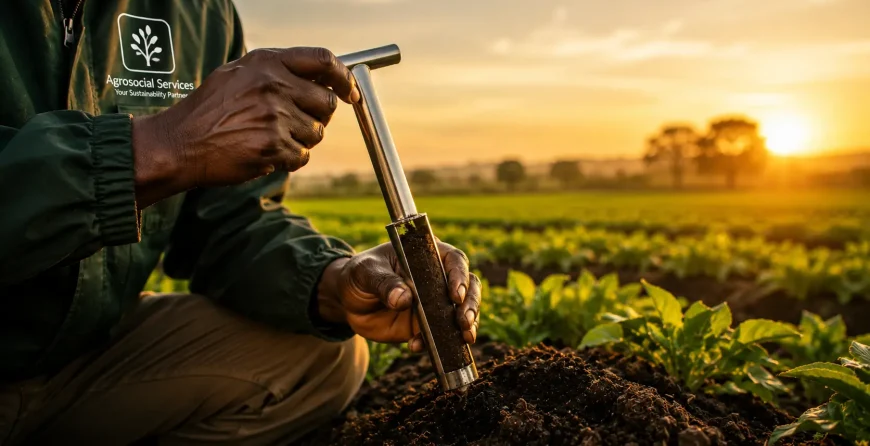
What Is MRV in Carbon Farming? The System That Decides What You Get Paid
MRV — Measurement, Reporting and Verification — is the system that turns a farming practice into a saleable carbon credit. It measures how much carbon your soil actually stored, documents it, and has an independent auditor confirm it. No MRV, no credits: a carbon credit is a claim, and a claim nobody can verify is worth nothing.
MRV also decides how much you get paid — and here is where most farmers are caught out. Measurement imprecision is punished through uncertainty deductions, and those deductions fall hardest on small projects. This guide explains the three measurement approaches, what verification actually costs, and why the arithmetic of MRV is the strongest financial argument for farming carbon as a group rather than alone.
Read this alongside our Carbon Farming in Kenya pillar guide and our breakdown of what farmers actually get paid.
Agrosocial Services is an independent agricultural certification and compliance consultancy. We are not a carbon project developer and we do not buy or sell credits.
⚡ Key Facts — MRV
- 📉 Uncertainty deductions punish small projects: ~12% for a 430-acre project over 5 years, versus under 5% for projects above 50,000 acres.
- 💸 A single conventional verification cycle costs an estimated USD 2,000–4,000 — testing, third-party audit and admin.
- ⏳ Longer monitoring periods reduce deductions — the same small project drops from 12% to ~5% over ten years.
- 🔬 Direct soil measurement is the analytical benchmark, but cost pushes projects toward integrated approaches.
- 📈 The MRV platform market is growing from ~USD 85m (2025) to a projected USD 638m by 2034 — because everyone is chasing cheaper measurement.
Sources: npj Sustainable Agriculture; Mitigation and Adaptation Strategies for Global Change; ScienceDirect MRV cost modelling; S4 Laboratories. Verified August 2026.
In This Guide
The Basics
What MRV Actually Is
Three words, three jobs:
- Measurement — quantifying how much carbon is actually stored in your soil and biomass, and how that has changed since the baseline.
- Reporting — documenting the practices, the data and the results in a form the methodology requires.
- Verification — an independent third party checking that the measurement and reporting are sound.
Accurate measurement and monitoring of carbon stocks form the foundation of credible soil carbon initiatives. Everything commercial — the credits, the price, the buyer’s confidence — rests on it. This is also where most of a carbon project’s cost sits, which is why it shapes the economics for everyone involved.
The Underlying Problem
Why Measuring Soil Carbon Is Genuinely Hard
Researchers describe the challenge precisely: MRV in carbon farming is fundamentally a problem of estimating small, slow and spatially heterogeneous changes in soil organic carbon under tight cost and credibility constraints.
Unpack that and you have the whole difficulty:
- Small — annual soil carbon gains are a tiny fraction of the total carbon already present. You are looking for a small signal inside a large, noisy number.
- Slow — changes accrue over years, not seasons, so short monitoring windows struggle to detect them.
- Spatially heterogeneous — soil carbon varies enormously across a single field, let alone a whole farm. Where you sample changes the answer.
- Under cost constraints — you could measure precisely with enough samples, but nobody can afford it.
Every design choice in MRV is a trade between those four pressures. There is no perfect option — only cost-accuracy compromises with different financial consequences.
How It’s Done
The Three MRV Approaches
Cost modelling of carbon farming MRV identifies three system types, with substantial cost variation depending on the monitoring approach, project design and protocol standards:
| Approach | How it works | Trade-off |
|---|---|---|
| Direct soil measurement | Physical sampling and laboratory analysis (dry combustion is the reference method) | The analytical benchmark — but high cost and heavy logistics |
| Process-based models | Biogeochemical models simulate carbon change from practice, soil and climate data | May become the market standard, but economic viability and labour demands remain concerns |
| Decision support tools | Simplified estimation tools using practice data and lookup factors | Cheapest, but least precise — larger uncertainty deductions |
In practice, the field is converging on hybrids. Direct measurement remains the analytical benchmark, but its high cost and logistical constraints necessitate a shift toward integrated MRV architectures combining sampling with modelling, sensing and data-driven inference. Portable infrared spectrometers — VNIR and MIR — have emerged as rapid, inexpensive alternatives to full laboratory analysis, and Verra’s model-based methodology VT0014 (2025) formalises the modelling route, though it requires independent validation for each project.
Free Download
MRV runs on records you have to keep
Practice logs, field histories and dated evidence — the same discipline certification audits test. Our free guide covers the 25 record-keeping gaps that cost Kenyan farms money.
The Number That Matters Most
⚠️ Uncertainty Deductions — Why Small Projects Lose Twice
This is the section almost no carbon article covers, and it decides real money.
An uncertainty deduction is a reduction applied to the credits you are issued, to account for measurement imprecision. The logic is sound: if the measurement could be wrong, credit conservatively. The consequence is that imprecision costs you credits — and therefore money.
Peer-reviewed modelling of soil carbon MRV gives concrete figures:
| Project profile | Monitoring period | Uncertainty deduction |
|---|---|---|
| ~430 acres (small) | 5 years | ~12% |
| ~430 acres (small) | 10 years | ~5% |
| 100,000 acres (large) | 3 years | ~5% |
| Over 50,000 acres | Typical | Below 5% |
The mechanism is straightforward: averaging uncertainty across large areas reduces overall uncertainty, and therefore the deduction. Researchers note this effect is well known but not really addressed in current literature and protocols.
📌 What this means for a Kenyan smallholder. A small project is penalised twice — it pays fixed MRV costs that a large project spreads across far more hectares, and it loses a larger share of its credits to uncertainty. Aggregation is not just administratively convenient; it is financially decisive. The same practice change, inside a large group project, earns proportionally more credits at proportionally lower cost. And note the second lever: a longer monitoring period cuts the deduction substantially even for a small project — worth understanding before you agree a monitoring schedule.
A Hidden Weakness
The Sampling Depth Problem
Two technical inconsistencies run through current protocols, and both affect what you are credited.
First, accounting method. Protocols differ between fixed-depth and equivalent soil mass approaches, and fixed-depth measurements can produce error because soil bulk density changes — precisely what practices like reduced tillage are designed to do. Measure at a fixed depth on soil that has become less dense, and the arithmetic misleads.
Second, depth. Most MRV protocols require sampling only to 30cm, which neglects a significant portion of the soil profile’s carbon stock. Deeper carbon is often more stable — and it goes uncounted.
Researchers note most protocols do not specify which sampling method to use. That ambiguity is worth knowing about before you sign, because it is decided in the project design — not by you, and not later.
The Money
What MRV Actually Costs
One published estimate puts a single soil carbon MRV verification cycle — covering testing, third-party audit and administrative overhead — at roughly USD 2,000 to 4,000 per cycle under conventional protocols. Multiplied across many projects or thousands of acres, MRV becomes one of the largest recurring costs in a carbon programme’s annual budget.
The market is responding to exactly that pressure. The soil carbon MRV platform market was valued at roughly USD 85 million in 2025 and is projected to reach USD 638 million by 2034 — around 25% compound annual growth, driven largely by demand for lower-cost, higher-confidence measurement.
For smallholder contexts, the honest research conclusion is that innovations like digitalisation hold promise for reducing costs, but policy support is likely required to ensure the scalability of MRV systems, especially for smaller farms. That is a candid admission that current MRV economics do not naturally work at smallholder scale without external support or aggregation.
Your Job
Your Part in MRV — and Why It Decides Your Payment
The soil sampling and modelling are the project’s responsibility. The reporting layer is largely yours — and it is the part farmers can control:
- Practice records — what you did, on which plot, on what date. Undated notes are not evidence.
- Field history — what the land was doing before the project began. This establishes your baseline, and it cannot be reconstructed later.
- Plot boundaries — accurate, consistent mapping of every parcel.
- Input records — fertiliser, compost, biochar, residue management, quantities and timing.
- Consistency over the whole crediting period — often twenty years.
This is the same records discipline that underpins an Internal Control System for group certification — which is why cooperatives that already run one start a carbon project from a genuinely stronger position, and why they should say so when negotiating terms.
Due Diligence
MRV Questions to Ask Any Developer
- Which MRV approach are you using — direct measurement, modelling, or a hybrid?
- What uncertainty deduction do you expect, and on what project area is that based?
- What is the monitoring interval? Longer intervals reduce deductions.
- To what depth will soil be sampled, and using fixed-depth or equivalent soil mass accounting?
- Who pays for MRV, and does it come out of the farmers’ share?
- How much is MRV per year, in total and per hectare?
- What records are we responsible for, and what support do we get to keep them?
- What happens if our records are judged insufficient at verification?
Build the records before the project needs them
We help cooperatives build the field-history and practice-record systems carbon methodologies demand — and review developer terms independently, because we earn nothing from your credits.
Quick Answers
Frequently Asked Questions
What does MRV stand for?
Measurement, Reporting and Verification. It is the system that quantifies how much carbon a farming practice has stored, documents it, and has it independently checked. Without MRV there are no credits, because a carbon credit is a claim that must be provable to a third party.
How much does carbon MRV cost?
Costs vary substantially by monitoring approach, project design and protocol. One published estimate puts a single conventional soil carbon MRV verification cycle — testing, third-party audit and administrative overhead — at roughly USD 2,000 to 4,000. These are largely fixed costs, which is why they weigh far more heavily on small projects.
What is an uncertainty deduction?
A reduction applied to the credits you are issued, to account for measurement imprecision. Research shows around 12% for a 430-acre project over five years, falling to roughly 5% over ten years, and typically below 5% for projects exceeding 50,000 acres — because averaging across larger areas reduces overall uncertainty.
Why does MRV penalise small farms?
Two reasons compound. Most MRV costs are fixed rather than proportional to area, so a small project pays a similar absolute amount as a much larger one. And uncertainty deductions fall as project area increases. Small projects therefore pay proportionally more and are credited proportionally less — which is the central economic argument for aggregating farms into group projects.
Key Takeaways
- MRV decides whether you get credits and how many — it is not administrative detail.
- Uncertainty deductions penalise small projects — ~12% at 430 acres versus under 5% above 50,000.
- Longer monitoring periods reduce deductions substantially, even for small projects.
- A verification cycle costs an estimated USD 2,000–4,000, largely fixed regardless of size.
- Your controllable part is records — practice logs, field history, plot boundaries, kept consistently.
Related Guides & Resources
Carbon & Climate
Carbon Farming in Kenya (pillar)
How Farmers Actually Get Paid
Regulation 29 & the 40% Rule
Records & Groups
Building an Internal Control System
Organic Group Certification
Work With Us
Last reviewed: August 2026 by Agrosocial Services. Compiled from peer-reviewed research including npj Sustainable Agriculture (digital soil mapping for MRV), Mitigation and Adaptation Strategies for Global Change (systematic review of SOC MRV systems), ScienceDirect MRV cost modelling, published work on soil carbon accounting methods and sampling depth, and industry cost reporting. Uncertainty deduction figures relate to the specific modelled scenarios cited and will differ for other projects, methodologies and registries. This article is general information, not financial or technical advice for any specific project. Agrosocial Services is an independent consultancy; we are not a carbon project developer or credit buyer.