Biochar for Kenyan Smallholder Farmers: What It Is and How You Actually Benefit
Biochar is the most commercially advanced carbon removal method operating in Kenya today. It is real, it is funded, and it is already at scale — one Mt Kenya producer announced a deal with Microsoft described as the largest single purchase of biochar carbon removal from an African project.
But there is a common misunderstanding worth clearing up immediately. Most Kenyan farmers will not earn carbon credits from biochar. They will benefit from it — genuinely, and in a way that shows up in their yields — but as buyers of a subsidised soil amendment, not as sellers of carbon. Understanding that distinction before you engage with any scheme will save you disappointment.
This guide explains what biochar is, what it does to soil, how the Kenyan model actually works, and what to ask before signing anything. Read it alongside our Carbon Farming in Kenya pillar guide.
Agrosocial Services is an independent agricultural certification and compliance consultancy. We are not a carbon project developer, a biochar producer, or a credit buyer.
⚡ Key Facts — Biochar in Kenya
- 🔥 Made by pyrolysis — heating organic matter without oxygen, at 550–700°C in one Kenyan operation.
- ⏳ Carbon stays locked in soil for more than 1,000 years — which is why buyers pay a premium.
- 🌱 Applied at 2–5 tonnes per hectare, it improves water retention, nutrient holding and yields.
- ⚠️ In Kenya, the company earns the credits; the farmer receives subsidised fertiliser.
- 💼 A Mt Kenya producer sold biochar removals to Microsoft — the largest such African purchase.
Sources: Bio-Logical company announcements and registry listings (Puro); BIOSORRA / Project Hippo via Biochar International; SLU and KTH Kenyan biochar field research; published research on pyrolytic cookstoves in Kenya. Verified August 2026.
In This Guide
The Basics
What Biochar Actually Is
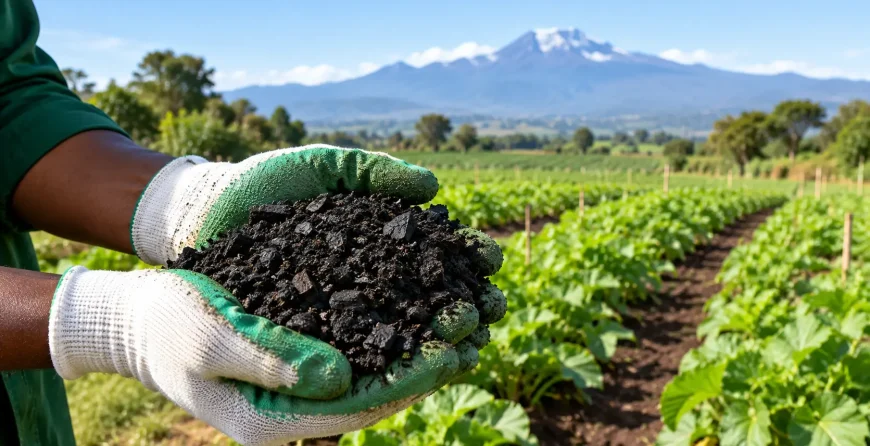
Biochar is a carbon-rich material produced by heating organic matter in the absence of oxygen — a process called pyrolysis. The feedstock is agricultural waste: crop residue, waste wood, husks. One Kenyan producer runs the process at 550 to 700°C.
Burning that same waste in the open releases its carbon straight back to the atmosphere. Leaving it to rot does much the same, more slowly. Pyrolysis instead converts it into a stable solid that can remain in soil for more than a thousand years.
That permanence is the commercial point. As our guide to MRV explains, soil carbon from farming practices is difficult to measure and slow to accumulate. Biochar is different: the carbon is in a physical product, the quantity can be weighed, and the storage is durable. Measurable and permanent is exactly what a corporate buyer wants.
Agronomic Value
What Biochar Does to Soil
Set the carbon market aside for a moment, because the agronomic case stands on its own. Applied at 2 to 5 tonnes per hectare, biochar improves:
- Water retention — its porous structure holds moisture, which matters increasingly as rainfall becomes less reliable.
- Nutrient holding — it reduces leaching, so fertiliser you apply stays available to the crop for longer.
- Crop yields — the practical outcome of both.
Kenyan field research has examined this directly, including published work on maize grain yield responses to realistic biochar application rates on smallholder farms in Kenya. The qualifier “realistic” matters — trial results at high application rates are not always achievable on a smallholding, and you should treat any yield promise with the same caution you would apply to a fertiliser claim.
In practice, biochar is rarely supplied alone. It is typically blended with compost, manure or other organic nutrients into a biofertiliser — which is how most Kenyan farmers will encounter it.
The Part Nobody Explains
⚠️ Who Actually Earns the Carbon Credits
Here is how the Kenyan biochar model actually works, stated plainly:
1 · A company sources agricultural waste — typically through partnerships with large agribusinesses. Waste wood and macadamia husks are one Kenyan operation’s feedstock.
2 · It produces biochar industrially at a central facility, with the volumes and consistency a carbon registry requires.
3 · The company sells the carbon removal credits — verified and reported to a registry such as Puro, and bought by corporates.
4 · The farmer buys biochar fertiliser at a subsidised rate, with the subsidy funded by those credit sales. That is the farmer’s share.
This is a legitimate and genuinely useful model. Farmers get an effective soil amendment at below commercial cost, agricultural waste is put to use, and real carbon is removed. Nobody is being cheated.
But be clear about what you are receiving. A discount on an input is not the same as a share of carbon revenue. If someone offers you “biochar carbon credits,” ask precisely who holds the credit, who sells it, and what share reaches you — the same questions we set out in how farmers actually get paid.
Free Download
Carbon schemes run on records you should already keep
Input records, field histories and dated evidence — the same discipline certification audits test. Our free guide covers the 25 record-keeping gaps that cost Kenyan farms money.
On the Ground
What’s Actually Operating in Kenya
Unlike much carbon farming talk, Kenyan biochar has real facilities producing real volumes:
A Mt Kenya operation works through partnerships with large regional agribusinesses, taking waste that would otherwise be burnt or left to rot — including waste wood and macadamia husks — and converting it to biochar. That biochar is blended with compost manure into an organic fertiliser sold to smallholders at subsidised rates, funded by carbon credit proceeds. The facility has passed audit and reports to the Puro registry. Having raised USD 1.3 million, it targets 100,000 tonnes of CO₂ removal annually with additional Kenyan sites planned. Its 2023 Microsoft deal was described as the largest single purchase of biochar carbon removal from an African biochar project.
A second Kenyan operation centralises agricultural residues under a project expected to remove approximately 33,125 tonnes of CO₂ equivalent over its first five years, operating pyrolysis at 550–700°C.
The Farm-Level Route
Making Biochar Yourself
There is a second route that does not depend on any company: pyrolytic cookstoves, which produce biochar as a by-product of cooking.
The benefits stack usefully for a rural household:
- Reduced fuel demand — relevant where most smallholders still depend on wood.
- Less indoor smoke exposure — a genuine health gain, and one that falls mainly on women and children.
- Biochar for your own soil, at no additional cost.
- Eased household labour traditionally borne by women.
Kenyan subsidies for biochar production have been credited with improving fuel efficiency, reducing indoor smoke exposure and helping mitigate soil degradation.
The honest limitation: volumes from a cookstove are small. Against a 2–5 tonne per hectare application rate, household production will treat a modest area over time, and it is generally too small to generate saleable credits alone. Treat it as free soil improvement plus a health benefit — not as a carbon income stream.
Market Context
Why Buyers Prefer Biochar
Understanding why corporates pay well for biochar removals helps you judge any offer put to you:
- It is measurable. Biochar is a physical product that can be weighed — unlike soil carbon, which must be sampled, modelled and discounted for uncertainty.
- It is durable. Storage exceeding a thousand years compares favourably with practices that can be reversed by a single season of ploughing.
- It is removal, not avoidance. Carbon is taken out of the atmosphere rather than emissions merely being prevented — a category buyers increasingly prioritise.
- It is verifiable. Facilities pass audit and report to registries; the chain of evidence is straightforward.
Those same qualities are why the credits command a premium — and why it is worth knowing where that premium ends up.
Due Diligence
Questions to Ask Before You Sign
- Am I buying a product or selling carbon? Get this clear first — it determines everything else.
- If I supply feedstock, am I paid for it, and does that payment reflect its value in the credit?
- Who holds and sells the credit, and what share reaches farmers?
- What does the biochar fertiliser cost me against comparable commercial inputs?
- What application rate is recommended for my crop and soil, and what yield response has actually been observed locally?
- Is the project registered and audited, and with which registry?
- What am I committing to, and for how long?
📌 If you supply the waste, you are supplying the raw material of the credit. Macadamia husks, crop residue and waste wood have value in this model. That does not mean you should refuse a subsidised-input arrangement — it does mean you should know what you are contributing before you agree terms.
Considering a carbon or biochar arrangement?
We review developer and offtake terms independently for cooperatives and farmer groups, and build the records those schemes require. We earn nothing from your credits, so our reading of the contract is not influenced by whether you sign it.
Quick Answers
Frequently Asked Questions
What is biochar?
A carbon-rich material made by heating organic matter such as crop residue or waste wood at high temperature without oxygen — pyrolysis. One Kenyan producer operates at 550–700°C. It locks carbon into a stable form that can remain in soil for over a thousand years, and produces a soil amendment that improves water retention, nutrient holding and yields.
Do Kenyan farmers earn carbon credits from biochar?
Usually not directly. The dominant Kenyan model is that a company centralises agricultural residue, produces biochar industrially and sells the removal credits. The farmer’s benefit arrives as subsidised biochar fertiliser funded by those sales. That is a real benefit — but it is a discount on an input, not a payment for carbon.
How much do you apply per hectare?
Rates of 2 to 5 tonnes per hectare are cited as the level at which biochar meaningfully transforms soil. It is applied either as a standalone conditioner or, more commonly in Kenya, blended with compost or manure into a biofertiliser.
Can I produce biochar myself?
Yes, at small scale. Pyrolytic cookstoves produce biochar as a by-product of cooking while reducing fuel use and indoor smoke. Volumes are modest against a 2–5 tonne per hectare application rate and generally too small to generate saleable credits alone, but the soil and health benefits are real.
Key Takeaways
- Biochar is measurable and durable — which is why it commands a premium over soil carbon.
- In Kenya the company earns the credits; farmers receive subsidised fertiliser.
- That subsidy is a genuine benefit — but it is not carbon revenue. Know the difference.
- Pyrolytic cookstoves give free soil improvement and cleaner air, at small scale.
- If you supply the feedstock, you are supplying the raw material of the credit. Negotiate accordingly.
Related Guides & Resources
Carbon & Climate
Carbon Farming in Kenya (pillar)
How Farmers Actually Get Paid
What Is MRV?
Regulation 29 & the 40% Rule
Records & Groups
Work With Us
Last reviewed: August 2026 by Agrosocial Services. Compiled from company announcements and carbon registry listings for Kenyan biochar producers, Biochar International reporting, peer-reviewed Kenyan field research on biochar application rates on smallholder farms, and published research on pyrolytic cookstoves in Kenya. Project figures reflect company statements at the time of publication. Application rates, yield responses and commercial terms vary by soil, crop and scheme — seek independent advice before entering any agreement. Agrosocial Services is an independent consultancy; we are not a biochar producer, carbon project developer or credit buyer.