
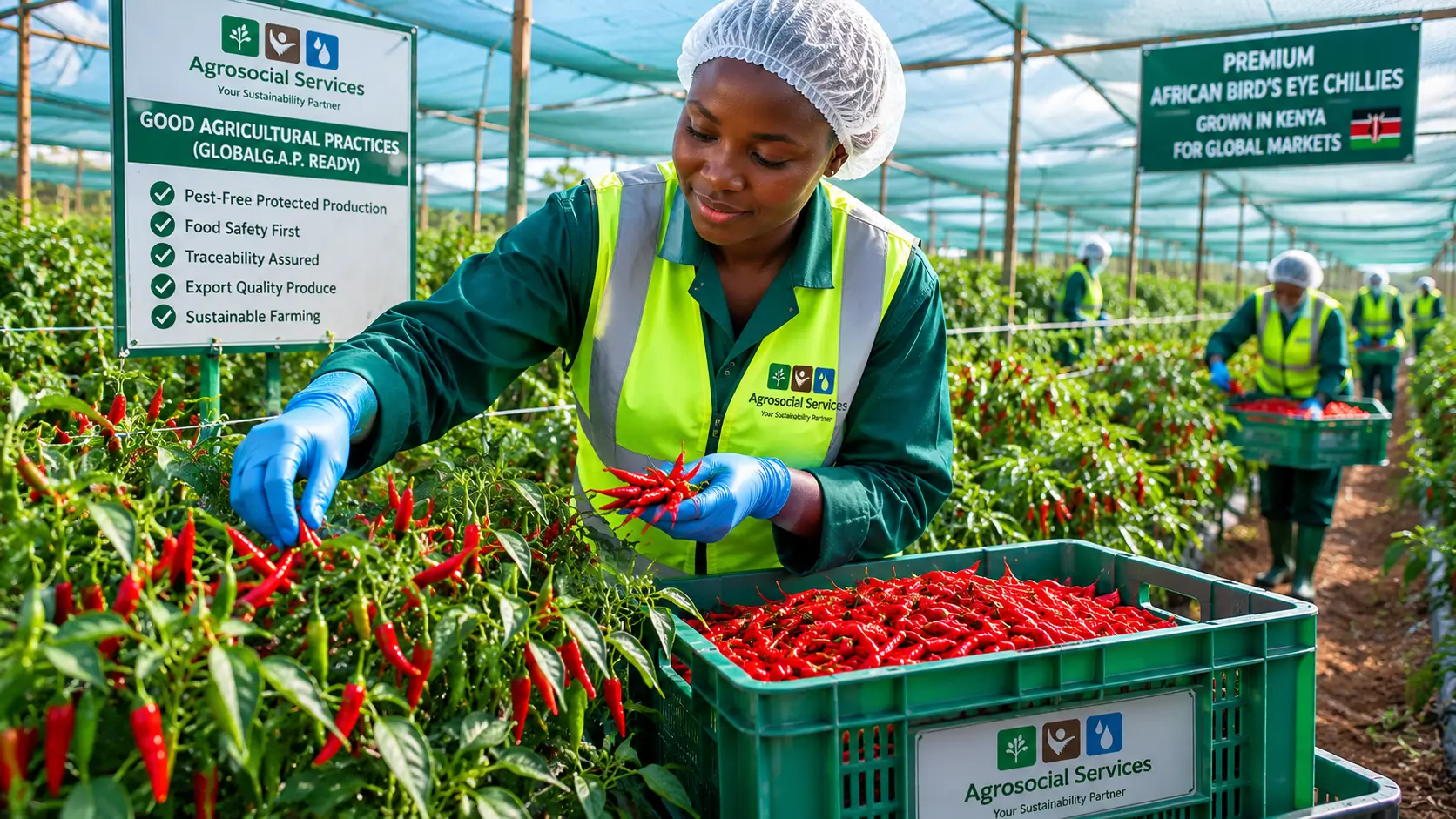
Chilli Export from Kenya: The Complete Certification & Compliance Guide
Chilli is one of the most profitable crops a Kenyan farmer can grow — and one of the easiest to lose money on. Global demand is rising, Kenyan chillies enter the EU at zero duty, and buyers in Europe, the Gulf and Asia are actively looking for supply. Yet over three-quarters of Kenya’s Capsicum exporters have lost their export licensing because of one insect: the False Codling Moth.
That single fact should shape how you approach this crop. Chilli export from Kenya is not an agronomy problem — Kenyan farmers grow excellent chilli. It is a compliance problem. This guide covers the market, the varieties, the counties, the regulatory chain, and above all the pest and residue controls that decide whether your consignment clears or is destroyed at the border.
Agrosocial Services is an independent agricultural certification and compliance consultancy. We prepare Kenyan farms, cooperatives and exporters to meet export requirements and pass audits — certificates and phytosanitary approvals are issued by accredited bodies and KEPHIS, not by us.
⚡ Key Facts — Kenyan Chilli Export
- 🐛 False Codling Moth (FCM) is the leading cause of Kenyan Capsicum interceptions in the EU — and the EU applies zero tolerance.
- 📉 When interceptions jumped from 11 to 45 in a single season, EU inspection frequency on Kenyan Capsicum was raised to 50% of consignments.
- 🌶️ African Bird’s Eye is the flagship export variety — 100,000–225,000 SHU, prized for oleoresin and extracts.
- 🇪🇺 Kenyan chillies enter the EU at 0% import duty under the EU–Kenya Economic Partnership Agreement.
- 📍 Leading counties by value (2017 HCD data): Meru (52%), Kwale (16%), Kilifi (15%).
Sources: KEPHIS; AFA Horticultural Crops Directorate; EUROPHYT interception data; peer-reviewed FCM research (University of Nairobi, icipe, MDPI); MARKUP Kenya. Verified August 2026.
In This Guide
Why This Crop
The Market Opportunity
Chilli sits in an unusual position among Kenyan horticultural crops: demand is genuinely growing across several distinct markets at once, and Kenya has natural advantages in all of them.
- Europe remains the anchor market for fresh chilli, and Kenyan produce enters at zero import duty under the EU–Kenya Economic Partnership Agreement — a real cost advantage over origins facing tariffs.
- The Gulf (UAE, Saudi Arabia) is expanding fast, including for organic bird’s eye chilli, where Kenya and Ethiopia are the growth suppliers.
- Asia, and China in particular, has become a serious buyer — Chinese investment in Africa has made chillies one of the most actively purchased products, and KALRO has been developing bird’s eye varieties partly in response.
- Processing and extracts — African Bird’s Eye is specifically demanded by international buyers for oleoresin, extracts and spice processing, a higher-value channel than fresh sale.
The scale is still modest, which is precisely the opportunity. Horticultural Crops Directorate data put the total 2018 value of Kenyan Capsicum production — sweet pepper, African Bird’s Eye, long cayenne and bullet pepper combined — at around USD 8.3 million. Demand comfortably exceeds what Kenya currently supplies. The constraint is not the market; it is compliance.
Know Your Product
Varieties & Which Markets Want Them
Different buyers want different heat levels for different uses. Choosing a variety without knowing your target market is one of the most common early mistakes.
| Variety | Heat (SHU) | Primary market & use | Days to maturity |
|---|---|---|---|
| African Bird’s Eye (ABE) | 100,000–225,000 | Export flagship — extracts, oleoresin, spice processing, dried & powdered | 90–100 |
| Cayenne (Long Red) | 30,000–50,000 | Fresh export & on-farm drying into flakes/powder | 70–80 |
| Habanero / Scotch Bonnet | Very high | Hot sauce manufacture; premium fresh export | — |
| Demon F1 / Bullet | Moderate | High-yielding; strong domestic market | — |
| Jalapeño | 2,500–8,000 | Restaurants, pickling, food service | 65–80 |
| Serrano | Medium-high | Growing East African & export demand | — |
📌 The market rule of thumb: across export destinations, hotter generally sells better — but the segments are distinct. Jalapeños go to restaurants and pickling; cayenne types go to drying and powder; ABE and habanero go to extract, oleoresin and hot sauce. Confirm the variety with your buyer before you plant.
Growing Conditions
Where Chilli Grows in Kenya
Chilli is a warm-climate crop that performs across a wide swathe of Kenya. The recognised production zones are the Eastern, Coastal and Rift Valley regions, plus parts of Central Kenya. On 2017 HCD figures for African Bird’s Eye, three counties dominated by value: Meru (52.4%), Kwale (16.3%) and Kilifi (14.7%). Makueni County has since become a focus of active government promotion, and production has expanded through Kitui, Machakos and the wider lower-eastern belt.
Agronomically, chilli wants low to medium altitude (roughly 0–1,500m), temperatures between 20°C and 32°C, and well-drained loamy or sandy-loam soils rich in organic matter. Warmer conditions increase capsaicin, so heat in the field translates fairly directly into heat in the fruit — which matters commercially when buyers are paying for pungency.
The Make-or-Break Issue
⚠️ False Codling Moth — Why Kenyan Chilli Gets Rejected
If you read only one section of this guide, read this one. False Codling Moth (Thaumatotibia leucotreta) is a quarantine pest endemic to sub-Saharan Africa, and it is the single leading cause of Kenyan Capsicum consignments being intercepted in the European Union. The EU, the USA and Far East markets all apply a zero-tolerance policy — one larva in a consignment is enough for rejection.
What happened to Kenya’s chilli exporters
The consequences have already been severe. Between October 2014 and September 2015, EU interceptions of Kenyan Capsicum rose from 11 to 45 in a single season. The EU responded by raising the inspection frequency on Kenyan Capsicum to 50% of all consignments — meaning one in every two shipments opened and examined. KEPHIS, acting to protect the credibility of Kenyan exports as a whole, withdrew licensing from non-compliant exporters: over three-quarters of Capsicum exporters lost their export licensing.
That is the risk you are managing. It is also, bluntly, the opportunity — because the growers who can demonstrate compliance are supplying a market where most of their competition has been removed.
What the EU now requires
EU emergency measures against FCM impose structural requirements, not just spraying:
- Production in pest-free or protected areas — shade nets, greenhouses or glasshouses, rather than fully open field production.
- Traceability through grower codes — every producing site carries a unique code so any interception can be traced back to source.
- Continuous farm inspection by the national plant protection organisation (KEPHIS in Kenya).
- Documented monitoring — KEPHIS maintains a dedicated FCM Inspection Manual for Capsicums covering field, packhouse and border inspection points.
The monitoring protocol that actually satisfies auditors
The FCM control regime Kenya has developed — refined first in the flower sector, and directly applicable to Capsicum — is built around evidence, not effort:
- Delta traps with FCM-specific pheromone lures, at a minimum of one trap per 1,000m² of protected growing area.
- Weekly trap checks with moth counts recorded — and those records retained for KEPHIS and EU DG SANTE audit review.
- Lures replaced every 4–6 weeks, depending on temperature and manufacturer specification.
- Defined threshold triggers — if weekly catch exceeds the threshold, intervention is mandatory within 48 hours.
📌 The pattern we see repeatedly: farms are often doing the monitoring but not recording it in a form an auditor accepts. An undated trap count in a notebook is not evidence. This is the same failure mode that sinks certification audits across every standard — the practice exists, the proof doesn’t.
The Systems Approach — where Kenya is heading
Kenya has adopted the Systems Approach, an EU-approved regulatory method built on layered, verifiable controls rather than a single treatment. The Ministry of Agriculture has declared zero tolerance on FCM and submitted its Systems Approach Protocol to the EU with supporting evidence from production sites. In the flower sector — the template — 134 farms have been approved, each assigned a unique traceability code, alongside training for 849 industry personnel and 475 agro-attendants, and PCPB registration of FCM-specific control products.
The direction of travel is clear: approved sites with traceability codes and documented monitoring will export; undocumented open-field production will not.
Free Download
The 25 gaps that fail Kenyan export audits
Pest monitoring records and spray documentation are among the most common failure points for high-scrutiny crops like chilli. Get the checklist auditors actually work from.
The Second Trap
Pesticide Residues & MRLs — the Vicious Circle
Here is where many growers destroy their own market access. Faced with FCM and its zero-tolerance rule, the instinctive response is to spray harder and more often. That reaction creates the second major cause of rejection: pesticide residues above EU Maximum Residue Levels. Research on Kenyan horticulture is explicit that continuous unregulated pesticide use is both uneconomical and self-defeating, driving interceptions for residues even where it succeeds against the pest.
The way out is Integrated Pest Management: pheromone trapping and monitoring to time interventions precisely, protected structures to exclude the moth physically, approved and correctly-timed products applied within pre-harvest intervals, and biological controls where available. Fewer, better-targeted interventions beat heavy calendar spraying on both counts — pest control and residue compliance.
The Regulatory Chain
Who Regulates What
Three bodies govern chilli export from Kenya, and confusing them causes real delays.
| Body | Role | What you get |
|---|---|---|
| AFA – Horticultural Crops Directorate (HCD) | Licensing & standards enforcement under the Crops Act 2013 | Your export licence — the primary operating permission |
| KEPHIS | Plant health; farm & packhouse registration; inspection | Phytosanitary certificate for every consignment |
| KEBS | Quality & MRL enforcement under the Standards Act | Standards compliance; residue testing framework |
One naming point that still trips people up: the old HCDA no longer exists. It was absorbed into AFA by Gazette Notice No. 197 of 2014 and now operates as the Horticultural Crops Directorate (HCD), retaining the licensing and certification functions. Many older guides still reference an “HCDA export licence” — the current instrument is the AFA-HCD export licence, handled through the AFA IMIS and eHCD portals, with KEPHIS registration through its IEICS platform. Note also that the Crops (Horticultural Crops) (Amendment) Regulations were updated in 2025 — confirm current forms and fees directly with AFA-HCD rather than relying on older guidance.
Paperwork That Travels
Your Export Document Set
KEPHIS has specifically flagged document-related interceptions at destination markets — consignments rejected not for pests or residues, but for paperwork errors. That is the most avoidable loss in this entire guide. A complete chilli consignment file typically comprises:
- KEPHIS phytosanitary certificate — no consignment is accepted without it
- AFA-HCD export certificate / valid export licence
- Laboratory test report (residue analysis, where required)
- Certificate of Origin — from KNCCI or KRA depending on preference regime
- Commercial invoice and packing list
- Airway bill (or bill of lading for sea freight)
- Importing country’s import permit, where that market requires one
KEPHIS explicitly recommends checklist-based documentation control to reduce rejections. Build the checklist once, run every consignment against it, and this category of loss disappears.
What Buyers Demand
Certification Buyers Require
Government licensing gets you legally permitted to export. Certification gets you a buyer. These are separate hurdles and both must be cleared.
- GLOBALG.A.P — the de facto entry ticket for EU and UK supermarket supply. It documents safe crop-protection use, worker hygiene, traceability and record-keeping: precisely the controls that prevent the failures described above. For smallholder groups, Option 2 group certification spreads the cost across members. See our GLOBALG.A.P guide →
- Organic certification — a genuine premium channel, particularly for bird’s eye chilli into the Gulf, where Kenyan organic ABE exports to the UAE and Saudi Arabia are growing. Demanding, but the highest-margin route. See our Organic Certification guide →
- KS 1758 — Kenya’s own horticulture code of practice, the sensible on-ramp for local supermarket and regional supply before you take on export-grade certification.
- Buyer-specific and social standards — larger buyers may additionally require ethical-trade audits such as SMETA alongside the food-safety and GAP requirements.
The Numbers
Yields, Prices & Economics
Indicative production figures for planning purposes:
- Fresh yield: roughly 4,000–8,000 kg (4–8 tonnes) per acre per season.
- Dried Bird’s Eye: roughly 1.5–2.5 tonnes per acre.
- Harvest window: 3–4 months of picking under good management, with first pickings light and peak production mid-cycle.
- Value addition: sun-drying and milling into powder extends shelf life substantially and lifts margin — and shade-dried chilli reportedly fetches a premium over sun-dried.
On price, one European importer published indicative FOB Nairobi figures for late July 2026 giving a useful sense of relative variety values: Serrano around €1.35/kg, Cayenne/Bullet around €1.55/kg, Bird’s Eye around €2.05/kg, and premium Scotch Bonnet around €2.60/kg — with air freight adding roughly €2.40/kg and handling €0.19/kg to reach a landed EU price, and zero import duty under the EPA.
📌 Treat those prices as directional, not bankable. They come from a single importer’s published indicative list for one week and one destination market. Prices move with season, variety, grade, volume and buyer relationship. Always secure a dated, written offer for your specific volume and grade before committing to a planting plan.
Learn From Others
Why Kenyan Chilli Exports Fail
- False Codling Moth interceptions — the leading cause, under EU zero tolerance.
- Pesticide residues above MRLs — usually the direct result of over-spraying against FCM.
- Open-field production where the market now expects protected structures and pest-free-area status.
- Undocumented monitoring — trap counts taken but not recorded in auditable form.
- Documentation errors — an avoidable cause KEPHIS has specifically flagged.
- Planting before securing a buyer — variety, heat level and grade should follow the buyer’s specification, not precede it.
- No traceability from plot to consignment — without grower codes and lot records, one interception contaminates your whole operation’s standing.
Find out where your chilli operation actually stands
We assess chilli farms and cooperatives against FCM monitoring requirements, residue controls, traceability and GLOBALG.A.P readiness — and give you a clear roadmap to export-compliant. Start with a Farm Readiness Assessment.
Quick Answers
Frequently Asked Questions
Why are Kenyan chilli exports rejected by the EU?
The single biggest cause is False Codling Moth (Thaumatotibia leucotreta), a quarantine pest the EU applies zero tolerance to — it is the leading reason Kenyan Capsicum consignments are intercepted. The second major cause is pesticide residues exceeding EU Maximum Residue Levels, which often results from spraying heavily to control that same pest. Documentation errors are a third, entirely avoidable cause.
What licences do I need to export chilli from Kenya?
An export licence from the AFA Horticultural Crops Directorate (HCD), registration of your farm and packhouse with KEPHIS through its IEICS platform, and a KEPHIS phytosanitary certificate for every consignment. Most EU and UK buyers additionally require GLOBALG.A.P certification as a commercial condition, even though it is not a government licence.
Which chilli varieties are grown for export in Kenya?
African Bird’s Eye (ABE) is the flagship export variety at roughly 100,000–225,000 SHU, sought after for extracts, oleoresin and spice processing. Others include Cayenne (around 30,000–50,000 SHU), Habanero and Scotch Bonnet for hot sauce, Demon F1 or bullet chilli, Serrano, and Jalapeño (roughly 2,500–8,000 SHU) for restaurants and pickling.
Do I need GLOBALG.A.P certification to export chilli?
It is not a Kenyan legal requirement, but in practice most EU and UK supermarket buyers will not purchase without it. GLOBALG.A.P documents safe crop-protection use, worker hygiene, traceability and record-keeping — precisely the controls that prevent the residue and pest failures Kenyan chilli exports are known for. For smallholder groups, Option 2 group certification is usually the affordable route.
Key Takeaways
- Chilli export from Kenya is a compliance challenge, not an agronomy challenge.
- False Codling Moth under EU zero tolerance is the make-or-break issue — it has already cost most Capsicum exporters their licences.
- Over-spraying against FCM creates the second failure mode: MRL breaches. IPM is the way out of that circle.
- The future is protected production + grower codes + documented weekly monitoring under the Systems Approach.
- Licensing (AFA-HCD, KEPHIS) gets you legal; certification (GLOBALG.A.P, organic) gets you the buyer. You need both.
Related Guides & Resources
Export Guides
Agricultural Export from Kenya
Cut Flower Export (FCM protocols)
French Beans Export from Kenya
Work With Us
Last reviewed: August 2026 by Agrosocial Services. Compiled from KEPHIS, the AFA Horticultural Crops Directorate, EUROPHYT interception data, peer-reviewed False Codling Moth research (University of Nairobi, icipe and MDPI journals), the Kenya News Agency and published market data. Pest status, EU inspection frequencies, MRLs, licensing forms and fees change — confirm current requirements directly with KEPHIS and AFA-HCD before making commercial decisions. Indicative prices cited are from a single published importer list for one week and one destination and should not be relied on for planning. Agrosocial Services is an independent certification-preparation consultancy; we are not a certification body and do not issue phytosanitary certificates.