Regulation 29 Explained: When Kenyan Communities Are Legally Owed 40% of Carbon Project Profits
You have probably read that Kenyan communities are legally entitled to 40% of carbon project profits. That is true — but only for projects on public or community land. If your farm sits on private title, Regulation 29 expressly exempts the project from paying it, and almost nobody writing about carbon markets in Kenya mentions this.
That single distinction decides whether you are negotiating from a legal floor or from nothing at all. This guide sets out exactly what Regulation 29 says, how the 40% is calculated, where the money goes in each land category, what must appear in a Community Development Agreement, and who can lawfully sign one.
Agrosocial Services is an independent agricultural certification and compliance consultancy. This article is general information, not legal advice — for a specific agreement, take qualified legal counsel. We are not a carbon project developer and earn nothing from carbon credits.
⚡ Key Facts — Regulation 29
- 📊 Land-based projects: ≥40% of previous year’s aggregate earnings, less cost of doing business. Non-land-based: ≥25%.
- ⚠️ Private projects on private land are exempt — Regulation 29(3). The 40% is not owed.
- 📄 Payment terms must sit in a Community Development Agreement, in the prescribed Fourth Schedule form.
- ✍️ Only a community assembly or registered community land management committee can sign for community land — not individual elders.
- 📑 Proponents must file annual earnings and disbursement reports to the community committee.
Sources: Kenya Law — Legal Notice No. 84 of 2024; Climate Change Act Cap 387A; Bowmans; Cliffe Dekker Hofmeyr; Chambers & Partners; EY; NEMA. Verified August 2026.
In This Guide
The Rule Itself
What Regulation 29 Actually Says
Regulation 29 of the Climate Change (Carbon Markets) Regulations 2024 — Legal Notice No. 84 of 2024, in force since 17 May 2024 — governs the annual social contribution: the share of carbon project earnings that must flow to the community hosting the project.
The headline requirement, for carbon projects on public and community land:
- Land-based projects — not less than 40% of the aggregate earnings of the previous year, less the cost of doing business.
- Non-land-based projects — not less than 25%, on the same basis.
Agriculture, forestry and land-use projects fall in the first category. Cookstoves, energy and similar fall in the second. Both figures are floors, not caps — a community can negotiate more, and nothing in the law prevents it.
The Part Everyone Leaves Out
⚠️ The Land Tenure Exception — Read This First
Regulation 29(3) provides that a private carbon project on private land is not required to disburse the annual social contribution under section 23E(5)(b) of the Act. Legal analysis of the Regulations confirms the same point from the other direction: Community Development Agreements are necessary only where the carbon project is undertaken on public or community land.
This matters enormously in practice, because most Kenyan smallholders hold private title. If a developer aggregates hundreds of privately-titled farms into a soil carbon project, Regulation 29 does not set a floor on what those farmers receive. Their share is purely whatever the contract says.
| Land type | Is 40% owed? | CDA required? |
|---|---|---|
| Community land | ✅ Yes — minimum 40% (land-based) | Yes |
| Public land | ✅ Yes — but remitted to the DNA | Yes |
| Private land (private project) | ❌ No statutory minimum | Not required |
📌 What this means for you. On private land you have no legal floor — which makes the contract the only thing protecting you. Do not assume the 40% applies; ask the developer directly, in writing, which land category the project falls under and what your share is. On community land, the 40% is a right you can insist on.
The Arithmetic
How the 40% Is Actually Calculated
The formula is precise, and the order of operations is where communities lose money:
(Aggregate earnings of the previous year − cost of doing business) × 40%
Note what happens first: the cost of doing business is deducted before the 40% is applied. The Regulations permit this deliberately, so proponents can recover the genuinely high development costs carbon projects carry — validation, verification, MRV, monitoring and staffing.
But it also means “40%” is not 40% of revenue. A project earning KES 10 million that books KES 8 million in costs pays 40% of KES 2 million — KES 800,000, or 8% of gross. The same project with KES 4 million in costs pays KES 2.4 million. Same headline percentage; three times the money.
How “cost of doing business” is defined in the agreement is therefore the single most valuable commercial term in the entire CDA. Insist it is itemised, capped where possible, and independently reportable — not left as a discretionary line the proponent calculates alone.
Free Download
Records decide what you can prove — and claim
Carbon projects and certification audits fail on the same thing: documentation. Our free guide covers the 25 record-keeping gaps that cost Kenyan farms money.
Follow the Money
Where the Money Actually Goes
The payment route differs by project type — and knowing which applies tells you who to hold accountable:
- Community carbon projects — the contribution is paid to the community through the community development agreement committee.
- Public carbon projects — the contribution is remitted to the Designated National Authority (NEMA).
- Non-land-based projects — the DNA remits the contribution to the Climate Change Fund, administered by the National Climate Change Council and managed by the Principal Secretary responsible for climate affairs.
Separately, the DNA remits to the Climate Change Fund 50% of the corresponding adjustment fees set out in the Second Schedule, alongside the 25% of aggregate earnings for non-land-based projects.
The Contract
The Community Development Agreement
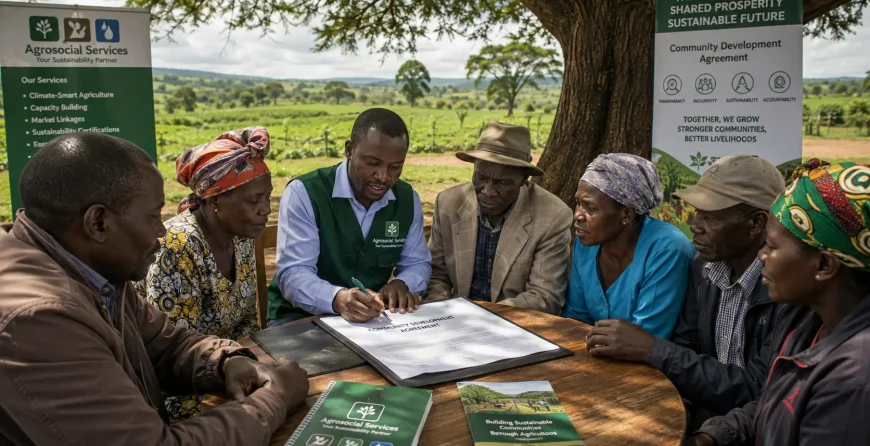
For projects on public or community land, the Community Development Agreement (CDA) is the binding instrument setting out the relationship and obligations between proponent and community. Crucially, it must follow the prescribed form in the Fourth Schedule of the Regulations — it is not a free-form contract a developer can draft however they like.
The Fourth Schedule form covers, among other things:
- The annual social contribution and its mode of disbursement.
- Confirmation that the proponent has consulted the community and obtained free, prior and informed consent (FPIC) in accordance with Kenyan law and applicable carbon standards.
- The types of community development projects to be funded.
- Committee composition, meetings and allowances.
- Participation and transparency management.
- Review and amendment procedures.
- Transfer provisions — if the proponent transfers the project to a third party, the transferee assumes all rights and obligations.
- A Grievance Resolution Sub-Committee for complaints about implementation.
Authority Matters
Who Can Legally Sign for a Community
This is where several Kenyan carbon disputes have originated. Only the community assembly, or a legally registered community land management committee, has authority to enter agreements over community land. Individual elders, self-appointed representatives or informal delegations do not — however senior or well-intentioned they may be.
An agreement signed by an unauthorised party is exposed to challenge, and can unravel years into a project. Alongside authority, documented evidence of FPIC is mandatory for community land-based carbon projects — meaning consent that is genuinely free, given in advance, and properly informed, with the evidence retained.
Who Holds the Money
The Community Project Development Committee
Management and disbursement of community benefits is handled by a community project development committee, in the manner set out in the CDA. The prescribed composition is deliberately inclusive — the Regulations require representation including:
- A representative elected by civil society organisations working on climate change in the county.
- A representative of marginalised groups, ethnic and other minorities, elected by the community.
- A representative of persons with disability, elected by the community.
Those seats are not decorative. They exist because benefit-sharing failures in Kenya have typically taken the form of capture by a narrow group — and inclusive composition is the statutory answer to it. If a proposed committee omits these seats, that is a compliance gap worth raising immediately.
Accountability
What the Proponent Must Report
Under the CDA, the project proponent is obliged to:
- Pay the annual social contribution each financial year toward community development projects.
- Provide the Committee with an annual report setting out the proponent’s aggregate earnings for that financial year.
- Prepare an annual report of the contribution actually paid, specifying amounts disbursed for administrative expenses versus community project development.
That third obligation is the community’s audit trail. It is the mechanism that lets you see how much of “your” 40% was consumed by administration before reaching an actual project — and it is your right to receive it, annually, in writing.
Due Diligence
Before You Sign — the Questions That Matter
- Which land category is this project on? Community, public or private — it determines whether you have a legal floor at all.
- How is “cost of doing business” defined, itemised and verified? This decides what 40% is worth.
- Does the agreement follow the Fourth Schedule form? Ask to see both.
- Is the signatory legally authorised? Community assembly or registered land management committee only.
- Is FPIC documented across the membership, not just leadership?
- Does the committee include the required representation — civil society, minorities, persons with disability?
- What are the annual reporting commitments, and what happens if they are missed?
- What is the crediting period, and what are the exit terms? Twenty years is common.
- What happens if the project is transferred to another company?
- Has the project been entered in the National Carbon Registry?
One caution on sources: some published commentary states the Regulations do not fix percentages. The weight of authority — including the Regulations themselves as published by Kenya Law, and analysis from several leading firms — supports the 40% and 25% floors for public and community land. Either way, the practical answer is identical: get the exact percentage, the calculation basis and the payment timing written explicitly into your agreement. Do not rely on the statutory floor to fill a silent contract.
Considering a carbon project? Get independent advice first.
We help cooperatives and farmer groups assess carbon project eligibility, build the records methodologies require, and evaluate developer terms against the 2024 Regulations — independently, because we are not project developers and earn nothing from your credits.
Quick Answers
Frequently Asked Questions
Does the 40% rule apply to private land?
No. Regulation 29(3) expressly provides that a private carbon project on private land is not required to disburse annual social contributions under section 23E(5)(b) of the Act. The 40% minimum applies to projects on public and community land. On private title, your share is whatever you negotiate — so the contract terms are everything.
How is the 40% calculated?
It is not less than 40% of the aggregate earnings of the previous year, less the cost of doing business, for land-based projects (25% for non-land-based). Because costs are deducted first, how “cost of doing business” is defined in the Community Development Agreement determines what actually reaches the community.
Who can legally sign a carbon agreement on community land?
Only the community assembly or a legally registered community land management committee. Individual elders, self-appointed representatives or informal groups do not have that authority, and agreements signed by unauthorised parties are open to challenge. Documented free, prior and informed consent is also mandatory.
What is a Community Development Agreement?
It is the binding agreement between a carbon project proponent and the community, required for projects on public or community land. It must follow the prescribed form in the Fourth Schedule of the Regulations and must set out the annual social contribution and how it will be disbursed, managed by a community project development committee.
Key Takeaways
- The 40% floor applies to public and community land only — private land projects are exempt.
- It is 40% of earnings after cost of doing business — that definition is the money term.
- The CDA must follow the Fourth Schedule prescribed form.
- Only a community assembly or registered land management committee can sign for community land.
- Proponents owe annual earnings and disbursement reports — that is your audit trail.
Related Guides & Resources
Carbon & Climate
Group Structures
Organic Group Certification
Building an Internal Control System
Work With Us
Last reviewed: August 2026 by Agrosocial Services. Compiled from the Climate Change (Carbon Markets) Regulations 2024 (Legal Notice No. 84 of 2024) as published by Kenya Law, the Climate Change Act Cap 387A, and published analysis from Bowmans, Cliffe Dekker Hofmeyr, Chambers & Partners and EY. Carbon market regulation is evolving and published interpretations differ on some points — this article is general information, not legal advice. Obtain qualified legal counsel before entering any carbon agreement. Agrosocial Services is an independent consultancy; we are not a carbon project developer, credit buyer or law firm.