Mango Export from Kenya 2026 — The Complete Certification, Fruit Fly & Market Access Guide
🥭 Markets: Middle East · China (new 2026) · EU (open via treatment) | 📅 Seasons: Mar–Jun & Oct–Dec | ⚠️ Key barrier: fruit fly | ✅ Gateway: GLOBALG.A.P + fruit fly programme + HWT/VHT | 📅 Last reviewed: June 2026
In This Guide
- Key Facts — Read This First
- Why Mango Export Certification Matters
- Growing Counties, Varieties & Seasons
- The Fruit Fly Barrier & Your Programme
- Hot Water & Vapour Heat Treatment
- The 7 Export Requirements
- Step-by-Step Export-Ready Process
- Export Markets, Prices & What to Target
- Certification Costs & ROI
- 5 Mistakes That Lose Contracts
- Frequently Asked Questions
⚡ Key Facts — Mango Export Kenya 2026
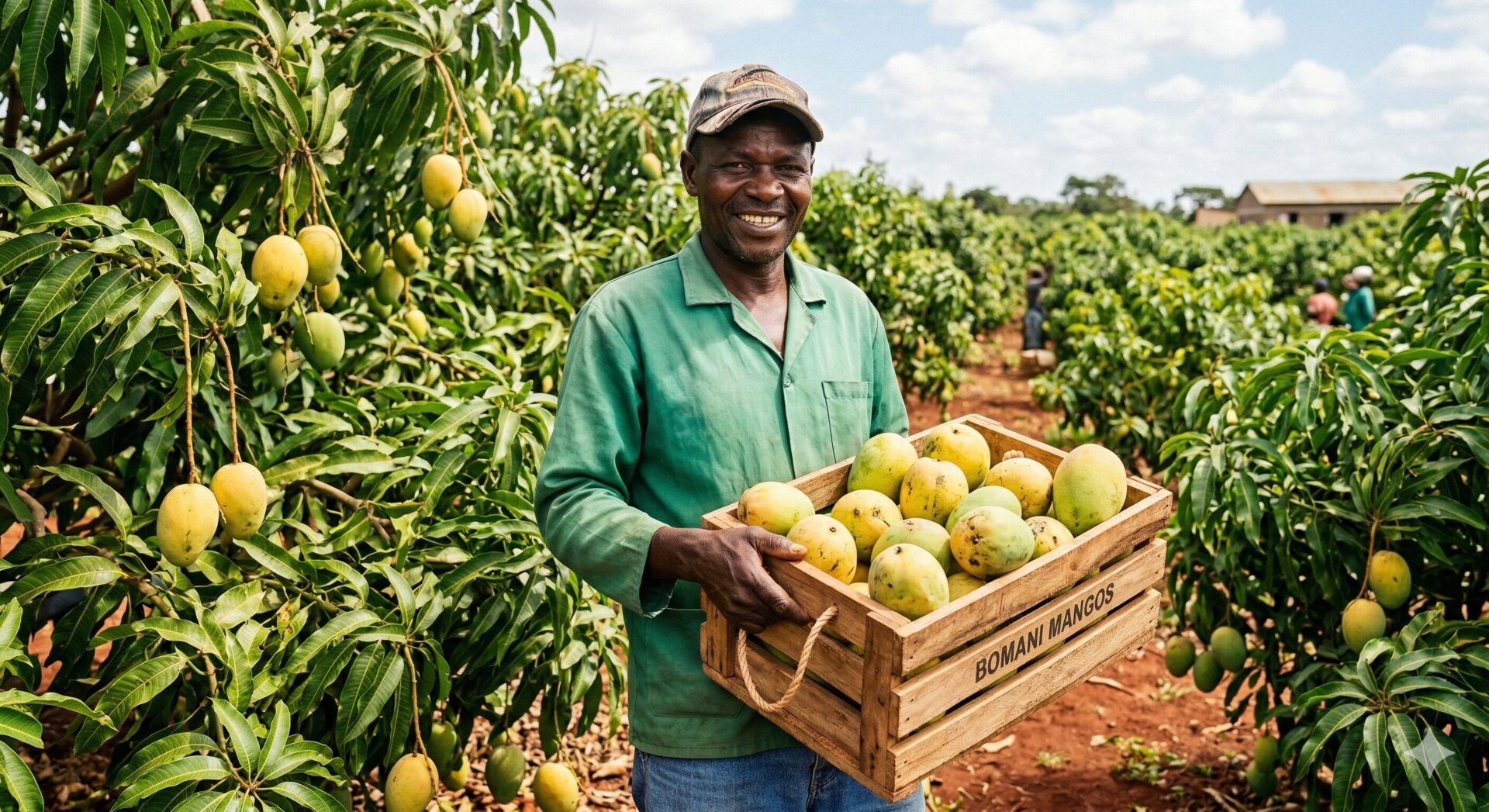
- Kenya produces ~780,000 tonnes of mangoes a year on ~49,000 hectares — the second most common fruit after banana — and over 80% is grown by smallholders.
- Fruit fly (Bactrocera dorsalis) destroys 40–80% of the crop and is the #1 export barrier — a quarantine pest that triggers import restrictions wherever it is present.
- The EU reopened in September 2021 after Kenya’s 2014 self-ban — but only for fruit disinfested by hot water treatment or, since 2023, vapour heat treatment at a KEPHIS-approved facility.
- The price gap is the opportunity: KES 5–20/kg at the farm gate in glut vs KES 60–120/kg certified for export. Same fruit, same tree.
- China opened in 2026: mango is covered by the Kenya–China duty-free deal effective 1 May 2026. China duty-free guide →
- GLOBALG.A.P IFA v6 is the gateway, affordable for smallholders via group certification at ~KES 15,000–25,000 per farmer. Group certification guide →
- Best sequence: Middle East first, China next, EU once your treatment and certification are in place.
Kenya is one of Africa’s largest mango producers, growing roughly 780,000 tonnes a year across the Eastern, Coast and Central regions. Mango is the country’s second most common fruit after banana, and more than 80% of it is grown by smallholders. Yet the overwhelming majority is sold domestically at glut-season prices, while the export premium — two to six times higher per kilogram — goes largely uncaptured. The reason is not demand and not quality. It is a specific, solvable set of compliance and phytosanitary barriers, led by the mango fruit fly, that this guide maps end to end — including the hot water and vapour heat treatment route that reopened the EU market and that almost no other guide explains correctly.
Consider the economics directly. A Makueni farmer selling 2,000 kilograms at the farm gate during the March–June glut, at around KES 10 per kilogram, earns about KES 20,000. The same 2,000 kilograms — certified, fruit-fly compliant, treated where required, properly graded and packed for a Gulf or European buyer at KES 80 per kilogram — earns KES 160,000 from the same trees. The gap between those two numbers is what certification, treatment and a buyer relationship unlock, and it is why mango is one of the highest-return upgrades available to a Kenyan fruit farm.
📩 Free: Kenya Mango Export Readiness Checklist 2026
The fruit fly programme template, GLOBALG.A.P IFA v6 requirements for mango, the KEPHIS phytosanitary checklist, the hot water treatment protocol summary and the EU MRL pesticide list for mango — one pack, straight to your inbox. Free, instant delivery.
Why Kenyan Mango Farmers Need Export Certification
International buyers of fresh mangoes — Gulf importers, European retail programmes and premium commodity traders — operate under strict food-safety, traceability and phytosanitary rules. GLOBALG.A.P certification to the current IFA v6 standard is the baseline credential they verify before any commercial conversation: it confirms food safety, traceability, worker welfare and responsible pesticide use, and issues a GGN that buyers check in the global database. Without it, EU and UK retail buyers are closed regardless of fruit quality.
The price gap that makes mango export worth the effort
The economics are stark, and they are the reason to certify and treat:
| Channel | Typical Price (KES/kg) | What It Requires |
|---|---|---|
| Local farm gate (glut) | KES 5–20 | Nothing — but margins collapse in season |
| Local processor / juice | KES 15–30 | Consistent supply, basic quality |
| Certified export — Middle East | KES 60–100 | GLOBALG.A.P + fruit fly control + grading |
| Certified export — EU retail | KES 90–120 | All of the above + HWT/VHT treatment |
Certification moves a farm from the top two rows to the bottom two — but for mango there are two further gates that sit alongside it, both unique to this crop in their severity: the fruit fly, and the disinfestation treatment that fruit fly makes necessary.
Kenya’s Mango Growing Counties — Varieties, Seasons & Export Readiness
Mango is grown across more than 20 counties, but production concentrates in the Eastern and Coast regions. Makueni is the runaway leader, producing close to a third of national supply, followed by Machakos, Kitui and the Coast counties. Understanding where you sit shapes your variety choice, your season, and your route to a packhouse and treatment facility.
| County / Region | Position | Main Varieties |
|---|---|---|
| Makueni | #1 — ~30% of national supply; ~4.3M trees; export supply hub being built | Apple, Ngowe, Kent, Tommy Atkins |
| Machakos | #2 producer; strong Nairobi market access | Apple, Ngowe, Van Dyke |
| Kitui | Major Eastern producer | Apple, Ngowe |
| Embu / Murang’a / Meru | Central — earlier season, good quality | Apple, Kent, Tommy Atkins |
| Coast (Kilifi, Kwale, Lamu) | Earliest season; proximity to Mombasa port | Ngowe, Apple, Boribo |
Export varieties — what buyers specify
Apple and Ngowe are Kenya’s workhorse export varieties with strong Middle East demand. Kent, Tommy Atkins and Van Dyke suit European-style retail for their colour, firmness, shelf life and low fibre. Variety also interacts with treatment: Tommy Atkins in particular has been the basis of Kenya’s validated hot water treatment protocol and holds quality well through the process, which is one reason it features in EU-bound consignments. Matching variety to market — and to treatment — matters: a Gulf trader and a European supermarket programme do not want the same fruit.
Two export seasons
Kenya harvests a main crop from March to June and a shorter crop from October to December. The March–June window is the commercially valuable one — it coincides with peak Gulf and European demand when several competing origins are out of season, so certified, treated fruit available then commands the best prices. The Coast region’s earlier onset can give growers there a useful timing advantage into early markets.
The Fruit Fly Barrier — and How to Build Your Management Programme
Every Kenyan export crop has a compliance pathway, but mango carries one extra, decisive obstacle: the mango fruit fly, Bactrocera dorsalis (historically also referred to as B. invadens). An invasive species of Asian origin, it lays eggs in the fruit; the larvae feed inside, causing rot and drop, and damage 40–80% of an unmanaged crop. Critically, it is a quarantine pest — importing countries restrict or ban fruit from areas where it is present, irrespective of how good the fruit looks. Managing it is therefore not a yield question alone; it is the precondition for export at all.
What a credible fruit fly programme contains
Buyers and KEPHIS inspectors look for a documented, continuously-run programme — not a last-minute effort. The core components:
- Orchard sanitation: collect and destroy all fallen and damaged fruit, which is where larvae complete their cycle. This is the single highest-impact, lowest-cost action and inspectors look for evidence it is routine.
- Monitoring traps: pheromone/para-pheromone traps (e.g. methyl eugenol lures) deployed at a sensible density across the orchard and checked on a fixed schedule, with catch counts recorded to track pressure over time.
- Bait application: protein bait spot-sprays or male annihilation technique (MAT) stations to suppress the population, applied on a documented schedule rather than reactively.
- Area-wide coordination: fruit flies do not respect farm boundaries, so the most effective control is neighbourhood-wide — a strong argument for organising through a cooperative, as Makueni’s 15,000-trap, EU-funded rollout in 2025 demonstrates.
- Records: dated logs of every sanitation round, trap count and bait application. A farm with a year of disciplined records will out-compete a better-looking orchard that cannot prove control.
Strong field control reduces — but for many markets does not eliminate — the need for post-harvest disinfestation. That is the next gate.
Hot Water & Vapour Heat Treatment — The Gate That Reopened the EU
This is the part of mango export most guides get wrong, so it is worth stating precisely. In 2014 Kenya imposed a self-ban on fresh mango exports to the EU after repeated fruit fly interceptions threatened a full trade block. That ban was lifted in September 2021, when Kenya resumed EU mango exports — but on a condition: the fruit must be disinfested by an approved post-harvest temperature treatment. Kenya first secured approval for hot water treatment (HWT) in 2021, and the EU published approval for vapour heat treatment (VHT) as an alternative in June 2023. So the EU is open to Kenyan mango today — provided every consignment is treated and accompanies the Kenya mango certification protocol.
🔬 The treatment, in plain terms
Hot water treatment immerses the fruit in precisely controlled hot water long enough to kill fruit fly larvae inside it. Research by icipe established that around 46.1°C for roughly 73 minutes achieves “probit 9” quarantine security — 99.9968% mortality — for Tommy Atkins mango without harming fruit quality, a level that meets the requirements of most mango-importing countries. Vapour heat treatment achieves the same disinfestation outcome using heated, saturated air instead of water. Both are done at a KEPHIS-approved treatment facility — KEPHIS approved its first for the EU and Jordan markets and is licensing more as volumes grow.
For your planning this has three practical consequences. First, EU and other treatment-required markets need facility access — either your own approved treatment line (a serious capital item) or, far more commonly for smallholders and cooperatives, a commercial KEPHIS-approved facility you book. Second, treatment is additional to certification, not a substitute — you still need GLOBALG.A.P, KEPHIS registration and the documentation set. Third, markets differ: the Middle East and regional markets generally do not require this treatment, which is exactly why they are the sensible first targets while you build toward treated EU shipments.
The 7 Export Requirements Every Kenyan Mango Farmer Must Meet
Export readiness for mango rests on seven pillars. Miss any one and consignments are rejected, held, or never commissioned in the first place.
1. HCD & KEPHIS registration
Register your farm with the Horticultural Crops Directorate (HCD) and on the KEPHIS e-certification system. KEPHIS issues the phytosanitary certificate that must accompany every consignment, confirming it was inspected and found free of regulated pests. Production sites and the packhouse must both be KEPHIS-registered.
2. GLOBALG.A.P IFA v6 certification
The baseline buyer requirement for EU and UK markets. Smallholders achieve this affordably through a cooperative under group certification (Option 2). Start with the GLOBALG.A.P certification overview and the farm audit guide.
3. ⚠️ Fruit fly management programme — the most critical requirement
The documented, continuously-run programme described above: sanitation, trapping, bait, area-wide coordination and records. This is the requirement that decides whether a restricted market is even reachable, and the one inspectors scrutinise most. Build it first, not last.
4. Post-harvest disinfestation treatment (for treatment-required markets)
For the EU and other markets that require it, fruit must pass hot water or vapour heat treatment at a KEPHIS-approved facility. Plan facility access into your logistics and costing from the outset if the EU is a target.
5. Pesticide compliance & EU Maximum Residue Limits (MRLs)
Every chemical used must be registered and applied within the destination market’s MRLs, with pre-harvest intervals observed and spray records kept. EU MRLs are strict and a single exceedance can cause rejection and an RASFF notification. See the MRL compliance guide.
6. Maturity assessment, post-harvest handling & cold chain
Harvest at correct maturity using dry-matter, firmness and sometimes brix indicators rather than colour alone; manage sap/latex burn at harvest; and pre-cool and hold within the right temperature band through to dispatch. Note that fruit destined for hot water treatment must be handled to tolerate the process, so maturity and handling discipline matter even more for EU consignments.
7. Export documentation
Each shipment travels with a KEPHIS phytosanitary certificate, commercial invoice, packing list, certificate of origin, transport document (air waybill or bill of lading), the GLOBALG.A.P certificate/GGN, and — for treated consignments — the treatment certificate. Missing or inconsistent paperwork is a frequent cause of consignments being held at destination.
📋 Run Your Own Export-Readiness Gap Check
Assess your mango farm against every IFA v6 control point, the fruit fly programme and treatment requirements before spending on consultancy. Instant download, M-Pesa accepted.
Farm Audit Checklist — KES 3,500 →
Complete Starter Kit — KES 6,000
Step-by-Step Process to Get Your Mango Farm Export-Ready
- Gap assessment — benchmark your farm against IFA v6, the fruit fly programme and (if targeting the EU) treatment access; identify what’s missing.
- Start the fruit fly programme immediately — traps, sanitation and records need a history before an audit, so this can’t wait.
- Register with HCD and KEPHIS; register your packhouse.
- Implement GLOBALG.A.P systems — records, hygiene, worker welfare, agrochemical store, traceability; individually or via a cooperative.
- Decide your first market — Middle East/China (no treatment) to start earning, EU (treatment) as the premium build.
- Secure treatment-facility access if the EU is a target — identify a KEPHIS-approved HWT/VHT facility and factor it into cost and logistics.
- Internal audit and corrective actions — close non-conformities before the certification body visits.
- Certification audit — pass and receive your GGN.
- Line up the buyer and execute the first shipment — prepare the documentation set and ship.
Export Markets for Kenyan Mangoes — Prices, Requirements & What to Target First
| Market | Access in 2026 | Notes |
|---|---|---|
| Middle East (UAE, Saudi, Qatar) | ✅ Open — easiest entry | Strong Apple/Ngowe demand; generally no treatment requirement; best first market |
| China | ✅ New — duty-free from May 2026 | Mango covered by the Kenya–China deal; premium demand; needs GACC/packhouse listing |
| European Union / UK | ✅ Open via treatment | Highest prices; requires HWT/VHT at a KEPHIS-approved facility + the mango certification protocol |
| Regional (COMESA) | ✅ Open | Lower barriers and prices; useful for volume and learning the export process |
Which to target first: start with the Middle East — open, strong demand for Kenyan Apple and Ngowe, and generally no treatment requirement. Add China as the new premium opportunity now that the duty-free deal is live. Build toward the EU with treated fruit, since that’s where the top prices sit and where your HWT/VHT investment pays back. To find and approach buyers, see How to Find International Buyers and the agricultural export pillar.
How Much Does Mango Export Certification Cost — and What’s the Return?
| Cost Item | Typical Range | Notes |
|---|---|---|
| GLOBALG.A.P — individual farm | KES 150,000–490,000 | First-year; larger estates exporting in own name |
| GLOBALG.A.P — group (Option 2) | KES 15,000–60,000 / farmer | Smallholders aggregating through a cooperative |
| Fruit fly programme | Mostly one-time + low ongoing | Traps, lures, bait, sanitation labour |
| HWT/VHT treatment (EU only) | Per-consignment fee | Booked at a KEPHIS-approved facility; avoids own-line capital cost |
📈 A worked example — a 2-hectare Makueni smallholder via a cooperative
Say two hectares yield ~12 tonnes of marketable export-grade fruit in the main season. Sold locally in glut at KES 10/kg, that is ~KES 120,000. Certified through a cooperative (per-farmer cost ~KES 20,000) and sold to a Gulf buyer at KES 70/kg, the same 12 tonnes earns ~KES 840,000 — before the EU premium that treated fruit can reach. Even after certification, programme and logistics costs, the export route is several times more profitable. The constraint is rarely the maths; it is doing the compliance work and securing the buyer.
For a full breakdown and ROI maths, see the GLOBALG.A.P cost & ROI guide, and the agricultural funding sources guide for grants that can offset certification and equipment costs.
5 Mistakes That Cost Kenyan Mango Exporters Their Contracts
Mistake 1 — Treating fruit fly control as an afterthought
Starting trapping a month before an audit fools no one. Inspectors and buyers want a history of records. Begin the programme the day you decide to export.
Mistake 2 — Assuming the EU is either closed or freely open
It is neither. The EU reopened in 2021 but requires hot water or vapour heat treatment. Plan facility access early — discovering the treatment requirement after you have a buyer is a costly surprise.
Mistake 3 — Harvesting at the wrong maturity
Picking by colour alone leads to fruit that arrives under- or over-ripe after transit — and fruit that handles treatment poorly. Use dry-matter and firmness indicators to harvest at the correct stage.
Mistake 4 — Promising volumes you can’t sustain
A buyer who is let down once rarely returns. Commit to honest, seasonal volumes — aggregating through a cooperative if needed — rather than over-promising and failing on delivery.
Mistake 5 — Under-investing in packaging and cold chain
Export mango needs proper field-heat removal, ventilated cartons and an unbroken cold chain. Cutting corners turns premium fruit into a rejected consignment at destination.
📩 Planning your mango export year?
Get the free Mango Export Readiness Checklist — fruit fly template, IFA v6 requirements, KEPHIS, treatment protocol and EU MRL lists. Free, instant delivery.
Frequently Asked Questions — Mango Export Kenya 2026
Can Kenyan farmers export fresh mangoes to the EU in 2026?
Yes. Kenya self-banned EU mango exports in 2014 over fruit fly, then reopened in September 2021 — but only for fruit disinfested by hot water treatment or, since June 2023, vapour heat treatment at a KEPHIS-approved facility, alongside the Kenya mango certification protocol. The EU is open, but every consignment must be treated first. The Middle East and China have lower barriers and make good first markets.
What is hot water treatment for mango export?
A phytosanitary step that immerses mangoes in precisely controlled hot water to kill fruit fly larvae inside the fruit. Research at icipe established that about 46.1°C for roughly 73 minutes achieves probit 9 security (99.9968% mortality) for Tommy Atkins without harming quality. It is done at a KEPHIS-approved facility; vapour heat treatment is an approved alternative.
What is the most critical export requirement for Kenyan mango?
A documented fruit fly management programme, backed by approved treatment for treatment-required markets. Fruit fly destroys 40–80% of the crop and is the biggest phytosanitary barrier; control and treatment matter even more than the certificate, because without them no restricted market opens.
Which mango varieties are most in demand for export?
Apple, Ngowe, Kent, Tommy Atkins and Van Dyke. Apple and Ngowe sell strongly to the Middle East; Kent and Tommy Atkins suit European-style retail, and Tommy Atkins handles hot water treatment well, which matters for EU shipments.
When is the Kenyan mango export season?
Two seasons — a main crop March to June and a shorter crop October to December. The March–June window is the most valuable because it overlaps peak Gulf and European demand.
How much does mango export certification cost in Kenya?
Roughly KES 150,000–490,000 for an individual farm in year one, or KES 15,000–60,000 per farmer through a cooperative, plus largely one-time costs for the fruit fly programme and KEPHIS registration, and a per-consignment fee for HWT/VHT treatment if exporting to the EU.
Can smallholder mango farmers access export markets?
Yes, through group certification. A cooperative certifies members under one Quality Management System and a shared fruit fly programme, cutting per-farmer cost to about KES 15,000–25,000 and aggregating volume. Over 80% of Kenya’s mango is smallholder-grown, so this is the realistic route.
Key Takeaways
- The price gap is real — KES 5–20/kg local vs KES 60–120/kg certified export.
- Fruit fly is the decisive barrier — a documented management programme is the single most important early investment.
- The EU is open via treatment — HWT (2021) or VHT (2023) at a KEPHIS-approved facility; not closed, not freely open.
- Sequence your markets — Middle East and China first (no treatment), EU with treated fruit for the top prices.
- GLOBALG.A.P IFA v6 is the gateway — affordable for smallholders via group certification.
- A certificate is not a buyer — line up your market as you certify.
Agrosocial Services — Mango Export Certification Support, Nationwide
From fruit fly programme to treated EU shipment — we prepare your mango farm for export.
Agrosocial Services Limited helps Kenyan mango farmers and cooperatives meet GLOBALG.A.P, build compliant fruit fly management programmes, navigate hot water and vapour heat treatment for the EU, register with KEPHIS and HCD, and connect to Middle East, China and EU buyers. Since 2018 we’ve supported 150+ farms and cooperatives across 12 counties. We respond within 2 hours, Monday–Saturday, 7am–7pm EAT.
Serving mango-growing counties: Machakos · Meru · Embu · Murang’a · Nairobi & nationwide
Related Guides from Agrosocial Services
Certification: GLOBALG.A.P Certification Kenya · Group Certification · MRL Compliance · Cost & ROI
Markets: Agricultural Export Pillar · Kenya–China Duty-Free Exports · Find International Buyers
Other crops: Avocado · Passion Fruit · French Beans · Macadamia
Agrosocial Services Export Team
Kenya Agricultural Export & Certification Consultancy — Since 2018
Agrosocial Services Limited prepares Kenyan farms and cooperatives for export — GLOBALG.A.P certification, fruit fly and pest management programmes, hot water and vapour heat treatment navigation, KEPHIS and HCD registration, packhouse and cold chain, documentation and buyer linkage. Since 2018 we’ve worked with 150+ farms and cooperatives across 12 counties, including mango growers in Makueni, Machakos, Meru and Embu.
📧 info@agrosocialservices.co.ke · 📲 WhatsApp +254 713 935 361 · 📅 Last reviewed: June 2026