Corporate & Institutional Training
Compliance fails on people, not paperwork. An audit is lost because a supervisor did not know what the standard required, a spray operator was never trained on pre-harvest intervals, or a worker gave an answer in an interview that contradicted the written policy.
We deliver practical compliance training to the people who actually have to apply the requirements — management, supervisors, quality staff, internal auditors and workers. Not theory, but what to do differently on Monday morning.
📌 Our track record. Agrosocial Services is an approved training supplier to Del Monte Kenya and has delivered contracted training for Cargill Kenya. Since 2018 we have prepared over 150 farms and cooperatives across more than 12 counties for international certification, with a 94% first-attempt pass rate. Our trainers work in certification preparation daily — the training reflects what auditors actually look for, not a generic syllabus.
What We Deliver
Training Programmes
Ethical trade & social compliance
- SMETA awareness training — the current SMETA methodology, the pillars, what auditors examine, and the practical preparation that prevents non-conformities. See our SMETA guide →
- Worker interview preparation — one of the most common causes of critical findings is inconsistency between written policy and what workers say. This is trainable.
- Social compliance for supervisors — working hours, records, grievance procedures and the documentation that evidences them.
Food safety
- HACCP awareness and implementation — the seven principles applied to your actual process, including the record-keeping that most operations fail on.
- ISO 22000 and FSSC 22000 — management system requirements, and the PRP, OPRP and CCP distinction that causes more audit findings than any other single issue.
- Hygiene and food handling for packhouse and processing staff.
Certification & auditing
- GLOBALG.A.P awareness — what the standard requires and how it is evidenced.
- Internal auditor training — equipping your own staff to run the internal audits your standard requires, competently and independently.
- Internal Control System management — for cooperatives and groups: running the ICS, member registers, internal inspections, sanctions and traceability.
Market access & field practice
- EUDR compliance — what the regulation requires, plot geolocation, traceability and due diligence data.
- Good Agricultural Practices for farm supervisors and technical teams.
- Safe handling of crop protection products — storage, application, personal protective equipment, pre-harvest intervals and spray records. This directly addresses residue failures.
- Records, traceability and worker health & safety.
Programmes can be combined or tailored. If your requirement is not listed, ask — if it falls outside our expertise we will tell you plainly rather than improvise.
How It Runs
Format & Delivery
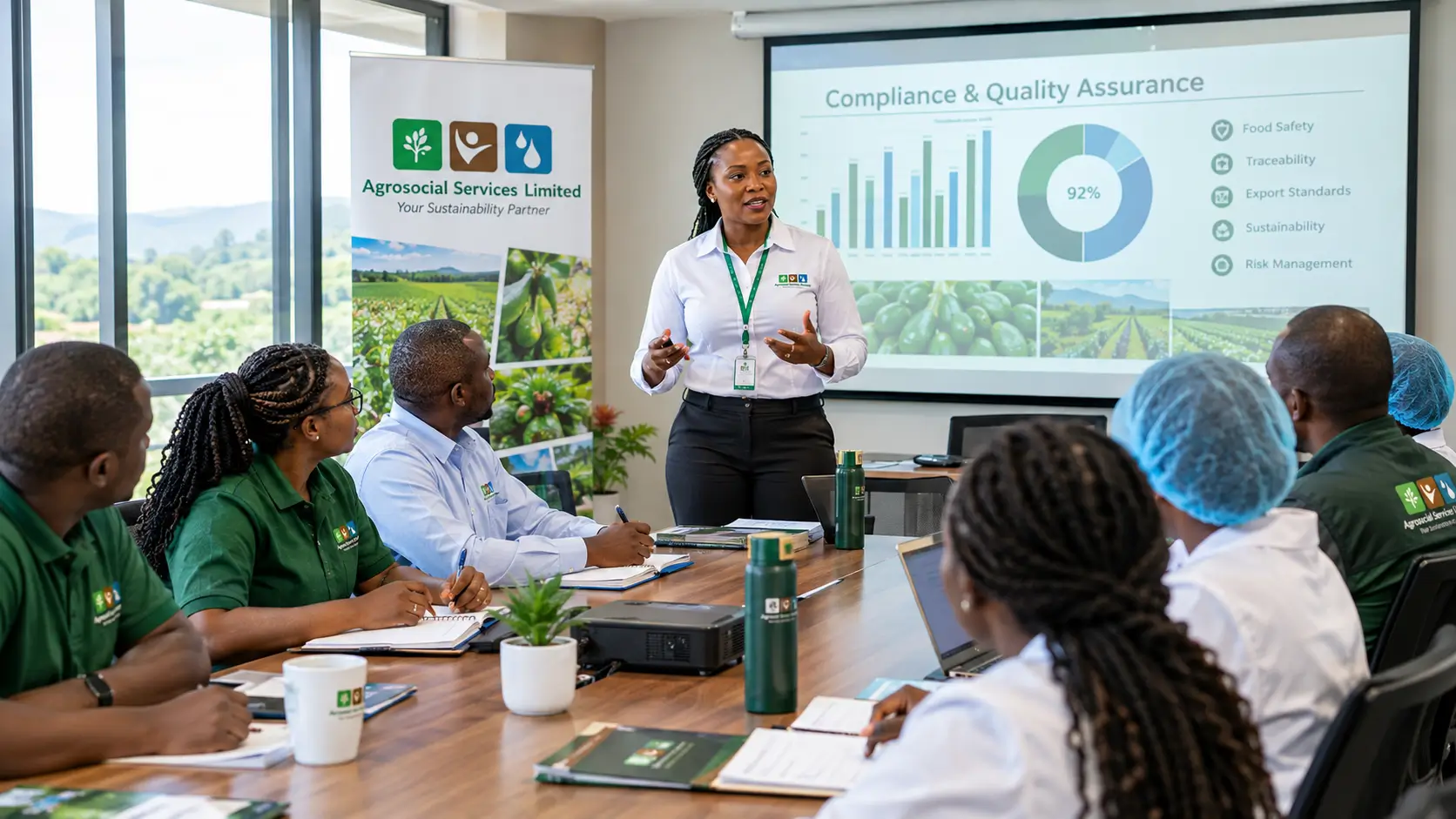
A typical programme runs over two days, 09:00 to 16:00, for up to 25 participants. Sessions combine facilitated instruction with practical simulations, role-play exercises, group discussion, guided interpretation of requirements, and open question-and-answer time. The balance is deliberate — people retain what they have practised, not what they have heard.
| Format | Best for | You provide |
|---|---|---|
| On-site | Practical work, facility walkthroughs, team cohesion | Venue, projector or screen, participant catering |
| Online | Dispersed teams, tighter budgets, shorter modules | Platform access and reliable connectivity for participants |
| Hybrid | Some staff on site, field teams joining remotely | Room camera and microphone, stable internet, an on-site technical contact |
Hybrid delivery works well, and we have run it successfully — but it needs the room set up properly, with the camera positioned so remote participants can see both the facilitator and the presentation. We run a short connection test the day before rather than discovering problems on the morning.
Beyond the Session
What’s Included
Customised case studies. Exercises built around your own operation rather than generic examples. This is the difference between a session people sit through and one they use.
An editable gap assessment checklist. Your team keeps a working tool for self-assessment against the standard after we leave.
30 days of post-training support. Direct email access to your lead trainer for interpretation questions as your team applies what they learned. Questions surface once people start doing the work, not during the session.
Certificates of completion for every participant, recording the programme, dates and duration.
Training materials issued digitally to all participants, plus hard copies for those attending in person.
Please note: certificates confirm attendance at and completion of the training programme. They do not constitute certification to any standard, which is issued only by an accredited certification body.
Which Training Do You Need?
Corporate Training or Farmer Training?
| Corporate & Institutional | Farmer Training | |
|---|---|---|
| Audience | Management, supervisors, quality and compliance staff | Farmers and farm workers |
| Focus | Standards, systems, auditing, social compliance | Field practice, GAP, record-keeping at farm level |
| Setting | Boardroom, training room, online | Farm, collection centre, cooperative |
| Go here | This page | Farmer Training → |
Many organisations need both — management trained on the system, farmers trained on practice. We can deliver them as a combined programme.
Working With Us
How an Engagement Runs
1 · Enquiry. Tell us the subject, roughly how many participants, and what has prompted the need — an upcoming audit, a buyer requirement, or new staff.
2 · Scoping. We confirm the programme, duration, format and what we will customise to your operation, then quote in writing.
3 · Agreement and scheduling. A short training services agreement setting out scope, dates and terms. Materials preparation and facilitator scheduling begin on confirmation.
4 · Delivery. The programme runs, with your participant list confirmed in advance so materials and certificates are ready.
5 · Follow-through. Certificates issued, checklist handed over, and 30 days of direct support as your team applies the training.
Allow reasonable lead time between confirmation and delivery. Customised case studies and materials take preparation, and rushing that is the fastest way to end up with a generic session.
Investment
How Training Is Priced
Training is scoped rather than sold from a price list. Cost depends on the subject, duration, number of participants, delivery format and how much material is customised to your operation. We quote in writing before any engagement, and our quotations state plainly what is included and what we assume you will provide — for on-site delivery that is typically venue, projector and participant catering.
Train Your Team
Audits are passed by people who know what is expected
Tell us the subject, how many participants, and when you need it. We will confirm the programme and quote in writing.
Quick Answers
Frequently Asked Questions
Can training be delivered online?
Yes — online, on-site, or hybrid with some participants in the room and field staff joining remotely. Hybrid needs a camera and microphone positioned so remote participants can see the facilitator and screen, stable internet throughout, and an on-site technical contact. Materials go to all participants digitally so remote attendees are not disadvantaged.
How many people can attend?
Our standard format takes up to 25 participants, which keeps groups small enough for practical exercises and genuine question time. Larger organisations are usually better served by multiple sessions than one oversized group, and we will say so when scoping.
Do participants receive certificates?
Yes — a certificate of completion recording the programme, dates and duration. These certify attendance and completion of the training; they do not constitute certification to any standard, which is issued only by an accredited certification body.
How is training priced?
It is scoped rather than sold from a fixed list, because cost depends on subject, duration, participant numbers, format and customisation. We confirm the fee in writing beforehand, and state clearly what is included and what we assume the client provides, such as venue and catering for on-site delivery.
Related
Training Subjects
SMETA & Ethical Trade
HACCP & Food Safety
GLOBALG.A.P
EUDR Compliance
Get in Touch
Agrosocial Services Limited is an independent certification-preparation, compliance and training consultancy. Training certificates confirm completion of the programme delivered and do not constitute certification to any standard. Scope and fees are confirmed in writing before any engagement begins.