Crop Insurance for Kenyan Farmers: What’s Available and Why Few Use It
Kenya has spent a decade building genuinely innovative agricultural insurance — subsidised premiums, satellite-triggered payouts, mobile money enrolment through M-Pesa. And after all of that investment, formal insurance penetration among Kenyan farmers remains below 1%.
That gap between what exists and what farmers actually use is the honest starting point for this guide. The programmes are real, the payouts are real, and for the right farmer they are worth having. But understanding why uptake has stayed so low is exactly what will help you decide whether — and how — to use them.
⚡ Key Facts — Kenyan Crop Insurance
- 📉 Penetration remains below 1% despite a decade of subsidised programmes.
- 💰 Government subsidises up to 50% of crop premiums, and up to 100% of livestock premiums under KLIP.
- 👨🌾 1.8 million+ cumulative farmers participated by 2024, 42% of them women.
- ⏱️ Index-based payouts land in 14–21 days; indemnity claims take 30–60 days.
- 🌾 Coverage available from as little as half an acre, via aggregated group policies.
Sources: UNDP Insurance and Risk Finance Facility; IFPRI; Climate Policy Initiative (ACRE Africa case study); Financial Protection Forum. Verified September 2026.
In This Guide
The Public Programme
KAIP — The Kenya Agricultural Insurance Programme
Launched in 2016, KAIP is a public-private partnership between government, licensed insurers and development partners, built specifically to bring affordable cover to smallholders who commercial insurers would otherwise consider too costly to reach individually.
KAIP operates across most Kenyan counties and covers five value chains: maize, sorghum, green grams, potatoes and onions. If your primary crop sits outside that list, KAIP itself will not cover you — though the private route below may.
The government subsidises up to 50% of the premium for eligible smallholders, which is the single biggest reason this insurance is affordable at all. Without that subsidy, commercial rates for weather-related crop risk are steep — they have to reflect a genuinely high probability of payout in a country where drought and erratic rainfall are common.
For Livestock Keepers
KLIP — Kenya Livestock Insurance Programme
Launched in October 2015, KLIP protects pastoralists against drought specifically, in the arid and semi-arid counties where herding rather than cropping is the dominant livelihood: Turkana, Marsabit, Mandera, Wajir, Isiolo, Samburu, Tana River, Garissa and Baringo.
The mechanism is satellite-based: when vegetation index data indicates severe drought conditions across a monitored area, insured herders receive automatic cash payments to buy feed, water and veterinary care — without waiting for an assessor to visit. Government subsidy under KLIP runs higher than for crops, reported at up to 100% of the livestock premium in the areas covered.
If you grow crops rather than herd livestock, KLIP does not apply to you — that is what KAIP and the private products below are for.
Free Download
Funders and buyers increasingly ask about risk management
Insurance is one part of the resilience picture funders assess. Our free guide covers the 25 record-keeping gaps that fail Kenyan farm audits.
Beyond the Five Crops
ACRE Africa — The Private Route
If your crop is not one of KAIP’s five, ACRE Africa (Agriculture and Climate Risk Enterprise) is the leading private index-insurance intermediary operating in Kenya, working through a panel of underwriters that has included UAP Insurance, CIC Insurance Group, APA Insurance and Heritage Insurance.
ACRE covers a considerably wider list: maize, sorghum, coffee, sunflower, wheat, cashew nuts and potato, against drought, excess rain and storm damage. Coffee’s inclusion matters — it is one of the few programmes extending index insurance to a high-value export crop rather than only staple food crops.
The delivery model is distinctive: smallholders typically buy agricultural inputs — often seed — from an agribusiness partner and are enrolled into the insurance programme at the point of purchase, frequently by scanning a code on the product. The premium is 50% subsidised, with the farmer paying half and the agribusiness partner covering the other half. By 2018, this model had insured over 1.7 million farmers across Kenya, Tanzania and Rwanda against more than USD 180 million in weather risk.
The Mechanics
How Index Insurance Actually Works
Almost everything described above is index-based rather than traditional indemnity insurance, and the difference matters for what you should expect.
| Index-based insurance | Traditional indemnity | |
|---|---|---|
| Trigger | Weather station or satellite data crosses a threshold | A physical assessor inspects your actual loss |
| Payout speed | 14–21 days after season data finalised | 30–60 days after claim filed |
| Delivery | Automatic, via mobile money | Requires a claim and a visit |
| Main weakness | Basis risk — see below | Slow, and costly to administer at smallholder scale |
Two design features underpin the model. Weather index insurance pays out when weather station data — rainfall, typically — crosses a pre-agreed threshold. Area yield index insurance instead pays based on measured crop yields across a defined geographic area, not your individual farm. Both are built to be fast and cheap to administer at scale, which is precisely what makes them viable for smallholders at all.
Read This Before You Buy
⚠️ Why Uptake Stays Below 1%
Three honest reasons explain the gap between a decade of programme-building and near-invisible adoption.
Affordability, even subsidised. A 50% subsidy still leaves a real cash cost, and for a smallholder already stretched, an upfront premium against a loss that might not happen competes directly with fertiliser, school fees, or food.
Limited awareness. Much of this insurance is distributed through input suppliers and cooperatives rather than marketed directly to farmers, so many simply do not know it exists or that they may already be enrolled through a seed purchase.
Basis risk — the most important one to understand. Because index insurance pays out on measured weather or area-wide yield data rather than an inspection of your own field, it is possible for your specific farm to suffer a genuine loss while the index does not trigger a payout — because the nearest weather station recorded different rainfall, or the wider area’s yield held up even though your plot did not. This mismatch is well documented and has contributed directly to farmer trust issues, which is a significant barrier to adoption in its own right.
📌 Basis risk is not a flaw to be embarrassed about — it is the trade-off that makes the whole model affordable. A policy that inspected every individual field would cost far more to administer and would not be viable at smallholder scale. Go in understanding this, and index insurance becomes a sensible tool for managing catastrophic, area-wide risk — not a guarantee against every individual misfortune.
Getting Covered
How to Actually Enrol
- Through an input purchase. The ACRE Africa model bundles insurance with seed bought from a participating agribusiness partner, often enrolled by scanning a code at the point of sale.
- Through an aggregator or cooperative. Coverage is available from as little as half an acre, because aggregators pool many smallholders together into a single policy that is viable for the insurer to underwrite.
- Through a county KAIP or KLIP scheme directly, where your county and crop or livestock activity qualifies — ask your county agricultural office which programmes are currently active locally.
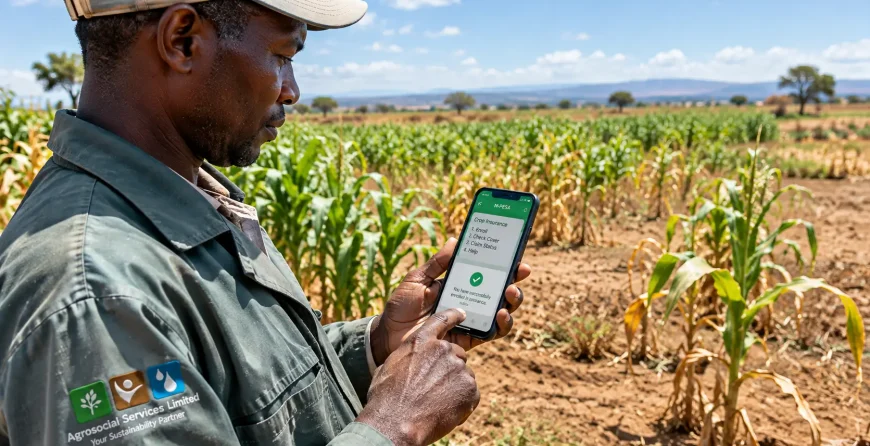
- Enrolment and claims run through mobile money, typically M-Pesa, for both premium payment and payout — no bank account required.
The Honest Verdict
Is It Worth It For You?
The real risk being priced here is genuine. Floods in 2024 destroyed over 168,000 acres of Kenyan cropland — insurance exists precisely because that kind of loss recurs.
Weigh it honestly: if you grow one of KAIP’s five crops or one of ACRE’s seven, the subsidised premium is genuinely cheap, payout is fast by insurance standards, and enrolment is low-friction through mobile money. The trade-off is basis risk — you are insuring against area-wide weather events, not guaranteeing compensation for anything that goes wrong on your specific plot. For a farmer whose main exposure is drought or extreme rainfall rather than a localised pest or disease problem, that trade-off is a reasonable one.
Building a fundable, resilient operation?
Funders and buyers increasingly look for organisations that manage risk seriously, not just those that grow well. We help cooperatives build the records, governance and readiness that make an operation genuinely fundable.
Quick Answers
Frequently Asked Questions
What crop insurance programmes exist in Kenya?
The main public programme is KAIP, launched in 2016, covering maize, sorghum, green grams, potatoes and onions across most counties. Pastoralists in arid and semi-arid counties are covered separately under KLIP. Private intermediaries such as ACRE Africa offer a wider crop list including coffee, sunflower, wheat and cashew nuts, usually bundled with input purchases.
How much does crop insurance cost?
Government programmes subsidise up to 50% of the premium for eligible smallholders. Under the ACRE Africa model, the premium is also split — the farmer pays half, an agribusiness partner covers the other half. Coverage is available from as little as half an acre through aggregated group policies.
How quickly does it pay out?
Index-based insurance typically pays within 14 to 21 days of the season’s data being finalised. Traditional indemnity insurance, requiring a physical field visit, generally takes 30 to 60 days after a claim is filed.
Why is uptake so low?
Penetration remains below 1% despite a decade of subsidised programmes. The main barriers are affordability, limited awareness, and basis risk — the mismatch that can occur when an index-based policy does not trigger a payout even though a farmer’s own field has suffered real loss. That mismatch has contributed to trust issues that slow adoption.
Key Takeaways
- Penetration is below 1% despite subsidised programmes running for a decade — know why before you dismiss or oversell it.
- KAIP covers five crops; ACRE Africa covers more, including coffee — check which fits your farm.
- Basis risk is the real trade-off — insurance protects against area-wide weather events, not every individual misfortune.
- Enrolment is low-friction — mobile money, bundled with input purchases, from half an acre upward.
- Index payouts land in 14–21 days — genuinely fast by insurance standards.
Related Guides & Resources
Funding & Resilience
Crops Mentioned
Work With Us
Last reviewed: September 2026 by Agrosocial Services. Compiled from the UNDP Insurance and Risk Finance Facility, IFPRI research on smallholder index insurance in Kenya, the Climate Policy Initiative’s case study of ACRE Africa, and the Financial Protection Forum’s documentation of KLIP. Programme eligibility, subsidy levels and covered crops vary by county and season — confirm current terms with the relevant scheme or insurer before purchasing. Agrosocial Services is an independent agricultural certification and compliance consultancy; we are not an insurer or insurance broker and do not sell insurance products.