
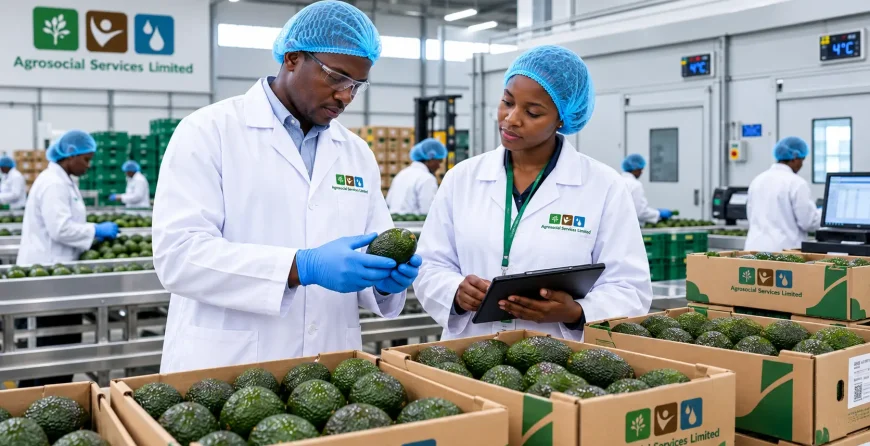
Packhouse Requirements for Kenyan Exporters: Registration, Inspection & What Fails
Certification gets you a buyer. KEPHIS registration and an AFA-HCD licence make you legal. But the packhouse is where consignments actually stop — and it is the gate most new exporters underestimate, because it is a physical facility that has to pass a physical audit.
This guide covers what a compliant Kenyan export packhouse requires: how registration works, what the KEPHIS facility audit examines, how pre-export inspection runs, and the failures that leave produce sitting on the floor while a flight departs without it.
For the full regulatory map of all four gates, see Agricultural Export from Kenya.
⚡ Key Facts — Export Packhouses
- 🏭 You need access to a registered packhouse — not necessarily your own. HCD licensing requires you to demonstrate it.
- 📋 Registration runs through KEPHIS IEICS and involves a facility audit, not a form.
- 🧪 Fresh produce dealers must submit a sample for residue analysis at the KEPHIS laboratory after the field audit.
- ⏰ Apply for pre-export inspection at least three days before shipment.
- ❄️ Cold chain requirements are crop-specific — and set by your destination market, not by you.
Sources: KEPHIS Procedure for Registration as an Exporter of Agricultural Produce; KEPHIS IEICS and ePhyto; AFA Horticultural Crops Directorate / eHCD. Verified August 2026.
In This Guide
First Decision
Do You Need Your Own Packhouse?
You need access to a registered packhouse. You do not necessarily need to own one. The AFA-HCD export licence vetting process requires you to demonstrate access to a licensed facility — whether that is yours, an exporter’s, or a shared commercial packhouse.
This matters commercially. Building and registering a packhouse is a substantial capital project: the structure, cold rooms, grading equipment, secure stores, waste handling, and the staff to run it. At modest volumes those fixed costs are very hard to carry — which is one of the main reasons most smaller growers supply an established exporter rather than exporting in their own name.
📌 If you are using someone else’s packhouse, verify its registration yourself. Do not take it on trust. If the facility is not registered with KEPHIS, your consignment cannot be certified — regardless of how good your produce is or how well your own farm is certified.
Getting Registered
Registering a Packhouse With KEPHIS
KEPHIS registers both farms and packhouses through its IEICS platform, and also operates Kenya’s connection to the IPPC ePhyto hub for electronic phytosanitary certificates.
The important thing to understand is that registration is not a paper exercise. It involves a facility audit conducted by KEPHIS, and for dealers in fresh fruit and vegetables there is an additional step: after a successful field audit, a produce sample must be submitted for pesticide residue laboratory analysis at the KEPHIS laboratory. Registration is not complete until that analysis clears.
Alongside KEPHIS, your exporting entity registers with the AFA Horticultural Crops Directorate through the eHCD portal, which since 2024 links directly to KEPHIS inspection data and to the EU’s TRACES NT system. Cargo clearance itself runs through the Kenya Electronic Single Window System.
The Audit
What the Facility Audit Actually Checks
The KEPHIS exporter registration procedure sets out what auditors examine. Read this as a checklist — because that is how it is used:
| Area | What is examined |
|---|---|
| Technical staff | Qualified personnel in agriculture, horticulture or a related field |
| Spray operations | Trained sprayers and calibrated spray equipment — calibration records matter |
| Chemical store | Secure store for plant protection products, with records maintained |
| PPE store | Separate store for protective equipment, with records |
| Input store | Fertiliser and seed storage, with records |
| Waste disposal | Mechanisms guaranteeing food, environmental and human safety |
| Handling & packing | Compliance of the produce handling and packing facilities themselves |
| Residue analysis | Produce sample to the KEPHIS laboratory after a successful field audit |
Notice how much of that list is about separate, secure, documented storage. Chemicals, protective equipment and inputs each need their own store with its own records. A single shed holding everything together is one of the most common and most avoidable audit failures.
Notice too how closely this overlaps with GLOBALG.A.P requirements. Build once for both — the chemical store, calibration records and worker facilities satisfy the regulator and the certification body alike.
Free Download
Know what inspectors check before they arrive
Our free guide covers the 25 gaps that most commonly fail Kenyan farm and facility audits — including the storage and records failures described above.
Design Principles
Packhouse Layout & Product Flow
Beyond the checklist, auditors and buyers assess whether the facility is designed to protect produce. The principles are consistent across crops:
- One-directional flow — produce moves from reception through grading and packing to dispatch without crossing back over itself.
- Separation of clean and dirty areas — field crates, waste and staff facilities kept away from packed product.
- Hygiene infrastructure — handwashing, toilets, changing areas, and cleaning schedules that are documented, not just performed.
- Pest exclusion — screened openings, sealed doors and monitoring. This is not optional for crops facing quarantine pests such as False Codling Moth.
- Traceability at the point of packing — every carton traceable to the farm and the harvest date. This is what saves you when a residue detection occurs.
- Temperature control — pre-cooling and cold storage appropriate to the crop.
Temperature
❄️ Cold Chain — Requirements Vary by Crop
There is no single Kenyan cold chain standard. The requirement is set by the crop and the destination market, and getting it wrong is expensive — a broken chain means rejection regardless of how well the produce was grown.
| Crop | Requirement | Detail |
|---|---|---|
| Cut flowers | 2–4°C continuous | Packhouse → refrigerated truck → JKIA cold storage → aircraft hold, unbroken |
| Roses (FCMSA) | ≤2°C, validated period | Held for a validated minimum before loading; temperature records retained per consignment |
| Avocado | Hydrocooling | Rapid pulp temperature reduction; sustained monitoring, critical for sea freight |
📌 Temperature records are part of compliance, not just good practice. Under the roses FCM Systems Approach, cold-chain disruption renders the batch non-compliant — and the records are what prove the chain held. If you cannot evidence the temperature history of a consignment, you cannot defend it.
Every Consignment
Pre-Export Inspection — How It Runs
1 · Apply at least three days ahead. Not the morning of the flight. Late applications are among the most common causes of missed shipments.
2 · KEPHIS inspects. At the production site or the export packhouse — checking for regulated pests and verifying the destination country’s specific requirements.
3 · Records are reviewed. For crops under a systems approach, the inspector reviews monitoring records, trap data and spray logs before clearance — not only the produce in front of them.
4 · ePhyto issued. On passing, an electronic phytosanitary certificate is transmitted through the IPPC ePhyto hub direct to the destination border post — replacing paper and reducing delays.
5 · Or it fails. If regulated pests are found, no certificate is issued and the consignment cannot ship. It may be treated and reinspected where permitted, or destroyed. Repeated failures trigger escalated KEPHIS surveillance and risk suspension of your certification.
Learn From Others
Why Packhouses Fail
- Combined storage. Chemicals, PPE and inputs in one room. The requirement is separate, secure stores each with its own records.
- Uncalibrated spray equipment. Calibration is explicitly examined, and the records are what prove it.
- Traceability that stops at the packhouse door. If a carton cannot be traced to a farm and a harvest date, one residue detection contaminates the whole consignment.
- Waste handling as an afterthought. Disposal must demonstrably protect food, environment and people.
- Cold chain gaps between links. The chain typically breaks in transit or at handover, not inside the cold room.
- Late inspection applications. Entirely self-inflicted, and it costs a flight.
- Assuming someone else’s packhouse is registered. Verify it yourself.
Preparing a facility for registration?
We assess farms and packhouses against KEPHIS and GLOBALG.A.P. requirements together — stores, records, traceability and hygiene — so one programme of work satisfies both. Start with a readiness assessment.
Quick Answers
Frequently Asked Questions
Do I need my own packhouse to export?
Not your own, but you must have access to a registered one — HCD licensing requires you to demonstrate it, and KEPHIS must have the facility registered. Many growers use a third-party or exporter-operated packhouse rather than building their own, which is usually sensible at smaller volumes.
How do I register a packhouse with KEPHIS?
Through the KEPHIS IEICS platform, and it involves a facility audit rather than a paper exercise — qualified technical staff, trained sprayers, calibrated equipment, separate secure stores for chemicals, PPE and inputs, documented waste disposal, and the handling and packing facilities themselves. Fresh produce dealers must also submit a sample for residue analysis at the KEPHIS laboratory after a successful field audit.
When should I apply for pre-export inspection?
At least three days before your intended shipment. A KEPHIS inspector examines the consignment at the production site or packhouse, checks for regulated pests and verifies destination requirements, then issues an electronic phytosanitary certificate through the IPPC ePhyto hub. Leaving it to the last day is a common cause of missed flights.
What temperature must produce be held at?
It depends on the crop, and the destination market sets it. Cut flowers need a continuous 2–4°C from packhouse to aircraft hold. Roses under the FCM Systems Approach must be held at or below 2°C for a validated period before loading, with per-consignment temperature records. Avocado requires hydrocooling to reduce pulp temperature rapidly. Confirm your crop and market before investing in equipment.
Key Takeaways
- You need access to a registered packhouse — verify registration yourself, never assume.
- Registration is a facility audit, plus residue analysis for fresh produce.
- Separate, secure, documented stores — chemicals, PPE and inputs each with their own records.
- Cold chain is crop-specific, and the temperature records are part of compliance.
- Apply for inspection three days ahead. Repeated failures escalate to KEPHIS surveillance.
Related Guides
Crop Cold Chain
Work With Us
Last reviewed: August 2026 by Agrosocial Services. Compiled from the KEPHIS Procedure for Registration as an Exporter of Agricultural Produce, KEPHIS IEICS and ePhyto documentation, and AFA Horticultural Crops Directorate guidance. Registration requirements, inspection lead times and cold chain specifications change and vary by crop and destination — confirm current requirements with KEPHIS and AFA-HCD before making commercial decisions. Agrosocial Services is an independent certification-preparation consultancy; we are not a certification body and do not issue phytosanitary certificates.