
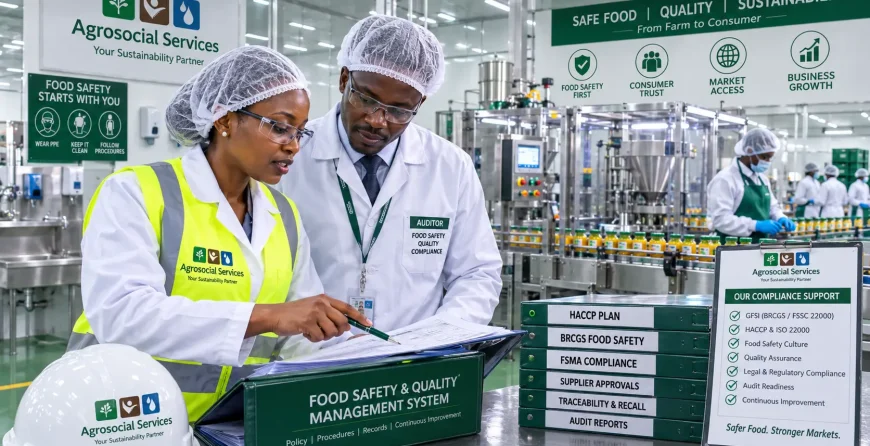
FSSC 22000 Certification in Kenya: What It Is and Why It Beats Plain ISO 22000
FSSC 22000 (Food Safety System Certification 22000) is a food safety certification scheme owned by the Foundation for Food Safety Certification, built on ISO 22000 plus sector-specific prerequisite programs and additional requirements, and recognised by the Global Food Safety Initiative (GFSI) — a recognition plain ISO 22000 does not carry. That single distinction — GFSI recognition — is why large international retailers and buyers ask for FSSC 22000 by name, and why it sits one rung above ISO 22000 on the food-safety certification ladder we introduced in our HACCP guide.
This article is the direct follow-on to HACCP Certification in Kenya — read that first if you’re starting from the beginning of the food-safety journey. This guide covers what FSSC 22000 actually requires, what changed with the May 2026 Version 7 release, and whether it’s the right next step for your business.
Agrosocial is an independent certification consultancy. We help processors and exporters prepare for FSSC 22000 and related food-safety audits — the certificate itself is issued by an FSSC-licensed certification body, not by us.
⚡ Key Facts — FSSC 22000
- 🏛️ Owned by the Foundation for Food Safety Certification, and GFSI-recognised — unlike plain ISO 22000.
- 🧩 Built from 3 elements: ISO 22000:2018, a sector-specific Pre-Requisite Program (ISO/TS 22002-x), and FSSC’s own Additional Requirements.
- 🆕 Version 7 released May 2026 — aligns with the revised ISO/TS 22002-1:2025 prerequisite program.
- 🔁 3-year certification cycle — annual surveillance audits, one unannounced audit per cycle, recertification every 3 years.
- 🌐 Covers manufacturing, packaging, animal feed, transport & storage, catering and retail — not just food factories.
Sources: Foundation FSSC official Scheme documents (Version 6 & 7); GFSI; BSI; NQA; TQCSI. Verified July 2026.
In This Guide
The Basics
What FSSC 22000 Is Built From
FSSC 22000 isn’t a single standard — it’s a Scheme that layers three things together:
- ISO 22000:2018 — the core Food Safety Management System standard, covering policy, planning, hazard control and continual improvement.
- A sector-specific Pre-Requisite Program (PRP) — drawn from the ISO/TS 22002-x series, matched to your part of the food chain: ISO/TS 22002-1 for manufacturing, 22002-4 for packaging, 22002-5 for transport and storage, 22002-6 for animal feed, and further addenda for catering.
- FSSC’s own Additional Requirements — covering Food Defense, Food Fraud Mitigation, Management of Allergens, Environmental Monitoring, Food Safety Culture, and (since Version 6) Food Loss & Waste, aligned to UN Sustainable Development Goal 12.3.
All three elements are mandatory — you can’t pick and choose. That’s deliberate: it’s what makes FSSC 22000 a complete, audit-ready package rather than a patchwork of separately-verified pieces.
The Decision That Matters Most
FSSC 22000 vs ISO 22000 vs HACCP
| Standard | GFSI recognised? | What it is |
|---|---|---|
| HACCP | No | A hazard-control methodology — the foundation everything else is built on |
| ISO 22000 | No | A full food safety management system standard incorporating HACCP principles |
| FSSC 22000 | Yes | ISO 22000 + sector PRPs + FSSC Additional Requirements — the complete, buyer-recognised package |
📌 Why GFSI recognition is the fact that actually matters. Many large retailers and international buyers won’t accept ISO 22000 alone as sufficient proof of food safety — they specifically require GFSI-recognised certification. FSSC 22000 has that recognition; ISO 22000 on its own does not. If your buyer requires “GFSI-benchmarked” or names FSSC 22000 specifically, plain ISO 22000 will not satisfy them.
📩 Free: know what auditors check before they arrive
Our free Top 25 Audit Fail Points guide covers the documentation gaps that quietly sink food-safety audits in Kenya — FSSC 22000 included. Instant to your inbox, no cost.
What’s Current
What’s New in Version 7 (May 2026)
FSSC 22000 Version 6 (April 2023) strengthened food safety culture requirements, introduced an unannounced-audit component, updated allergen management provisions, and earned formal GFSI recognition in August 2024. Version 7, released in May 2026, builds directly on that foundation rather than restructuring it — the main change is alignment with the revised ISO/TS 22002-1:2025 prerequisite program, along with updated language across the Additional Requirements.
The practical guidance: if you haven’t started certification yet, pursue Version 7 directly rather than certifying against the outgoing V6. If you already hold V6 certification, your certification body will guide you through the transition audit scope and deadline — you don’t need to restart from zero.
Is This You?
Who It’s For
FSSC 22000’s scope is wider than most people expect — it isn’t limited to food factories. It applies to manufacturers of food, beverages, ingredients, additives, and pet or animal food; food packaging producers; and businesses in storage, transportation, catering and retail. If your buyer is a large international retailer, a branded food company, or any organisation that specifically requires GFSI-benchmarked certification, FSSC 22000 — not plain ISO 22000 — is what they’re actually asking for.
Getting There
Getting Certified
1 · Build your FSMS against all three elements. ISO 22000 structure, your sector’s PRP, and the FSSC Additional Requirements — not just one of them.
2 · Consider a pre-assessment. Many FSSC-licensed certification bodies offer a gap-identification pre-assessment before the real audit — worth using if this is your first certification.
3 · Arrange the certification audit. An FSSC-licensed certification body audits your FSMS against the full Scheme.
4 · Get listed in the public register. Once certified, your organisation appears in Foundation FSSC’s public database — a verifiable trust signal buyers can check directly.
5 · Maintain it. Annual surveillance audits, one unannounced audit per 3-year cycle, and full recertification every 3 years.
A Realistic Entry Point
The SME Route: FSSC Development Program
If full FSSC 22000 feels like a big jump from where your operation stands today, Foundation FSSC runs a Development Program specifically for small and medium-sized food-chain businesses. It’s a structured stepping stone — helping smaller operations build a conforming food safety system that progresses them toward eventual GFSI-recognised FSSC 22000 certification, rather than requiring a first-time leap straight to the full Scheme.
For most Kenyan processors, the realistic sequence is: HACCP first, to build the hazard-control foundation, then FSSC 22000 (via the Development Program if you’re smaller) once you’re ready to sell to buyers who specifically require GFSI recognition.
📩 Free — Start Here
See exactly where your food-safety system falls short
Get the free Top 25 Audit Fail Points guide — the documentation gaps that sink certification audits in Kenya, FSSC 22000 included. Straight to your inbox, instant.
Ready To Get FSSC-Ready?
We prepare food processors and exporters for FSSC 22000, HACCP and ISO 22000 audits — gap assessment, documentation, and a costed path to your certificate. Start with a readiness assessment.
Exporting as well? The Agrosocial Starter Kit (KES 6,000) includes the export market guide (EU, UK, China & Middle East) and a funding proposal template to help finance certification and open buyer markets.
Trusted by 150+ farms and cooperatives across 12 counties since 2018 · We reply within 2 hours, Mon–Sat.
Quick Answers
Frequently Asked Questions
What is FSSC 22000?
FSSC 22000 (Food Safety System Certification 22000) is a certification scheme for food safety management systems, owned by the Foundation for Food Safety Certification. It combines the ISO 22000:2018 standard with sector-specific Pre-Requisite Programs (the ISO/TS 22002-x series) and additional Scheme requirements covering food defense, food fraud, allergen management and food safety culture.
Is FSSC 22000 the same as ISO 22000?
No. FSSC 22000 uses ISO 22000 as its foundation but adds sector-specific prerequisite programs and FSSC’s own additional requirements. The key difference: FSSC 22000 is GFSI-recognised; plain ISO 22000 certification is not. Most large international retailers require GFSI-recognised certification, which is why FSSC 22000 carries more commercial weight.
What changed with FSSC 22000 Version 7?
Version 7, released in May 2026, builds on Version 6 by aligning with the revised ISO/TS 22002-1:2025 prerequisite program and updating the Additional Requirements language. It extends V6’s core pillars (food safety culture, unannounced audits, updated allergen management) rather than restructuring the Scheme. New applicants should pursue V7 directly; V6 holders transition with their certification body’s guidance.
How often is FSSC 22000 certification audited?
FSSC 22000 runs on a three-year certification cycle. Certified organisations undergo annual surveillance audits, including one unannounced audit at some point within each three-year cycle, and a full recertification audit every three years.
Key Takeaways
- FSSC 22000 = ISO 22000 + sector PRP + FSSC Additional Requirements — a complete Scheme, not a single standard.
- GFSI recognition is the fact that actually matters commercially — ISO 22000 alone doesn’t have it.
- Version 7 (May 2026) is the current version to pursue if you’re not yet certified.
- Scope covers far more than factories — packaging, transport, storage, catering and retail all qualify.
- Smaller operations have a real stepping-stone route via the FSSC Development Program.
Related Guides & Resources
Food Safety
Certification
Work With Us
Last reviewed: July 2026 by Agrosocial Services. Requirements are drawn from Foundation FSSC’s official Scheme documents (Versions 6 and 7), GFSI, and certification-body guidance from BSI, NQA and TQCSI. Certification body requirements, costs and transition timelines vary and evolve — confirm current terms with a licensed certification body before making commercial decisions. Agrosocial Services is an independent certification-preparation consultancy; we are not a certification body.