
HACCP Certification in Kenya: What It Is and Why Exporters Need It
If you process, pack or handle food for sale — especially for export — HACCP is the certification your buyers assume you already have before they even ask about anything else. It is not the most demanding food-safety standard out there, but it is the foundation everything else is built on. This guide explains what HACCP actually requires, how it fits into Kenya’s food-safety regulatory picture through KEBS, and where it sits relative to the bigger standards (ISO 22000, FSSC 22000) that sit above it.
Agrosocial is an independent certification consultancy. We help food processors, packhouses and exporters prepare for HACCP and related food-safety audits — the certificate itself is issued by an accredited certification body, not by us.
⚡ Key Facts — HACCP
- 📋 HACCP stands for Hazard Analysis and Critical Control Points — built on 7 core principles from the Codex Alimentarius.
- 🇪🇺 Mandatory for EU market entry under Regulation (EC) No. 852/2004, and embedded in US federal food safety rules.
- 🇰🇪 In Kenya, overseen by KEBS (Kenya Bureau of Standards), which also runs GMP certification and the KS 2573 hygiene scheme.
- 🌍 EAC markets (Uganda, Tanzania, Rwanda, South Sudan) accept KEBS-certified products under mutual recognition — a lighter bar than EU/US.
- 🪜 The first rung of the food-safety ladder — ISO 22000 and FSSC 22000 build directly on top of it.
Sources: Kenya Bureau of Standards (KEBS); Codex Alimentarius CXC 1-1969; EU Regulation (EC) No. 852/2004. Verified July 2026.
In This Guide
📩 Free: Kenya Food Safety Certification Checklist 2026 — straight to your inbox
HACCP system requirements, KEBS GMP checklist, the 7 principles in audit-ready format, ISO 22000 transition requirements, and the Top 25 Audit Fail Points for Kenyan food processors. Free, instant delivery.
The Basics
What HACCP Actually Is
HACCP is a prevention-first system: instead of testing finished products and hoping for the best, it identifies exactly where things could go wrong across your process — a Critical Control Point — and puts a specific control in place at each one, before contamination happens. It applies to biological, chemical and physical hazards — bacteria, chemical residues, foreign objects — anywhere they could enter food during growing, handling, processing or packing.
It is built on the Codex Alimentarius General Principles of Food Hygiene (CXC 1-1969) — the internationally agreed baseline for food hygiene that most national and buyer-specific food-safety standards ultimately trace back to. That shared origin is exactly why HACCP is recognised so widely: it is not a proprietary scheme owned by one company or country, it is the common language food-safety systems around the world are built in.
The Technical Core
The 7 Core Principles
| # | Principle | In practice |
|---|---|---|
| 1 | Conduct a hazard analysis | Map every step of your process and identify where hazards could realistically occur. |
| 2 | Identify Critical Control Points | Pinpoint the specific steps where control is essential to prevent or eliminate a hazard. |
| 3 | Establish critical limits | Set measurable limits (temperature, time, pH) that must be met at each CCP. |
| 4 | Establish monitoring procedures | Define how and how often each CCP is checked to confirm it stays within limits. |
| 5 | Establish corrective actions | Decide in advance what happens the moment monitoring shows a CCP is out of control. |
| 6 | Establish verification procedures | Confirm, periodically, that the whole system is actually working as designed. |
| 7 | Establish record-keeping | Document everything — this is what an auditor actually reviews. |
📌 Principle 7 is where most Kenyan businesses actually fail audits. Not because the food-safety controls are not happening — but because they are not written down. An auditor cannot verify a control point exists unless there is a record proving it was checked, every time. This mirrors the single biggest failure pattern across every certification we cover on this site: documentation, not practice, is usually the gap.
Free Download
Know what auditors check before they arrive
Our free guide — the Top 25 Audit Fail Points in Kenya — covers exactly the record-keeping and documentation gaps that sink food-safety audits like HACCP.
Is This You?
Who Genuinely Needs This
- Food processors and manufacturers — anyone converting raw produce into a packaged or processed product.
- Exporters selling to the EU or US — where HACCP-aligned systems are effectively a market-entry requirement, not optional.
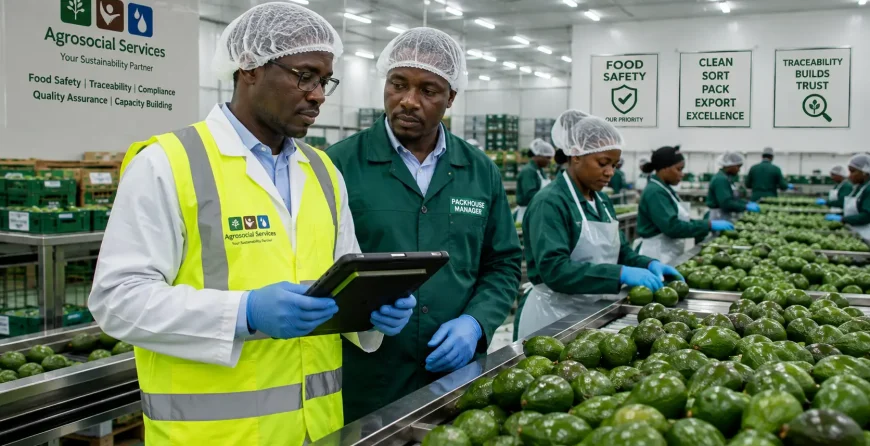
- Packhouses handling fresh produce for export, where hygiene and traceability through packing and cold chain matter as much as the field.
- Hotels, restaurants and catering businesses — KEBS explicitly includes these alongside processors and exporters.
If you are a smallholder farmer growing a single fresh crop for export with no processing step, HACCP is less directly relevant to you than certifications like GLOBALG.A.P. — but the moment produce is processed, packed, or value-added in any way, HACCP becomes the standard buyers expect to see.
The Local Picture
KEBS and the Kenyan Regulatory Picture
In Kenya, HACCP sits within a wider set of schemes run by the Kenya Bureau of Standards (KEBS). KEBS positions Good Manufacturing Practices (GMP) as the foundation layer — the basic hygiene and process controls that HACCP, and eventually ISO 22000, are built on top of. KEBS also runs a hygiene certification scheme for food establishments and restaurants (based on standard KS 2573), the Diamond Mark of Quality for locally manufactured products, and the Import Standardization Mark for imported goods.
Here is the market-access distinction worth understanding clearly: within the East African Community (Uganda, Tanzania, Rwanda, South Sudan), KEBS-certified products are accepted under mutual recognition agreements — a comparatively lighter regional bar. Selling to the EU or US is a different story: HACCP compliance is effectively non-negotiable there, and depending on the product, additional requirements like FDA registration or specific EU food safety compliance steps may also apply.
The Cost of Not Having HACCP — vs the Cost of Getting It Right
A Kenyan processor rejected at EU customs for no HACCP records: entire consignment destroyed at importer cost. Buyer relationship ended. KEBS investigation opened.
HACCP certification preparation: a fraction of that — and it only has to happen once.
EU Regulation (EC) No. 852/2004 requires all food business operators to put in place, implement and maintain a permanent procedure based on HACCP principles. There is no waiver for Kenyan exporters, no equivalence arrangement, and no grace period. A Kenyan packhouse or processor that cannot demonstrate an operating HACCP system to an EU buyer’s pre-qualification auditor will not receive a supply contract. A consignment that arrives at a European port without the food-safety documentation to back it up can be detained or destroyed. The cost of a single rejected consignment — warehouse charges, destruction costs, lost product value — typically exceeds the full cost of HACCP preparation and certification by a factor of five to ten. Agrosocial field observation and KEBS compliance data 2025/26.
The Bigger Picture
Where HACCP Sits on the Food-Safety Ladder
HACCP is a methodology for controlling hazards — it is not, on its own, a full management system. Two standards build directly on top of it:
- ISO 22000 — a broader food safety management system standard that incorporates HACCP’s hazard-control principles alongside wider management, communication and continuous-improvement requirements. KEBS provides accreditation support for ISO 22000 certification in Kenya.
- FSSC 22000 — builds further on ISO 22000 with additional sector-specific requirements, and carries GFSI (Global Food Safety Initiative) recognition — the level most valued by large international retailers and buyers. KEBS notes that operators already certified to ISO 22000 can transition to FSSC 22000 relatively smoothly.
For most Kenyan processors and exporters, HACCP is the right place to start — it is achievable, it is what buyers expect as a baseline, and everything you build for it (hazard analysis, monitoring records, corrective-action procedures) carries forward directly into ISO 22000 or FSSC 22000 if you pursue them later.
Getting There
Getting Certified — the Practical Process
1 · Map your process and run the hazard analysis. Walk every step from raw material to finished product, and identify realistic hazards at each one.
2 · Identify your Critical Control Points and set limits. Decide exactly where control is essential, and what measurable limit defines “in control.”
3 · Build your monitoring and record-keeping system. This is the part that actually gets audited — build it to be used daily, not assembled the week before an audit.
4 · Run the system for real, and verify it. Operate it through a genuine production cycle, and check it is actually catching what it is meant to catch.
5 · External audit and certification. An accredited certification body audits your system against the standard and issues certification if it passes.
Costs vary meaningfully by certification body, business size and audit scope, so rather than quote a generic figure here, the honest answer is to get a real quote from an accredited body — what we can help with is the preparation side, so you walk into that audit ready to pass the first time.
Agrosocial Services — Food Safety Certification Kenya
Ready to See Where Your Process Stands?
We help processors, packhouses and exporters build HACCP-ready systems and prepare for audit — before the auditor finds the gaps. Start with a readiness assessment to see exactly where you stand.
Quick Answers
Frequently Asked Questions
What is HACCP certification?
HACCP (Hazard Analysis and Critical Control Points) is a globally recognised food safety system that identifies, assesses and controls biological, chemical and physical hazards throughout food production and handling. It is built on the Codex Alimentarius General Principles of Food Hygiene (CXC 1-1969) and structured around seven core principles, from hazard analysis through to record-keeping.
Is HACCP certification required to export food from Kenya?
It depends on your market. HACCP is a mandatory requirement for food entering the EU under Regulation (EC) No. 852/2004, and is embedded in US federal food safety regulation — so it is effectively required for those markets. For the East African Community, KEBS-certified products are accepted under mutual recognition agreements — a lighter regional bar than EU or US requirements.
Who regulates HACCP in Kenya?
The Kenya Bureau of Standards (KEBS) recognises and oversees HACCP alongside its own certification schemes, including Good Manufacturing Practices (GMP) and hygiene certification for food establishments under KS 2573. KEBS positions GMP as the foundational layer that businesses build HACCP, and eventually ISO 22000, on top of.
What is the difference between HACCP, ISO 22000 and FSSC 22000?
HACCP is a hazard-control methodology, not a full management system. ISO 22000 is a broader food safety management system that incorporates HACCP principles alongside management and communication requirements. FSSC 22000 builds further on ISO 22000 with sector-specific requirements and carries GFSI recognition — the standard most valued by large international retailers. Everything you build for HACCP carries forward directly into ISO 22000 or FSSC 22000 if you pursue them later.
Key Takeaways — HACCP Certification Kenya
- HACCP is a prevention-first hazard-control system built on 7 core Codex Alimentarius principles.
- Effectively mandatory for EU and US export; the EAC region accepts KEBS certification under a lighter mutual-recognition bar.
- Record-keeping (Principle 7) is where most audits are actually won or lost — not the underlying practice.
- Overseen by KEBS in Kenya, alongside GMP and hygiene (KS 2573) schemes.
- The cost of a single rejected EU consignment typically exceeds the full cost of HACCP certification preparation by a factor of five to ten.
- It is the first rung — ISO 22000 and FSSC 22000 build directly on the same foundation, and everything you build for HACCP carries forward.
Ready to Build Your HACCP System and Pass First Time?
Get the free audit guide to see the 25 fail points, book a readiness assessment, or download the Farm Audit Checklist to start your gap assessment.
Contact Agrosocial Services — HACCP & Food Safety Certification Kenya
For HACCP system design, GMP compliance preparation, ISO 22000 or FSSC 22000 readiness assessment, or food safety audit preparation — we respond within 24 hours Mon–Sat. Email: info@agrosocialservices.co.ke
HACCP Certification Kenya — Related Guides & Resources
Agrosocial Services Limited — Food Safety Certification Kenya
Kenya Agricultural Certification & Export Market Consultancy — Established 2018
Agrosocial Services Limited prepares Kenyan food processors, packhouses and exporters for HACCP, ISO 22000, and FSSC 22000 certification. We are an independent certification consultancy; we do not issue food-safety certificates. Requirements in this guide are drawn from the Kenya Bureau of Standards (KEBS), the Codex Alimentarius General Principles of Food Hygiene (CXC 1-1969), and EU Regulation (EC) No. 852/2004. Specific certification body requirements and costs vary — confirm current terms before making commercial decisions. Last reviewed: July 2026.
📧 info@agrosocialservices.co.ke · 📲 WhatsApp +254 713 935 361 · 📅 Last reviewed: July 2026
Food safety services:
✅ HACCP system design & implementation
✅ GMP compliance preparation
✅ ISO 22000 readiness assessment
✅ FSSC 22000 preparation
✅ Packhouse & processor audit prep
✅ Food safety record-keeping systems
✅ 24hr response · 94% first-attempt pass rate