
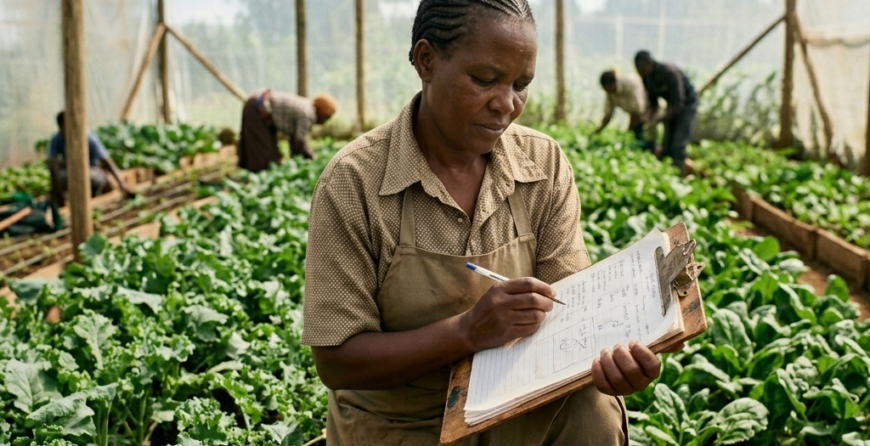
Farm Record Keeping for GLOBALG.A.P Certification in Kenya 2026 — What Records You Must Have
📋 Topic: Farm Records | ✅ Standard: GLOBALG.A.P IFA v6 | 🇰🇪 Applies to: All Certified Kenyan Farms | 🗓 Updated: May 2026 | ⏱ Read time: 15 minutes
In This Guide
- Key Facts — What Auditors Check First
- Why Records Are the Foundation
- Field Codes — The System That Links Everything
- Record 1: Pesticide Application
- Record 2: Fertiliser and Soil Amendments
- Record 3: Harvest Records and Lot Numbers
- Record 4: Worker Training and Attendance
- Record 5: Water Quality Testing
- Record 6: Equipment Calibration
- Record 7: Site History and Risk Assessment
- The 15-Minute Mock Recall Test
- How Auditors Detect Retrospective Records
- Setting Up Your Record System
- Group Certification — Records for Every Member
- Frequently Asked Questions
⚡ Key Facts — What Auditors Check Before They Walk Your Farm
- Records are reviewed before the farm walk begins. Certification body auditors spend 30–60 minutes reviewing your records file before visiting any field. Incomplete or retrospective records found at this stage set a negative tone that the farm walk rarely recovers from.
- 7 record categories are required — pesticide application, fertiliser, harvest and lot numbers, worker training, water quality tests, equipment calibration, and site history. Missing any category is a Major Must non-conformance.
- Under IFA v6, a Water Risk Assessment is now required alongside lab results. A folder of water test certificates alone is no longer sufficient — see Record 5 below.
- Records must be contemporaneous — completed at the time of the activity, not reconstructed before the audit. Auditors are trained to detect retrospective records and treat them as deliberate misrepresentation.
- The 15-minute mock recall test requires tracing any produce lot from buyer invoice back to the specific field, spray records, and water tests within 15 minutes. A broken traceability chain is a Critical non-conformance.
- Minimum retention period: 2 years. Keep pesticide and traceability records for 5 years.
In every GLOBALG.A.P certification audit on a Kenyan farm, there is a moment that determines the outcome before the auditor has walked a single field. It is the moment the auditor opens the farm records file. What they find in that file — complete, dated, legible records filled in at the time of every farm activity — tells them everything about how seriously the farm manages its compliance obligations throughout the year. A well-maintained records file builds auditor confidence that carries through the entire inspection. A records file with gaps, inconsistencies, or obvious retrospective entries undermines the auditor’s confidence in everything they observe on the farm walk.
This guide covers every record category that GLOBALG.A.P IFA v6 requires Kenyan farms to maintain — what to record, when to record it, how long to keep it, and how auditors verify it. It also explains the most common record-keeping failures on Kenyan farms and exactly how to avoid them. Whether you are preparing for your first GLOBALG.A.P audit, managing records for a cooperative of 50 member farmers, or troubleshooting non-conformances from a previous audit cycle, this guide gives you the complete 2026 standard.
📩 Get our free Farm Record Keeping Checklist — delivered instantly
A one-page printable summary of all 7 GLOBALG.A.P record categories with the exact fields required for each. Free, instant delivery. Used by over 150 Kenyan certified farms.
💬 Or request instantly via WhatsApp → | visit Free Resources page →
The Most Expensive Farm Record Mistake
The most common reason Kenyan farms fail GLOBALG.A.P audits is not
non-compliant farming practices. It is records that are missing,
incomplete, or completed after the fact.
A failed audit costs KES 45,000–100,000 in re-audit fees plus the cost of the corrective action period — and delays your first export shipment by 2–4 months. Complete, contemporaneous records cost nothing extra to maintain once the system is set up correctly.
Why Records Are the Foundation of Your Certification — Not the Paperwork Burden
Many Kenyan farmers approach GLOBALG.A.P farm records as a compliance burden — something to be filled in because the auditor requires it. This framing leads to poor record-keeping habits and eventually to audit failures. The more accurate framing is that farm records are the evidence base that proves your farm is managed the way you say it is — and they are the foundation of the traceability chain that allows buyers to verify the safety of your produce at any point in the supply chain.
Under GLOBALG.A.P IFA v6, the shift from prescriptive CPCCs to outcome-based Principles and Criteria means that records carry more evidential weight than they did under v5. Where v5 required specific actions, v6 requires demonstrated outcomes — and farm records are the primary way you demonstrate outcomes. An auditor who cannot verify that your Water Risk Assessment actually informed your water management decisions, or that your IPM plan actually changed your spray decision-making, will find non-conformances regardless of how well your farm is managed in practice. Records make the invisible visible.
This is not the same as saying your farm will pass if the records look good but the practices are poor. Auditors combine record review with farm walks, worker interviews, and physical observations. But records are the starting point — and gaps in records create non-conformances even where the farming practice is compliant.
📖 Also read: For the full list of what GLOBALG.A.P auditors assess during a Kenyan farm inspection — beyond records — see our guide on 7 farm audit mistakes that cost Kenyan farms their certification. Records failures account for 3 of the 7 most common audit failures.
Field Codes — The System That Links Every Record Together
Before setting up any individual record category, establish your field code system. This is the single most important structural decision in your record system — because field codes are the thread that links every record type together into a traceable chain.
A field code is a unique identifier assigned to each distinct production area on your farm. It can be as simple as F1, F2, F3 or Block A, Block B, Block C — or it can include crop information (AV1 for avocado field 1, FB1 for French bean field 1). The specific format does not matter. What matters is that the same code is used consistently in every record type throughout the certification year.
⚠️ The Field Code Inconsistency That Breaks Traceability
The most common traceability failure on Kenyan farms during GLOBALG.A.P audits: a field is called “Block A” in spray records, “North Field” in harvest records, and “the avocado section” in fertiliser records — and none of these identifiers appear on the produce lot label. When the auditor attempts the mock recall test, they cannot link the packed lot to a specific spray record. This is a Critical non-conformance. Standardise your field codes across every record type from Day 1 and never deviate.
How to set up your field code system:
- Walk every field on your farm and identify distinct production areas — different crops, different irrigation sources, or different management zones.
- Assign a simple unique code to each area. Write it on the field post or boundary marker.
- Draw a simple farm map showing all field boundaries with their codes. This map does not need to be to scale — a clear hand-drawn sketch is acceptable.
- Use the field code on every record form for that field — pesticide, fertiliser, harvest, and traceability labels.
- For cooperatives: each member farmer uses their own field codes (F1, F2, etc.) but the cooperative’s traceability system links the field code to the specific member farmer’s GGN number and lot number.
Record 1 — Pesticide Application Records
Pesticide application records are the most scrutinised records in any GLOBALG.A.P audit — because they are the primary evidence of MRL compliance and the basis for the pre-harvest interval verification that protects buyers from residue violations at destination markets.
What every pesticide application record must contain
| Field Required | What to Record | Why Auditors Check This |
|---|---|---|
| Product name | Commercial product name exactly as it appears on the label | Cross-checked against PCPB registered products list |
| PCPB registration number | The PCPB number from the product label (e.g. PCPB/CR/000123) | Verifies product is legally registered in Kenya for this crop |
| Active ingredient | Chemical name of active ingredient(s) from the product label | Cross-checked against approved pesticides list and MRL limits for target market |
| Target pest or disease | Specific pest or disease being controlled | Verifies spray decision was need-based, not calendar-based (IFA v6 IPM requirement) |
| Field code | Specific field identifier (e.g. F1, Block A) where product was applied | Links spray record to harvest record and produce lot for mock recall |
| Date of application | Day/month/year of the actual application event | PHI calculation — days from spray to harvest must exceed the stated PHI |
| Application rate | Dosage per hectare or per litre of water as per label recommendation | Verifies label rate compliance — over-application increases MRL risk |
| Total quantity used | Total amount of product used (litres or kg) for this application event | Cross-checked against stock records to verify quantities are plausible |
| Operator name and signature | Name of the person who applied the product and their signature | Confirms a trained operator applied the product — cross-checked with training records |
| Pre-harvest interval (PHI) | Days stated on label and actual days elapsed before harvest | Must confirm harvest did not occur before PHI expired — zero tolerance |
| Equipment used | Knapsack sprayer, tractor sprayer, drone — with equipment ID or serial number | Linked to equipment calibration records to verify spray volumes were accurate |
🔍 Auditor Tip — The Approved Pesticides List
Under IFA v6, every GLOBALG.A.P certified farm must maintain a written Approved Pesticides List — a documented list of all products approved for use on your farm that have been verified as PCPB-registered, crop-specific, and compliant with the MRL limits of your target export market. Any product appearing in your pesticide application records that is not on your Approved Pesticides List is a Major Must non-conformance. Create your Approved Pesticides List during the preparation phase and review it annually as PCPB registrations and MRL standards are updated.
Record 2 — Fertiliser and Soil Amendment Records
Fertiliser records serve two purposes under GLOBALG.A.P: they demonstrate that fertiliser applications are based on documented soil analysis rather than habitual or calendar-based application, and they provide evidence that nitrogen application rates are managed to reduce leaching risk into water sources.
What fertiliser records must contain
- Product name and nutrient content (N-P-K percentages from label)
- Date of application
- Field code — same code as in pesticide and harvest records
- Application rate (kg per hectare or total quantity applied)
- Application method (broadcast, side-dressing, foliar, fertigation)
- Basis for application — reference to soil test results or nutrient management plan that justified this application
- Operator name
The soil test requirement: Under IFA v6, fertiliser applications must be based on documented soil analysis results. This does not require a soil test for every application — one comprehensive soil test per field per season, with a documented nutrient management plan derived from the results, satisfies the requirement. Soil tests should be conducted at a KEBS-accredited laboratory. Cost: KES 3,000–6,000 per composite sample. For farms applying organic manures, records must additionally confirm the manure source, any composting process used, and the application-to-harvest interval to manage pathogen contamination risk.
Record 3 — Harvest Records and Lot Numbers
Harvest records are the bridge between your on-farm compliance records and the commercial supply chain. They are the link that makes the 15-minute mock recall test possible. Every harvest event — from every field, on every date — must be recorded with a unique lot number that travels with the produce from your farm to the buyer’s receiving dock.
What harvest records must contain
- Field code — the specific field or fields harvested
- Harvest date — day/month/year
- Crop variety — e.g. Hass avocado, Kent mango, Amy fine bean
- Quantity harvested — in kilograms or number of units
- Harvest crew or operator — names of workers who harvested
- Lot number — a unique identifier assigned to this specific harvest event
- Post-harvest destination — packhouse name, cooling facility, or buyer name
- Quality observations at harvest — any visual defects, pest damage, or quality concerns observed at picking
The lot number system: The lot number assigned at harvest must appear on the packed produce label, in the packhouse receiving record, in the export documentation, and in the buyer invoice. It is the thread that connects every link in the supply chain. A simple sequential lot number system (LOT-001-2026, LOT-002-2026, etc.) works well for most Kenyan farms. More sophisticated farms encode the field code and harvest date in the lot number (F1-2026-0315 = Field 1, harvested 15 March 2026) — making the mock recall instant.
📖 Also read: For cooperative-level traceability systems — where produce from multiple member farms is combined at a collection point before going to the packhouse — see our GLOBALG.A.P group certification guide for Kenyan cooperatives which covers the full cooperative traceability system requirements including how to maintain lot separation from member farm to export.
Record 4 — Worker Training and Attendance Records
Under IFA v6, worker training records must demonstrate outcomes — not just attendance. This is one of the most significant changes from IFA v5, where a signed attendance sheet was often sufficient. IFA v6 auditors will conduct private worker interviews to verify that workers actually know and apply what their training records say they were taught. If workers cannot demonstrate basic knowledge of pesticide safety, PPE use, or food hygiene during private interviews, training records that show they attended these sessions become evidence of a dysfunctional training system rather than proof of compliance.
What worker training records must contain
- Date of training
- Trainer name and qualification — who conducted the training and their relevant knowledge or certification
- Training topics covered — specific topics, not “general training.” E.g. “Correct PPE donning/doffing procedure for spray operators” not “PPE training”
- Attendee names and signatures — every worker who attended must sign with their own name, not initials
- Assessment or knowledge check results — IFA v6 recommends a brief verbal or written check after training to verify understanding. Record the outcome.
Required training topics under IFA v6: pesticide safety and handling, correct PPE use for spray operations, first aid basics and location of first aid equipment, food hygiene (particularly for harvest and packhouse workers), environmental protection (buffer zones, chemical store protocols), and basic record-keeping. Workers involved in water source management additionally need training on water quality management. Under IFA v6, training records must be updated annually — not as a one-time event at certification preparation time.
Record 5 — Water Quality Testing Records
Water quality compliance under IFA v6 now requires two separate documents — not just laboratory test results. Both are mandatory.
Document A — Water Risk Assessment
A written document identifying every water source used on your farm for irrigation and post-harvest washing, assessing the risk of contamination from upstream sources (livestock, human settlements, other farms, industrial activity), documenting what management actions you take to control contamination risk, and linking the risk assessment conclusions to your testing frequency decisions. This does not require an external environmental consultant — a documented assessment written by the farm manager, identifying sources and risks and signed and dated, satisfies the requirement.
Document B — Laboratory Test Results
Laboratory test certificates from a KEBS-accredited laboratory covering E. coli (Escherichia coli) and total coliforms for every water source used. The acceptable limits are:
| Irrigation Method | E. coli Limit | Testing Frequency | Failed Test Action |
|---|---|---|---|
| Overhead / sprinkler irrigation | < 200 CFU/100ml | Minimum annually. Quarterly for high-risk sources. | Suspend use of water source. Implement corrective action. Retest before resuming. |
| Drip / furrow / surface irrigation | < 1,000 CFU/100ml | Minimum annually. More frequently for open dam sources. | Implement corrective action. Do not irrigate within the PHI period before harvest. |
| Post-harvest washing water | < 200 CFU/100ml | Each harvest season minimum. | Switch to alternative water source or treat water before use. |
Practical tip for Kenyan farms: Commission water testing at the very beginning of your certification preparation — not two weeks before the audit. Laboratory processing typically takes 3–4 weeks, and a failed test result requires corrective action and retesting before the audit can proceed. Farms that wait until the last minute for water testing regularly delay their entire certification timeline.
Record 6 — Equipment Maintenance and Calibration Records
Spray equipment calibration is the record that directly supports your pesticide application records. If your sprayer delivers more or less volume per hectare than assumed when calculating the application rate on your pesticide record, your actual application rate may differ significantly from what is recorded. An uncalibrated sprayer can result in over-application leading to MRL violations, or under-application failing to achieve the intended pest control.
What calibration records must contain
- Equipment identifier — knapsack serial number, tractor sprayer registration, or equipment description
- Calibration date
- Calibration method used — catch and measure, distance/volume calculation
- Calibration result — litres per hectare delivered at operating pressure
- Operator who conducted calibration
- Any adjustments made — nozzle replacement, pressure setting change
- Next calibration date
Frequency: Calibrate all spray equipment at the beginning of each spray season and after any nozzle replacement or equipment repair. Document every calibration event. Additionally, maintain a simple maintenance log for all equipment showing cleaning dates, repairs, and parts replaced — particularly relevant for equipment used in pesticide application where contamination between uses is a compliance risk.
Record 7 — Site History and Risk Assessment
The site history and risk assessment is a one-time document (updated annually) that provides context for your farm’s compliance management — and is increasingly important under IFA v6’s outcome-based approach.
What site history and risk assessment documents must cover
- Land use history — previous crops grown on each field for the last 3–5 years, any previous non-agricultural use (e.g. industrial, waste disposal), and any contamination events.
- Soil contamination risk — assessment of whether previous land use creates any soil contamination risk (e.g. previous use of persistent organochlorine pesticides, proximity to former industrial sites).
- Adjacent land use risk — what is on the land bordering your farm and what contamination risk does it create (neighbouring farms spraying, roads, livestock operations, settlements).
- Biodiversity Action Plan (BAP) — under IFA v6 this is now a separate requirement: identify key habitats on or adjacent to your farm (forest patches, water bodies, hedgerows) and document conservation actions.
- Environmental risk assessment — documented assessment of risks from flooding, erosion, or pollution events and what mitigation measures are in place.
The 15-Minute Mock Recall Test — How to Pass It Every Time
The mock recall is the most visible test of your farm’s traceability system during a GLOBALG.A.P audit. The auditor selects a packed lot — either from your records or from a sample in your cold room — and asks you to trace it from the packed box back to the specific field where it was grown, the spray records for that field on the harvest date, the water test results for the field’s irrigation source, and the soil management records for that field. All of this must be completed within 15 minutes.
The chain that must be unbroken:
→
Lot Number
→
Harvest Record
→
Field Code
→
Spray Records (that field)
→
Water Test (that field’s source)
→
Soil Records
How to ensure your farm passes the mock recall test:
- Use consistent field codes across every record type — the same identifier in spray records, harvest records, and on the produce lot label.
- Assign a unique lot number to every harvest event and write it on both the harvest record and every packed box label from that harvest.
- Organise your records file by field code — so all records for Field F1 (spray, harvest, water, soil) are together and immediately findable.
- Practice the mock recall before your audit. Take a recent packed box lot number and time yourself tracing it back through your records. If it takes more than 10 minutes, your system needs reorganisation before audit day.
How Auditors Detect Retrospective Records — and Why It Is Career-Ending for Your Certification
Retrospective record completion — filling in records before an audit that should have been completed throughout the year — is the single most common integrity failure in GLOBALG.A.P certification programmes in Kenya. It is also the most detectable. Experienced certification body auditors have developed a highly accurate toolkit for identifying retrospective records.
How auditors detect retrospective records
1. Handwriting pattern analysis
Records completed at the time of each activity over weeks and months show natural variation in handwriting — different pens, different pressure, different fatigue levels. Records completed in a single session show consistent pen type, ink colour, pressure, and handwriting angle across dozens of entries spanning months. This uniformity is unnatural and immediately suspicious.
2. Stock reconciliation
Auditors compare the total quantities of pesticide recorded as applied against purchase receipts and current stock levels. A farm that records 12 applications of a product over the season must have purchased enough product to cover those applications. If stock records show only 2 purchase events and the remaining product is implausibly still in store, the application records are questioned.
3. Date logic cross-checks
Spray records that show applications on public holidays, during documented dry spells or heavy rainfall periods (from KCAA or KMD weather records), or on dates that conflict with the harvest records for the same field are red flags. Auditors access historical weather data and cross-reference it against spray dates.
4. Worker interview cross-checks
Auditors privately interview workers and ask them to describe how records are kept on the farm — when records are filled in, who fills them in, and what records they personally complete. Workers who have been filling in records contemporaneously can answer these questions specifically and confidently. Workers whose records were completed for them by a manager shortly before the audit give vague, inconsistent answers.
⚠️ The Consequence of Detected Retrospective Records
When a certification body auditor determines that records were completed retrospectively, the consequence is immediate certification suspension or refusal — regardless of how compliant the farm is in practice. The certification body is required to report the finding to GLOBALG.A.P central. The farm is typically barred from re-applying for certification for 12 months. The buyer relationship is terminated immediately. There is no corrective action period for deliberate record falsification. The only protection is genuine, contemporaneous record-keeping throughout the certification year.
Setting Up Your Record System — The 6-Step Process
The following sequence is the most efficient way to set up a complete, audit-ready GLOBALG.A.P farm record system from scratch. Begin on Day 1 of your certification preparation — not one month before the audit.
Step 1 — Map and code all fields (Day 1)
Walk every field, assign codes, draw the farm map. This takes half a day for most Kenyan smallholder farms. Do it before setting up any other record. Every other record type uses these field codes.
Step 2 — Set up pesticide records and begin filling immediately (Day 1)
Use a pre-designed pesticide record template with all required fields. Begin filling in the record for every spray application from this day forward. Do not record previous applications retrospectively — start from today and build your record from here.
Step 3 — Commission water testing (Week 1)
Collect water samples from all irrigation and post-harvest washing sources and submit to a KEBS-accredited laboratory. Allow 3–4 weeks for results. Simultaneously write your Water Risk Assessment document. This step has the longest lead time — begin immediately.
Step 4 — Set up harvest records and lot number system (before first harvest)
Design your lot number format, create harvest record templates, and print produce lot labels with the lot number format. Brief all harvest workers on how to record harvest events. Test the lot number system with one harvest before the certification audit.
Step 5 — Conduct first formal worker training session and document it (Month 1)
Schedule a formal training session covering all required topics. Use the training record template, capture every worker’s signature, and conduct a brief knowledge check at the end. Keep the signed record in the farm file.
Step 6 — Organise your farm file and practice the mock recall (Month 2)
Organise all records into a clearly labelled farm file with sections for each record category. Take a recent lot number and practice the full mock recall trace — from packed box to field to spray record to water test to soil record. Time it. If it takes more than 10 minutes, reorganise the file. Practice again.
📋 Get the Ready-Made Record Templates — Don’t Build From Scratch
Our Farm Records Starter Pack contains pre-designed, fill-in-the-blank templates for all 7 GLOBALG.A.P record categories — pesticide application, fertiliser, harvest and lot numbers, worker training, water testing log, equipment calibration, and site history. Optimised for Kenyan farming conditions, aligned to IFA v6 requirements, and designed to be printable and usable by farmers with limited formal education. Instant download, M-Pesa accepted.
Download Farm Records Starter Pack — KES 500 →
Farm Audit Checklist (IFA v6) — KES 3,500
Group Certification — Records for Every Member Farmer
Under GLOBALG.A.P group certification (Option 2), every member farmer must maintain their own individual farm records for their own fields. The producer organisation’s Quality Management System provides standardised templates and verifies that all member records are maintained correctly through the internal inspection programme — but the records themselves are the individual farmer’s responsibility.
What this means for cooperative managers:
- Distribute standardised record templates to all member farmers at the beginning of each certification year. Use the same templates across all members — consistency makes internal inspection and external audit review faster and more effective.
- Conduct quarterly record checks as part of your internal inspection programme — do not wait until the annual internal inspection to discover that a member farmer’s records are incomplete.
- Provide dedicated record-keeping training for member farmers at the start of each season — particularly for new members and for farmers with limited formal education.
- The internal inspector’s records review is the quality control layer between member farms and the certification body’s external audit. An internal inspector who finds complete records across all members during the annual inspection signals to the certification body auditor that the QMS is functioning as intended.
The Farm Records Starter Pack was specifically designed for distribution to cooperative member farmers — simple, standardised templates that satisfy GLOBALG.A.P IFA v6 requirements without requiring farmers to design their own record formats. At $5 for the full set of 7 templates, it is cost-effective for cooperative-wide distribution. See our complete group certification guide for the full QMS requirements surrounding member farm record management.
📖 Also read: Thinking about the full cost of getting your farm or cooperative GLOBALG.A.P certified — including preparation, audit fees, and laboratory testing? See our GLOBALG.A.P certification cost guide for Kenya. For budget planning and funding options, see our certification budget planning guide for Kenya 2026.
Frequently Asked Questions
What farm records are required for GLOBALG.A.P certification in Kenya?
GLOBALG.A.P certified Kenyan farms must maintain records across 7 categories: (1) pesticide application records — product, PCPB number, active ingredient, target pest, field code, date, rate, operator, and PHI; (2) fertiliser and soil amendment records; (3) harvest records linked to lot numbers; (4) worker training and attendance records with signatures; (5) water quality laboratory test results and Water Risk Assessment; (6) equipment calibration and maintenance records; (7) site history and risk assessment. All records must be completed at the time of the activity. The cheapest way to set up all 7 is our Farm Records Starter Pack — KES 500.
How long must GLOBALG.A.P farm records be kept in Kenya?
GLOBALG.A.P requires a minimum 2-year retention period for all farm records from the date of the activity. Pesticide application records and traceability records should be retained for 5 years to support potential buyer audit requests and KEPHIS investigations. Records must be stored on the farm or at the cooperative office in a location accessible during an unannounced audit.
Can GLOBALG.A.P auditors detect retrospective farm records?
Yes — reliably. Auditors use handwriting pattern analysis (uniform pen and pressure across months of records is unnatural), stock reconciliation (total product quantities recorded against purchase receipts), date logic checks (cross-referencing spray dates with weather data), and private worker interviews asking how records are kept. Detected retrospective records result in immediate certification suspension or refusal and a 12-month ban from re-applying. There is no corrective action period for deliberate record falsification.
What is a farm field code and why does GLOBALG.A.P require it?
A field code is a unique identifier (e.g. F1, Block A) assigned to each distinct production area on your farm. GLOBALG.A.P requires consistent field codes across all record types because the traceability system must link any packed lot back to the specific field’s spray records, water test results, and harvest records. Without consistent field codes, the traceability chain breaks — a Critical non-conformance. The same field code must appear in pesticide records, fertiliser records, harvest records, and on the produce lot label.
What water records are required under GLOBALG.A.P IFA v6 in Kenya?
IFA v6 requires two documents: (1) A Water Risk Assessment identifying all water sources, upstream contamination risks, and management actions; (2) Laboratory test results from a KEBS-accredited laboratory for E. coli and total coliforms — limits are <200 CFU/100ml for overhead irrigation and <1,000 CFU/100ml for drip or furrow irrigation. Laboratory results alone — without the Water Risk Assessment — are a non-conformance under IFA v6. Commission water testing at the very beginning of preparation as results take 3–4 weeks.
Do smallholder farmers in a GLOBALG.A.P group certification need their own farm records?
Yes. Every member farmer in a group certification must maintain their own individual farm records for their own fields. The cooperative’s QMS provides standardised templates and verifies records through internal inspections, but the records themselves are the individual farmer’s responsibility. Member farmers sampled by the certification body’s external auditor who cannot show complete, current records will cause the entire group to fail — regardless of how good the records are for other members. See our group certification guide for the full QMS requirements.
What is the 15-minute mock recall test in GLOBALG.A.P?
The mock recall test requires a farm to trace any packed produce lot from the buyer invoice back to the specific field, harvest date, spray records, water test results, and soil management records within 15 minutes. The test is passed by: using consistent field codes across all records, linking lot numbers in harvest records to the same lot numbers on produce labels, and organising your records file so all records for each field are findable in under 2 minutes. Practice the test before your audit using a recent lot number — if it takes more than 10 minutes, reorganise your file.
What is the cheapest way to set up a GLOBALG.A.P farm record system in Kenya?
The most cost-effective approach is to use pre-designed IFA v6-aligned templates rather than building your own from scratch. Our Farm Records Starter Pack (KES 500) includes fill-in-the-blank templates for all 7 required record categories, designed for Kenyan farming conditions and printable on standard A4 paper. For cooperative-wide distribution, the pack is economical enough to print for every member farmer. For auditor-ready compliance across the full 200+ GLOBALG.A.P checklist items, combine with our Kenya Farm Audit Checklist (KES 3,500).
Key Takeaways — Share With Your Farm Manager or Cooperative Internal Inspector
- 7 record categories are mandatory under GLOBALG.A.P IFA v6 — missing any category is a Major Must non-conformance.
- Records must be contemporaneous — completed at the time of the activity, not before the audit. Auditors detect retrospective records reliably and treat them as deliberate falsification.
- Field codes are the foundation of your entire traceability system. Standardise them across every record type from Day 1.
- IFA v6 adds a Water Risk Assessment requirement alongside laboratory test results. Lab results alone are no longer sufficient.
- The 15-minute mock recall test requires unbroken linkage from packed box → lot number → harvest record → field code → spray records → water tests → soil records. Practice it before your audit.
- Group certification requires individual records from every member farmer. The cooperative’s QMS manages the system — but every farmer maintains their own records on their own farm.
- The Farm Records Starter Pack (KES 500) gives you ready-made IFA v6-aligned templates for all 7 categories. The Kenya Farm Audit Checklist (KES 3,500) gives you the complete 200+ item auditor checklist to verify you are ready.
Need Help Setting Up Your Farm Record System?
Our consultants set up complete, audit-ready GLOBALG.A.P record systems for Kenyan farms and cooperatives across Kiambu, Meru, Nakuru, Embu, Machakos, and Kisii. We respond within 2 hours, Mon–Sat.
Related Resources from Agrosocial Services
Certification guides: GLOBALG.A.P Certification Kenya · IFA v6 Transition Guide · Group Certification for Cooperatives · Certification Cost Guide Kenya
Audit and compliance: 7 Audit Mistakes to Avoid · MRL Compliance Guide · How to Pass a Farm Audit in Kenya · Certification Budget Planning 2026
Crop export guides: Avocado Export Kenya · French Bean Export Kenya · Mango Export Kenya · Passion Fruit Export Kenya
County consultants: Nairobi · Kiambu · Nakuru · Meru · Machakos · Embu · Kisii
Agrosocial Services Limited is Kenya’s specialist agricultural certification and export market consultancy, serving farms, cooperatives, and agri-exporters across 12 counties since 2018. Our consultants have conducted hundreds of pre-audit farm record assessments across Kiambu, Embu, Meru, Nakuru, Machakos, and Kisii counties. For farm record system setup support or pre-audit gap assessment, contact us at info@agrosocialservices.co.ke or WhatsApp +254 713 935 361. Last reviewed: May 2026.
Sources: GLOBALG.A.P official documentation — IFA v6 Principles and Criteria (globalgap.org); KEBS accredited laboratory directory; Agrosocial Services Limited pre-audit assessment records from 2018–2026 engagements with Kenyan farms and cooperatives. All record requirements verified from primary IFA v6 source documents as of May 2026.