
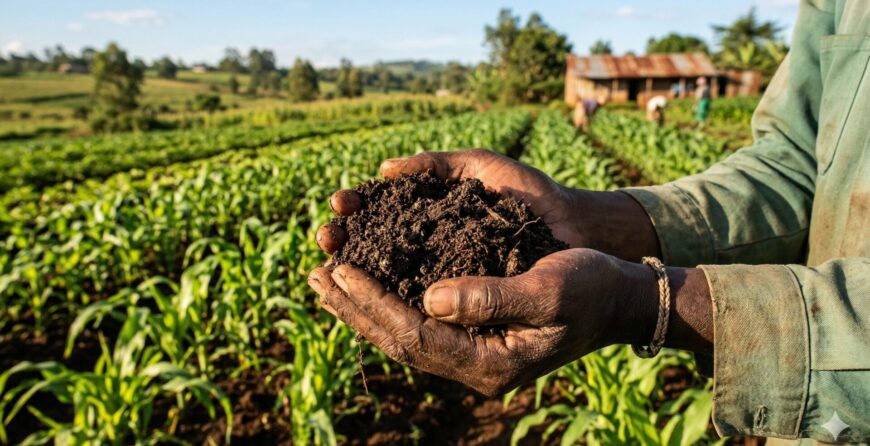
Sustainable Soil Management for Kenyan Smallholder Farmers — A Practical Guide 2026
🌱 Topic: Soil Health & Fertility | ✅ Standard: GLOBALG.A.P IFA v6 | 🇰🇪 Applies to: All Kenyan Export Farms | 🌍 Export: EU · UK · Middle East · Asia | 📖 Read time: 15 minutes | 📅 Last reviewed: May 2026
In This Guide
- Key Facts — Read This First
- GLOBALG.A.P IFA v6 Soil Requirements
- Kenyan Soil Types and Crop Suitability
- Step 1: Baseline Soil Testing
- Step 2: Soil pH Correction
- Step 3: Soil Fertility Planning
- Step 4: Building Organic Matter
- Step 5: On-Farm Composting
- Step 6: Erosion Control
- Step 7: Soil Amendment Records
- Step 8: Writing Your Soil Management Plan
- Approved Inputs and Prohibited Amendments
- Soil Health and Pesticide Residue Risk
- Crop-Specific Soil Priorities
- Frequently Asked Questions
⚡ Key Facts — Read This First
- Soil management is audited under IFA v6. Farms must have a written Soil Management Plan, contemporaneous soil amendment records (with agronomic justification), and a soil risk assessment. Missing any of these is a Minor Must non-conformance.
- Most Kenyan highland soils are acidic (pH 4.5–5.5) — below the optimal range for every major export crop. Lime application is the highest-return single investment for most Kenyan export farms.
- Sewage sludge is absolutely prohibited on GLOBALG.A.P certified farms. Raw uncomposted manure applied within 60 days of harvest is a food safety non-conformance.
- The agronomic basis field is the most frequently missing element in Kenyan fertiliser records under IFA v6. Every application record must state why that rate was applied at that time.
- Soil organic matter above 3% reduces pesticide residue carryover — making soil health part of your MRL compliance programme, not just your fertility programme.
- Tools: Farm Records Starter Pack ($5) includes soil amendment record templates and a soil management plan template, both formatted to IFA v6 requirements for Kenyan farms.
Soil health is the foundation on which every Kenyan export farm is built. It determines your yield potential, your fertiliser efficiency, your pesticide residue risk, and — directly — your GLOBALG.A.P IFA v6 compliance status. Under the current IFA v6 standard, Kenyan farms must maintain a written Soil Management Plan, contemporaneous soil amendment records with agronomic justification, and a documented soil risk assessment. These are not optional — they are audited control points that count toward your Minor Must compliance percentage.
But compliance documentation is the minimum. The farms that achieve sustained export competitiveness in Kenya — consistent produce quality, stable yields, lower input costs year on year — are the farms that treat soil management as a commercial investment, not a paperwork exercise. This guide gives you both: the GLOBALG.A.P compliance requirements and the practical agronomic steps that build the soil health those requirements are designed to protect.
All guidance in this article reflects direct experience with Kiambu, Meru, Nakuru, Embu, Machakos, and Kisii county farm systems — not generic agronomic textbook advice.
📩 Free: Farm Certification Readiness Guide — straight to your inbox
Covers all compliance requirements your farm needs before booking a GLOBALG.A.P audit — including soil management documentation. Used by 150+ Kenyan farms. Free, instant delivery.
The Compliance Gap Most Kenyan Farms Miss
Soil amendment records without an agronomic justification
column fail IFA v6 FV 5.2 — even if every other field is correct.
It is the most common Minor Must gap found on Kenyan farms.
Every fertiliser and lime application record must state why that rate was applied at that time. A soil test result, a crop requirement reference, or a documented crop symptom — without one of these, the record is incomplete under IFA v6. This guide shows you exactly how to structure your records to pass audit scrutiny.
GLOBALG.A.P IFA v6 Soil Compliance Requirements — What Auditors Check
IFA v6 introduced strengthened soil management requirements compared to v5, particularly around documentation of the agronomic basis for all soil amendment decisions. Farms that were compliant under v5 with informal fertiliser programmes are often non-compliant under v6 because the agronomic justification is missing from their records. Understanding which control points are assessed is the starting point for building a compliant soil management system.
| IFA v6 Control Point | Requirement | Classification | Common Kenya Failure |
|---|---|---|---|
| CB 1.2 — Soil Management Plan | Written soil management plan covering fertility, erosion, organic matter, and contamination risks. Reviewed annually. | Minor Must | No written plan exists; or plan exists but has never been updated |
| FV 5.1 — Soil Amendment Records | Contemporaneous records for every fertiliser and amendment application including product, rate, date, field code, and agronomic basis. | Minor Must | Records exist but lack agronomic justification column; or records are retrospective |
| FV 5.2 — Soil Test Basis | Fertiliser application rates must be based on demonstrable need — soil analysis, tissue test, visual symptoms, or published crop recommendation. Rate must not exceed crop requirement. | Minor Must | No soil test exists; fertiliser applied at habitual rates without documented justification |
| FV 5.3 — Organic Amendments | Organic amendments of animal origin must be composted or treated. Sewage sludge is prohibited. Pre-harvest interval observed and documented. | Minor Must | Raw manure applied without composting; no documentation of composting process or application date |
| CB 2.1 — Erosion Risk Assessment | Documented risk assessment of soil erosion risk across all production areas. Specific control measures implemented for each identified risk. | Recommended | Missing from site risk assessment entirely; or not specific to actual farm topography |
| ES 1.1 — Biodiversity & Soil (v6 new) | Biodiversity Action Plan must address soil health as part of the farm’s environmental sustainability commitments. | Minor Must (v6 new) | Farms transitioning from v5 — Biodiversity Action Plan does not yet exist or does not cover soil health |
IFA v6 soil-related control points applicable to Kenyan export farms. Minor Must = counted toward the 95% compliance threshold required for certification.
📖 Also read: GLOBALG.A.P IFA v6 Transition Guide for Kenyan Farms — complete breakdown of all IFA v6 changes from v5, including the new sustainability and Biodiversity Action Plan requirements that affect soil management compliance.
Kenyan Soil Types and Export Crop Suitability
Kenya’s export farming regions encompass five major soil types, each with distinct characteristics that directly affect crop performance and soil management requirements. Understanding your specific soil type is the starting point for every fertility, pH, and organic matter decision.
| Soil Type | Key Counties | Typical pH | Key Limitations | Best Export Crops |
|---|---|---|---|---|
| Nitisols (Red volcanic) | Kiambu, Meru, Embu, Nyeri | 4.8–5.8 | Acidity; phosphorus fixation; aluminium toxicity below pH 5.0 | Avocado, tea, coffee, French beans |
| Andosols (Volcanic ash) | Nakuru, Nyandarua, Mt. Kenya slopes | 5.0–6.0 | High phosphorus fixation; moderate acidity; good water retention | French beans, roses, capsicums |
| Vertisols (Black cotton) | Machakos, Kitui, Makueni lowlands | 6.5–8.0 | Waterlogging; shrink-swell cracking; very difficult to till when wet or dry | Mango, passion fruit (raised beds) |
| Ferralsols (Deeply weathered) | Kisii, Nyamira, Homa Bay | 4.5–5.5 | Severe acidity; very low nutrient reserves; poor structure without organic matter inputs | Avocado, passion fruit, tea (with lime) |
| Cambisols (Young brown) | Nairobi peri-urban, Rift Valley | 5.5–7.0 | Variable — moderate fertility; responsive to organic matter additions | Mixed vegetables, French beans, floriculture |
Kenyan soil types and export crop suitability. pH ranges are indicative — test your specific field for accurate planning. Sources: KARI soil survey data, FAO Kenya soil map.
Step 1: Baseline Soil Testing — The Foundation of Every Decision
Every soil management decision — lime rate, fertiliser programme, organic matter strategy — should be built on actual soil test data for your specific field units. Applying lime or fertiliser without a soil test is not only agronomically inefficient; it is a GLOBALG.A.P IFA v6 Minor Must gap (FV 5.2 — fertiliser application must have a demonstrable need basis). Soil test results are the agronomic justification that satisfies this requirement.
How to collect a representative soil sample
- Divide your farm into field units using your field code system. Each distinct soil area, crop block, or management zone should be sampled separately.
- Within each field unit, identify 10–15 sampling points distributed randomly across the area — not clustered near the field boundary or near any previous manure or compost application spot.
- At each point, use a clean soil auger or spade to collect a soil slice from 0–20 cm depth. Remove surface crop residues before sampling.
- Combine all subsamples from the same field unit into a clean plastic bucket. Mix thoroughly and take approximately 500 grams as your composite sample.
- Label each sample bag clearly with: your name, field code, crop grown in that field, and the date of sampling.
- Air-dry samples at room temperature for 24 hours before submission. Do not oven-dry or microwave — heat destroys the biological activity that informs organic matter analysis.
- Submit to an accredited Kenyan soil laboratory within 1 week of collection.
Accredited soil testing laboratories in Kenya
- KARI Kabete Analytical Laboratory, Nairobi — Kenya’s primary government soil testing facility; tests pH, NPK, micronutrients, organic carbon
- KEPHIS Crop Protection Laboratory, Nairobi — accredited for soil chemical and biological analysis
- Cropnuts (Nairobi) — private accredited laboratory with fast turnaround and crop-specific fertiliser recommendations
- University of Nairobi, Department of Land Resource Management — academic accredited laboratory
- Fertiliser and Soil Analysis Laboratory, Nakuru — serves Rift Valley and Central Rift farms
Laboratory turnaround is typically 2–3 weeks. Request results including: pH (water), organic carbon (%), total nitrogen (%), available phosphorus (mg/kg), exchangeable potassium (cmol/kg), calcium, magnesium, and zinc. Cost: approximately KES 2,500–5,000 per sample. Keep all test certificates in your GLOBALG.A.P records file — auditors will ask to see them.
Step 2: Soil pH Correction — Lime Application for Kenyan Export Farms
Soil acidity is the most widespread soil fertility constraint on Kenyan export farms, particularly in the central and western highlands where high rainfall drives leaching of calcium and magnesium. Most Kenyan highland soils test at pH 4.5–5.5 — below the optimal range for every major export crop. Correcting soil pH is the highest-return single investment many Kenyan smallholder farms can make: at pH 5.0, aluminium and manganese become toxic to root systems, phosphorus availability drops by 40–60% compared to pH 6.5, and the activity of nitrogen-fixing soil bacteria is severely reduced.
| Crop | Optimal pH Range | Critical Minimum pH | Response to Lime |
|---|---|---|---|
| Avocado | 6.0–6.5 | 5.5 | Strong — fruit size and oil content improve significantly with pH correction |
| French beans | 6.0–7.0 | 5.5 | Very strong — nitrogen fixation in root nodules requires pH above 5.8 |
| Mango | 6.0–7.0 | 5.5 | Moderate — tolerates wider range but performs better above pH 6.0 |
| Passion fruit | 5.5–6.5 | 5.0 | Strong — flower set and fruit quality respond to pH correction |
| Roses / cut flowers | 5.5–6.5 | 5.0 | Very strong — stem length and vase life improve measurably above pH 5.8 |
Lime application guide for Kenyan smallholder farms
- Calculate lime requirement from your soil test. Most Kenyan soil laboratories provide a lime recommendation alongside test results. A general guide for clay-loam Kenyan highland soils: 1 tonne/ha of agricultural lime raises pH approximately 0.3–0.5 units. To raise pH from 5.0 to 6.0 typically requires 2–4 tonnes/ha depending on soil texture and organic matter.
- Choose the right lime product. Agricultural lime (calcium carbonate, CaCO₃) — widely available from Kenyan agro-dealers at KES 3,500–6,000 per 50 kg bag — is the standard product. Dolomitic lime (CaMg(CO₃)₂) is preferred when magnesium deficiency is also identified in the soil test.
- Timing: Apply lime at least 2–3 months before planting to allow time for pH adjustment. Incorporate into the top 15–20 cm of soil during land preparation. Lime applied on the soil surface without incorporation takes 6–12 months to affect pH in the root zone.
- Do not over-lime. Raising pH above 7.0 causes micronutrient deficiencies — particularly iron, manganese, zinc, and boron — that are difficult and expensive to correct. Target the crop-specific optimal range, not the maximum.
- Record every lime application in your soil amendment records: product name, lime rate (kg/ha), field code, application date, and the soil test result that justified the application. This is your IFA v6 FV 5.2 agronomic justification evidence.
Step 3: Soil Fertility Planning — From Test Results to Application Rates
A soil fertility plan translates your soil test results and crop nutrient requirements into a specific fertiliser programme for each field unit and each season. Under IFA v6, fertiliser application rates must not exceed the crop requirement — overapplication is both a compliance issue and an unnecessary cost. A soil-test-based fertility plan is the most effective tool for maximising fertiliser efficiency on Kenyan smallholder farms.
For each field unit, your fertility plan should specify: the target nutrient levels based on the crop’s requirements; the current soil nutrient levels from the test; the deficit (target minus current); the fertiliser product that supplies that nutrient most efficiently; the application rate in kg/ha; the application timing (pre-plant, split application, top-dress); and the application method (broadcast, band, foliar).
📖 Also read: Farm Record Keeping for GLOBALG.A.P Certification Kenya — the complete guide to setting up and maintaining the 7 required record categories, including the fertiliser and soil amendment records that document your fertility plan execution for IFA v6 compliance.
Step 4: Building Soil Organic Matter — The Most Durable Investment on Your Farm
Soil organic matter (SOM) is the single most important property of a productive Kenyan agricultural soil. It improves water holding capacity (critical on sandy soils in drier counties), improves drainage and aeration (critical on clay soils in wetter counties), provides a slow-release nutrient pool that reduces fertiliser dependency, supports the microbial activity that drives nutrient cycling and disease suppression, and actively contributes to pesticide residue degradation. Most Kenyan smallholder export farm soils test at 1.5–2.5% organic carbon. The target for sustained productivity is above 3%.
| Organic Matter Input | Application Rate | Key Benefit | GLOBALG.A.P Note |
|---|---|---|---|
| Finished compost | 2–5 t/ha/season | Builds organic matter; improves structure; slow-release nutrients | ✅ Permitted — must be fully composted; record application date and rate |
| Raw animal manure | Not recommended | Nutrient-rich but food safety risk | ⚠️ Must be composted first — raw manure within 60 days of harvest is a non-conformance |
| Crop residue incorporation | All non-diseased residue retained | Zero cost; adds organic matter; improves microbial diversity | ✅ Permitted — do not incorporate diseased material |
| Organic mulch (dry grass, wood chips) | 5–10 cm layer in crop rows | Conserves moisture; suppresses weeds; decomposes to organic matter | ✅ Permitted — use weed-free material only |
| Cover crops (Mucuna, lablab, clover) | Intercrop rows or fallow periods | Fixes nitrogen; adds organic matter; improves structure; suppresses weeds | ✅ Supports IFA v6 Biodiversity Action Plan and IPM requirements |
| Sewage sludge / biosolids | N/A | — | 🔴 PROHIBITED — never use on certified farms |
Step 5: On-Farm Composting — The Low-Cost Amendment Every Kenyan Farm Can Make
On-farm composting transforms crop residues, animal manure, and organic waste into a stable, nutrient-rich soil amendment at near-zero cost. For Kenyan smallholder export farms, a well-managed compost system is one of the most financially impactful soil management investments available — reducing purchased fertiliser dependency, building organic matter, and satisfying IFA v6 organic amendment requirements simultaneously.
Basic composting system for Kenyan export farms
- Site selection: Choose a shaded, well-drained site at least 30 metres from any water source, produce storage area, or crop production area. Document the compost site in your farm map with its own code.
- Layer construction: Build alternating layers of carbon-rich material (dry crop residues, wood chips, dry grass) and nitrogen-rich material (fresh green material, poultry litter, kitchen waste). Ratio: approximately 25–30 parts carbon to 1 part nitrogen by weight. Add a thin soil layer every 4–5 layers to inoculate with soil microorganisms.
- Moisture management: The compost pile should be as moist as a wrung-out sponge. In dry conditions, water the pile. In heavy rainfall, cover with a tarpaulin to prevent waterlogging and nutrient leaching.
- Turning: Turn the pile every 2–3 weeks to introduce oxygen and accelerate decomposition. Active compost piles reach internal temperatures of 55–65°C during turning — this heat destroys pathogens and weed seeds. Record turning dates in your farm records.
- Maturity test: Finished compost is dark brown to black, earthy-smelling, crumbly, and shows no recognisable original materials. It should not smell of ammonia or rotting material. Maturity takes 8–14 weeks for actively managed piles in Kenyan conditions.
- Documentation: Record all inputs to the compost pile (sources, dates, quantities), turning dates, and application dates and rates in your soil amendment records. This is your IFA v6 FV 5.3 composting evidence.
📖 Also read: How to Pass a Farm Audit in Kenya — Complete 12-Week Preparation System — covers exactly what an IFA v6 auditor checks in your soil management documentation, and how to ensure your composting records satisfy the organic amendment compliance requirement.
Step 6: Erosion Control — Protecting Your Soil Capital
Kenya loses an estimated 50 million tonnes of topsoil annually to water erosion — one of the highest rates in sub-Saharan Africa. For smallholder export farms in the central highlands where rainfall intensity is high and farms are often on slopes, erosion is an active, measurable loss of the organic matter, nutrients, and structure that underpin your export yield and GLOBALG.A.P compliance programme.
Erosion control measures for Kenyan export farm conditions
- Contour bunds on slopes above 8%: earth or vegetative bunds constructed along the slope contour at 5–10 metre vertical intervals. Planted with Napier grass or other deep-rooted grasses to stabilise the bund structure. On steeper slopes (above 15%), terracing is more effective.
- Mulching crop rows: a 5–10 cm mulch layer in crop rows significantly reduces the impact of rainfall on bare soil — the primary driver of surface erosion. Mulch also conserves soil moisture and reduces irrigation requirements during dry spells.
- Minimum tillage on erosion-prone soils: reducing the frequency and depth of tillage maintains soil structure and reduces loose topsoil available for erosion. For perennial crops (avocado, mango), avoid tillage altogether in established orchards — maintain permanent ground cover instead.
- Vegetated field boundaries: maintaining permanent grass strips or hedgerows along field boundaries reduces runoff velocity and filters sediment before it leaves the farm.
- Water harvesting structures: on farms in drier counties (Machakos, Kitui, Makueni), fanya juu terraces and water pans capture runoff and recharge soil moisture — converting erosion risk into a water resource.
Document all erosion control measures in your soil risk assessment — describing the slope gradient, erosion risk level, and specific control measures installed. This satisfies the IFA v6 CB 2.1 erosion risk assessment requirement and demonstrates the environmental stewardship commitment required in the Biodiversity Action Plan.
Step 7: Soil Amendment Records — The Compliance Document That Ties Everything Together
Every lime, fertiliser, compost, and soil conditioner application on your farm must be recorded contemporaneously in your soil amendment records — completed at the time of application, not compiled from memory before the audit. The IFA v6 FV 5.1 requirement specifies exactly what each record entry must contain:
- Field code — matching your farm map
- Date of application
- Product name and manufacturer
- Nutrient content (for fertilisers: N-P-K percentages)
- Application rate (kg/ha or litres/ha)
- Application method (broadcast, band, foliar, irrigation)
- Agronomic basis for application — the soil test result, crop requirement, or crop symptom that justified this application at this rate
- Operator name
The agronomic basis column is the most frequently missing field on Kenyan farm records under IFA v6. Auditors specifically check it. An application record that says “CAN applied at 100 kg/ha” with no agronomic justification fails FV 5.2. The same record with “100 kg/ha CAN applied based on soil test (March 2026) showing soil N at 0.12% against target of 0.25% for French bean at this growth stage” satisfies both FV 5.1 and FV 5.2.
Pre-designed soil amendment record templates formatted to IFA v6 requirements — including the agronomic basis field — are included in the Farm Records Starter Pack ($5), alongside templates for all 7 required GLOBALG.A.P record categories.
Step 8: Writing Your GLOBALG.A.P-Compliant Soil Management Plan
The Soil Management Plan (SMP) is the overarching document that ties your soil testing, pH correction, fertility planning, organic matter building, and erosion control into a coherent, auditable system. It is a living document — reviewed and updated annually at minimum, and updated whenever significant changes occur (new crop, new field unit, new soil test results, significant erosion event).
Minimum content of a GLOBALG.A.P-compliant Soil Management Plan
- Farm identification: Farm name, GGN (once certified), farm manager name, date of plan, and next review date.
- Current soil status: Summary of most recent soil test results per field unit — pH, organic matter %, key nutrient levels. Attach soil test certificates as annexures.
- Soil fertility objectives: Target pH and organic matter levels for each field unit and crop over the planning period.
- Fertility management programme: The planned fertiliser and amendment programme — products, rates, timing, and application method for each field unit and season. Reference the soil test basis for each major application.
- Organic matter strategy: How organic matter will be maintained or improved — composting programme, mulching schedule, cover crop plan.
- Erosion control measures: Description of all erosion control infrastructure installed or planned, referenced to the site map and field code system.
- Water management: How waterlogging and soil moisture are managed — drainage systems, irrigation scheduling, raised bed construction where applicable.
- Soil contamination risks: Assessment of contamination risks from adjacent land use with specific control measures for each risk identified.
- Review record: Date of last review, summary of changes made, and signature of responsible person.
📖 Also read: 7 Farm Audit Mistakes That Cost Kenyan Farms Their Certification — includes the quality management documentation failures most commonly found during IFA v6 audits, including Soil Management Plans that have never been reviewed or updated since the initial certification.
Approved Fertilisers and Prohibited Soil Inputs Under GLOBALG.A.P
GLOBALG.A.P does not maintain a prohibited fertiliser list equivalent to the EU Pesticides Database for pesticides. Most mineral fertilisers widely used in Kenya — CAN, DAP, NPK compounds, urea, TSP, MOP — are permitted. However, three categories of soil inputs require specific attention:
- Raw animal manure: Permitted only when composted or otherwise treated before application. Raw, uncomposted animal manure applied within 60 days of harvest on fresh produce crops is a food safety non-conformance under IFA v6. This applies to cattle manure, poultry litter, goat manure, and any other animal-origin organic amendment. Composting destroys pathogens — the compost pile must reach 55°C internally for at least 3 days to achieve effective pathogen reduction.
- Sewage sludge and biosolids: Absolutely prohibited under GLOBALG.A.P IFA on any farm producing fresh produce for export. There are no exceptions. Do not use sewage sludge or processed biosolids on any certified field, regardless of stated treatment level.
- Soil conditioners and biostimulants from non-standard sources: Products of unknown composition or from unregistered manufacturers must be accompanied by manufacturer specification sheets confirming they do not contain prohibited substances. If you cannot verify a product’s compliance, do not use it on a certified field.
All fertiliser products used on your farm must be KEPHIS-registered. Unregistered fertiliser products — increasingly common in the Kenyan agro-dealer market — carry additional compliance and quality risks beyond GLOBALG.A.P requirements. Always verify KEPHIS registration before purchasing any fertiliser or soil amendment product.
Soil Health and Pesticide Residue Risk — The Connection Most Kenyan Farms Miss
The relationship between soil health and pesticide residue outcomes is one of the most underutilised management insights available to Kenyan export farmers. Soils with high organic matter content and active microbial populations degrade many pesticide residues significantly faster than depleted, low-organic-matter soils. This means that building soil organic matter is not just a fertility and compliance investment — it is also an active component of your MRL compliance programme for EU export markets.
For avocado, French bean, and passion fruit farms targeting EU markets: soils with organic carbon above 3% consistently show lower background residue carryover from season to season. For crops with the strictest EU MRLs — French beans are the most sensitive Kenyan export crop — the combination of a compliant spray programme and a high-organic-matter soil reduces residue risk at two independent points in the system.
For farms that have experienced MRL exceedance rejections, soil organic matter improvement should be part of the corrective action plan — alongside the spray programme review covered in the MRL Compliance Guide.
Crop-Specific Soil Management Priorities for Kenyan Export Crops
🥑 Avocado — Kiambu, Embu, Meru
Avocado root systems are highly sensitive to waterlogging and root rot (Phytophthora cinnamomi). Drainage management is the most critical soil management priority — even 24–48 hours of waterlogging in poorly drained soils causes significant root death. On clay Nitisols in Kiambu and Embu, install subsurface drainage channels in orchards on flat to gently sloping land. Mound planting (raising the planting point 30–50 cm above ground level) significantly improves drainage in high-clay soil conditions.
pH correction to 6.0–6.5 combined with organic matter improvement consistently improves fruit size and oil content on Kenyan highland avocado farms. See our complete guide on avocado export from Kenya.
🫘 French Beans — Nakuru, Kiambu, Nyandarua
French beans are the most pH-sensitive of Kenya’s major export vegetables. Below pH 5.5, aluminium toxicity and phosphorus fixation combine to reduce root development, nitrogen fixation in root nodules, and yield. Lime application to pH 6.0–6.5 on acidic Andosols and Nitisols is the highest-return intervention for Kenyan French bean producers.
French beans also respond exceptionally well to compost application — 2–3 t/ha incorporated before planting consistently improves stand establishment, pod quality, and yields. See our guide on French bean export from Kenya.
🥭 Mango — Machakos, Makueni, Kilifi
Mango is the most soil-tolerant of Kenya’s major export crops but performs poorly on waterlogged Vertisols (black cotton soils) and on highly compacted soils. The priority on black cotton soils is drainage management — raised bed or mound planting, and avoiding any tillage or irrigation that increases waterlogging risk.
Organic matter building through mulching around mango trees (2 metres radius) significantly improves moisture retention in the dry season without creating the waterlogging risk that damages root systems. See our guide on mango export from Kenya.
🌿 Passion Fruit & Roses
Passion fruit requires well-drained, slightly acidic soils (pH 5.5–6.5). The primary soil management priorities are drainage (passion fruit is extremely susceptible to Fusarium wilt in waterlogged conditions) and organic matter improvement. Kisii’s cooperative advantage for passion fruit makes it Kenya’s leading passion fruit export county — but the county’s Ferralsols require regular lime application to maintain pH above 5.5.
Roses require very precise pH management (5.5–6.5) and consistent fertiliser programmes — the floriculture sector on Andosols around Nakuru benefits most from regular soil testing and split fertiliser applications that maintain consistent nutrient availability throughout the production cycle.
📋 Tools to Build Your Soil Management System and Pass Your Audit
Pre-designed soil amendment record templates, fertiliser records, and a soil management plan template — all formatted to IFA v6 requirements for Kenyan export farms. Instant download. M-Pesa, Visa, and Mastercard accepted.
Agrosocial Services — Soil Management & Certification Support
On-Farm Soil Assessments
Soil Management Plan Writing
GLOBALG.A.P Certification Support
Agrosocial Services provides on-farm soil management assessments, soil management plan writing, and end-to-end GLOBALG.A.P certification support for Kenyan farms and cooperatives. We build the soil management documentation that satisfies IFA v6 compliance requirements and the practical agronomic programme that improves your export yield. We respond within 2 hours, Monday–Saturday, 7am–7pm EAT.
Serving: Kiambu · Meru · Nakuru · Embu · Nairobi · Machakos · Kisii
Frequently Asked Questions
What are the GLOBALG.A.P IFA v6 soil management requirements for Kenyan farms?
IFA v6 requires three soil-related compliance documents: a written Soil Management Plan (reviewed annually), contemporaneous soil amendment records for every fertiliser and organic amendment application including agronomic justification, and a soil risk assessment covering erosion, waterlogging, and contamination risks. IFA v6 also added a Biodiversity Action Plan requirement that must address soil health. Missing any of these counts as Minor Must non-conformances toward the 95% compliance threshold. See the full compliance table in this guide and our IFA v6 Transition Guide for Kenyan Farms.
What is the ideal soil pH for avocado, French beans, and mango in Kenya?
Avocado: pH 6.0–6.5 (minimum 5.5). French beans: pH 6.0–7.0 (minimum 5.5 — below this, nitrogen fixation in root nodules stops, dramatically reducing yield). Mango: pH 6.0–7.0 (tolerates down to 5.5). Passion fruit: pH 5.5–6.5. Roses: pH 5.5–6.5. Most Kenyan central highland soils are naturally acidic at pH 4.5–5.5 — lime application to reach optimal ranges is the highest-return single intervention for most Kenyan export crop farms. See the pH correction guide in this article for lime rates and product selection.
How do I improve soil organic matter on a Kenyan smallholder farm?
The five most effective strategies for Kenyan smallholder export farms are: finished compost at 2–5 t/ha per season; organic mulching at 5–10 cm in crop rows; leguminous cover crops (Mucuna, lablab, clover) in intercrop rows or fallow periods; crop residue retention (do not burn non-diseased residues); and reduced tillage frequency and depth. Target above 3% organic carbon. Most Kenyan highland farms test at 1.5–2.5% — below the productive threshold. Consistent application of these strategies typically raises organic carbon by 0.3–0.5% per year.
Can I use raw animal manure on my GLOBALG.A.P certified farm?
Only if it is fully composted before application. Raw, uncomposted animal manure applied within 60 days of harvest on fresh produce crops is a food safety non-conformance under GLOBALG.A.P IFA v6 (control point FV 5.3). The composting process must include a documented thermal treatment phase — the compost pile must reach 55°C internally for at least 3 days to achieve effective pathogen reduction. Document the composting process (inputs, turning dates) and the application date and rate in your soil amendment records. Sewage sludge is absolutely prohibited on certified farms regardless of treatment level.
How do I conduct a soil test in Kenya?
Collect composite soil samples from 10–15 points per field unit at 0–20 cm depth. Mix subsamples into one 500g composite per field unit. Air-dry at room temperature and label with field code, crop type, and date. Submit to an accredited laboratory — KARI Kabete, KEPHIS, Cropnuts (Nairobi), or the University of Nairobi Faculty of Agriculture. Request pH, organic carbon, NPK, and key micronutrients. Turnaround: 2–3 weeks. Cost: approximately KES 2,500–5,000 per sample. Keep all test certificates in your GLOBALG.A.P records file. Re-test annually to track your soil management programme’s impact.
What is a Soil Management Plan and how do I write one for GLOBALG.A.P?
A GLOBALG.A.P Soil Management Plan is a written document covering: current soil status (from soil test); fertility objectives; fertiliser and amendment programme with agronomic justification; erosion control measures; organic matter strategy; water management approach; and soil contamination risk assessment. It must be reviewed and updated annually. The Soil Management Plan template in the Farm Records Starter Pack ($5) is formatted specifically for Kenyan IFA v6 compliance, covering all required sections for smallholder and medium-scale Kenyan export farms.
How does soil health affect pesticide residue levels on export crops?
Soils with high organic matter content and active microbial populations degrade pesticide residues faster than depleted soils. For Kenyan export crops with strict EU MRL limits — particularly French beans and avocado — building soil organic matter above 3% organic carbon reduces background residue carryover from season to season. This makes soil organic matter improvement a component of your MRL compliance programme, not just your fertility programme. For farms that have experienced MRL exceedance rejections, soil organic matter improvement should form part of the corrective action plan alongside the spray programme review. Full guidance: MRL Compliance Guide for Kenyan Export Farms.
What fertiliser records do I need to keep for GLOBALG.A.P?
Every fertiliser and soil amendment application must be recorded contemporaneously with: field code; date; product name and manufacturer; nutrient content (N-P-K%); application rate (kg/ha); application method; agronomic basis for the application; and operator name. The agronomic basis field is the most frequently missing element on Kenyan farm records under IFA v6 — it must state the soil test result, crop requirement, or crop symptom that justified that specific rate and timing. Pre-designed templates with all required fields are in the Farm Records Starter Pack ($5). For the full records system: Farm Record Keeping Guide.
Key Takeaways — Share With Your Farm Manager or Cooperative Committee
- Soil management is audited under IFA v6. A written Soil Management Plan, contemporaneous soil amendment records with agronomic justification, and a soil risk assessment are all Minor Must requirements. Missing any one of them reduces your Minor Must compliance percentage toward the 95% certification threshold.
- The agronomic basis column is the most commonly missing field in Kenyan fertiliser records. Every application entry must state why that rate was applied — a soil test result, a crop requirement reference, or a documented crop symptom. Without it, the record fails FV 5.2.
- Most Kenyan highland soils are naturally acidic at pH 4.5–5.5. Lime application to crop-specific optimal ranges is the highest-return single soil investment for most Kenyan export farms — improving yield, fertiliser efficiency, and nitrogen fixation simultaneously.
- Raw manure must be composted before application. Applied raw within 60 days of harvest, it is a food safety non-conformance. Sewage sludge is absolutely prohibited on all certified farms with no exceptions.
- Building soil organic matter above 3% reduces pesticide residue carryover — making it a component of your MRL compliance programme as well as your fertility programme.
- The Farm Records Starter Pack ($5) includes soil amendment record templates and a soil management plan template formatted to IFA v6 requirements — the lowest-cost route to soil compliance documentation for any Kenyan farm.
Ready to Build a Compliant Soil Management System?
Start with the Farm Records Starter Pack for soil amendment templates, get on-farm support from our consultants, or talk to us about full GLOBALG.A.P certification preparation. We respond within 2 hours, Monday–Saturday, 7am–7pm EAT.
Related Resources from Agrosocial Services
Certification compliance: GLOBALG.A.P Certification Kenya · IFA v6 Transition Guide · How to Get GLOBALG.A.P Certified · Rainforest Alliance Kenya
Records, audit and MRL compliance: Farm Record Keeping Guide · MRL Compliance Guide Kenya · How to Pass a Farm Audit Kenya · 7 Farm Audit Mistakes Kenya · 5 Audit Day Mistakes
Audit tools: Farm Records Starter Pack ($5) · Kenya Farm Audit Checklist ($35) · Complete Starter Kit ($59)
Crop export guides: Avocado Export Kenya · French Beans Export Kenya · Mango Export Kenya · Passion Fruit Export Kenya · Rose Export Kenya
Funding and market access: Agricultural Funding Sources Kenya 2026 · How to Write a Funding Proposal · Find International Buyers Kenya
County certification consultants: Nairobi · Kiambu · Nakuru · Meru · Machakos · Embu · Kisii
Agrosocial Services Certification & Agronomy Team
Kenya Agricultural Certification Consultancy — Established 2018
Agrosocial Services Limited is Kenya’s specialist agricultural certification and export market consultancy. Our agronomy team has conducted soil management assessments, soil test interpretation, and GLOBALG.A.P IFA v6 soil compliance documentation for 150+ Kenyan farms and cooperatives across 12 counties since 2018. All soil management guidance in this article is drawn from direct farm-level experience with Kenyan soil types, Kenyan agro-dealer markets, and the IFA v6 compliance requirements as they are applied in Kenyan certification body audits — not from generic agronomy textbooks.
📧 info@agrosocialservices.co.ke · 📲 WhatsApp +254 713 935 361 · 📅 Last reviewed: May 2026
Certifications we prepare farms for:
✅ GLOBALG.A.P IFA v6 ✅ Rainforest Alliance 2020 ✅ FairTrade Kenya ✅ Kenya GAP ✅ GRASP v2 ✅ SMETA · EUDR Ready · MPS-ABC