
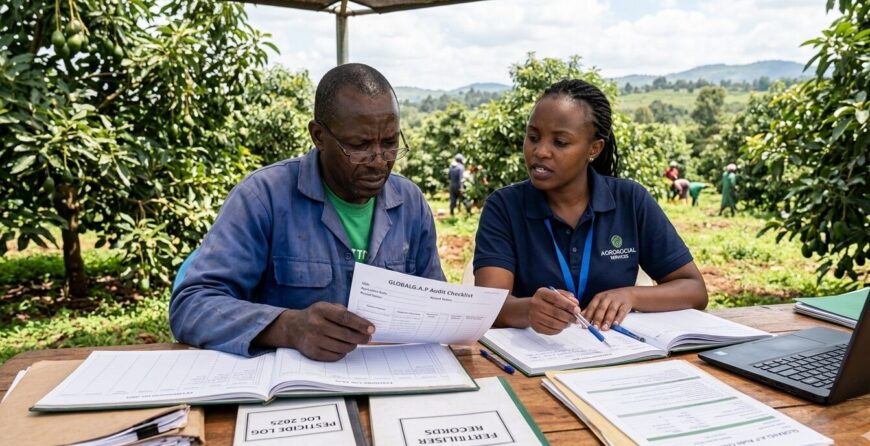
Your GLOBALG.A.P Audit Day in Kenya: What the Auditor Checks and How to Handle It
✅ Standard: GLOBALG.A.P IFA v6 | 🎯 Focus: Audit Day Conduct | 🇰🇪 Based on: Kenyan farm audit experience | 📅 Updated: May 2026 | ⏱ Read time: 13 minutes
In This Guide
- Key Facts — What Audit Day Is Really Assessing
- The Audit Day Timeline — Hour by Hour
- Worker Interviews: Never Coach, Always Train
- Auditor Findings: Acknowledge, Don’t Argue
- The Farm Walk: Don’t Steer — Disclose
- Your Records: Show the Complete File
- Accompanying the Auditor: Stay Present
- What Auditors Notice That You Don’t Realise
- The Closing Meeting — How to Handle It
- After the Audit — Responding to the NCR
- Unannounced Audits — What IFA v6 Changed
- Frequently Asked Questions
⚡ Key Facts — What Audit Day Is Really Assessing
- Preparation is a separate job from audit day. If your audit is more than three weeks away, start with our complete farm audit preparation guide. This article is about what happens from the moment the auditor arrives to the moment they leave.
- Audit day conduct shapes the auditor’s read on your management culture — not just the checklist. A farm manager who is evasive, defensive, or inconsistent signals integrity problems that change how rigorously the auditor scrutinises every finding.
- Worker coaching is detectable and treated as misrepresentation. Workers who give identical, word-perfect answers signal that they were coached, and cross-checking answers between workers exposes it. This is treated as seriously as falsified records.
- Under IFA v6, a proportion of recertification audits — typically around 10% — are unannounced. If your farm only behaves correctly on scheduled audit days, you will eventually fail an unannounced inspection.
- Non-conformances found during the audit are not final. How you respond at the closing meeting decides whether the certification relationship is constructive or adversarial — and how the auditor interprets ambiguous findings.
- The auditor’s main tool is inconsistency. A farm walk that contradicts the records, worker answers that contradict training records, documents presented selectively that contradict each other — inconsistency is the signal that triggers deeper investigation.
A Kenyan farm that has prepared thoroughly for its GLOBALG.A.P certification audit can still lose the certificate on the day — through a handful of specific conduct mistakes that undermine the auditor’s confidence in how the farm is run. This guide is about the day itself.
Preparation — records, the pesticide programme, traceability, the chemical store — is covered in our complete farm audit preparation guide. Read that first if your audit is still weeks away. Then read this to understand how the day unfolds and how to conduct yourself through it.
Everything here draws on Agrosocial Services’ work supporting Kenyan farms and cooperatives through IFA v6 audits across 12 counties. These are real patterns we have seen repeatedly on Kenyan farms — not theoretical risks — and every one of them is avoidable with the right preparation and the right mindset on the day.
📩 Get our free Audit Day Preparation Checklist — delivered instantly
A one-page printable guide covering what to prepare, what to say, and what to avoid on the day of your GLOBALG.A.P external audit. Free, instant delivery.
Why Conduct Counts on Audit Day
A well-prepared farm that behaves badly on audit day can get a worse result than a less-prepared farm whose manager is honest, cooperative, and professional.
Auditors are professional risk assessors. A farm manager who is evasive, inconsistent, or appears to be coaching workers raises the auditor’s risk assessment of the whole farm and triggers more rigorous inspection of every finding. The audit is a compliance check and a management-integrity assessment at the same time.
The Audit Day Timeline — Hour by Hour
Understanding what happens at each stage of a GLOBALG.A.P audit is the foundation of correct conduct. Most of the mistakes in this guide happen because farm managers do not understand what the auditor is doing at a given stage, and react wrongly as a result.
| Time | Audit Stage | What the Auditor Is Assessing | Your Role |
|---|---|---|---|
| 7:30–8:30am | Arrival and Opening Meeting | Farm management structure, certification history, general compliance approach | Professional welcome, factual farm introduction, immediate records access |
| 8:30–10:30am | Records Review | All 7 record categories — completeness, consistency, contemporaneity, cross-linkages | Make the full records file immediately available. Answer factual questions. Do not volunteer information that contradicts your records. |
| 10:30am–1:00pm | Farm Walk | Physical compliance against records — chemical store, field conditions, worker facilities, irrigation, buffer zones, hygiene | Accompany the auditor throughout. Answer factually. Do not steer away from any area. Identify field codes and facilities on request. |
| 1:00–2:30pm | Worker Interviews | Worker knowledge, rights awareness, training effectiveness, Workers’ Representative election, grievance mechanisms | Make workers available privately. Do not attend interviews. Do not brief workers on specific answers beforehand. |
| 2:30–3:30pm | Mock Recall Test | Traceability from packed lot → field → spray records → water test → soil records. Must complete in 15 minutes. | Demonstrate the trace yourself — do not hand over the records and step away. Show the auditor the system. Time the trace. |
| 3:30–4:30pm | Auditor’s Review Time | Auditor compiles findings, cross-checks observations, classifies non-conformances | Be available for follow-up questions. Do not interrupt or enter the auditor’s workspace. |
| 4:30–5:30pm | Closing Meeting | Auditor presents preliminary findings. Farm manager confirms understanding of each. | Listen carefully. Confirm understanding. Ask clarifying questions. Do not argue. Note deadlines for each finding category. |
Worker Interviews: Never Coach, Always Train
If you get this wrong: Coaching is treated as deliberate misrepresentation and can invalidate the audit.
When it happens: the night before or the morning of the audit — the farm manager briefs workers on specific answers to expect.
In the hours before an audit, a farm manager who suspects their workers have not genuinely absorbed the training — or who is uncertain they will give the “right” answers — tells workers what to say. Sometimes it is a group rehearsal the day before, sometimes a written list of answers, sometimes just an informal nudge to say they “know” something they do not. It rests on a misreading of how experienced auditors run worker interviews: they are specifically trained to spot coached responses, and they are good at it.
How auditors detect coaching
- Identical, word-perfect answers across workers. If four workers independently give exactly the same phrasing to “what do you do if you see a food safety hazard?”, they were coached. Genuine knowledge produces varied, naturally phrased answers.
- Workers who can answer the scripted question but not the follow-up. The auditor asks something that was not in the script — “and if you couldn’t find that person, who would you go to?” A worker with real knowledge answers naturally; a coached worker stalls.
- Answers that contradict observable reality. A worker who says “we always wear full PPE during spraying” while the auditor saw spray operators without correct PPE on the farm walk has given an answer that does not match what was seen.
- Nervousness that does not fit genuine knowledge. A coached worker is often visibly tense, glances toward the farm manager before answering, and hesitates as if recalling a script rather than their own work.
What to do instead
The right approach is year-round training, not pre-audit coaching. Workers genuinely trained on food hygiene, PPE use, first aid location, the Workers’ Representative process, and grievance mechanisms throughout the year answer auditor questions naturally and correctly with no intervention. The only appropriate pre-audit briefing is to tell workers an audit is happening, that an auditor will speak with them privately, and that they should answer honestly based on what they genuinely know.
If you discover a week out that workers do not know what the auditor will ask about, the correct response is a genuine refresher session, documented with a training record — not a coaching session. Real training that transfers knowledge is very different from coaching that transfers scripted answers, and auditors can tell the difference.
📖 Related: Worker knowledge gaps in private interviews are one of the most common causes of audit non-conformances on Kenyan farms. Our farm audit preparation guide sets out the full worker-welfare framework, including how to run a pre-audit worker knowledge check that finds genuine gaps rather than creating coaching needs.
Auditor Findings: Acknowledge, Don’t Argue
If you get this wrong: It damages the relationship with the certification body and triggers more rigorous scrutiny of every finding.
When it happens: during the farm walk or the closing meeting, when the auditor raises something you believe is compliant or unfair.
When an auditor identifies a non-conformance you think is incorrect, minor, or unfair, the natural reaction is to push back — to explain why the auditor is wrong, point out that other farms do the same and pass, note that it was not raised last cycle, or insist it should be classified differently. This consistently makes the outcome worse, never better.
Why arguing makes it worse
Certification body auditors are professional risk assessors. When a farm manager argues defensively about a finding, the auditor’s assessment of the farm’s management integrity rises — it reads as a commitment to compliance-on-paper rather than genuine compliance, and that triggers closer scrutiny of every remaining area. An auditor who finds a straightforward non-conformance that the manager accepts professionally moves through the rest of the audit without elevated vigilance. The same auditor met with defensive argument scrutinises the rest of the farm far more closely.
What to do when the auditor raises a finding
- Listen to the full explanation before responding. Do not interrupt to defend before you understand what was found and why it is a non-conformance under the standard.
- Acknowledge the finding clearly. “I understand what you have found and I will address this” is the right response — not agreeing the farm is non-compliant, but acknowledging the auditor has identified something to resolve.
- Ask a clarifying question if the finding is genuinely unclear. “To understand this correctly — is the issue X, or that the documentation of X is insufficient?” is professional. “This is wrong because other farms do it and passed” is not.
- If you believe a finding is factually incorrect, present the evidence calmly at the closing meeting. “I believe the document you were looking for is here — could you confirm whether this satisfies the requirement?” invites reconsideration based on evidence. “You are wrong and that is compliant” is adversarial.
- Raise formal disagreements through the certification body’s appeal process, not by arguing on the day. Every accredited body has a formal findings appeal route — submit a documented appeal within the specified window if you still disagree after the audit.
The Farm Walk: Don’t Steer — Disclose
If you get this wrong: Auditors are trained to notice avoidance, and avoidance immediately raises scrutiny of the area you steered around.
When it happens: during the farm walk, when the manager tries to redirect the auditor away from a known problem area.
A manager who knows there is a gap somewhere — a chemical store with inadequate bunding, a field section where PPE was not worn, a sub-standard worker facility — may try to steer the walk around it: suggesting a different route, creating a distraction so the area is skipped, or walking past quickly without stopping. Experienced auditors have run hundreds of farm walks and recognise route management. When they sense they are being steered away, their response is to insist on inspecting that exact area, with heightened scrutiny.
What avoidance looks like to an experienced auditor
- A route that systematically avoids the chemical store, a specific field section, or worker facilities — all of which should be priority stops.
- An unsolicited explanation for why a specific area “is not relevant” to the audit.
- Distracting the auditor with extended conversation or document review just before they would naturally reach a problem area.
- Body language — blocking access to a room, hurrying past an area, looking away from specific spots during the walk.
What to do instead
If there is a known gap on audit day, disclose it before the walk begins. “I want to flag that our chemical store bunding was damaged recently and we have ordered the repair materials — I will show you the current situation and the repair plan.” That does several things at once: it shows honest management, gives the auditor context before they see the issue, and signals that the farm is actively managing its compliance — exactly what an auditor wants to see.
A disclosed issue is still a non-conformance, but the auditor’s read on your management integrity is very different when you raise it than when they discover it concealed — and that difference can affect how they classify ambiguous findings across the rest of the audit.
Your Records: Show the Complete File
If you get this wrong: Selective presentation is read as concealment and triggers an expanded document review.
When it happens: during records review, when the manager shows only the records that look complete and keeps the rest out of sight.
A manager who knows their records have gaps for certain months or fields may present only the complete sections — leaving the incomplete ones in a separate folder, a different location, or simply unmentioned. Full pesticide records for Fields F1 and F2 but not F3, where three months of spray records were missed. Or training records from the most recent session but not the earlier one with poor attendance.
How auditors detect selective presentation
Auditors are trained to request the complete set, not what the manager volunteers. They ask for specific date ranges, specific fields, and specific record categories. When records are not produced promptly — or the manager seems unsure where they are — suspicion rises that records were selectively presented. They also cross-reference: a spray record on Field F3 with no corresponding harvest record or PHI entry creates an internal inconsistency that triggers a detailed review of all F3 records.
What to do instead
Make your complete records file available at the start of the audit, clearly organised — one section per category, all dates and fields represented. The way to avoid incomplete periods is to have kept records contemporaneously all year, which our farm records guide explains in full.
If records are genuinely incomplete, acknowledge the gap proactively: “Our harvest records for Field F3 in February are incomplete — the harvest supervisor was away, and we have identified this as a gap to address.” That is a Minor Must non-conformance. Selective presentation that hides the gap and is later detected becomes a Major Must non-conformance or worse, because it signals intentional concealment rather than a management gap.
Accompanying the Auditor: Stay Present All Day
If you get this wrong: The auditor observes conditions with no context, which usually leads to a more conservative reading of findings.
When it happens: the manager steps away to handle other farm matters, or delegates the audit to a junior who does not know the compliance systems.
A GLOBALG.A.P audit is an all-day event, sometimes 7–8 hours for larger farms or group audits. For a busy Kenyan farm manager the temptation to step away is real — phone calls, staff issues, buyer communications. Some delegate parts of the audit to junior staff who lack full knowledge of the systems; others simply disappear during the records review.
Why an unaccompanied auditor creates problems
Two problems arise. First, the auditor reads or observes things they cannot get context for, and incomplete context usually leads to a more conservative interpretation. Second, on the farm walk they see conditions without anyone present to explain systems that are not obvious from visual inspection alone. There is also an integrity dimension: a manager absent for significant portions of the audit signals that the audit is not a priority, and that feeds the auditor’s overall assessment.
What to do instead
Treat audit day as your most important operational priority of the year, because it is. Block the whole day. Delegate other farm responsibilities to a capable deputy. Silence your phone during audit stages (real emergencies aside, which you briefly flag to the auditor). Assign one knowledgeable staff member to handle practical tasks — carrying records, opening facilities, finding workers for interviews — so your full attention stays on engaging with the auditor professionally throughout.
Agrosocial Services — Pre-Audit Mock Audit & Audit-Day Support
Walk into your audit having already passed a tougher one.
The surest way to handle audit day well is to have rehearsed it. Our consultants run a full mock audit on your farm 6–8 weeks before the real one — using the same framework as certification body auditors — so you find every finding while there is still time to fix it, and so your team knows exactly how the day unfolds. We can also be on call on audit day itself. Serving farms and cooperatives across 12 counties; we respond within 2 hours, Monday–Saturday, 7am–7pm EAT.
What Auditors Notice That You Don’t Realise
Beyond the formal checklist, experienced auditors gather information all day that feeds their risk assessment of the farm. Most managers are not aware of these, because they are not in the GLOBALG.A.P standard — but they shape the auditor’s judgment.
Your demeanour and consistency
An auditor notes whether your manner stays consistent — relaxed and professional in areas you are confident about, and equally relaxed where they raise questions. A manager who is calm during the records review but visibly tense near the chemical store on the walk is telling the auditor where the gaps are likely to be.
The state of the farm on arrival
What the auditor sees from the entrance to the meeting room, before the formal opening, tells them about your everyday standard. Spray equipment left near the entrance with open containers. Workers without appropriate workwear in food-handling areas. A farm under obvious last-minute preparation (freshly painted signage, staff who appear to have just arrived) versus one that shows consistent everyday management. None of these are checklist items, but all of them inform the risk assessment.
How staff interact with the auditor naturally
When the auditor encounters workers outside the formal interview — asking someone in the field where the first aid kit is, or watching PPE use during normal work — those observations carry real weight. A worker who confidently points to the first aid kit confirms training in a way a formal interview cannot. A worker confused by the question contradicts the training record that says they attended.
📖 Also read: The physical farm conditions auditors check on the walk — and how to get the chemical store, records, and worker welfare right before the day — are covered in our farm audit preparation guide. Read both together for the full preparation-and-conduct picture.
The Closing Meeting — How to Handle It Professionally
The closing meeting is the most important conversation of the day. The auditor presents preliminary findings, classifies non-conformances, and explains the corrective action process and timelines. How you conduct yourself here affects both the auditor’s final assessment and your ongoing relationship with the certification body.
Listen fully before responding to each finding
Let the auditor present each finding completely before you respond. Do not interrupt, and do not start forming your reply while they are still explaining. Listening fully shows professional respect and ensures you actually understand the finding.
Confirm your understanding of each finding
After each finding, confirm what was found and why it is a non-conformance. “I understand — our water test results from April are missing, and under IFA v6 this is a Major Must. I will provide them within the corrective action period.” This confirms you understand and shows you are engaging professionally with the process.
Ask what evidence will close each finding
If the corrective action is not clear, ask: “To close this finding, what specific evidence would you need to see?” That helps you implement the right corrective action the first time, rather than discovering after submission that your evidence was insufficient.
Present additional evidence for genuinely contested findings — calmly
If a finding is based on the auditor not having seen a document that exists — “I believe this document is in a different section of the file, could I show it to you?” — present it calmly and let them reconsider. That is different from arguing the finding is wrong; you are simply providing evidence, and either answer advances your understanding of the requirement.
Note every deadline carefully
Every non-conformance carries a corrective action deadline — for most findings this is within 28 days, and your certification body confirms the exact deadline for each. Write them down during the meeting. The formal non-conformance report will repeat them, but noting them now lets you begin corrective actions immediately.
After the Audit — Responding to the NCR Correctly
The certification body sends a formal Non-Conformance Report (NCR) within 5–10 working days of the audit. How you respond decides whether you get your certificate efficiently or drag the process out.
- Respond to every finding — not just the easy ones. A submission addressing 7 of 9 findings is not accepted. Every finding needs a response with specific evidence of corrective action.
- Provide photographic evidence for physical corrective actions. Repaired the chemical store bunding? Submit dated photos of the completed repair. Replaced damaged PPE? Submit a photo of the new PPE and a dated receipt.
- Provide training records for knowledge corrective actions. If a finding relates to workers not knowing their rights, the corrective action is a documented training session with signed attendance confirming it happened after the audit date.
- Address the root cause, not just the symptom. “We have now completed the missing pesticide records” does not address why they were not kept contemporaneously. “We have completed the records and implemented a weekly record check (procedure attached) to prevent recurrence” addresses both — and is far more likely to satisfy the review.
- Submit before the deadline, not on it. Review teams process submissions in the order received. Submitting several days early means it is reviewed sooner and any follow-up questions are easier to resolve within the remaining window.
📩 Take the audit-day playbook with you
Get the one-page Audit Day Preparation Checklist — what to prepare, what to say, and what to avoid — to keep on hand for the day itself. Free, instant delivery.
📋 Are You Ready for Audit Day? Use the Same Checklist Our Consultants Use
The Kenya Farm Audit Checklist — built on the IFA v6 P&C framework — covers all 200+ compliance points across 8 audit areas with Critical, Major, and Minor classifications and 2026 auditor tips. Run it on your farm 6–8 weeks before the external audit to find every issue the auditor will find, with time to fix them. Includes an integrated corrective action plan template for managing NCR responses. Instant download, M-Pesa accepted.
Download Audit Checklist — KES 3,500 →
Complete Starter Kit — KES 6,000
Unannounced Audits Under IFA v6 — What Changed and Why It Matters
Under GLOBALG.A.P IFA v6, a proportion of recertification audits within a certification body’s portfolio — typically around 10% — are conducted unannounced, within the standard annual audit count. The auditor arrives on a randomly selected date without prior notice. The implication for Kenyan certified farms is simple: the farm must be audit-ready on any given day, not just on the scheduled date.
The audit-day conduct in this guide matters even more for an unannounced audit, because there is no time to prepare workers, organise records, or present the farm in a curated way. Whatever state the farm is in when the auditor arrives is what gets assessed.
What unannounced readiness means in practice
- Records maintained contemporaneously every week — not completed in bulk before a scheduled audit. See our farm records guide for the year-round system.
- The chemical store compliant every day — not cleaned and organised the day before.
- Workers who genuinely know their rights and the farm’s practices every day — not briefed on answers the morning of a known audit.
- PPE worn by spray operators on every spray day — not only when an auditor might be watching.
- The farm manager or a knowledgeable deputy contactable when the auditor arrives, even unannounced.
The practical point: farms that earn certification through genuine year-round compliance are barely disrupted by unannounced audits, because the auditor sees the same farm they would on a scheduled day. Farms that manage their presentation rather than their compliance are the ones at real risk, because on an unannounced day the actual state of the farm is what shows.
Frequently Asked Questions
Can a certification body auditor show up unannounced to a Kenyan farm?
Yes. Under GLOBALG.A.P IFA v6, a proportion of recertification audits — typically around 10% — are conducted unannounced within the standard annual count. If your farm is selected, the auditor arrives without notice. This is why the farm must be audit-ready on any given day, not just on the scheduled date. Unannounced audits assess whether the farm maintains year-round compliance or only performs it during scheduled inspections.
What should a Kenyan farm manager do when a GLOBALG.A.P auditor arrives?
Greet the auditor professionally and confirm their identity and certification body credentials. Give a brief, factual introduction to the farm. Make the complete records file available immediately, without selective presentation. Accompany the auditor throughout, including the farm walk. Answer questions directly and honestly. Do not leave the auditor unaccompanied, and do not attend or observe the private worker interviews — make workers available privately as requested.
What do GLOBALG.A.P auditors look for during worker interviews in Kenya?
Auditors ask workers about food hygiene rules; correct PPE use; what to do if they observe a food safety hazard; where the first aid kit is; who their Workers’ Representative is and how they were elected; when they were last trained; where to report complaints; and their employment rights. They look for genuine knowledge versus rehearsed answers — asking follow-up questions and cross-checking between workers. Coached workers give identical, word-perfect answers; workers with genuine knowledge give naturally varied responses.
How should a Kenyan farm manager brief workers before a GLOBALG.A.P audit?
Tell workers that an audit is happening, that an auditor will ask them some questions privately, and that they should answer honestly based on what they genuinely know. Do not coach workers on specific answers — this is treated as deliberate misrepresentation if detected, which experienced auditors do reliably. The correct approach is year-round training so workers genuinely know the information before audit day. If workers lack genuine knowledge a week before, run a genuine refresher training session — not a coaching session for anticipated questions.
What happens to a certified farm that fails an unannounced inspection?
Non-conformances found in an unannounced inspection trigger the same corrective action process as a scheduled audit. If the farm’s compliance during the unannounced inspection differs significantly from its scheduled-audit performance — suggesting it only performs compliance when an audit is known — the certification body investigates whether the certificate was obtained under conditions not genuinely maintained year-round. That can lead to suspension or withdrawal. Genuine year-round compliance makes unannounced audits straightforward, because the everyday state of the farm is the same as its audit-day state.
Should a Kenyan farm manager be present during the auditor’s farm walk?
Yes — throughout the entire walk. You answer factual questions about operations, identify field blocks and production areas, and facilitate the auditor’s observations. Do not steer the auditor away from any area — avoidance is read as concealment and prompts closer inspection of the area being avoided. If there is a known gap, disclose it before the walk begins: “I want to flag that our chemical store has an issue we are correcting — here is the situation and our plan.” Proactive disclosure demonstrates management integrity; concealment undermines it.
What should a Kenyan farm do if an auditor identifies a non-conformance during the audit?
Listen to the full explanation. Acknowledge the finding professionally — “I understand what you have found and I will address this.” Ask clarifying questions if it is not clear. Do not argue defensively. If additional evidence may resolve it, present it calmly. Raise genuine disagreements through the certification body’s formal appeal process after the audit, not by arguing on the day. After the audit, respond to the NCR with specific evidenced corrective actions before the deadline, addressing both the symptom and the root cause of each finding.
Is it acceptable to offer food or drinks to a GLOBALG.A.P auditor during a Kenya farm audit?
Light refreshments — water, tea, a simple meal during a full-day audit — are acceptable and appropriate in the Kenyan professional context. Gifts, money, or anything that could be perceived as influencing the outcome are prohibited under all certification body codes of conduct. An auditor who receives such an offer is required to report it, which results in immediate audit invalidation. Professional hospitality is fine; anything that could create a perception of conflict of interest is not.
Key Takeaways — Share With Your Farm Manager Before Every Audit
- Worker coaching is detectable and treated as misrepresentation. Year-round genuine training is the only approach that produces consistently authentic interview answers.
- Arguing with findings makes the outcome worse. Acknowledge professionally, ask clarifying questions, and use the formal appeal process for genuine disagreements after the audit.
- Auditors specifically investigate areas they sense are being avoided. Avoidance is the most reliable signal that a gap is being concealed — disclose proactively instead.
- Present your complete records file immediately, not a curated selection. Selective presentation is read as concealment and triggers an expanded review.
- Accompany the auditor all day. Leaving them unaccompanied, or delegating to a junior who cannot answer compliance questions, creates avoidable risk.
- A proportion of IFA v6 audits are unannounced. Year-round compliance management — not audit-day presentation — is the only protection against an unannounced inspection.
- The closing meeting sets the tone for the corrective action relationship. Listen fully, acknowledge professionally, ask what evidence closes each finding, and note all deadlines.
- For preparation, use our Kenya Farm Audit Checklist (KES 3,500). For a pre-audit mock audit or audit-day support, WhatsApp Agrosocial Services.
Is Your Farm Ready — Both Before and On Audit Day?
Agrosocial Services provides pre-audit mock audits, gap assessments, and audit-day coaching for Kenyan farms and cooperatives across Kiambu, Meru, Nakuru, Embu, Machakos, and Kisii. We respond within 2 hours, Mon–Sat.
Related Resources from Agrosocial Services
Audit preparation: Farm Audit Preparation Guide · Farm Record Keeping Guide · MRL Compliance Guide · IFA v6 Transition Guide
Certification guides: GLOBALG.A.P Certification Kenya · Certification Cost Guide · Group Certification for Cooperatives
Crop export guides: Avocado Export Kenya · French Bean Export Kenya · Mango Export Kenya · Passion Fruit Export Kenya
Funding and market access: Agricultural Funding Sources 2026 · How to Find International Buyers
County consultants: Nairobi · Kiambu · Nakuru · Meru · Machakos · Embu · Kisii
Agrosocial Services Limited is Kenya’s specialist agricultural certification and export market consultancy, serving farms, cooperatives, and agri-exporters across 12 counties since 2018. The audit-day conduct guidance in this article is based on direct observations from supporting Kenyan farms and cooperatives through GLOBALG.A.P IFA v6 certification audits from 2018 to 2026. For pre-audit preparation, audit-day coaching, or corrective action assistance, contact us at info@agrosocialservices.co.ke or WhatsApp +254 713 935 361. Last reviewed: May 2026.