Is GLOBALG.A.P Certification Worth the Cost for Kenyan Farms? Real 2026 ROI Data
📊 Topic: Certification ROI | 🌍 Market: Kenya | ✅ Standard: GLOBALG.A.P IFA v6 | 💰 Data: 2026 actual farm prices | ⏱ Read time: 12 minutes
In This Guide
- Key Numbers — The Short Answer
- The Real Question to Ask
- Price Premiums by Crop — 2026 Data
- ROI: Avocado
- ROI: French Beans
- ROI: Mango
- ROI: Passion Fruit
- Cooperative vs Individual — The ROI Gap
- What Certification Gives You Beyond Price
- When Certification Is NOT Worth It
- How to Make Sure It Pays Off
- Frequently Asked Questions
⚡ Key Numbers — The Short Answer
- Avocado: KES 40–80/kg certified export vs KES 5–20/kg through local middlemen. On a 2-acre farm: additional KES 180,000–540,000 per year.
- French beans: KES 80–140/kg certified export vs KES 20–40/kg uncertified. On a 0.5-acre farm: additional KES 100,000–200,000 per year.
- Mango: KES 60–120/kg certified Middle East export vs KES 8–25/kg local. On a 1-acre farm: additional KES 208,000–380,000 per year.
- Passion fruit: KES 80–120/kg certified export vs KES 15–35/kg local. On a 0.5-acre farm: additional KES 112,500–212,500 per year.
- Group certification cost per farmer: KES 15,000–25,000 in Year 1. Payback: 2–6 months of first export season.
- For the full cost and budget breakdown see our dedicated GLOBALG.A.P certification budget guide for Kenya 2026.
The question every Kenyan farmer and cooperative manager asks before committing to GLOBALG.A.P certification is a rational one: is this worth the investment? The honest answer depends on your crop, your farm size, your route to market, and whether you certify individually or as a cooperative group. But for most Kenyan farmers growing export crops, the answer is unambiguously yes — and the numbers make the case more clearly than any claim about market access or buyer relationships can.
This article gives you the real 2026 ROI calculations — actual current Kenyan market prices, realistic farm production assumptions, and honest payback period analysis. It also tells you honestly when certification is NOT worth it — and what conditions must be in place for the investment to pay off the way the numbers suggest it should.
📩 Not ready to invest yet? Get our Free Farm Audit Sample Checklist first
See exactly what GLOBALG.A.P auditors check before spending a shilling on certification. Understand your compliance gaps before calculating your ROI.
💬 Or visit our Free Resources page → | request via WhatsApp →
The Commercial Case in One Comparison
An uncertified Kenyan avocado farmer selling to a local middleman
earns KES 5–20 per kilogram.
A certified farmer selling to a European buyer earns KES 40–80 per kilogram.
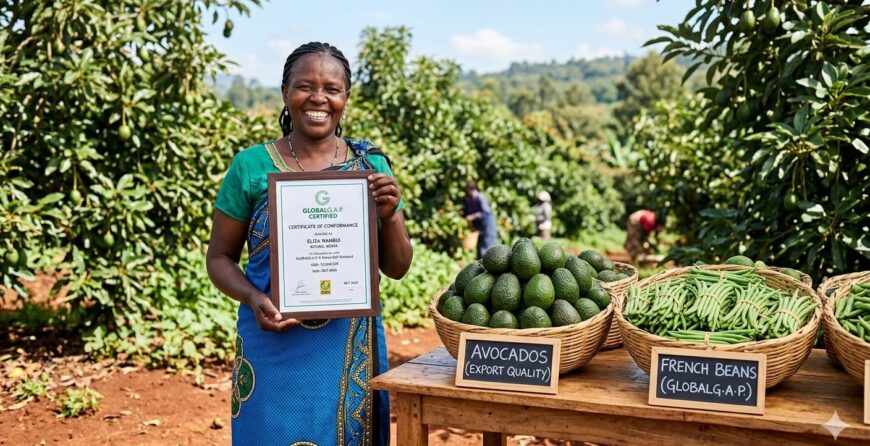
The same avocado. The same farm. The same amount of work. The difference is a certificate that costs KES 15,000–25,000 per farmer in a cooperative group and recovers within the first export season.
The Real Question to Ask — Before Any ROI Calculation
“Is certification worth it?” is actually two separate questions that most Kenyan farmers conflate. The first is the financial question: does the income increase justify the investment cost? This article answers that question with specific numbers for each crop. The answer is almost always yes for group-certified smallholder farmers.
The second question — which is more important but less often asked — is the market access question: do you have a credible pathway to an export buyer? A GLOBALG.A.P certificate without a buyer relationship does not generate income. It is a market access tool, not a guaranteed revenue stream. The sequence matters: identify your target market and buyer channel first, then certify to qualify for it.
📖 Also read: For a complete breakdown of exactly what you pay before the income begins — preparation costs, certification body fees, laboratory testing, infrastructure — see our dedicated GLOBALG.A.P certification budget guide for Kenya 2026. This ROI article focuses on the return side of the equation. That article covers the investment side in full detail.
Price Premiums by Crop — 2026 Kenya Market Data
The following price data is based on 2026 Kenya export market prices from Agrosocial Services client engagements, FPEAK market reports, and Kenya Horticulture Council validated data. Prices fluctuate by season, buyer relationship, quality grade, and packaging — these are realistic mid-range values, not peak prices.
| Crop | Uncertified / Local Middlemen | Certified Export Price | Price Premium | Main Export Markets |
|---|---|---|---|---|
| 🥑 Avocado (Hass) | KES 5–20/kg | KES 40–80/kg | 200–400% | EU, UK, China, Middle East |
| 🫘 French Beans (fine) | KES 20–40/kg | KES 80–140/kg | 150–250% | UK, Netherlands, France |
| 🥭 Mango | KES 8–25/kg | KES 60–120/kg | 200–600% | Middle East, China, EU |
| 🌿 Passion Fruit | KES 15–35/kg | KES 80–120/kg | 150–300% | EU, Middle East, UK |
| 🌹 Cut Flowers (Rose) | KES 8–15/stem | KES 25–60/stem | 150–300% | Netherlands, UK, Russia |
| 🥜 Macadamia | KES 30–60/kg (in-shell) | KES 120–280/kg (shelled) | 200–400% | China, EU, US |
ROI Deep Dive: Avocado
Avocado is Kenya’s fastest-growing export crop and the certification ROI is the clearest of any crop for farmers in Kiambu, Embu, Meru, and Muranga. The full avocado export guide for Kenya covers the complete certification and market access requirements.
Annual income before certification: 6,000 kg × KES 12 = KES 72,000
Annual income after certification: 6,000 kg × KES 55 = KES 330,000
Annual income increase: KES 258,000 per year
Group certification cost (Year 1): KES 25,000
Investment recovered in: ~1.2 months of exports
3-year cumulative additional income at KES 258,000/year: KES 774,000 against a 3-year total certification investment of approximately KES 45,000. 3-year ROI: ~1,620%.
📖 Also read: Kenya’s avocado sector is the primary target for the China duty-free deal effective May 2026. Certified Kenyan Hass avocado entering China at 0% tariff is price-competitive with Peruvian and Chilean supply for the first time.
ROI Deep Dive: French Beans
French bean certification generates the fastest payback of any crop. Farms in Kiambu and Nakuru are Kenya’s primary French bean producing counties.
Annual income before certification: 2,000 kg × KES 30 = KES 60,000
Annual income after certification: 2,000 kg × KES 100 = KES 200,000
Annual income increase: KES 140,000 per year
Group certification cost including GRASP (Year 1): KES 28,000
Investment recovered in: ~2.4 months of exports
⚠️ French Bean MRL Risk — The Certification Requirement That Must Not Be Skipped
French beans face the strictest MRL scrutiny of any Kenyan export crop. Read our complete MRL compliance guide for Kenyan export farms before beginning French bean certification preparation.
ROI Deep Dive: Mango
Mango certification generates the highest per-kilogram ROI of all four crops. Farms in Machakos, Embu, and Meru are Kenya’s primary mango growing counties.
Annual income before certification: 5,000 kg × KES 15 = KES 75,000
Annual income after certification: 5,000 kg × KES 80 = KES 400,000
Annual income increase: KES 325,000 per year
Group certification cost including fruit fly programme (Year 1): KES 27,000
Investment recovered in: ~1.0 months of exports
Important: Mango certification takes 8–12 months due to the fruit fly monitoring requirement. Factor this into cash flow planning.
ROI Deep Dive: Passion Fruit
Passion fruit certification has the most accessible certification costs and the most rapid payback. Kisii is Kenya’s primary passion fruit county with an established cooperative culture that makes group certification particularly practical.
Annual income before certification: 2,500 kg × KES 25 = KES 62,500
Annual income after certification: 2,500 kg × KES 100 = KES 250,000
Annual income increase: KES 187,500 per year
Group certification cost (Year 1): KES 20,000
Investment recovered in: ~1.3 months of exports
📋 Know Your Compliance Gaps Before You Calculate Your ROI
The ROI calculations above assume successful first-time certification. Farms that fail their first audit incur an additional KES 45,000–100,000 in costs and delay the first export season by 2–4 months. Our Kenya Farm Audit Checklist gives you the exact tool to self-assess before spending anything else.
Download Audit Checklist — KES 3,500 →
Get Free Sample Checklist First →
Cooperative vs Individual — The ROI Gap That Changes Everything
The ROI calculations above use group certification costs — KES 15,000–28,000 per farmer. Individual farm certification costs KES 160,000–490,000 in Year 1. This difference fundamentally changes the financial case for certification at the smallholder level.
| Scenario | Certification Cost (Year 1) | Additional Annual Income (2-acre avocado) | Payback Period |
|---|---|---|---|
| Group certification — cooperative of 40 | KES 25,000 | KES 258,000 | ~1.2 months |
| Individual farm certification | KES 300,000 (mid estimate) | KES 258,000 | ~14 months |
Read our complete guide to GLOBALG.A.P group certification for Kenyan cooperatives for the full process, QMS requirements, and complete group certification cost breakdown.
What Certification Gives You Beyond the Price Premium
1. Supply chain security — contracts, not spot sales
Certified farms enter supply relationships with buyers who need consistent, traceable supply and are willing to pay a premium for it. These relationships involve advance purchase commitments and price agreements set before the season — transforming the commercial resilience of a farming household.
2. Access to funding — certified farms are better loan risks
GLOBALG.A.P certified farms with documented export buyer relationships are treated as significantly lower-risk borrowers by the Agricultural Finance Corporation and commercial lenders.
3. The compliance dividend — better farming practices reduce input costs
The GLOBALG.A.P IFA v6 standard requires documented IPM plans and threshold-based spray decisions. Farms that implement these correctly typically reduce pesticide costs by 15–25%.
4. Market diversification — China access from May 2026
The Kenya-China duty-free arrangement effective May 2026 means certified Kenyan avocado, macadamia, mango, and French bean farmers now have a second major premium export market alongside Europe.
When Certification Is NOT Worth It — The Honest Assessment
No credible export buyer pathway
A GGN number without a buyer generates cost, not income. Identify at least one specific buyer channel before pursuing certification.
Production volume below buyer minimums
Most international buyers require minimum supply commitments of 5–20 metric tonnes per shipment. This is the structural reason why group certification through a cooperative is commercially necessary for most Kenyan smallholder farmers.
Cannot sustain the compliance management commitment
Certification achieved and then lost through non-renewal destroys both the investment and the buyer relationship. The compliance management commitment must be honest and sustainable before the investment is made.
How to Make Sure Certification Pays Off — 5 Actions Before You Start
1. Know your compliance gap before engaging anyone. Use the Kenya Farm Audit Checklist to self-assess first.
2. Form or join a cooperative. Group certification is the only route that makes the financial case unambiguous for smallholder farmers. See our complete group certification guide.
3. Identify your buyer channel before starting preparation. Confirm there is a market for your certified produce before investing in certification.
4. Find funding before using your own cash. The AFC, KCSA, and county government funds all provide co-financing for group certification investments.
5. Get the full cost picture before deciding. See our complete GLOBALG.A.P certification budget guide for Kenya 2026 for every cost category, by crop type, by certification route, and by farm size.
Frequently Asked Questions
Is GLOBALG.A.P certification worth the cost for Kenyan smallholder farmers?
Yes — for Kenyan farmers with export market access. Certified avocado farmers earn KES 40–80/kg vs KES 5–20/kg through local middlemen. On a 2-acre farm, this represents KES 180,000–540,000 additional annual income against a group certification cost of KES 15,000–25,000 per farmer — recovering the investment within 2–4 months of the first export shipment.
How much more do certified Kenyan farms earn compared to uncertified farms?
Avocado: 200–400% premium. French beans: 150–250%. Mango: 200–600%. Passion fruit: 150–300%. These premiums are sustained year-on-year for as long as certification is maintained and buyer relationships are active.
How long does it take to recover the GLOBALG.A.P certification investment?
For group-certified smallholder farmers: avocado ~1.2 months, mango ~1.0 months, passion fruit ~1.3 months, French beans ~2.4 months. Individual farm certification takes 6–18 months to recover. This is the primary financial reason group certification is strongly recommended.
Is GLOBALG.A.P certification worth it for a cooperative versus an individual farm?
The ROI is dramatically better for cooperatives — 80–90% lower per-farmer costs with identical market access. See our complete group certification guide for the full process.
Are there situations where GLOBALG.A.P certification is NOT worth the investment?
Yes — if there is no credible export buyer pathway, if production volume is below buyer minimums, or if the farm cannot sustain year-round compliance management. Address these conditions before investing in certification.
What is the ROI of GLOBALG.A.P certification for a Kenyan avocado farmer?
A group-certified avocado farmer with 2 acres producing 6,000 kg annually moving from KES 12/kg to KES 55/kg export generates KES 258,000 additional annual income. Against a KES 25,000 group certification cost, the 3-year ROI is approximately 1,620%. See the complete avocado export guide for all requirements.
Key Takeaways
- GLOBALG.A.P certification generates price premiums of 150–600% across all four main Kenyan export crops.
- Group certification recovers its cost in 1–3 months of the first export season. Individual certification takes 6–18 months.
- Certification also delivers supply chain security, improved funding access, lower pesticide costs from IPM, and access to the China duty-free market from May 2026.
- Certification is NOT worth it without a credible export buyer pathway, minimum supply volumes, or management capacity for year-round compliance.
- For every cost category before the income begins, see our GLOBALG.A.P certification budget guide for Kenya 2026.
Ready to Start Your Farm’s Certification Journey?
Our consultants work with farms and cooperatives across Kiambu, Meru, Embu, Nakuru, Machakos, and Kisii. We respond within 2 hours.
Related Resources from Agrosocial Services
Certification guides: GLOBALG.A.P Certification Kenya · Certification Budget Guide 2026 · IFA v6 Transition Guide · Group Certification for Cooperatives
Crop export guides: Avocado Export Kenya · French Bean Export Kenya · Mango Export Kenya · Passion Fruit Export Kenya
Compliance and market access: MRL Compliance Guide · Agricultural Funding Sources 2026 · Kenya-China Duty-Free Guide 2026
County consultants: Nairobi · Kiambu · Nakuru · Meru · Machakos · Embu · Kisii
Agrosocial Services Limited is Kenya’s specialist agricultural certification and export market consultancy, serving farms, cooperatives, and agri-exporters across 12 counties since 2018. All price data reflects actual 2026 Kenya export market prices from Agrosocial Services client engagements, FPEAK market reports, and Kenya Horticulture Council validated data. Contact us at info@agrosocialservices.co.ke or WhatsApp +254 713 935 361. Last reviewed: May 2026.