4C Certification for Coffee in Kenya: What It Is and How to Get It
Not every coffee certification is trying to win you a price premium. 4C — the oldest, most widely-held baseline sustainability standard in coffee — isn’t. It exists to get a cooperative into disciplined, documented, continuously-improving practice quickly and affordably, as the foundation other, more demanding certifications get built on top of. This guide explains what 4C actually requires, who qualifies, how Kenya’s existing cooperative structure fits it almost perfectly, and where it honestly sits next to Fairtrade and Rainforest Alliance.
This sits alongside our main Coffee Export from Kenya guide — that covers the whole export landscape; this article is the dedicated deep-dive on 4C specifically.
Agrosocial is an independent certification consultancy. We help cooperatives and exporters prepare for and pass 4C and other coffee certification audits — the certificate itself is issued by an accredited certification body, not by us.
⚡ Key Facts — 4C Certification
- 🌍 Held by more than 300,000 farmers across 19 countries — one of the most widely-adopted coffee sustainability standards in the world.
- 👥 Certifies as a “4C Unit” — a cooperative, group, mill, trader or exporter — not individual farmers directly.
- 📦 Minimum 20 tonnes (one container) of green coffee and a designated managing entity are the only two entry prerequisites.
- 📈 A tiered system over 6 years — Level 1 at first audit, Level 2 at 3-year recertification, Level 3+ at 6-year recertification.
- 🇰🇪 Offered in Kenya through certification bodies including AfriCert Ltd — a real, active local option, not a scheme available only elsewhere.
Sources: 4C Services GmbH; Global Coffee Platform; QIMA; AfriCert Ltd (Kenya); Ecom Agroindustrial Kenya. Verified July 2026.
In This Guide
The Basics
What 4C Actually Is
4C started life as the Common Code for the Coffee Community — a multi-stakeholder effort to give the coffee sector a shared, baseline definition of sustainable production. Today it operates as an ongoing third-party certification run by 4C Services GmbH, certifying compliance with the 4C Code of Conduct across three dimensions: economic (viable, well-managed production), social (fair labour, community wellbeing) and environmental (resource conservation, responsible input use). It’s a distinct programme from the separate Global Coffee Platform’s own Coffee Sustainability Reference Code — related in origin, but a different tool serving a different purpose.
The honest positioning matters: 4C is deliberately not a strict, narrow production-criteria scheme, and it isn’t built around winning a price premium the way Fairtrade or Rainforest Alliance are. It’s designed to get producers into continuous improvement quickly and cost-effectively — a foundation, not a finish line.
Eligibility
Who Qualifies — the “4C Unit”
4C doesn’t certify individual farmers one by one. It certifies a “4C Unit” — a deliberately inclusive term covering a group of small producers, a cooperative, a farmers’ association, a local trader, a mill, or an export organisation. A unit can form at almost any point in the supply chain, provided it meets two straightforward prerequisites:
- Production volume — a minimum of 20 tonnes (roughly one container) of green coffee.
- Management capacity — a person or team responsible for implementing the 4C Code of Conduct across the unit.
Both individual farms large enough to hit that volume and, more commonly for Kenya, groups of smallholders certifying together can qualify — provided everyone in the unit commits to the Code and to continuous improvement over time.
The Local Angle
Why Kenya’s Cooperative Structure Fits This Almost Perfectly
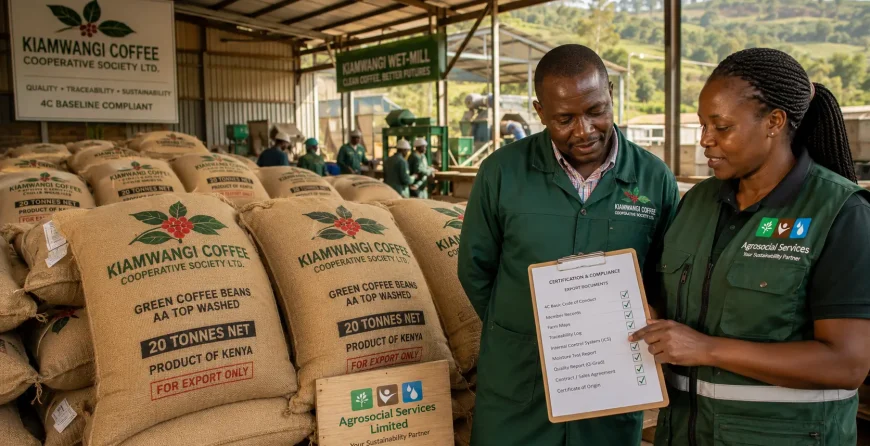
Kenya’s coffee sector is already organised in a way that maps directly onto the 4C Unit model. Smallholder coffee farmers are required to belong to a registered Farmer Cooperative Society (FCS), which handles wet milling and other essential services, and FCS in turn sell through a licensed Coffee Marketing Agent (CMA) — either at the weekly Nairobi coffee auction or through arranged direct “second window” sales to specific buyers. That FCS structure is, in effect, a ready-made managing entity: the cooperative already aggregates volume well above the 20-tonne threshold, and already has the organisational backbone 4C asks a “4C Unit” to have.
This is also why 4C isn’t a foreign, imported concept in Kenya — AfriCert Ltd, a Kenya-based certification body, offers 4C certification directly, and 4C is already used as a recognised baseline standard by major Kenyan coffee marketers alongside other schemes such as C.A.F.E. Practices.
How It Actually Runs
The Tiered Certification Process
4C’s defining feature is that it doesn’t demand everything at once. Compliance is assessed across three progressive levels over a six-year cycle, so a unit builds up its practice over time rather than needing to be audit-perfect from day one:
| Stage | When | What’s required |
|---|---|---|
| Level 1 | Initial certification audit | Baseline Code of Conduct requirements |
| Level 2 | First recertification, year 3 | Level 1 requirements + additional control points |
| Level 3+ | Second recertification, year 6 | Levels 1 & 2 requirements + further control points |
Optional Add-on modules — covering Gender Equality, Food Security and Carbon Footprint — let a unit go further on specific themes without changing the core certification. Modern 4C tooling also includes a digital portal and a “Business Partner Map” for supply-chain traceability, which increasingly supports the kind of due-diligence documentation buyers are now asking for under regulations like the EU Deforestation Regulation.
Free Download
Know what auditors check before they arrive
Our free guide — the Top 25 Audit Fail Points in Kenya — covers the record-keeping and documentation gaps that sink certification audits across every standard, 4C included.
The Honest Comparison
4C vs Fairtrade vs Rainforest Alliance
These three certifications aren’t competing for the same job — they sit at different levels of the same ladder.
| Standard | Positioning | Core focus |
|---|---|---|
| 4C | Entry-level baseline | Fast, affordable entry into continuous improvement; not price-premium focused |
| Fairtrade | Differentiated, price-focused | Guaranteed minimum price + premium; strong cooperative/membership focus |
| Rainforest Alliance | Differentiated, practice-focused | Rigorous on-farm environmental & social practice, annual audits |
In practice, many Kenyan cooperatives use 4C as the first rung — it builds the record-keeping, management and continuous-improvement habits that make a later Fairtrade or Rainforest Alliance audit far less daunting, without demanding the full weight of those standards from day one.
The Business Case
Why It’s Worth Doing
- Low barrier to entry. No strict production criteria to meet before you start — you commit to the Code and improve over the six-year cycle.
- Builds the discipline higher standards demand. Record-keeping, a designated management structure, and documented practice — exactly what Fairtrade and Rainforest Alliance audits will later test far more rigorously.
- Signals credibility to buyers who require at least a baseline sustainability standard before they’ll engage, even if they don’t require a premium certification.
- Traceability tooling that increasingly overlaps with what buyers now expect for regulatory compliance on other fronts.
Next Steps
Getting Started & Cost
Because 4C certifies at the “Unit” level and pricing depends on the certification body, your production volume and audit scope, we won’t quote a generic figure here — it varies by provider and cooperative size, and the honest answer is to get a real quote from an approved certification body such as AfriCert directly. What we can help with is the preparation side: confirming your cooperative meets the 20-tonne and management-entity prerequisites, getting your records and documentation audit-ready, and deciding whether 4C, a higher-tier standard, or both in sequence fits your buyers’ requirements.
Ready to see where your cooperative stands?
We help coffee cooperatives assess readiness for 4C and plan the path to higher-tier certifications when the time is right. Start with a readiness assessment.
Quick Answers
Frequently Asked Questions
What is 4C certification for coffee?
4C (originally the Common Code for the Coffee Community) is a baseline sustainability certification for coffee, run by 4C Services GmbH. It certifies compliance with the 4C Code of Conduct across three dimensions — economic, social and environmental — and is designed as an accessible entry point rather than a premium, price-differentiated label.
Can a Kenyan coffee cooperative get 4C certified?
Yes. 4C certifies through “4C Units” — a group of small producers, a cooperative, a farmers’ association, a trader, mill or export organisation — provided the unit can supply at least 20 tonnes (one container) of green coffee and has a designated managing entity. Kenya’s Farmer Cooperative Society structure fits this model closely, and 4C is offered locally through certification bodies such as AfriCert Ltd.
How is 4C different from Fairtrade or Rainforest Alliance?
4C is a baseline, entry-level standard focused on getting farmers into continuous improvement quickly and affordably, without strict production criteria or a price premium. Fairtrade and Rainforest Alliance sit above it as more demanding, differentiated certifications. Many cooperatives use 4C as a stepping stone before pursuing these higher-tier certifications.
How long does 4C certification last and what is the recertification cycle?
4C uses a tiered compliance system over a six-year cycle. Level 1 requirements are met at the initial certification audit; Level 2 requirements are added at the first recertification audit after three years; Level 3 and above are added at the second recertification after six years — each stage building on the one before it.
Key Takeaways
- 4C is a baseline, entry-level coffee sustainability standard — not a premium-price certification.
- It certifies “4C Units” — groups, cooperatives, mills or exporters — not individual farmers directly.
- Only two prerequisites: 20 tonnes of green coffee and a designated managing entity.
- Kenya’s Farmer Cooperative Society structure maps naturally onto the 4C Unit model.
- Widely used as a stepping stone toward Fairtrade or Rainforest Alliance, available locally via AfriCert.
Related Guides & Resources
Group Certification
Work With Us
Last reviewed: July 2026 by Agrosocial Services. 4C requirements are drawn from 4C Services GmbH, the Global Coffee Platform and approved certification bodies including QIMA and AfriCert Ltd; specific costs and audit scope vary by certification body, so confirm current terms directly before making commercial decisions. Agrosocial Services is an independent certification-preparation consultancy; we are not a certification body.