Agricultural Consultant Kakamega — Avocado, Tea & GLOBALG.A.P. Certification in Western Kenya
📍 Location: Kakamega County — Lugari · Malava · Lurambi · Shinyalu · Mumias | 🥑 Western Kenya’s Horticulture Transition Hub | 🌿 Crops: Avocado · Macadamia · Tea · Banana · Soybeans | ✅ Services: GLOBALG.A.P. · RA · Audits · Funding | 📞 Response: Within 24 Hours | 📅 Last reviewed: May 2026
⚠️ URGENT FOR KAKAMEGA AVOCADO FARMERS: The Certification Window Is Now
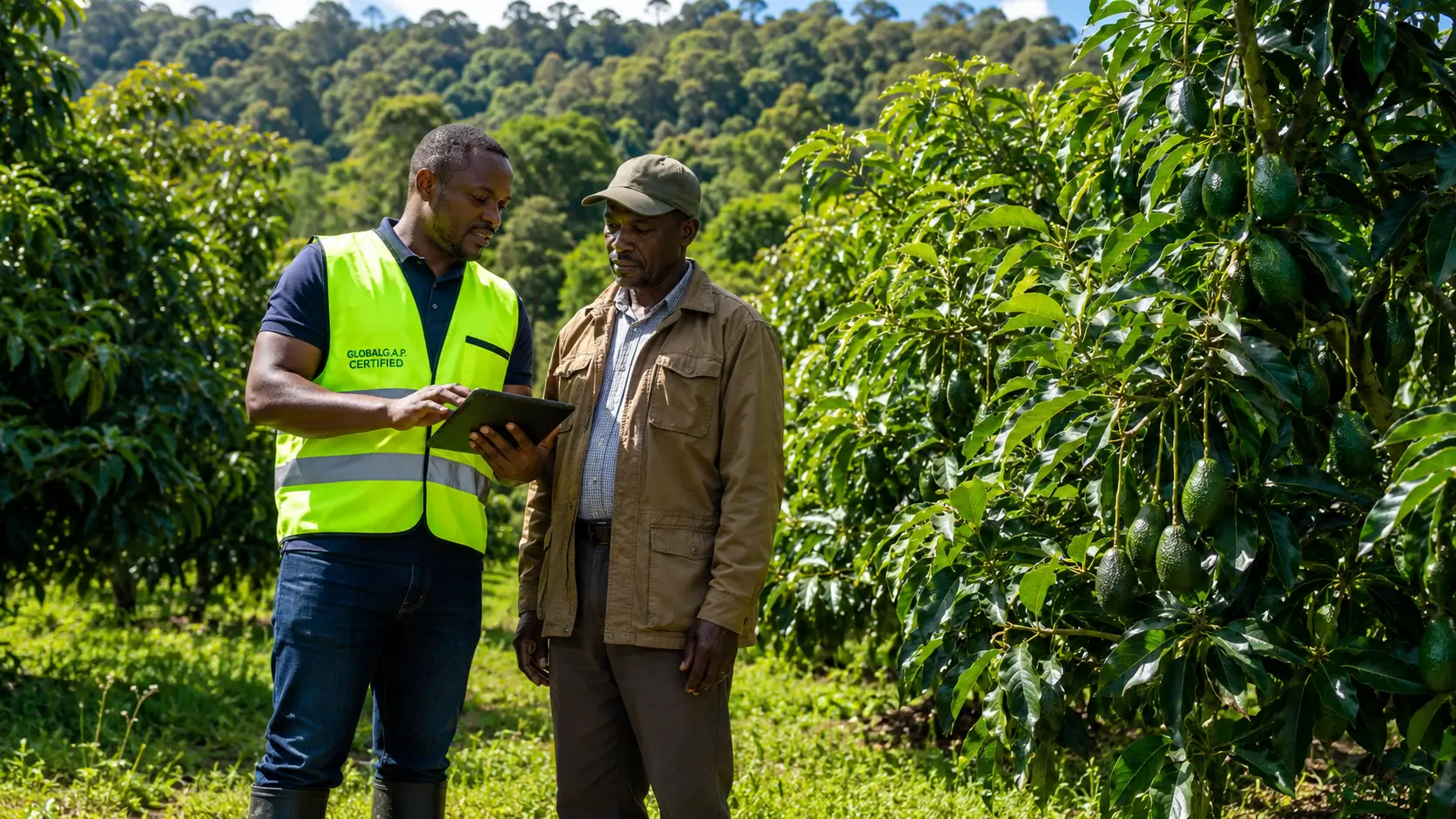
The thousands of Hass avocado seedlings distributed by the Kakamega County Government 3 to 4 years ago are reaching commercial fruiting maturity right now. Without GLOBALG.A.P. IFA v6 certification, EU and Chinese export packhouses cannot legally purchase your fruit — trapping you into selling to local brokers at a fraction of export prices. Do not let your 4-year investment go to middlemen. Start certification today →
In This Guide
- Agriculture in Kakamega County
- The Sugarcane Transition Story
- Three Agroecological Zones & Crops
- Avocado Export — IPM & High-Humidity Compliance
- Eldoret Airport — The Cold Chain Advantage
- Uganda EAC Border — Regional Market Access
- Tea — Rainforest Alliance in Shinyalu & Ikolomani
- Macadamia — China Duty-Free & Aflatoxin Compliance
- Banana Export — EAC & Middle East
- GLOBALG.A.P. Certification in Kakamega
- Group Certification for Cooperatives
- Farm Audit Preparation — Kakamega-Specific Gaps
- Institutions & Research Partners
- Agricultural Funding in Western Kenya
- Market Linkage — EU, UK, China, EAC
- Why Choose Agrosocial Services
- Frequently Asked Questions
⚡ Key Facts — Kakamega County Agricultural Consulting
- The Great Pivot: Sugarcane to Export Horticulture. The partial collapse of the Mumias Sugar Company has driven a historic transition across Western Kenya from volatile sugarcane farming to high-value export avocado and macadamia. Former sugarcane cooperative structures are the ready-made governance framework for GLOBALG.A.P. group certification — significantly reducing per-farmer compliance costs.
- Eldoret International Airport: 1–2 hours from northern Kakamega. Northern Kakamega (Lugari, Likuyani) is closer to Eldoret Airport cargo than any other major Kenyan avocado county is to its nearest airport. This cold chain logistics advantage means less post-harvest heat exposure, lower transport costs, and higher produce quality at destination versus the 7–9 hour JKIA Nairobi route used by Central Kenya competitors.
- Rain-fed agriculture: Kakamega receives 1,200–2,200mm annually. Most Kakamega avocado and macadamia farms require no irrigation investment — the equatorial rainfall provides adequate water without infrastructure cost. This is a significant capital advantage over drier counties where drip systems (KES 60,000–200,000/acre) are required.
- Uganda EAC border: ~80km from Kakamega Town. Certified Kakamega produce reaches Kampala in approximately 2 hours — the fastest Kenya-Uganda produce route. EAC preferential trade protocols enable duty-reduced access to Uganda, Tanzania, Rwanda, and other EAC markets as a supplementary revenue channel.
- High-humidity IPM challenge — Kakamega’s unique compliance test. Kakamega’s equatorial climate creates persistent fungal disease pressure (anthracnose, Phytophthora) that requires a carefully designed EU MRL-compliant Integrated Pest Management programme specifically adapted to Western Kenya conditions. Most pesticide programmes designed for Central Kenya’s drier zones are non-compliant in Kakamega’s disease environment.
- MMUST (Masinde Muliro University of Science and Technology) is Kakamega’s unique agribusiness research and graduate talent institution — providing soil testing, crop research specific to Western Kenya conditions, and graduate placement for cooperative technical staff.
- Response: 24 hours. On-site mobilisation: 48–72 hours to all Kakamega sub-counties from our Nairobi headquarters.
Agrosocial Services Limited provides specialist agricultural consulting to farmers, cooperatives, and agribusinesses throughout Kakamega County — the vibrant agricultural heart of Western Kenya. Kakamega is undergoing a historic commercial transformation: pivoting away from decades of reliance on the volatile sugarcane industry toward highly profitable, export-oriented horticulture. From the emerging macadamia belts of Lugari in the north, to the rainforest-canopied tea zones of Shinyalu, to the expanding avocado orchards of Mumias and Matungu, Kakamega offers some of Kenya’s largest untapped export horticulture potential.
The primary barrier for Kakamega farmers is no longer crop production — it is compliance. Certification is the missing structural link between Kakamega’s growing production capacity and the international buyers who will pay 3–4× local broker prices for certified produce. Our consultants support Kakamega farmers and cooperatives to bridge this gap by achieving GLOBALG.A.P. IFA v6 certification for avocado and macadamia; Rainforest Alliance certification for tea; agricultural funding acquisition; and direct buyer linkage to EU, Middle East, China, and EAC markets.
We also serve farmers across Kenya: Uasin Gishu · Nakuru · Nairobi · Kiambu · Meru · Kisii · Murang’a · Embu. Full certification guide: GLOBALG.A.P. guide for Kenyan farmers.
📩 Free: Kakamega Farm Certification Readiness Guide — straight to your inbox
GLOBALG.A.P. requirements for Kakamega avocado and macadamia farmers. Rainforest Alliance compliance for tea cooperatives. Eldoret Airport cold chain logistics mapping. Uganda EAC border export process. Free, instant delivery.
The Cost of Uncertified Avocado in Western Kenya — and the Certified Alternative
KES 40–80/kg for certified EU export.
KES 10–25/kg to local brokers.
Certification is the only bridge between the two. It pays for itself in one season.
Thousands of Kakamega farmers planted Hass avocado trees between 2020 and 2022. Those trees are now yielding commercial volumes. Without GLOBALG.A.P. IFA v6 certification, EU and Chinese export packhouses cannot legally purchase your fruit — trapping uncertified farmers into selling to exploitative local brokers at 15–30% of the crop’s international value. Through cooperative group certification, the per-farmer cost drops to KES 20,000–60,000 — recovered entirely in the first certified export season through the price differential. This is not a marginal improvement. It is a structural transformation of farm income.
Agriculture in Kakamega County — Western Kenya’s Transition Hub
Kakamega County is uniquely positioned geographically — receiving high, reliable equatorial rainfall of 1,200–2,200mm annually from the Congo Basin weather system, maintaining fertile, well-drained loamy soils formed over ancient basement rocks, and sitting at 1,200–1,800 metres altitude across its most productive farming zones. These conditions make Kakamega one of Kenya’s most naturally productive agricultural counties — and one of the few where high-value export horticulture requires no irrigation investment because rainfall is adequate year-round.
Historically dominated by maize in the north and sugarcane in the south and west, the county’s agricultural narrative is rapidly changing. Declining fortunes in the sugar sector have forced a structural shift. The County Government, alongside private sector players, has heavily promoted the planting of Hass avocado, macadamia, and tissue-culture bananas. The production capacity is being built — the urgent missing element is the export compliance infrastructure (certifications, audited records, cold chain traceability) needed to connect this produce to global markets at full export prices.
📖 Rain-fed agriculture context: Unlike most Kenyan avocado counties where drip irrigation (KES 60,000–200,000/acre) is required for year-round production, Kakamega’s equatorial rainfall provides continuous soil moisture. This eliminates irrigation capital cost as a barrier to market entry — making Kakamega avocado and macadamia farms among Kenya’s lowest-cost operations per acre. See our Irrigation Farming Kenya — Complete Guide for context on what irrigation investment typically costs farms in drier counties.
The Sugarcane Transition Story — Kakamega’s Unique Agricultural Context
The Mumias Sugar Company — once East Africa’s largest sugar miller, employing over 1,800 people and sourcing from approximately 40,000 outgrower farmers across Western Kenya — entered receivership in 2019 and has operated at severely reduced capacity since. The collapse of the Mumias outgrower payment system left tens of thousands of Kakamega, Busia, and Bungoma farmers with unpaid cane deliveries and land previously committed to long-cycle sugarcane with no viable commercial offtake.
This structural disruption, while devastating for affected farmers in the short term, has created the conditions for Kakamega’s most commercially significant agricultural transformation in decades. Former Mumias outgrower land is being replanted with Hass avocado, macadamia, and bananas — crops with shorter payback periods, higher per-acre margins when certified for export, and access to international markets that sugarcane never provided. The Kakamega County Government has actively supported this transition through subsidised Hass avocado seedling distribution programmes that placed trees on thousands of farms between 2020 and 2023.
For Agrosocial Services, the Mumias outgrower cooperative network is one of Kakamega’s most valuable underutilised assets. These cooperatives have existing member registration, land documentation, governance structures, and banking relationships — exactly the institutional infrastructure that GLOBALG.A.P. Option 2 group certification requires. Restructuring an existing Mumias outgrower cooperative into a GLOBALG.A.P. certified avocado export group is faster, cheaper, and more commercially viable than building a cooperative from scratch. We have direct experience in this cooperative transition pathway across Western Kenya.
Three Agroecological Zones — Targeted Export Strategies
Kakamega County’s landscape can be divided into three distinct zones, each requiring a tailored approach to export certification and market linkage.
| Zone | Key Sub-Counties | Primary Export Crops | Target Markets | Certification |
|---|---|---|---|---|
| Northern Belt | Lugari, Likuyani, northern Malava | 🌰 Macadamia, 🥑 Avocado | China (duty-free), EU, Middle East | GLOBALG.A.P. IFA v6; Eldoret Airport routing |
| Central Equatorial | Shinyalu, Ikolomani, Lurambi | ☕ Tea, 🥑 Avocado, Soybeans | EU/UK specialty buyers, Middle East | Rainforest Alliance + GLOBALG.A.P. IFA v6 |
| Western Transition | Mumias, Matungu, Butere, Khwisero | 🥑 Emerging Avocado, 🍌 Banana, Macadamia | EU, China, EAC (Uganda border) | GLOBALG.A.P. IFA v6; former sugarcane group certs |
Avocado Export — High-Humidity IPM & EU Compliance in Kakamega
Kakamega is rapidly establishing itself as Western Kenya’s Hass avocado powerhouse. The equatorial climate provides adequate rainfall without the irrigation infrastructure cost required in drier Central Kenya counties — a significant capital advantage. However, the same high humidity that eliminates irrigation cost creates a unique compliance challenge: persistent fungal and pest disease pressure that requires a specifically designed, EU MRL-compliant Integrated Pest Management (IPM) programme.
The High-Humidity IPM Challenge — Kakamega’s Specific Compliance Test
Kakamega’s consistently high relative humidity (often above 80% year-round in the Central Equatorial zone) creates conditions conducive to:
- Avocado Anthracnose (Colletotrichum gloeosporioides): the primary post-harvest disease threat for Kakamega avocado. Develops in high-humidity conditions and becomes visible as sunken dark lesions after ripening — causing EU buyer rejections. Management requires pre-harvest copper-based and systemic fungicide applications that must be carefully selected to comply with EU MRL limits. Many commonly available Kakamega agro-dealer fungicides contain compounds at registration levels that exceed EU avocado MRL thresholds.
- Phytophthora Root Rot: waterlogged soils in the Western Transition zone (former sugarcane land often has degraded drainage) create Phytophthora infection risk. This requires phosphonate-based soil drenches — which must be reviewed against EU limits for avocado — and improved drainage documentation as part of the GLOBALG.A.P. environmental management record.
- Spray drift into Kakamega Forest: farms adjacent to the Kakamega Forest — Kenya’s only remaining equatorial rainforest — face a specific GLOBALG.A.P. IFA v6 environmental management requirement: a documented spray drift risk assessment and buffer zone protocol. This is a compliance gap unique to Kakamega and not covered by any generic IFA v6 preparation template designed for Central Kenya.
Agrosocial Services designs Western Kenya-specific spray programmes that manage Kakamega’s actual disease pressure using only EU MRL-compliant compounds, within the environmental constraints of forest proximity. This is not a standard template — it is a bespoke programme based on Kakamega’s specific pest calendar, compound availability at local agro-dealers, and the EU MRL database for avocado.
📖 Also read: MRL Compliance Guide for Kenyan Export Farms — covers the EU Maximum Residue Limit framework, how to design a compliant spray programme, and the most commonly found prohibited compounds at Kenyan agro-dealers. · How to Export Avocados from Kenya — Complete Guide · Avocado Buyers Kenya 2026 — Specific Buyer Names, Volumes & Prices
Eldoret International Airport — Western Kenya’s Cold Chain Advantage
The Logistics Shift That Defines Western Kenya’s Export Competitiveness
Lugari to Eldoret Airport: 1–2 hours via A104.
Lugari to JKIA Nairobi: 7–9 hours via A1.
5–7 hours of cold chain heat exposure eliminated. Every harvest.
Cold chain integrity is one of the three criteria that EU avocado and macadamia buyers rank as critical for supplier selection — alongside dry matter content and GLOBALG.A.P. certification. Every additional hour between harvest and aircraft represents increased internal fruit temperature, accelerated respiration, and measurably shorter shelf life on arrival. Lugari and Likuyani avocado farms that route through Eldoret Airport are eliminating 5–7 hours of this temperature accumulation compared to equivalent Central Kenya farms routing through JKIA — producing arrivals in better condition that attract higher price premiums and reduce buyer rejection rates. Agrosocial Services designs post-harvest protocols and harvest scheduling for Kakamega cooperatives specifically calibrated to the Eldoret Airport logistics window.
Eldoret International Airport currently handles scheduled cargo flights to Europe and the Middle East on services including Kenya Airways cargo and charter cargo operators. For northern Kakamega producers, the logistics flow is: farm harvest (early morning) → packhouse pre-cooling (6–8 hours, Lugari or Malava) → refrigerated transport to Eldoret (1–2 hours) → airport cold store → same-day or next-day cargo flight. Agrosocial Services maps this entire chain, including the documented temperature logs that GLOBALG.A.P. IFA v6 post-harvest records require and EU buyers review as part of supply chain assurance.
📖 County comparison — logistics context: Uasin Gishu County also benefits from Eldoret Airport logistics — the same airport that gives northern Kakamega its cold chain advantage. The two counties effectively share a logistics corridor that competes favourably with Central Kenya’s JKIA-dependent supply chains.
Uganda EAC Border — Kakamega’s Regional Market Access Advantage
Kakamega Town sits approximately 80km from the Malaba and Busia border crossings into Uganda — the two busiest Kenya-Uganda land crossing points for agricultural produce. This proximity gives certified Kakamega farmers access to Uganda’s growing premium retail market in Kampala (approximately 2 hours from Kakamega Town) faster and at lower logistics cost than virtually any other Kenyan agricultural county.
EAC preferential trade protocols allow certified Kenyan agricultural produce to enter Uganda, Tanzania, Rwanda, Burundi, and South Sudan with reduced duties. For certified Kakamega avocado, banana, and macadamia cooperatives, the EAC regional market provides a valuable supplementary channel alongside EU and China export income — particularly useful for absorbing supply during EU market windows when prices temporarily soften, and for produce that meets export quality standards but falls below the size or visual specifications of the most demanding EU buyers.
The EAC channel requires: a KEPHIS phytosanitary certificate for each consignment; the Certificate of Origin documenting Kenyan production for EAC preferential tariff access; and, for the most demanding Ugandan premium retail buyers, GLOBALG.A.P. IFA v6 certification. Agrosocial Services provides EAC documentation support and Uganda buyer introductions for certified Kakamega cooperatives.
Tea Export — Rainforest Alliance Certification in Shinyalu & Ikolomani
The sub-counties bordering the Kakamega Forest — Shinyalu and Ikolomani — feature a unique microclimate produced by the forest’s moisture retention and canopy influence: consistently high humidity, lower daytime temperatures than surrounding areas, and a dense forest-edge biodiversity that creates conditions for exceptional tea quality. With global buyers increasingly demanding verified sustainable sourcing, Rainforest Alliance (RA) 2020 certification is the key to unlocking 10–30% price premiums for Kakamega forest-zone tea.
RA certification is particularly well-suited to Shinyalu and Ikolomani tea cooperatives because the standard’s emphasis on biodiversity conservation, water catchment protection, and shade tree management directly mirrors the environmental stewardship that farming adjacent to the Kakamega Forest requires and that EU specialty tea buyers specifically value as a provenance narrative. Agrosocial Services conducts full RA 2020 gap assessments for Kakamega forest-zone tea cooperatives, helping implement biodiversity action plans, worker welfare systems, and KTDA-compatible traceability that protects and grows EU specialty market access.
📖 Also read: Rainforest Alliance Certification Kenya — Complete Guide — covers RA 2020 standard requirements, biodiversity action plan implementation, worker welfare standards, and the certification process for Kenyan tea and coffee cooperatives.
Macadamia — China Duty-Free Opportunity & Aflatoxin Compliance for Kakamega Farmers
Kakamega Macadamia — The China Duty-Free Premium That Changes the Intercropping Economics
KES 180–280/kg certified macadamia for China, EU, USA.
KES 60–100/kg through commodity channels.
Duty-free access to China since 2024. The market is open. Certification is the key.
Lugari and Likuyani macadamia farmers intercropping with avocado are building two-crop export income streams that use the same GLOBALG.A.P. IFA v6 certification infrastructure. Since Kenya’s 2024 duty-free arrangement with China opened the world’s largest macadamia import market, certified Kenyan macadamia earns 2–4× commodity prices. The specific compliance challenge in Kakamega’s high-humidity environment — post-harvest drying to below 3.5% moisture content and aflatoxin prevention — is where most Kakamega macadamia farmers currently fail compliance requirements. Agrosocial Services provides complete post-harvest compliance protocol design for Kakamega macadamia operations.
Lugari and Likuyani sub-counties in northern Kakamega are emerging as a significant macadamia belt, with farmers intercropping macadamia with avocado to diversify income across different seasonal cycles. The macadamia tree’s compatibility with avocado in terms of altitude requirements (1,200–1,800m), soil type, and rainfall makes intercropping particularly attractive for Kakamega farms.
Macadamia Moisture & Aflatoxin Compliance — Kakamega’s Specific Post-Harvest Challenge
Kakamega’s high humidity (often 75–90% RH year-round) creates a specific post-harvest compliance challenge for macadamia that does not apply in the same way to drier producing counties. Macadamia destined for China, EU, and USA markets must meet strict moisture and aflatoxin standards:
- Moisture content: in-shell macadamia must be dried to below 10% moisture content; kernel moisture must reach below 3.5% for most export markets. In Kakamega’s humid environment, achieving these moisture targets without purpose-built drying infrastructure is significantly more difficult than in drier counties. Solar-assisted drying tunnels or mechanical batch dryers are typically required — and GLOBALG.A.P. IFA v6 requires documented post-harvest temperature and moisture records for each batch.
- Aflatoxin prevention: Aspergillus mould — the aflatoxin-producing fungus — thrives in high-humidity post-harvest environments. Chinese import regulations require aflatoxin levels below 10 ppb (parts per billion) for macadamia; EU standards require below 4 ppb. Kakamega macadamia farmers must implement rapid harvest-to-drying protocols, adequate drying station hygiene, and — under GLOBALG.A.P. IFA v6 — documented traceability linking each dried batch to its harvest field block and moisture testing records.
Agrosocial Services provides post-harvest compliance system design for Kakamega macadamia farmers — including drying station specification, moisture testing protocol, aflatoxin sampling plan, and the batch records documentation required by both GLOBALG.A.P. IFA v6 and GACC (Chinese customs) registration. For the complete China market opportunity, see our guide: China Duty-Free Access for Kenyan Farmers — Avocado, Coffee & Macadamia 2026.
Banana Export — EAC & Middle East Opportunities from the Western Transition Zone
Kakamega County is one of Kenya’s significant banana producing areas, with Cavendish (Williams, Grand Nain) varieties grown extensively in the Mumias, Matungu, and Butere sub-counties of the Western Transition zone. Banana has historically been sold through domestic channels — Kakamega market, Kisumu wholesale, and Nairobi — but the EAC regional export opportunity and growing Middle East demand for East African Cavendish banana are creating new income pathways for organised Kakamega banana cooperatives.
The Uganda border proximity is particularly advantageous for Kakamega banana exports: certified Kakamega Cavendish banana can reach Kampala’s supermarket and wholesale channels in under 2 hours via Malaba — competing directly on freshness with Ugandan domestic banana while offering the consistency of GLOBALG.A.P.-documented Good Agricultural Practice that premium Kampala retailers increasingly require. Middle East sea freight via Mombasa provides a secondary channel for larger Cavendish volumes produced by organised cooperatives with sufficient packing and cold chain infrastructure.
For EAC banana export, primary compliance requirements are: a documented Good Agricultural Practice (GAP) programme covering pesticide records and harvesting hygiene; a KEPHIS phytosanitary certificate per consignment; and EAC Certificate of Origin for preferential tariff access. The most demanding Ugandan and Middle East premium retail buyers additionally require GLOBALG.A.P. IFA v6 certification.
GLOBALG.A.P. Certification Support in Kakamega County
Our comprehensive GLOBALG.A.P. IFA v6 certification support in Kakamega covers all 8 IFA v6 audit areas with specific adaptations for Western Kenya conditions. We design robust farm record systems, create Western Kenya-specific EU MRL-compliant agrochemical lists, implement humidity-appropriate worker welfare and chemical storage infrastructure, and prepare farms for audit with full knowledge of the Kakamega-specific compliance gaps that most certifiers outside Western Kenya are not positioned to address.
📊 Start With a Farm Audit Gap Assessment
The Kenya Farm Audit Checklist ($35) maps every IFA v6 control point in plain language — all 8 audit areas including avocado-specific requirements, macadamia post-harvest records, water management, and chemical storage (particularly important for Kakamega’s humidity). Use it for self-assessment before engaging our consultants.
📖 Also read: How to Pass a Farm Audit in Kenya — 12-Week Preparation Guide · Farm Manager Audit Guide · 7 Farm Audit Mistakes That Cost Kenyan Farms Their Certification
Group Certification for Kakamega Cooperatives — The Sugarcane Transition Path
Kakamega has deep roots in cooperative farming, originally built around the sugarcane outgrower system. These existing governance structures are precisely what GLOBALG.A.P. group certification (Option 2) requires — and the transition from a Mumias Sugar outgrower cooperative to a GLOBALG.A.P. certified avocado or macadamia export cooperative is faster and cheaper than building a cooperative from scratch because the member registration, land records, and governance infrastructure already exist.
Group certification reduces per-farmer cost from KES 150,000–280,000 (individual) to KES 20,000–60,000 per member, while aggregating the avocado or macadamia volumes (minimum 60–90 tonnes per season for a 30-member group) that EU and Chinese export buyers require for programme supply relationships. Agrosocial Services provides complete QMS design, internal auditor training, member farm compliance management, and first-year certification support for Kakamega cooperatives in transition.
Farm Audit Preparation — Kakamega-Specific Compliance Gaps
Our on-site pre-audit gap assessments for Kakamega farms cover every IFA v6 compliance gap before the certification body arrives. Based on our direct field experience in Western Kenya, the following gaps are most frequently found at initial assessment on Kakamega avocado and macadamia farms — several of which are unique to Western Kenya’s conditions and not addressed by certification preparation resources designed for Central Kenya:
- Chemical storage non-compliant with humidity requirements: IFA v6 requires a ventilated, lockable, purpose-built chemical store. In Kakamega’s high-humidity environment, metal pesticide containers develop rust and corrosion that contaminates surrounding chemicals — presenting both a compliance failure and a human safety risk. Most Kakamega farms store chemicals in repurposed structures without adequate ventilation or humidity control.
- Site history documentation absent for former sugarcane land: IFA v6 requires documented site history for every production block — including the previous crop, any agrichemical applications, and contamination risk assessment. Former Mumias outgrower land has often been treated with herbicides and soil fumigants specific to sugarcane production. The transition to avocado does not erase this history — it must be documented and assessed for residual contamination risk.
- IPM programme using EU-prohibited compounds: the standard Kakamega agro-dealer spray programme for avocado anthracnose and Phytophthora typically includes compounds at formulation rates that exceed EU MRL limits for avocado. An EU MRL-compliant replacement programme must be designed and signed before the first recorded spray of the certification period.
- Missing macadamia post-harvest records (moisture, aflatoxin): farms growing macadamia rarely have batch-level moisture content records or documented aflatoxin sampling protocols at initial assessment — both mandatory under IFA v6 for tree nut certification.
- Spray drift risk assessment absent for forest-adjacent farms: farms within 500 metres of the Kakamega Forest boundary require a documented spray drift risk assessment and buffer zone management protocol under IFA v6 environmental management requirements. This is a gap specific to Kakamega and the Shimba Hills zone in Coast region.
- Worker welfare infrastructure inadequate for seasonal harvest labour: casual harvest labour — particularly for avocado and macadamia — is rarely covered by the same welfare documentation (training records, PPE provision, health screening) as permanent farm staff. IFA v6 requires equivalent documentation for all workers including seasonal casual labour.
We recommend engaging at least 9 months before your target audit date for avocado farms, and 12 months for macadamia farms where post-harvest infrastructure development (drying stations, moisture testing equipment) requires construction lead time. The earlier the gap assessment, the lower the cost of corrective action.
📖 Also read: Farm Record Keeping for GLOBALG.A.P. Certification in Kenya — covers all 7 IFA v6 record categories including the post-harvest and traceability records that are most commonly absent on Kakamega farms at first audit.
Kakamega Agricultural Institutions & Research Partners
| Institution | Role for Kakamega Farmers | Website / Contact |
|---|---|---|
| Masinde Muliro University of Science & Technology (MMUST) | Agribusiness and agricultural research specific to Western Kenya conditions; soil testing; graduate placement for cooperative technical staff; post-harvest technology research for high-humidity macadamia drying | mmust.ac.ke |
| KALRO — Kakamega Research Station | Research on crop varieties suited to Western Kenya’s equatorial conditions; integrated pest management for high-humidity avocado; crop diversification advisory | kalro.org |
| Kakamega County Government — Agriculture Department | Hass avocado seedling distribution programme; agricultural extension officers in all sub-counties; county agricultural development fund; cooperative registration and governance support | kakamega.go.ke |
| Kenya Plant Health Inspectorate Service (KEPHIS) | Phytosanitary certificates for all Kakamega export produce; avocado and macadamia residue testing; farm and packhouse registration for export | kephis.org |
| Agriculture Finance Corporation (AFC) | Horticultural production credit for avocado and macadamia; macadamia post-harvest drying infrastructure loans; cooperative enterprise loans | afc.go.ke |
| Fresh Produce Exporters Association of Kenya (FPEAK) | EU and UK buyer introductions for certified Kakamega avocado and macadamia cooperatives; export logistics guidance; trade fair access | fpeak.org |
| Eldoret International Airport — Cargo Services | Critical logistics hub for air freighting Northern Kakamega’s fresh produce directly to EU and Middle East markets. Cold store facilities; scheduled cargo flights to Europe and Middle East | Kenya Airports Authority: kaa.go.ke |
| Horticultural Crops Directorate (HCD) | Export licence for horticultural produce; packhouse registration; annual export returns. Required before any commercial horticultural export from Kakamega farms | Ministry of Agriculture: agriculture.go.ke |
Agricultural Funding Support for Kakamega Farmers
Kakamega cooperatives are highly competitive for agricultural grants aimed at value chain diversification, climate-smart agriculture, and sugarcane transition programmes. The county’s active transition from sugarcane to export horticulture positions it as a priority county for several major funding programmes. Key accessible sources for Kakamega farmers include:
- Agriculture Finance Corporation (AFC) — horticultural production credit for avocado and macadamia; macadamia post-harvest drying infrastructure loans (essential for high-humidity Kakamega moisture compliance); cooperative enterprise loans from KES 50,000.
- Kenya Climate Smart Agriculture Project (KCSA — World Bank) — Matching Grants (50% co-financing) for climate-adaptive crop diversification. Kakamega’s sugarcane-to-horticulture transition is explicitly the type of climate-smart agriculture pivot these grants are designed to support.
- Kakamega County Government — Agricultural Development Fund — county budget allocations for cooperative support, avocado value chain development, and certification support. Contact the Kakamega County Agriculture Department at kakamega.go.ke.
- USAID Feed the Future Kenya — value chain competitiveness grants for avocado and macadamia cooperatives in Western Kenya. USAID has specific Western Kenya programming through its Feed the Future horticulture corridor.
- GIZ Kenya — horticultural value chain development; specific Western Kenya agribusiness programmes; macadamia post-harvest technology grants.
- Rainforest Alliance Programme Grants — for Shinyalu and Ikolomani tea cooperatives pursuing RA 2020 certification, RA and its development partners provide technical assistance and in some cases grant funding for certification preparation costs.
The strongest Kakamega funding applications combine a market access evidence document (buyer letter of intent or GLOBALG.A.P. certification commitment letter) with a compelling sugarcane transition narrative — demonstrating climate-smart agricultural diversification, smallholder income transformation, and export market development. Full guidance: Agricultural Funding Sources Kenya 2026 · How to Write a Winning Agricultural Funding Proposal.
Need the Complete Certification Package?
The Agrosocial Starter Kit ($59) covers everything a Kakamega farm or cooperative needs: farm audit checklist, step-by-step certification preparation guide, farm record templates for all 7 IFA v6 categories, export market access guide for EU/UK/Middle East/China/EAC, and a full agricultural funding proposal template.
Market Linkage — EU, UK, Middle East, China & EAC for Certified Kakamega Farms
Once certified, Agrosocial Services supports Kakamega farmers in building supplier profiles and approaching buyers across all relevant channels:
- Avocado — EU and UK: Dutch importers and UK programme buyers via FPEAK-registered exporters. UK buyers additionally require GRASP v2 social compliance — included in our UK-market Kakamega certification preparation.
- Avocado and Macadamia — China: GACC-registered packhouse routing for avocado; Chinese macadamia buyers in Guangzhou and Shanghai via our export network. China duty-free since 2024.
- Tea — EU specialty buyers: European specialty tea importers seeking Kakamega Forest-adjacent single-origin with Rainforest Alliance credentials — the provenance and sustainability narrative that premium European tea brands pay for.
- Avocado and Banana — Uganda EAC: Kampala premium retail and wholesale channels via the Malaba/Busia border (2 hours from Kakamega Town). EAC regional market as a supplementary income channel alongside EU and China.
- Avocado and Macadamia — Middle East: UAE, Saudi Arabia, and Qatar channels for certified Kenyan horticulture — via Eldoret Airport air freight for Northern Kakamega producers.
For buyer approach strategy, see: How to Find International Buyers for Kenyan Agricultural Products · How to Link Farmers to Buyers and Exporters in Kenya · Agricultural Export Kenya — Operational Complete Guide 2026.
Why Kakamega Farmers Choose Agrosocial Services Limited
Agrosocial Services does not apply copy-paste templates from Central Kenya to Kakamega farms. Western Kenya’s agricultural environment is distinct in ways that matter for certification: equatorial rainfall eliminates irrigation as a compliance variable while creating high-humidity disease pressure that requires a specifically designed IPM programme; proximity to Kakamega Forest adds environmental management compliance requirements that most certifiers outside Western Kenya have no experience with; Eldoret Airport logistics enable cold chain protocols that differ entirely from JKIA-based Central Kenya operations; and the sugarcane cooperative transition pathway requires governance restructuring expertise that standard certification consultants do not provide.
We respond within 24 hours and mobilise for on-site visits within 48–72 hours to all Kakamega sub-counties. Our research partnership with MMUST provides access to Western Kenya-specific crop and pest research that informs our certification programmes. Our direct engagement with Kakamega County agricultural extension officers supports cooperative formation and county-level funding channel access for our Kakamega clients.
Agrosocial Services — Agricultural Consultant Kakamega County
Talk to an Agricultural Consultant in Kakamega Today
GLOBALG.A.P. avocado and macadamia certification, Rainforest Alliance tea compliance, group certification for sugarcane cooperative transition, Uganda EAC market linkage, and agricultural funding — we respond within 24 hours.
Certifications, Crops & Guides We Support in Kakamega County
Certifications: GLOBALG.A.P Certification · Fairtrade (tea) · Rainforest Alliance (tea) · Group Certification · Pass a Farm Audit
Export crops: Avocado Export · French Beans Export
Guides: Agricultural Export Pillar · Funding Sources · China Duty-Free Access
Nearby counties: Uasin Gishu · Kisii
Frequently Asked Questions
Do you provide consulting across all Kakamega sub-counties?
Yes. We cover all Kakamega sub-counties: Lurambi, Malava, Lugari, Likuyani, Shinyalu, Ikolomani, Mumias, Matungu, Butere, Khwisero, and Navakholo. We respond within 24 hours and mobilise for on-site visits within 48–72 hours from Nairobi.
How do Kakamega farmers benefit from Eldoret International Airport?
Eldoret Airport is 1–2 hours from Northern Kakamega (Lugari, Likuyani) via the A104 — eliminating the 7–9 hour JKIA Nairobi road transit that Central Kenya competitors use. This saves 5–7 hours of post-harvest heat accumulation, preserves cold chain integrity, reduces post-harvest losses, and delivers fresher produce that EU buyers pay premium prices for. Agrosocial Services designs harvest scheduling and cold chain documentation specifically calibrated to the Eldoret Airport cargo flight window.
What certification is needed to export avocado from Kakamega?
GLOBALG.A.P. IFA v6 is mandatory for EU and UK buyers. Kakamega-specific compliance challenges include: EU MRL-compliant IPM programme for high-humidity anthracnose and Phytophthora management; spray drift risk assessment for forest-adjacent farms; site history documentation for former sugarcane land. UK buyers additionally require GRASP v2 social compliance. We handle all Kakamega-specific preparation.
Can former Mumias Sugar Company farmers form export cooperatives?
Yes — and the existing Mumias outgrower cooperative infrastructure (member registration, land records, governance structures, banking relationships) makes the transition to GLOBALG.A.P. Option 2 group certification faster and cheaper than starting from scratch. Per-farmer cost drops to KES 20,000–60,000. Agrosocial Services provides complete cooperative restructuring, QMS design, and internal auditor training for transitioning groups.
What is the macadamia export opportunity for Lugari and Likuyani farmers?
Certified macadamia earns KES 180–280/kg vs KES 60–100/kg commodity — a 2–4× premium. China duty-free since 2024 = world’s largest macadamia import market now accessible. The Kakamega-specific compliance challenge is post-harvest drying in a high-humidity environment: macadamia must reach below 3.5% kernel moisture and strict aflatoxin limits (10ppb China, 4ppb EU). Purpose-built drying infrastructure and documented batch moisture records are required. Agrosocial provides complete post-harvest compliance design. Full guide: China Duty-Free Access for Kenyan Farmers 2026.
Does Kakamega have an EAC border market access advantage?
Yes. Kakamega Town is ~80km from the Malaba/Busia Kenya-Uganda border crossings — the busiest Kenya-Uganda agricultural produce crossings. Certified Kakamega avocado, banana, and macadamia reaches Kampala in approximately 2 hours, giving Kakamega farms the fastest Kenya-Uganda produce route. EAC preferential trade protocols enable duty-reduced access for certified Kenyan produce entering Uganda, Tanzania, Rwanda, and other EAC members. Agrosocial provides EAC documentation support and Uganda buyer introductions.
How much does agricultural consulting cost in Kakamega?
Pre-audit gap assessments: KES 30,000–85,000. Full GLOBALG.A.P. certification preparation: KES 100,000–280,000. Rainforest Alliance tea certification: KES 80,000–200,000. Group certification per member: KES 20,000–60,000. Full cost guide: Certification Cost Kenya 2026. WhatsApp us for a specific quotation.
Key Takeaways — Kakamega County Agricultural Consulting
- Certification is the bridge to profitability. Uncertified Kakamega avocado: KES 10–25/kg to local brokers. GLOBALG.A.P. certified EU export: KES 40–80/kg. The ROI on group certification is realised in a single harvest season through this price differential.
- Eldoret Airport logistics edge. Northern Kakamega (Lugari, Likuyani) is 1–2 hours from Eldoret Airport via A104 — eliminating 5–7 hours of cold chain heat exposure that Central Kenya competitors cannot avoid on the JKIA route. This logistical advantage translates directly into arrival quality and buyer price premiums.
- Rain-fed agriculture = no irrigation investment. Kakamega’s 1,200–2,200mm annual rainfall supports avocado and macadamia without drip system investment (KES 60,000–200,000/acre in drier counties). Lower capital cost per acre = faster certification ROI.
- Uganda EAC border = 2 hours from Kakamega Town. The Malaba/Busia crossings give Kakamega the fastest Kenya-Uganda produce route. EAC regional markets supplement EU and China income and provide a lower-logistics-cost secondary revenue stream.
- High-humidity IPM is Kakamega’s unique certification challenge. Anthracnose, Phytophthora, spray drift into Kakamega Forest — these require a Western Kenya-specific EU MRL-compliant spray programme, not a Central Kenya template. Agrosocial Services designs bespoke programmes for Kakamega’s actual disease calendar and compound availability.
- Macadamia China duty-free since 2024 = KES 180–280/kg certified. Post-harvest drying infrastructure for high-humidity moisture and aflatoxin compliance is the key barrier. Solve the drying problem, unlock the China premium.
- Former Mumias cooperative structures are ready-made GLOBALG.A.P. group certification frameworks. Member registration, land records, governance, and banking — all the infrastructure Option 2 requires — already exists in Kakamega’s outgrower cooperatives. The transition from sugarcane outgrower to certified export cooperative is Kakamega’s most commercially powerful ready-made opportunity.
- MMUST agribusiness faculty and KALRO Kakamega research station provide Western Kenya-specific crop science and graduate technical talent that supports Kakamega cooperative certification and post-harvest programme quality.
Ready to Start Your Certification Journey in Kakamega?
Contact us for GLOBALG.A.P. avocado, macadamia, Rainforest Alliance tea, cooperative transition, or agricultural funding support. Download the Farm Audit Checklist to start your self-assessment.
Our Agricultural Consulting Services in Kakamega — Complete Resource Hub
Certification & compliance: GLOBALG.A.P. Certification Kenya · IFA v6 Transition Guide · Rainforest Alliance Kenya · GRASP v2 Kenya — UK Supermarket Compliance
Crop export guides: Avocado Export Kenya · French Bean Export Kenya · Passion Fruit Export Kenya · Avocado Buyers Kenya 2026
Audit, funding & market: Pass a Farm Audit Kenya · 7 Farm Audit Mistakes · Funding Sources Kenya 2026 · Agricultural Export Kenya 2026 · China Duty-Free 2026
Agricultural practices: Irrigation Farming Kenya 2026 · MRL Compliance Guide · Farm Record Keeping Guide · Group Certification Kenya
Downloads: Farm Audit Checklist (KES 3,500) · Farm Records Pack (KES 500) · Complete Starter Kit (KES 6,000) · Proposal Writing Template (KES 2000)
Other county consultants: Nairobi · Kiambu · Murang’a · Embu · Kirinyaga · Nakuru · Uasin Gishu · Meru · Kisii · Machakos · Nyandarua · Taita Taveta
Contact Our Agricultural Consulting Team for Kakamega County
For GLOBALG.A.P. certification, Rainforest Alliance tea, macadamia compliance, cooperative transition, Uganda EAC market linkage, or agricultural funding — we respond within 24 hours. Email: info@agrosocialservices.co.ke
Agrosocial Services Limited — Agricultural Consultant Kakamega County
Kenya’s Specialist Agricultural Certification & Export Market Consultancy — Western Kenya Experts
Agrosocial Services Limited provides GLOBALG.A.P. IFA v6 certification for Kakamega’s Hass avocado and macadamia farmers; Rainforest Alliance certification for tea producers in the Kakamega Forest zones; macadamia post-harvest moisture and aflatoxin compliance for high-humidity conditions; group certification restructuring for transitioning sugarcane cooperatives; Eldoret Airport cold chain protocol design; Uganda EAC export documentation and buyer linkage; agricultural funding proposals; and EU, UK, Middle East, China, and EAC buyer linkage throughout Kakamega County. Research partnership with Masinde Muliro University of Science and Technology (MMUST).
📧 info@agrosocialservices.co.ke · 📲 WhatsApp +254 713 935 361 · 📅 Published & last reviewed: May 2026
Kakamega expertise covers:
🥑 GLOBALG.A.P. — Hass Avocado
🌰 GLOBALG.A.P. — Macadamia (China DF)
☕ Rainforest Alliance — Forest-Zone Tea
🛩 Eldoret Airport Cold Chain Protocol
🇺🇬 Uganda EAC Border Market Linkage
🌧 Rain-Fed Avocado IPM (High Humidity)
🔄 Mumias Cooperative Transition
🎓 MMUST Research Partnership