
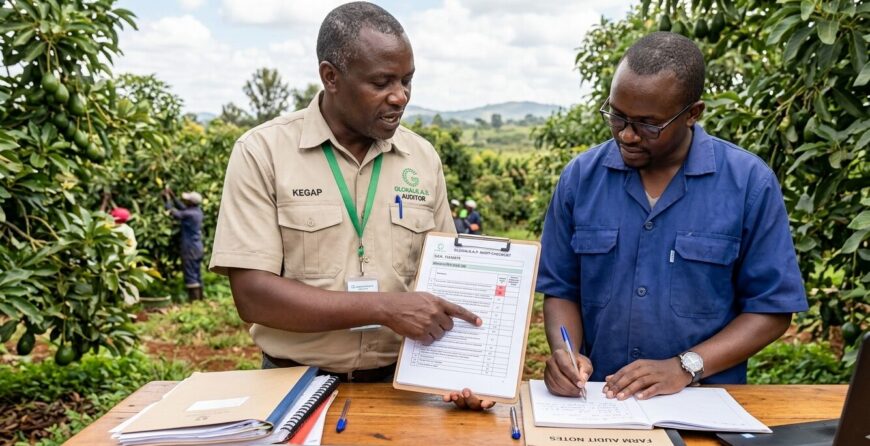
7 Farm Audit Mistakes That Cost Kenyan Farms Their GLOBALG.A.P Certification — and How to Prevent Every One
✅ Standard: GLOBALG.A.P IFA v6 | 🇰🇪 Based on: Kenyan farm audit experience | 💰 Avg. failed audit cost: KES 45,000–100,000 extra | 📅 Updated: May 2026 | ⏱ Read time: 13 minutes
In This Guide
- Key Facts — The Real Cost of Audit Failure
- Mistake 1: Retrospective Farm Records
- Mistake 2: Non-Compliant Pesticide Programme
- Mistake 3: Worker Welfare Gaps
- Mistake 4: Broken Traceability Chain
- Mistake 5: Chemical Store Non-Compliance
- Mistake 6: Missing IFA v6 New Requirements
- Mistake 7: Scheduling the Audit Too Early
- How to Self-Audit Before Your External Audit
- Frequently Asked Questions
⚡ Key Facts — The Real Cost of Audit Failure
- A failed GLOBALG.A.P audit costs KES 45,000–100,000 in additional certification body re-audit fees — plus 6–12 weeks of delayed export income during the corrective action period.
- The most common cause is not bad farming — it is preventable administrative failures: incomplete records, broken traceability chains, and unpreparred workers.
- All 7 mistakes in this guide are detectable and preventable with a structured pre-audit self-assessment conducted 6–8 weeks before the scheduled external audit.
- Retrospective records = immediate certification suspension in almost all cases. There is no corrective action period for deliberate falsification — and auditors detect it reliably.
- IFA v6 has introduced new requirements that many Kenyan farms miss — Water Risk Assessment, Biodiversity Action Plan, IPM documentation, resistance rotation records. Missing these is a non-conformance even for previously certified farms.
- Worker welfare is the highest-risk area for private interview non-conformances — workers must genuinely know their rights and the farm’s practices, not merely recite rehearsed answers.
Every GLOBALG.A.P certification audit on a Kenyan farm covers more than 200 compliance points across eight audit areas. Most Kenyan farms that fail their audit do not fail on all 200 points — they fail on a small number of specific, preventable mistakes that recur across farms and across seasons with remarkable consistency. After supporting farms and cooperatives across 12 Kenyan counties through IFA v6 certification since 2018, Agrosocial Services has identified the seven mistakes that account for the majority of Kenyan farm audit failures.
This article goes through each mistake in detail — the specific failure pattern, how certification body auditors detect it, the financial cost of the failure, and the precise prevention action that eliminates the risk. Every farm preparing for a GLOBALG.A.P audit in Kenya should work through this list as a pre-audit checklist — 6 to 8 weeks before the scheduled external audit date, while there is still time to fix every issue identified.
📩 Get our free Pre-Audit Readiness Checklist — delivered instantly
A one-page printable checklist covering all 7 audit mistake prevention actions — use it 6–8 weeks before your external audit to confirm your farm is ready. Free, instant delivery.
The Audit Failure Reality in Kenya
Most Kenyan farm audit failures are not caused by bad farming.
They are caused by preventable administrative mistakes
that a 6-week pre-audit preparation programme eliminates.
A failed audit delays your first export shipment by 6–12 weeks and costs KES 45,000–100,000 in extra certification fees. Prevention is always cheaper — and this guide gives you the prevention playbook.
Mistake 1 — Retrospective Farm Records
Severity: CRITICAL — Immediate certification refusal. No corrective action period.
Cost of failure: Immediate suspension + 12-month reapplication bar + all lost export income during the period.
The failure pattern
A farm completes its certification preparation, schedules the external audit — and realises in the final two weeks that its farm records are incomplete, inconsistent, or simply not maintained throughout the year. The farm manager, under pressure, fills in the records for the preceding months in the days before the audit arrives. The records look complete when the auditor opens the file. But experienced certification body auditors are trained specifically to detect this — and they almost always do.
How auditors detect it
- Handwriting pattern analysis: Records completed across months of genuine activity show natural variation — different pens, different pressure, different fatigue. Records completed in one or two sessions show uniform ink type, pen pressure, and handwriting angle across dozens of entries dated weeks apart.
- Stock reconciliation: The total product quantities recorded as applied are cross-checked against purchase receipts and current inventory. If the records show 12 applications of a product over the season but purchase receipts only show 2 buying events and the current stock level is implausibly high, the application records are questioned.
- Date logic checks: Spray records on dates when weather data shows heavy rainfall. PHI calculations that are internally inconsistent — a spray on date X with a 21-day PHI, and a harvest record showing harvest on date X+14. These logical inconsistencies immediately signal retrospective completion.
- Private worker interviews: Workers are asked privately how records are kept — when they are filled in, who fills them in, where the record books are kept. Workers who have genuinely been completing records answer these questions specifically and consistently. Workers whose records were completed for them give vague, inconsistent answers that contradict the records.
Prevention action
Begin completing records from Day 1 of your certification preparation — not from the week an audit is scheduled. Set up your record templates at the beginning of the certification year. Brief every spray operator, harvest supervisor, and farm manager on their specific record-keeping responsibilities. Conduct a monthly record review to identify and address gaps before they become audit failures. Our complete farm record keeping guide gives you the full system — including the Farm Records Starter Pack ($5) with pre-designed templates for all 7 required record categories.
Mistake 2 — A Non-Compliant Pesticide Programme
Severity: MAJOR — Certification failure + commercial risk of MRL violation at destination port.
Cost of failure: Re-audit fee KES 35,000–80,000 + potential MRL violation cost KES 500,000–5,000,000.
The failure pattern
A farm approaches certification without reviewing its pesticide programme against GLOBALG.A.P requirements or EU/UK/China MRL limits. The programme includes products that are PCPB-registered in Kenya but have 0.01 mg/kg default EU MRL limits — effectively zero tolerance. The farm has no Approved Pesticides List. Spray operators are applying compounds based on local agronomic advice without reference to export market requirements. The auditor reviews the pesticide application records, cross-references against the EU Pesticides Database, and identifies multiple prohibited or high-risk compounds.
Most common problem compounds on Kenyan farms
- Dimethoate / omethoate: EU MRL 0.01 mg/kg. Most commonly detected. Must be removed from all export crop programmes targeting EU/UK.
- Chlorpyrifos: Banned in EU since 2020. EU MRL 0.01 mg/kg. Still PCPB-registered in Kenya. Must be removed.
- No written IPM plan: IFA v6 requires a documented IPM plan showing evidence-based spray decisions. Calendar-based spray schedules without monitoring records are a non-conformance.
- No resistance rotation records: IFA v6 requires documented IRAC/FRAC mode-of-action rotation. Auditors check whether the same active ingredient class is being repeated without rotation.
Prevention action
Conduct a full pesticide programme review at the beginning of your certification preparation — before any records are created. Verify every active ingredient against the EU Pesticides Database. Remove all compounds with 0.01 mg/kg limits. Build your Approved Pesticides List. Write your IPM plan. Begin pest monitoring records immediately. Our complete MRL compliance guide for Kenyan export farms covers every step of this process. The Kenya Farm Audit Checklist ($35) includes a full Approved Pesticides List template aligned to IFA v6.
📖 Also read: A pesticide programme non-conformance does not just fail your audit — it may also result in an MRL violation at an EU or UK port if the wrong compound was applied to an export consignment. Our MRL compliance guide explains exactly which compounds are prohibited on each Kenyan export crop and what compliant alternatives to use.
Mistake 3 — Worker Welfare Gaps That Private Interviews Expose
Severity: MAJOR — Multiple Major Must non-conformances possible from a single farm visit.
Cost of failure: Re-audit fee + corrective action period (typically 4–8 weeks for worker welfare issues) + delayed export income.
The failure pattern
Worker welfare is consistently the most audit-sensitive area on Kenyan farms — because it is verified through a combination of documentation review, physical inspection, and private worker interviews. A farm can have perfect spray records and a compliant chemical store but fail because workers cannot demonstrate knowledge of their rights during private interviews, because the Workers’ Representative was appointed by management rather than elected by peers, or because the sanitation ratios are below minimum requirements.
The 7 most common worker welfare non-conformances on Kenyan farms
- Workers cannot demonstrate knowledge of training content during private interviews. Training attendance records exist — but when the auditor privately asks a harvest worker what food hygiene rules they were trained on, the worker cannot recall the content. Training that does not result in knowledge transfer does not satisfy IFA v6’s outcome-based requirement.
- Workers’ Representative was appointed by management. IFA v6 requires the Workers’ Representative to be elected by peers, not appointed by management. The election must be documented — date, process, and outcome — and the Workers’ Representative must be able to describe their role to the auditor independently.
- Insufficient sanitation facilities. Minimum 1 toilet per 15 workers, with separate facilities for male and female workers. Many Kenyan smallholder farms — particularly those with seasonal labour spikes at harvest — fall below this ratio during peak labour periods.
- First aid kit is inaccessible or incomplete. The first aid kit must be accessible in the field — not in the farm manager’s office. Workers must know where it is. Auditors test this during both documentation review and on-farm walk. A first aid kit that is locked in a storeroom or has expired contents is a non-conformance.
- Spray operator PPE is inadequate or damaged. Spray operators must have and use appropriate PPE: gloves, goggles, respiratory protection, overalls, and boots — specific to the hazard level of the compounds being applied. Damaged PPE, absent PPE, or PPE being used incorrectly during the farm walk immediately triggers a non-conformance.
- Payslip or payment records cannot demonstrate minimum wage compliance. Under IFA v6, payment records must be able to show the base pay rate and any deductions clearly. A farm that pays workers in cash without maintaining wage records cannot demonstrate minimum wage compliance — regardless of what the farm manager claims to pay.
- Children working in prohibited activities. Zero tolerance. Any evidence of workers involved in pesticide application or hazardous activities without verified age documentation (National ID) is an immediate Critical non-conformance.
Prevention action
Conduct a worker welfare pre-audit assessment 8 weeks before the external audit. Walk through every worker welfare requirement physically — count toilet facilities against current labour numbers, check PPE condition, confirm the first aid kit is field-accessible and complete, verify the Workers’ Representative election was properly documented. Then conduct brief knowledge-check conversations with 3–5 workers privately — the same questions the auditor will ask. If workers cannot answer them — conduct a training refresher session before the audit is scheduled.
Mistake 4 — A Broken Traceability Chain That Fails the Mock Recall
Severity: CRITICAL — Mock recall failure is a Critical non-conformance under IFA v6.
Cost of failure: Immediate certification failure + re-audit + 6–12 week delay.
The failure pattern
The mock recall test under IFA v6 requires a farm to trace any packed lot of produce from the buyer invoice back to the specific field, harvest date, spray records, water test results, and soil management records within 15 minutes. The most common reason this test fails on Kenyan farms is not that records are missing — it is that the same field is called different things in different record types.
A field called “Block A” in spray records, “North Field” in harvest records, and “the avocado section” in the fertiliser records — and labelled with lot number “Lot 23” on the packed produce label with no reference to any field code — creates an untraceable chain. The auditor cannot link the packed lot to any specific spray record. This is a Critical non-conformance regardless of how compliant the actual farming practices are.
Prevention action
Establish your field code system before setting up any other record. Assign one unique code to each production area. Use that exact code in every record type — pesticide records, fertiliser records, harvest records, and produce lot labels. Then practice the mock recall yourself before the audit: take a recent packed box lot number and trace it back through your records to the specific field, spray records, and water test. Time yourself. If it takes more than 10 minutes — reorganise your records file. See our complete farm records guide for the full traceability system setup — including the field code map and lot number system that passes the IFA v6 15-minute mock recall test.
Mistake 5 — A Non-Compliant Chemical Store
Severity: MAJOR — Multiple checkpoints in a single area. One of the most audited physical areas on every farm.
Cost of failure: Re-audit after infrastructure upgrade — typically KES 25,000–60,000 upgrade cost + re-audit fee.
The failure pattern
The chemical store is one of the first areas a GLOBALG.A.P auditor visits during the farm walk — because it covers multiple compliance points simultaneously: storage conditions, segregation, secondary containment, ventilation, security, MSDS access, and inventory management. Many Kenyan farms store pesticides in spaces originally designed for other purposes — a corner of a general storeroom, a section of the farm office, or an unlocked structure that also holds harvest equipment. None of these arrangements satisfy GLOBALG.A.P requirements.
The GLOBALG.A.P IFA v6 chemical store requirements
- Dedicated, lockable structure: Pesticides must be stored in a dedicated space — not shared with food, PPE, fertilisers (unless separately contained), or personal items. The store must be lockable and access must be restricted to authorised persons.
- Bunded floor: The floor must have a bund or lip capable of containing a spill equal to 110% of the largest single container in the store. Most Kenyan smallholder chemical stores do not have bunded floors — this is the most common single physical non-conformance across all farm types.
- Ventilation: Both high-level and low-level ventilation is required to prevent vapour accumulation. A store with only a single opening or a single ceiling vent is non-compliant.
- MSDS (Material Safety Data Sheets) accessible: MSDS sheets for every stored product must be immediately accessible in the store. Laminated copies on the store wall are ideal. Digital copies on a farm manager’s phone accessible during an emergency satisfy the requirement if demonstrated to the auditor.
- Secondary containment for liquid products: Liquid pesticide products must be stored in secondary containment — a spill tray or bunded shelf section — capable of catching leaks from damaged containers.
- No food, water, or PPE stored with pesticides: Food, drinking water, personal items, and PPE (other than dedicated spray PPE in a segregated section) must not be in the chemical store.
- Prohibition signage: “No Smoking,” “No Eating or Drinking,” “Authorised Access Only,” and chemical hazard symbols must be displayed on or near the store entrance.
Prevention action
Physically inspect your chemical store against this list 8 weeks before the audit. The most common upgrade required on Kenyan farms is bunding — adding a concrete lip or sealed tray system to the store floor. This is a one-day task for a local builder at a cost of KES 5,000–15,000 for a typical small farm store. Ventilation improvements (adding a low-level vent) and signage are also low-cost, high-impact upgrades. Infrastructure improvements take time — do not leave this until the week before the audit.
Mistake 6 — Missing the New IFA v6 Requirements
Severity: MAJOR — Multiple Major Must non-conformances from a single gap area. Particularly affects farms renewing from IFA v5.
Cost of failure: Corrective action period + re-audit + all delayed export income.
The failure pattern
Kenyan farms that were previously certified under IFA v5.2 and are renewing under IFA v6 for the first time sometimes approach the renewal as if the standard is largely unchanged. It is not. IFA v6 introduced several substantive new requirements that v5 farms did not need to meet. Farms that do not specifically identify and address these new requirements arrive at their re-certification audit with gaps that they are entirely unaware of.
The 5 IFA v6 requirements most commonly missed by Kenyan farms renewing from v5
New Requirement 1 — Water Risk Assessment (not just lab results)
Under v5, a folder of water test certificates was sufficient evidence of water quality compliance. Under IFA v6, a Water Risk Assessment document is additionally required — identifying all water sources, assessing upstream contamination risks, and linking the assessment to water management decisions. Many Kenyan farms still submit only lab results and wonder why the auditor raises a non-conformance. Add the Water Risk Assessment — it is a one-day document preparation task, not a complex exercise.
New Requirement 2 — Biodiversity Action Plan
IFA v6 requires a documented Biodiversity Action Plan identifying key habitats on or adjacent to the farm and documenting conservation actions. This does not need to be a complex ecological study — identifying 3–5 habitats (a forest patch, a stream, a hedgerow) and stating conservation measures (no clearing, buffer zone maintenance) in a signed, dated document satisfies the requirement. This document simply did not exist as a requirement under v5 and is frequently absent on first v6 renewal audits.
New Requirement 3 — Written IPM Plan with Pest Monitoring Records
Under v5, pest management records focused on what products were applied. Under IFA v6, farms must additionally maintain a written IPM plan showing monitoring-based spray decisions and resistance rotation by mode of action. Calendar-based spray programmes without scouting data explicitly fail the v6 IPM requirement. Begin pest monitoring records and write the IPM plan at the start of your certification year — not as a pre-audit document preparation activity.
New Requirement 4 — Self-Assessment Must Include Comments on N/A and Non-Compliant Items
Under v5, a completed tick-box self-assessment was largely sufficient. Under IFA v6, self-assessments must include written comments explaining why any criterion is marked Not Applicable, and must log a corrective action against any non-compliant criterion. A self-assessment with all ticks and no comments is not sufficient under v6 — and a self-assessment with zero non-conformances across 200+ criteria is a red flag to auditors that the self-assessment was not rigorous.
New Requirement 5 — Energy Monitoring Records
IFA v6 requires farms to monitor and record energy consumption — electricity, diesel, LPG — and document year-on-year efficiency improvement targets. Under v5, energy monitoring was not explicitly required for most Kenyan farms. Begin recording monthly energy consumption immediately and identify at least one efficiency improvement target.
Prevention action
Use the GLOBALG.A.P free transition tools at globalgap.org to compare your v5 CPCCs against their v6 P&C equivalents side by side. Identify every v6 requirement that is new or significantly changed from your previous v5 compliance. Read our complete IFA v6 Transition Guide for Kenyan Farms which explains every material change from v5 to v6 in plain language. Our Kenya Farm Audit Checklist ($35) is fully aligned to IFA v6 and specifically flags which requirements are new since v5.
📖 Also read: Our IFA v6 Transition Guide for Kenyan Farms covers every structural and substantive change from IFA v5 — including the Water Risk Assessment, Biodiversity Action Plan, IPM documentation, and energy monitoring requirements that most commonly surprise farms on their first v6 audit.
Mistake 7 — Scheduling the External Audit Before the Farm Is Ready
Severity: MAJOR — The most avoidable and most expensive mistake. Entirely within the farm’s control.
Cost of failure: Full re-audit fee + corrective action period + delayed export season income.
The failure pattern
A cooperative or farm commits to a target certification date — often driven by a buyer’s requirement or a development programme timeline — and schedules the external audit to meet that date, regardless of whether the farm is genuinely ready. The audit date is set. The certification body confirms. The farm arrives at the audit with open corrective actions from the internal inspection, laboratory results still pending, infrastructure upgrades incomplete, or IFA v6 new documents not yet created.
This is the most expensive and most avoidable mistake on the list — because it is entirely within the farm’s control. A certification body’s audit scheduling has 2–4 week lead times. Postponing the audit by 3–4 weeks to ensure readiness costs nothing. Proceeding with a premature audit and failing costs KES 45,000–100,000 in re-audit fees plus the corrective action period.
The specific conditions that must be met before scheduling the external audit
- All water quality test results received and confirmed compliant — or corrective action completed and retested.
- All internal inspection non-conformances resolved and documented as complete.
- All IFA v6 new requirement documents created: Water Risk Assessment, Biodiversity Action Plan, IPM Plan, energy monitoring records started.
- Chemical store infrastructure upgrades complete — bunding, ventilation, signage.
- Workers’ Representative election properly documented.
- Mock recall test practiced and confirmed completable within 10 minutes.
- All spray operators trained on updated IPM programme and PPE requirements — with signed training records.
Prevention action
Run the pre-audit readiness assessment in this article 6–8 weeks before your target audit date. If any item is not confirmed complete, postpone the audit by as many weeks as needed to complete it. Communicate the postponement to your certification body as soon as possible — they have scheduling flexibility in most cases and will reschedule without penalty if notified early. A farm that postpones its audit by 3 weeks and then passes on first attempt is commercially ahead of a farm that keeps its original date and fails.
How to Self-Audit Before Your External Audit — The 6-Week Pre-Audit Programme
The most effective way to prevent all seven mistakes in this guide is a structured pre-audit self-assessment conducted 6–8 weeks before the scheduled external audit. Six weeks is the right window — close enough to the audit that the assessment reflects your actual audit-day state, but far enough before it that every issue identified can be resolved before the auditor arrives.
Week 6–7 before audit: Records review
Pull every farm record file. Check for completeness — are all 7 record categories present? Check for consistency — do all records use the same field codes? Check for contemporaneity — are there obvious gaps or blocks of entries that appear to have been completed at the same time? Conduct the mock recall test and time it. If any issue is found — fix it now while there are 6+ weeks remaining.
Week 5–6 before audit: Pesticide programme check
Review your Approved Pesticides List against the current EU Pesticides Database. Verify all currently stocked products are on the list. Check that IPM monitoring records are current. Verify resistance rotation has been followed as documented. If any product has been used that is not on the APL or has a prohibited EU MRL — document the issue, implement the correction, and allow time for any residue to clear before the audit.
Week 4–5 before audit: Physical farm inspection
Walk the chemical store against the full requirements checklist. Check the first aid kit — location, accessibility, contents, expiry dates. Count toilets against current labour numbers. Check PPE for every spray operator — condition, completeness, correct specification. Walk the farm boundaries — check buffer zones, waste disposal areas, water source conditions. Any physical issue found now — 4–5 weeks before the audit — can be corrected in time.
Week 3–4 before audit: IFA v6 new document check
Confirm the Water Risk Assessment exists, is signed, and is dated within the current certification year. Confirm the Biodiversity Action Plan exists. Confirm the IPM plan is current and referenced by current monitoring records. Confirm energy consumption records are being maintained. Confirm the self-assessment is complete with comments on N/A and non-compliant items. Any missing document at this stage — write it now. These are all 1–2 day document preparation tasks.
Week 2–3 before audit: Worker welfare verification
Conduct private knowledge-check conversations with 5–6 workers — the same questions the auditor will ask. If workers cannot answer — conduct a training refresher session immediately. Verify the Workers’ Representative election is documented with date, process, and the elected person’s name. Check wage records — confirm minimum wage compliance is demonstrable from the records, not just from verbal confirmation.
Week 1–2 before audit: Final readiness confirmation
Confirm all issues identified in weeks 2–7 are resolved and documented. Organise your records file so all documents for each audit area are clearly sectioned and immediately accessible. Brief key farm staff on the audit day process — who will accompany the auditor, who will respond to documentation requests, who will manage worker interview scheduling. If any significant unresolved issue remains — contact your certification body to discuss postponement.
📋 Use the Same Checklist Our Auditors Use — Before the Certification Body Auditor Arrives
The Kenya Farm Audit Checklist is built on the IFA v6 P&C framework — 200+ checklist items across all 8 audit areas with Critical, Major, and Minor classifications, 2026 auditor tips, and an integrated corrective action plan template. It is the exact same framework certification body auditors use to assess Kenyan farms. Running it on your own farm 6–8 weeks before your external audit tells you exactly what the auditor will find — giving you time to fix every issue before it becomes a failed audit. Instant download, M-Pesa accepted.
Download Kenya Farm Audit Checklist — $35 / KES 3,500 →
Complete Starter Kit — $59
Book a Pre-Audit Gap Assessment — Catch Every Issue Before the Auditor Does
Agrosocial Services conducts professional pre-audit gap assessments for Kenyan farms and cooperatives across Kiambu, Meru, Nakuru, Embu, Machakos, and Kisii. Our consultants use the same assessment framework as certification body auditors — giving you a complete picture of your farm’s readiness 6–8 weeks before the external audit, with time to fix every issue identified. Our pre-audit assessment clients have achieved first-time certification at significantly higher rates than farms that self-prepare alone.
Frequently Asked Questions
What is the most common reason Kenyan farms fail GLOBALG.A.P audits?
Incomplete or retrospective farm records — records that were not maintained throughout the certification year but completed in the weeks before the audit. This is consistently the most common cause of audit failure across all Kenyan farm types. Certification body auditors detect it reliably through handwriting analysis, stock reconciliation, date logic checks, and worker interviews. Retrospective records result in immediate certification refusal — not a corrective action period. See our complete farm records guide for the contemporaneous record system that prevents this failure.
How do auditors detect that pesticide records were filled in retrospectively?
Four methods: (1) Handwriting pattern analysis — uniform pen and pressure across months of entries; (2) Stock reconciliation — total applied quantities versus purchase receipts and current inventory; (3) Date logic cross-checks — spray on dates that contradict weather records or PHI calculations that are internally inconsistent with harvest records; (4) Worker interview cross-checks — workers privately asked when and how records are completed give vague, inconsistent answers if records were completed for them.
What happens if my farm fails a GLOBALG.A.P audit in Kenya?
The certification body issues a non-conformance report. Major Must non-conformances have a 28-day corrective action deadline. A re-audit may be required at the farm’s expense (KES 35,000–80,000 in re-audit fees). Total time from failed audit to receiving a certificate is typically 6–12 weeks. If the failure is due to deliberate record falsification, the farm is immediately suspended and typically barred from reapplying for 12 months. To avoid this outcome, book a pre-audit gap assessment with Agrosocial Services 6–8 weeks before your scheduled audit. Contact us →
How long does it take to correct a failed GLOBALG.A.P audit in Kenya?
Major Must corrective actions have a 28-day deadline; Minor Must have 60 days. If a re-audit is required to verify corrections, add 2–4 weeks for scheduling. Total time from failed audit to receiving a certificate: typically 6–12 weeks for farms that respond promptly and comprehensively. Farms that delay corrective actions or implement incomplete fixes face a second failed audit and longer delays. The Kenya Farm Audit Checklist includes a corrective action plan template to manage this process systematically.
Can a farm that has previously failed certification still achieve GLOBALG.A.P?
Yes — unless the failure was due to deliberate record falsification (12-month bar). For farms that failed due to genuine compliance gaps, there is no bar on reapplying after implementing genuine corrective actions. Many Kenyan farms that failed their first certification subsequently achieved it on re-audit. The key is identifying the root cause of every non-conformance, implementing genuine corrections, verifying those corrections are sustained before the re-audit, and — critically — not scheduling the re-audit until you are genuinely ready.
What are the most common worker welfare failures on Kenyan farm GLOBALG.A.P audits?
The 7 most common: (1) Workers cannot demonstrate knowledge of training content during private interviews; (2) Workers’ Representative appointed by management rather than elected by peers; (3) Insufficient sanitation facilities — below 1 toilet per 15 workers; (4) First aid kit inaccessible in the field or incomplete; (5) Spray operator PPE inadequate or damaged; (6) Payment records cannot demonstrate minimum wage compliance; (7) Evidence of underage workers in hazardous activities. All 7 are preventable with a structured worker welfare pre-audit assessment 6–8 weeks before the external audit.
What should farm workers know before a GLOBALG.A.P audit?
Workers should be able to honestly and confidently answer: What to do if they observe a food safety risk. How to correctly use spray PPE. Where the first aid kit is located. Who their Workers’ Representative is and how they were selected. What food hygiene rules they were trained on. Where to report a workplace complaint. These must be genuinely known — not memorised for the audit. Auditors specifically test whether answers are authentic versus rehearsed by cross-checking worker interview answers against each other and against observable farm practices. Conduct knowledge-check conversations with workers 2–3 weeks before the audit and address any gaps immediately with training refreshers.
What does a GLOBALG.A.P auditor look for during the farm walk in Kenya?
During the farm walk, auditors specifically observe: chemical store conditions (bunding, ventilation, lock, MSDS, no mixed storage); pesticide storage segregation; field hygiene (no open containers, no improper waste disposal); harvest hygiene (clean bins, no contamination near harvest); worker welfare facilities (toilets, handwashing, first aid accessibility); irrigation water source conditions and buffer zones; evidence of field boundary markers and GPS-consistent farm map; required signage. Any physical observation that contradicts record entries — a field recorded as sprayed that shows no spray evidence, or a farm map that does not match actual field layout — is immediately flagged. The farm walk is a cross-verification of your records against physical reality.
Key Takeaways — Share With Your Farm Manager and Cooperative Internal Inspector
- Most Kenyan farm audit failures are preventable — the 7 mistakes in this guide account for the majority of failed audits and are all addressable 6–8 weeks before the external audit.
- Retrospective records = immediate certification refusal. There is no corrective action period. Begin records on Day 1 of certification preparation and maintain them throughout the year.
- Worker private interviews expose training gaps that attendance records hide. Test your workers’ knowledge 2–3 weeks before the audit and refresh training immediately if needed.
- The broken traceability chain is almost always caused by inconsistent field codes — the same field called different things in different records. Fix field coding before setting up any other record type.
- Chemical store bunding is the most common single physical non-conformance on Kenyan farms. It costs KES 5,000–15,000 to fix. Do it early — not the week before the audit.
- IFA v6 has 5 new requirements that v5 farms commonly miss: Water Risk Assessment, Biodiversity Action Plan, written IPM plan, self-assessment comments, energy monitoring. Check all 5 against your current documentation.
- Never schedule the external audit until you are ready. Postpone by 3–4 weeks if needed — it is always cheaper than a failed audit.
- The Kenya Farm Audit Checklist ($35) lets you run the same assessment the certification body auditor will run — 6 weeks early, when you still have time to fix everything found.
Is Your Farm Ready for Its GLOBALG.A.P Audit?
Book a professional pre-audit gap assessment with Agrosocial Services — or download the Kenya Farm Audit Checklist to run the assessment yourself. Either way, find out what the auditor will find before the auditor arrives.
Related Resources from Agrosocial Services
Audit and compliance: 5 Audit Process Mistakes on Audit Day · Farm Record Keeping Guide · MRL Compliance Guide · IFA v6 Transition Guide
Certification guides: GLOBALG.A.P Certification Kenya · Certification Cost Guide · Group Certification for Cooperatives · Is Certification Worth the Cost?
Crop export guides: Avocado Export Kenya · French Bean Export Kenya · Mango Export Kenya · Passion Fruit Export Kenya
County consultants: Nairobi · Kiambu · Nakuru · Meru · Machakos · Embu · Kisii
Agrosocial Services Limited is Kenya’s specialist agricultural certification and export market consultancy, serving farms, cooperatives, and agri-exporters across 12 counties since 2018. Our consultants have conducted pre-audit gap assessments on hundreds of Kenyan farms and cooperatives — the 7 mistakes in this article reflect patterns observed directly across real Kenyan farm audits from 2018 to 2026. For a professional pre-audit gap assessment for your farm, contact us at info@agrosocialservices.co.ke or WhatsApp +254 725 042 234. Last reviewed: May 2026.