How to Export Roses from Kenya 2026 — FCM Compliance, GLOBALG.A.P, MPS, Rainforest Alliance & Complete Market Guide
🌹 Crop: Cut Roses | 🌍 Markets: Netherlands · UK · Germany · Japan · Middle East | ✅ Certification: GLOBALG.A.P · MPS-ABC · Rainforest Alliance · FCMSA | 📦 Export: Year-Round | ⏱ Read time: 20 min | 📅 Updated: June 2026
⚠️ TWO URGENT DEVELOPMENTS FOR KENYAN ROSE FARMS EXPORTING TO THE EU IN 2026
EU Regulation 2024/2004 (FCM) — in force since April 26, 2025. Every Kenyan rose farm exporting to the EU must now operate the validated Rose FCM Systems Approach (FCMSA). Without FCMSA enrolment, EU border inspection is elevated toward 25% — compared to the standard 1% for enrolled, compliant farms. In 2024, FCM interceptions caused 95 EU shipment rejections and the destruction of over 2.1 million Kenyan rose stems. FCMSA enrolment is not optional. It is the new baseline for every EU rose exporter. · Royal FloraHolland MPS scoring changes 2025 now actively penalise farms that are not enrolled in FCMSA, regardless of their existing MPS grade. Your auction positioning is at risk if you are not enrolled. Contact Agrosocial to start FCMSA enrolment now →
In This Guide
- Kenya as a Global Rose Exporter
- 7 Export Requirements for Rose Farms
- FCM & EU Regulation 2024/2004 — FCMSA
- GLOBALG.A.P, MPS & Rainforest Alliance
- Rose Varieties Buyers Specify
- Export Markets — Auction, UK, Japan, ME
- Step-by-Step Certification Process
- Certification Costs for Rose Farms
- 4 Mistakes That Kill Export Relationships
- Frequently Asked Questions
⚡ Key Facts — Rose Export Kenya 2026
- Kenya supplies over 35% of all roses sold through the Dutch auction — the world’s largest cut flower trading platform. Year-round production, 24-hour airfreight to Amsterdam, and exceptional stem length and vase life make Kenya’s roses the benchmark for EU buyers.
- The price gap between auction supply and direct buyer supply is KES 15–35 per stem. A farm producing 500,000 stems per year moving from Dutch auction to direct UK supermarket supply gains KES 7.5–17.5 million in additional annual revenue — from the same flowers, the same farm, and the same season.
- FCM Systems Approach is mandatory since April 26, 2025. EU Regulation 2024/2004 — zero tolerance for False Codling Moth. Without FCMSA enrolment, border inspection rises to 25%. In 2024, 2.1 million Kenyan rose stems were destroyed due to FCM interceptions. This is the most urgent single compliance action for any Kenyan rose exporter.
- The certification stack for roses is the most complex of any Kenyan export crop. Three overlapping schemes — GLOBALG.A.P. (food safety baseline), MPS-ABC (environmental sustainability, Dutch auction), Rainforest Alliance (social/environmental, UK supermarkets) — each targeting different buyers. The right sequencing saves months and hundreds of thousands of shillings.
- Fairtrade rose certification commands €0.05–0.15 per stem premium in German and Dutch ethical retail channels — a meaningful additional income layer for certified cooperatives with the right buyer relationships.
- Kenya’s rose export infrastructure is the most developed of any agricultural export sector — established cold chain from farm to Amsterdam overnight, multiple licensed exporters, and strong Royal FloraHolland relationships built over 40 years. New entrants benefit from this infrastructure immediately after certification.
Kenya is the world’s third largest cut flower exporter — supplying over 35 percent of all roses sold through the Dutch auction system and exporting directly to buyers in the UK, Germany, Japan, and across the Middle East. Kenyan roses are internationally recognised for their exceptional stem length, vase life, and colour intensity — qualities produced by Kenya’s unique combination of high altitude, equatorial sunshine, and cool temperatures around Lake Naivasha and the slopes of Mount Kenya.
Yet despite Kenya’s dominant position in global rose trade, many Kenyan rose farms — particularly small and medium-scale operations — still face significant barriers to accessing premium export markets directly. The difference between supplying the Dutch auction through a Nairobi exporter at discounted rates and supplying a direct buyer in Germany or the UK at contracted prices can exceed KES 30 per stem — across a farm producing 500,000 stems per year, that is KES 15 million in additional annual revenue.
This guide covers everything a Kenyan rose farm, cooperative, or smallholder cut flower producer needs to know to access international markets directly — from FCM compliance and GLOBALG.A.P. certification through to finding buyers, managing export documentation, and understanding the Dutch auction system.
Agrosocial provides rose farm certification support across Kenya’s main growing areas: Nakuru (Naivasha) · Kiambu (Thika) · Meru (Timau). Cut flower export overview: Kenya Cut Flower Export & FCM Compliance — Complete Guide.
📩 Free: Kenya Rose Export Compliance Checklist 2026 — straight to your inbox
FCMSA enrolment requirements, GLOBALG.A.P. rose farm checklist, MPS-ABC environmental data collection template, Rainforest Alliance worker welfare requirements, and EU MRL pesticide list for roses. Free, instant delivery.
Kenya as a Global Rose Exporter — Scale, Infrastructure & Why Kenya Dominates
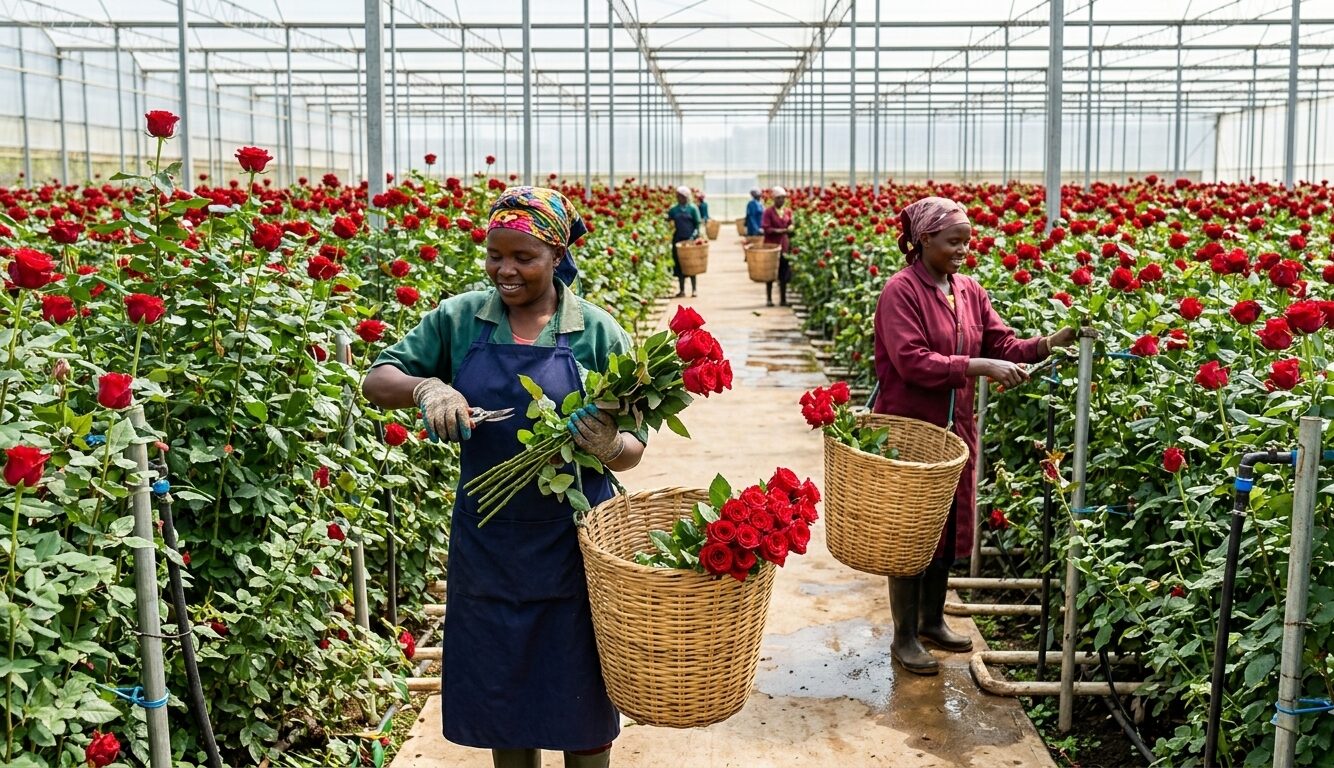
Kenya’s cut flower industry is centred primarily around Lake Naivasha in Nakuru County — home to some of the world’s largest and most technologically advanced rose farms. The altitude of 1,880 metres above sea level, combined with equatorial sunshine delivering 12 hours of daylight year-round, creates ideal conditions for continuous rose production without seasonal interruption. Kenya’s rose farms can harvest and deliver roses to Amsterdam within 24 hours of cutting — a supply chain speed that few other producing countries can match.
Beyond the large commercial estates around Naivasha, rose production is expanding to smaller farms in Thika (Kiambu County), the Timau area of Meru County, and parts of Nakuru County. Smallholder and medium-scale rose producers increasingly supply Nairobi-based exporters and are beginning to explore direct export relationships as certification becomes more accessible through group schemes and cooperative structures.
Why Kenyan Roses Command the World’s Attention — and the Premium Hidden in Every Stem
Kenya supplies 35%+ of all roses sold through the Dutch auction.
KES 15–35 more per stem: direct buyer vs Dutch auction supply.
500,000 stems/year × KES 25 premium = KES 12.5 million additional annual revenue.
The math of rose export certification is compelling. A Kenyan rose farm supplying the Dutch auction through a Nairobi exporter receives net prices after commission, airfreight, and auction charges that leave margins of KES 4–8 per stem. The same farm, certified and supplying a UK supermarket buyer directly under a contracted price agreement, receives KES 25–40 per stem. GLOBALG.A.P, MPS, and Rainforest Alliance certification — total first-year investment KES 400,000–900,000 for all three combined — is recovered within 1–2 export seasons from the direct-buyer price premium alone. Every subsequent season is pure premium income from the same farm, the same workers, and the same flowers.
See our complete guides for other Kenyan export crops: avocado export · French bean export · mango export · passion fruit export. For the full flower-sector compliance stack see our cut flower export pillar.
7 Export Requirements for Kenyan Rose Farms — What You Must Have Before Your First Shipment
The certification landscape for roses is more complex than for fresh produce — with multiple overlapping schemes targeting different buyer channels. Understanding which requirements apply to your target market before investing in certification saves months and significant cost.
1. HCD Farm Registration & KEPHIS Exporter Registration
Every farm exporting cut flowers from Kenya must be registered with the Horticultural Crops Directorate (HCD) under AFA, and the exporting entity must hold a valid HCD Export Licence and KEPHIS exporter registration. KEPHIS phytosanitary certificates — required per shipment — are only issued to registered exporters with active phytosanitary management programmes documented in KEPHIS-audited systems.
Governing body: HCD (AFA) + KEPHIS · Renewal: Annual · Guide: Register a Cooperative for Export Kenya
2. GLOBALG.A.P. IFA v6 Certification
GLOBALG.A.P. for cut flowers covers the same eight audit areas as fresh produce — site management, worker welfare, pesticide management, water quality, soil management, harvest and post-harvest handling, waste management, and environmental compliance. For rose farms, pesticide management and worker welfare are the most scrutinised areas given intensive greenhouse production and significant chemical use. Most European direct buyers require GLOBALG.A.P. as the baseline — without it, no Kenyan rose farm can access these channels regardless of quality.
Standard: GLOBALG.A.P. IFA v6 · Renewal: Annual · Full guide: GLOBALG.A.P. Certification Kenya
3. MPS-ABC Environmental Certification
MPS — Milieu Programma Sierteelt — is the sustainability certification specific to ornamental horticulture and the primary commercial requirement for Dutch auction supply. MPS-ABC assesses environmental performance across four categories: crop protection chemicals, fertilisers, water use, and energy consumption. Royal FloraHolland gives preferential auction positioning to MPS-certified farms — higher MPS scores mean better clock positioning, directly affecting prices achieved. MPS is not legally required but is commercially essential for Dutch auction supply. For the full grading system and Grade A optimisation strategy, see our MPS-ABC certification guide.
Grades: A (best) → D · Data collection: 3–4 months minimum before audit · Required by: Royal FloraHolland auction buyers
4. Rainforest Alliance Certification
Rainforest Alliance certification for cut flowers is required by UK supermarket buyers including Marks & Spencer, Sainsbury’s, and Tesco. The standard covers environmental management, worker welfare, community relations, and biodiversity. Many Kenyan rose farms hold both GLOBALG.A.P. and Rainforest Alliance simultaneously to access both Dutch auction and direct UK supermarket channels. The two certifications share many documentation requirements — combined preparation is more efficient than sequential. Full guide: Rainforest Alliance Certification Kenya.
Required by: M&S, Sainsbury’s, Tesco, Waitrose · Timeline: 5–7 months · Fairtrade premium: €0.05–0.15/stem (German/Dutch ethical retail)
5. ⚠️ Pesticide Compliance & EU MRL Management
Pesticide management is the most critical technical compliance area. The EU enforces Maximum Residue Limits for pesticide active ingredients on cut flowers — and while roses are not consumed, MRL exceedances at European ports result in shipment rejection and regulatory scrutiny affecting the entire Kenyan rose sector. Every farm must operate a documented pesticide programme using only EU-approved active ingredients at approved rates, with complete application records for every spray event (9 mandatory fields). Commission produce residue testing at a KENAS-accredited laboratory before major export shipments and whenever changing pesticide chemistry.
Check EU Pesticides Database before every application: ec.europa.eu/food/plant/pesticides/eu-pesticides-database
6. Phytosanitary Certification — Thrips, Spider Mites & Diseases
Every rose export consignment requires a KEPHIS phytosanitary certificate after physical inspection confirming freedom from regulated pests and diseases. For roses, primary phytosanitary concerns are Western Flower Thrips, spider mites, and fungal diseases. A documented integrated pest management programme — with weekly monitoring records — is required for consistent phytosanitary clearance. Book KEPHIS inspection at least 48 hours before shipment departure. Thrips interception at a European port causes immediate rejection and KEPHIS investigation.
Book KEPHIS: 48 hours before departure · Japan: strictest thrips inspection of any export market
7. ⚠️ Rose FCM Systems Approach (FCMSA) — Mandatory Since April 26, 2025
The most urgent new requirement for every Kenyan rose exporter. Since April 26, 2025, EU Regulation 2024/2004 enforces zero tolerance for False Codling Moth (FCM) on all fresh-cut roses from Kenya. Farms not enrolled in the validated FCMSA face elevated EU border inspection toward 25% — versus 1% for enrolled, compliant farms. In 2024, FCM interceptions caused 95 EU shipment rejections and the destruction of over 2.1 million Kenyan rose stems.
Full FCMSA protocol below ↓ · Full guide: Kenya Cut Flower Export & FCM Compliance Guide
False Codling Moth & EU Regulation 2024/2004 — The FCMSA Is Now the Decisive Rose Requirement
The FCM Numbers That Every Kenyan Rose Exporter Must Understand
95 EU shipment rejections from Kenya in 2024 due to FCM.
2.1 million Kenyan rose stems destroyed at EU ports in 2024.
25% border inspection without FCMSA vs 1% with FCMSA enrolment.
EU Regulation 2024/2004 — zero tolerance. In force since April 26, 2025.
False Codling Moth (Thaumatotibia leucotreta) is endemic in Kenya and can lay eggs in rose buds that survive transit and are found at EU border inspection. The EU’s response — Regulation 2024/2004 — is zero tolerance and elevated inspection rates for any Kenyan exporter not enrolled in the validated Rose FCM Systems Approach. A single FCM interception costs the exporter the entire consignment value, triggers a KEPHIS investigation, and raises inspection rates for all subsequent shipments. The Rose FCMSA — combining pheromone monitoring, biological control agents, greenhouse exclusion screening, a compliant spray programme, and cold-chain suppression — is the validated protocol that reduces FCM risk to a level where 1% inspection rates apply. Without it, at 25% inspection, every fourth consignment is delayed at the EU border.
What the Rose FCM Systems Approach (FCMSA) requires:
Pheromone trap monitoring
Delta traps baited with FCM sex pheromone installed at correct density. Weekly trap checks with documented moth count records maintained throughout the season. Monitoring records are the first document EU inspectors request.
Biological control
Application of Cryptophlebia leucotreta granulovirus (CrleGV) or egg parasitoid Trichogramma spp. at the prescribed rate and timing. Application records must include product, dose, date, and field. Biological control is what distinguishes FCMSA-enrolled farms from farms relying on chemistry alone.
Greenhouse exclusion
Physical exclusion screens on all openings (vents, doorways, water inlets) to prevent adult moth entry into growing structures. Screen mesh specifications are defined in the FCMSA protocol. Condition of screens is checked during KEPHIS system audits.
Compliant spray programme
Chemical interventions using only FCMSA-approved active ingredients at approved rates and intervals. The FCMSA spray schedule is separate from the broader pesticide programme — products must be specifically listed in the EU’s authorised list for FCM control on roses.
Cold-chain suppression
Maintenance of the defined cold chain from packhouse to aircraft: roses held at ≤2°C for a validated minimum period before loading. Temperature records throughout the cold chain must be retained per consignment. Cold-chain disruption renders the FCMSA non-compliant for that batch.
📖 Also read: Kenya Cut Flower Export & FCM Compliance — Complete Guide — the full FCMSA protocol, enrolment steps, KEPHIS audit requirements, and HCD FCM registration process. · MPS-ABC Certification Kenya — the full environmental sustainability certification for Dutch auction supply, including Grade A optimisation.
GLOBALG.A.P, MPS & Rainforest Alliance — Which Certification for Which Market Channel
Understanding which certifications your target buyers require — before investing in any of them — is the most important strategic decision a Kenyan rose farm will make. The three main certification schemes target different but overlapping buyer channels, and the right sequencing saves 6–12 months compared to pursuing them in the wrong order.
| Target Channel | Primary Certification | Additional Required | Recommended Sequence |
|---|---|---|---|
| Dutch auction (Royal FloraHolland) | MPS-ABC (commercial necessity) | GLOBALG.A.P. increasingly required. FCMSA mandatory. | Start MPS data collection + FCMSA immediately. GLOBALG.A.P. in parallel. |
| UK supermarket direct supply | GLOBALG.A.P. + Rainforest Alliance | GRASP (social compliance add-on). FCMSA mandatory for EU-routed supply. | GLOBALG.A.P + RA combined programme. GRASP at GLOBALG.A.P. audit visit. |
| Germany / continental EU direct | GLOBALG.A.P. + MPS | Fairtrade for premium ethical retail channel. FCMSA mandatory. | GLOBALG.A.P + MPS simultaneously. Fairtrade as third step if volume justifies. |
| Japan | GLOBALG.A.P. + strict quality specs | Stringent thrips inspection — best-in-class IPM programme required. | GLOBALG.A.P. first. Build thrips IPM records for 1 full season before attempting Japan. |
| Middle East (UAE, Saudi, Qatar) | Basic food safety + KEPHIS cert | GLOBALG.A.P. preferred but not always mandatory. | Good entry market while building certification. Less stringent, growing demand. |
MPS-ABC Grade System — What Each Grade Means for Your Auction Positioning
| Grade | Environmental Performance | RFH Auction Positioning | Target Strategy |
|---|---|---|---|
| A | Lowest chemical input, highest water/energy efficiency | Best clock positioning. Premium buyers actively seek Grade A farms. | Biological control, drip irrigation, solar, IPM over chemistry |
| B | Good performance — above-average chemical management | Good positioning. Acceptable to most auction buyers. | Transition goal for most Kenyan farms starting MPS |
| C | Average performance | Standard positioning — no RFH premium benefit | Starting grade for new farms. Build improvement plan to reach B/A |
| D | Below average — high chemical, water, or energy use | Penalised positioning. Some buyers exclude Grade D farms. | Immediate corrective action plan required. Do not enter auction at Grade D. |
📖 Also read: GLOBALG.A.P. Certification Kenya — Complete Guide — full IFA v6 requirements, certification process, and group certification for rose farm cooperatives. · Rainforest Alliance Certification Kenya — full SAS 2020 standard guide for cut flowers and UK supermarket supply. · GRASP Certification Kenya — social compliance add-on required by UK supermarket buyers alongside GLOBALG.A.P.
Certification Cost Calculator
Estimate the cost and timeline to get your Kenyan farm or cooperative certified — in under a minute.
Get your detailed breakdown + a tailored quote
We'll email your full cost breakdown and the exact steps for your situation. No spam — just your result and how to get started.
Rose Varieties — What EU, UK, Japan & Middle East Buyers Actually Specify
Variety selection directly affects which buyers will purchase your roses and what price they will pay. Buyers specify varieties precisely — planting the wrong variety means rejection at intake regardless of certification status. Confirm buyer specification before every planting cycle.
| Category | Examples | Key Characteristics | Primary Market | Price Tier |
|---|---|---|---|---|
| Large-headed hybrid tea | Freedom, Avalanche, Explorer, Furiosa | 60–90cm stems, large bud, excellent vase life (10–14 days) | Dutch auction, UK supermarkets, continental EU | Highest volume · premium pricing at peak seasons |
| Spray roses | Lydia, Chablis, Lovely Lydia, Papillon | Multiple buds per stem, complementary product | UK supermarkets, continental EU bouquets | Lower per-stem, high volume |
| Garden / specialty roses | Juliet, Keira, Patience (David Austin types) | Open cup form, fragrant, shorter vase life | Premium florists, Japan, UK gift | Highest per-stem price — requires direct buyer relationships |
| Red roses (Valentine) | Rhodos, Red Naomi, Explorer | Deep red, long stems, highest demand Feb & May | Dutch auction, all EU markets, Middle East | Peak price: Valentine’s Day (3–5× normal price) |
Export Markets for Kenyan Roses — Dutch Auction, UK, Germany, Japan & Middle East
| Market | Route | Net Price (KES/stem approx) | Key Requirement |
|---|---|---|---|
| 🇳🇱 Netherlands (Royal FloraHolland) | Dutch auction | KES 4–12 net (after all deductions) | MPS-ABC · FCMSA mandatory · GLOBALG.A.P. increasingly required |
| 🇬🇧 United Kingdom | Direct to supermarkets | KES 25–45 net (contracted) | GLOBALG.A.P. + Rainforest Alliance · GRASP · FCMSA |
| 🇩🇪 Germany / continental EU | Wholesale / supermarket / ethical retail | KES 18–35 net | GLOBALG.A.P. + MPS · Fairtrade for premium ethical channel · FCMSA |
| 🇯🇵 Japan | Direct / specialist importers | KES 40–80 (highest per-stem) | GLOBALG.A.P. · strictest thrips inspection · precise quality specs |
| 🇦🇪 Middle East (UAE, Saudi, Qatar) | Direct / wholesale | KES 15–30 net | KEPHIS phyto cert · GLOBALG.A.P. preferred · year-round demand |
The Netherlands Dutch Auction is the primary volume route. Royal FloraHolland in Aalsmeer handles the majority of Kenyan rose volumes — stems arriving overnight on KLM and other cargo carriers and appearing on the auction clock the following morning. Auction prices fluctuate daily, with peaks around Valentine’s Day, Mother’s Day, and Christmas. Farms receive payment based on auction price achieved minus commission (12–18%), cold chain, and logistics costs — resulting in the relatively low net per-stem prices in the table above.
Direct UK buyers represent the most attractive market for farms with the right certifications. UK supermarket contracted supply provides stable prices significantly above Dutch auction averages — typically KES 25–45 net per stem under annual supply agreements. This predictability and price level make UK direct supply the primary long-term commercial target for certified Kenyan rose farms.
Japan is the most demanding but highest-paying market — KES 40–80 per stem for farms that meet precise quality specifications on stem length, bud size, straightness, and thrips-freedom. Japanese buyers inspect consignments with greater rigour than any other market. Farms that achieve consistent Japan-standard quality command the highest per-stem revenue of any rose export destination.
📖 Also read: How to Find International Buyers for Kenyan Agricultural Products — step-by-step guide to identifying, approaching, and securing supply agreements with EU, UK, and Japanese buyers. · Agricultural Export Kenya — Complete Guide 2026
Step-by-Step Certification Process for Kenyan Rose Farms — 7 Steps to Export Readiness
Most Kenyan rose farms achieve all three certifications (GLOBALG.A.P., MPS, Rainforest Alliance) simultaneously with professional support within 7–9 months. The critical rule: start MPS data collection and FCMSA enrolment immediately — both require months of baseline records before audit.
Pre-Audit Farm Assessment — Month 1
Conduct a comprehensive gap assessment against GLOBALG.A.P. IFA v6, MPS-ABC, Rainforest Alliance, and FCMSA requirements. Identify every compliance gap — missing records, pesticide programme non-compliance, worker welfare gaps, environmental management deficiencies, FCMSA enrolment status. Our Kenya Farm Audit Checklist covers all GLOBALG.A.P. audit areas in the format used by accredited certification body auditors.
Pesticide Programme Review & FCMSA Enrolment — Month 1–2
Review every pesticide product against EU MRL requirements and GLOBALG.A.P. approved lists. Replace non-compliant products with approved alternatives. Establish complete spray records. Simultaneously, enrol in the Rose FCM Systems Approach — install pheromone traps, commission biological control agents, screen greenhouse openings, and begin documenting FCM monitoring records. FCMSA monitoring records must accumulate — begin enrolment immediately regardless of where you are in GLOBALG.A.P. preparation.
Worker Welfare Implementation — Months 1–3
Rose farming is labour-intensive and worker welfare assessments for GLOBALG.A.P. and Rainforest Alliance are rigorous. Requirements: PPE provision for all chemical handling, health and safety training with documented attendance records, first aid in every working area, sanitation facilities at the required worker ratio, grievance procedures, and minimum wage compliance. Private worker interviews during Rainforest Alliance and GRASP audits assess genuine implementation — not just documentation.
Environmental Management & MPS Data Collection — Months 1–4
MPS and Rainforest Alliance require documented environmental management: water use per stem, energy use, waste management, and chemical input tracking. Install water meters, energy meters, and establish chemical inventory records from day one. MPS-ABC requires 3–4 months of baseline data before the first audit — this is the most time-consuming step and must start immediately. Do not wait for GLOBALG.A.P. to be complete before starting MPS data collection.
Internal Audit — Month 4–5
Conduct a full internal audit against all required certification scheme checklists before applying for external audits. Verify all corrective actions are complete. Prepare complete document files for all required records. Test your traceability system — trace a packed consignment back to the specific greenhouse block and planting records. A rigorous internal audit is the single most effective preparation for first-attempt external audit success.
Certification Audits — Month 5–7
Schedule external audits with accredited certification bodies: GLOBALG.A.P. (SGS Kenya, Bureau Veritas Kenya, Kiwa), MPS-ABC (MPS-accredited auditors), Rainforest Alliance (SAN-accredited certification bodies). Running all three audits in the same window is most efficient — shared documentation and inspector familiarity reduces total audit time. Agrosocial Services achieves a 94% first-attempt pass rate for rose farms we prepare across all three schemes.
Market Linkage — Month 7+
With certifications achieved, develop your supplier profile: GGN number, MPS grade, Rainforest Alliance status, production volumes, variety range, stem lengths, and quality specifications. For Dutch auction entry, register with Royal FloraHolland and establish logistics through a Nairobi-based freight forwarder experienced in cut flower exports. For direct buyer relationships, approach UK supermarket importer partners or German/Dutch wholesale buyers directly — or through Agrosocial’s market linkage service.
📖 Also read: Farm Record Keeping for GLOBALG.A.P. Kenya — exact records required in every audit area including pesticide application logs, worker training records, and traceability documentation. · How to Pass a Farm Audit in Kenya — 12-week pre-audit preparation guide.
Certification Costs for Kenyan Rose Farms — and the Revenue That Recovers Them
The Certification ROI That Makes Every Cost Question Irrelevant
GLOBALG.A.P + MPS + Rainforest Alliance: KES 400,000–900,000 combined first year.
Net per-stem gain from Dutch auction to UK direct: KES 15–35.
500,000 stems/year × KES 25 = KES 12.5M additional annual revenue.
Payback: 1–2 export seasons. Every season after: pure premium.
The total first-year investment for all three certifications combined — KES 400,000 to KES 900,000 — is recovered within one to two export seasons once direct UK or German supply contracts are in place. A farm producing 500,000 stems per year at KES 25 additional net per stem gains KES 12.5 million annually — a 14–31× return on the first-year certification investment, every year. From year two, annual renewal costs are 40–60% lower than first-year costs. The question is not whether to certify. The question is which certifications to pursue first and in what sequence.
| Certification Route | First-Year Cost (KES) | Best For |
|---|---|---|
| GLOBALG.A.P. only (cert body fee) | KES 180,000–500,000 | EU/UK direct-buyer baseline |
| Pre-audit prep & consultancy (Agrosocial) | KES 100,000–250,000 | Gap assessment, systems, pesticide review, internal audit |
| MPS-ABC registration & audit | KES 40,000–100,000 | Dutch auction supply — required for RFH positioning |
| Rainforest Alliance certification | KES 50,000–120,000 | UK supermarket supply (M&S, Sainsbury’s, Tesco, Waitrose) |
| FCMSA setup (traps, screening, biocontrol, cold chain) | KES 30,000–80,000 | Every EU rose exporter — mandatory since April 26, 2025 |
| ALL THREE (GLOBALG.A.P + MPS + RA) — total first year | KES 400,000–900,000 | Farms serving auction + UK supermarket channels simultaneously |
📖 Also read: Agricultural Funding Sources Kenya 2026 — AFC loans, GIZ grants, USAID programmes, and EU funds available to help Kenyan rose farms fund certification. · How to Write an Agricultural Funding Proposal Kenya
4 Mistakes That Cost Kenyan Rose Exporters Their Contracts
Mistake 1 — Pursuing too many certifications simultaneously without sequencing
GLOBALG.A.P., MPS, and Rainforest Alliance have overlapping but distinct requirements. Farms that attempt all three simultaneously without professional consultancy support frequently fail multiple audits, incur repeat audit costs, and delay market access by 6–12 months compared to farms that sequence them strategically. The right sequence — chosen based on your primary target market — saves months and KES 200,000–400,000 in avoidable repeat fees.
Mistake 2 — Underestimating worker welfare requirements
Rose farms employing large numbers of seasonal and permanent workers face the most stringent worker welfare assessments of any Kenyan agricultural sector. Private worker interviews during Rainforest Alliance and GRASP audits assess whether training and grievance procedures are genuinely implemented — not just recorded in a file. Farms that document compliance without genuinely implementing it fail worker welfare assessments consistently. Genuine implementation — real training sessions with real attendance, a real grievance box that is actually used — is what auditors assess.
Mistake 3 — Inadequate thrips management for phytosanitary compliance
Western Flower Thrips is the primary phytosanitary concern for Kenyan rose exports — particularly for Japan, where consignments are inspected with exceptional rigour. A consignment rejected at a European or Japanese port for thrips contamination results in immediate financial loss, KEPHIS investigation, and damage to the farm’s export reputation that takes multiple seasons to recover. A documented integrated pest management programme with weekly monitoring records is both a GLOBALG.A.P. requirement and a commercial safeguard against this risk.
Mistake 4 — Not starting MPS data collection immediately
MPS certification requires 3–4 months of baseline environmental data — water use per stem, energy use, and chemical input quantities — before the first MPS audit can be completed. Farms that begin MPS preparation without establishing measurement systems on day one delay their certification timeline by an entire data collection period — typically adding 4–6 months to their Dutch auction access timeline. Install water meters, energy meters, and chemical input tracking systems on the day you start MPS preparation.
📊 Start Your Rose Farm Compliance Assessment Today
Our Kenya Farm Audit Checklist covers all 8 GLOBALG.A.P. IFA v6 audit areas for cut flowers — including pesticide record templates, worker welfare compliance checklist, environmental management requirements, and corrective action planning sheets. The exact tool our consultants use on farm visits. Instant download.
Frequently Asked Questions — Rose Export Kenya 2026
What is the most important certification for Kenyan rose export?
It depends on your target channel. For Dutch auction supply through Royal FloraHolland, MPS-ABC is commercially most important — MPS scores directly affect auction positioning and prices achieved. For UK and European direct buyer supply, GLOBALG.A.P. is the baseline with Rainforest Alliance required by most major UK supermarket buyers. Since April 26, 2025, every EU rose exporter must also operate the Rose FCM Systems Approach under EU Regulation 2024/2004 — regardless of other certifications held. Full guides: MPS-ABC Kenya · GLOBALG.A.P. Kenya · Rainforest Alliance Kenya.
Do Kenyan rose farms need to comply with the FCM regulation?
Yes — since April 26, 2025, all fresh-cut Kenyan roses entering the EU fall under Regulation (EU) 2024/2004, enforcing zero tolerance for False Codling Moth and raising border inspection toward 25% unless the farm operates the validated FCMSA. In 2024, FCM interceptions caused 95 EU shipment rejections and the destruction of over 2.1 million Kenyan rose stems. FCMSA enrolment is mandatory for every Kenyan rose farm exporting to the EU. Full guide: Kenya Cut Flower Export & FCM Compliance Guide.
How long does rose farm certification take in Kenya?
GLOBALG.A.P. for a well-prepared rose farm: 4–6 months from gap assessment to certificate. MPS-ABC: 5–7 months (3–4 months of data collection required before audit). Rainforest Alliance: 5–7 months. All three simultaneously with professional support: 7–9 months. FCMSA enrolment should begin immediately as monitoring records must accumulate over time. Agrosocial Services achieves a 94% first-attempt pass rate for farms we prepare across all three schemes.
Which counties in Kenya are best for rose farming?
Nakuru County around Lake Naivasha (1,880m altitude) is Kenya’s primary rose production area — established cold chain, multiple licensed exporters, and direct overnight airfreight to Amsterdam. Kiambu County (Thika area) has significant rose production with strong exporter infrastructure. Meru County (Timau area) at high altitude produces premium quality roses. All three areas have established logistics to JKIA. County consultancy pages: Nakuru · Kiambu · Meru.
Can small rose farms access export markets directly?
Yes — through group certification structures and by supplying licensed Nairobi exporters who aggregate certified farm volumes. Individual small farms producing fewer than 50,000 stems per week typically cannot supply the Dutch auction directly due to minimum volume requirements, but can supply through exporters or farmer group arrangements. Group certification reduces per-farm costs by 60–80% compared to individual certification. A producer organisation must be registered under Cap 490 before applying for group certification. Full guide: Register a Cooperative for Export Kenya.
What rose varieties are most in demand in export markets?
Large-headed hybrid tea roses in red, pink, white, and yellow dominate export volumes — with red roses commanding 3–5× normal auction prices around Valentine’s Day, Mother’s Day, and Christmas. Spray roses have growing UK and European demand as a complementary product. Garden/specialty roses (David Austin types) command the highest per-stem prices in premium florist channels but require specific buyer relationships. Confirm variety specification with your buyer before every planting cycle — buyers specify varieties precisely.
Key Takeaways — Rose Export Kenya 2026
- Kenya supplies 35%+ of all Dutch auction roses — the world’s most efficient flower market. Kenya’s altitude, year-round production, and 24-hour Amsterdam airfreight are structural competitive advantages no other origin can match.
- FCM Systems Approach is mandatory since April 26, 2025. Without FCMSA enrolment, EU border inspection rises to 25%. In 2024, 2.1 million Kenyan stems were destroyed at EU ports due to FCM. FCMSA enrolment is the single most urgent compliance action for any Kenyan rose exporter.
- The certification ROI is exceptional. KES 400,000–900,000 in first-year certification investment across GLOBALG.A.P., MPS, and Rainforest Alliance. 500,000 stems/year × KES 25 direct-buyer premium = KES 12.5 million additional annual revenue. Payback within 1–2 seasons.
- Sequence your certifications strategically. Dutch auction first: start MPS data collection + FCMSA immediately. UK supermarket first: GLOBALG.A.P. + Rainforest Alliance combined. Pursuing all three simultaneously without professional support is the most common and expensive mistake.
- MPS-ABC Grade A is the auction positioning gold standard — and the farms achieving it are doing it through biological control, drip irrigation, and solar energy, not just reducing chemical use. Grade D farms are being penalised by Royal FloraHolland’s 2025 scoring changes.
- Worker welfare is the most commonly failed audit area — not because of inadequate facilities, but because documented compliance is not genuinely implemented. Private worker interviews during Rainforest Alliance and GRASP audits expose the gap every time.
- Japan is the highest-paying market — KES 40–80 per stem for farms meeting the most exacting quality standards. Thrips-free, precisely specified variety, exact stem length, and bud size. Build towards Japan after mastering EU compliance.
Ready to Certify Your Rose Farm for Export?
Contact Agrosocial for FCMSA enrolment, certification preparation, or market linkage support. Download the Farm Audit Checklist to start your gap assessment. Or get the Complete Starter Kit for the full certification and export market access package.
Agrosocial Services — Rose Farm Certification Across Kenya
94% First-Attempt Pass Rate. FCMSA + GLOBALG.A.P + MPS + Rainforest Alliance.
Agrosocial Services prepares Kenyan rose farms and cut flower cooperatives for every certification required for EU and UK market access — FCMSA enrolment, GLOBALG.A.P. IFA v6, MPS-ABC, Rainforest Alliance, and GRASP. Active across Nakuru (Naivasha), Kiambu (Thika), and Meru (Timau). We respond within 24 hours and mobilise on-site within 48–72 hours.
Roses Export Kenya — Complete Resource Hub
Rose & cut flower certification: MPS-ABC Certification Kenya · GLOBALG.A.P. Certification Kenya · Rainforest Alliance Certification Kenya · GRASP Certification Kenya · SMETA Audit Kenya
FCM & flower export compliance: Kenya Cut Flower Export & FCM Compliance — Complete Guide · MRL Compliance Guide — Cut Flowers
Rose county consultancy: Agricultural Consultant Nakuru (Naivasha rose hub) · Agricultural Consultant Kiambu (Thika) · Agricultural Consultant Meru (Timau)
Export markets & policy: Agricultural Export Kenya — Complete Guide 2026 · Find International Buyers Kenya · Finance Bill 2026 — Kenya Farmers
Other crop export guides: French Beans Export Kenya · Avocado Export Kenya · Mango Export Kenya · Passion Fruit Export Kenya · Coffee Export Kenya · Macadamia Export Kenya
Downloads: Farm Audit Checklist (KES 3,500) · Farm Records Pack (KES 500) · GAP Training Manual (KES 800) · Complete Starter Kit (KES 6,000)
Contact Agrosocial Services for Rose Farm Certification Support
For FCMSA enrolment, GLOBALG.A.P., MPS-ABC, Rainforest Alliance, or GRASP preparation — or for rose farm market linkage to Dutch auction, UK, or German buyers — we respond within 24 hours and mobilise on-site within 48–72 hours across all major Kenyan rose growing areas. Email: info@agrosocialservices.co.ke
Agrosocial Services Limited — Rose Farm Export Certification Kenya
Kenya Agricultural Certification & Export Market Consultancy — Established 2018
Agrosocial Services Limited prepares Kenyan rose farms, cut flower cooperatives, and producer organisations for GLOBALG.A.P. IFA v6, MPS-ABC, Rainforest Alliance, FCM Systems Approach (FCMSA), and GRASP — with a 94% first-attempt pass rate. Active across Nakuru (Naivasha), Kiambu (Thika), Meru (Timau), and all major rose producing areas. Technical content in this guide is verified by certified agricultural professionals with active field experience across Kenya’s rose and cut flower sector. Data sources: Royal FloraHolland market reports 2024; KEPHIS Annual Export Performance Report 2024; EU Regulation 2024/2004 official text; CBI Netherlands flower market data 2024; Agrosocial Services field data 2025/26.
📧 info@agrosocialservices.co.ke · 📲 WhatsApp +254 713 935 361 · 📅 Published & last reviewed: June 2026
Services for rose exporters:
✅ FCM Systems Approach (FCMSA) enrolment
✅ GLOBALG.A.P. IFA v6 certification prep
✅ MPS-ABC environmental certification
✅ Rainforest Alliance — roses & flowers
✅ GRASP social assessment
✅ Pesticide MRL compliance review
✅ Market linkage — Dutch auction, UK, Germany
✅ Nakuru · Kiambu · Meru coverage