Agricultural Export from Kenya — The Complete Guide
Agricultural export from Kenya involves growing export crops such as avocado, French beans, mango, and passion fruit, achieving GLOBALG.A.P certification, meeting international pesticide compliance standards, and connecting with export buyers in Europe, the UK, and the Middle East. This guide explains the full export process for Kenyan farmers, including certification requirements, costs, export markets, and step-by-step preparation.
🌍 Export Crops: Avocado, French Beans, Mango, Passion Fruit | ✅ Certification: GLOBALG.A.P | 🏦 Markets: Europe, UK, Middle East | 📞 Consultant Support: Nationwide
In This Guide
- Kenya as an Agricultural Export Nation
- Key Export Crops from Kenya
- GLOBALG.A.P Certification — The Gateway to Export Markets
- International Markets for Kenyan Agricultural Products
- Step-by-Step: How to Become Export-Ready
- Agricultural Consultants Across Kenya
- Agricultural Funding and Support
- About Agrosocial Services Limited
- Frequently Asked Questions
Kenya is one of Africa’s leading agricultural exporters — supplying European supermarkets, Middle Eastern importers, and UK retailers with high-quality fresh produce year-round. Kenyan farmers grow some of the world’s most sought-after horticultural export crops including Hass avocados, French beans, mangoes, passion fruit, and cut flowers — all in strong and growing demand in international markets.
Yet the majority of Kenyan smallholder farmers still sell their produce through middlemen at farm gate prices far below the international market value of their crops. The single most important factor separating farmers who access export markets directly from those who do not is GLOBALG.A.P certification — the internationally recognised food safety and good agricultural practice standard required by virtually every European and UK buyer.
This guide covers everything a Kenyan farmer, cooperative, or agribusiness needs to know about agricultural export — from the key crops and their target markets, to the certification process, the step-by-step export readiness journey, and how to access professional consulting support throughout Kenya.
📊 Check If Your Farm Is Ready for Export
Most Kenyan farms fail certification because they do not know their compliance gaps before starting the process.
The Kenya Farm Audit Checklist helps farmers assess their farm against GLOBALG.A.P requirements before certification.
- GLOBALG.A.P compliance checklist
- Pesticide record templates
- Traceability system templates
- Farm corrective action planner
Agrosocial Services Limited provides specialist agricultural export consulting services throughout Kenya including Nairobi, Kiambu, Nakuru, Meru, and Machakos. Contact us on WhatsApp at 0725042234 to discuss your farm’s export readiness.
Kenya as an Agricultural Export Nation
Kenya’s agricultural export sector is one of the most dynamic in sub-Saharan Africa. The country exports over $1 billion worth of horticultural products annually — primarily to the European Union, the United Kingdom, and Middle Eastern markets. Kenya’s unique combination of equatorial climate, diverse altitude zones, fertile soils, and year-round growing conditions makes it one of the few countries in the world capable of supplying Northern Hemisphere markets with fresh produce throughout the year.
The Kenya horticultural export sector is anchored by cut flowers — which account for the largest share of export value — alongside fresh vegetables, fresh fruit, and processed agricultural products. Within the fresh fruit and vegetable category, avocados have emerged as Kenya’s fastest-growing export crop, while French beans remain the most established vegetable export. Mangoes, passion fruit, and macadamia are rapidly growing segments with strong international demand.
Kenya’s agricultural export infrastructure has developed significantly over the past decade. Nairobi’s Jomo Kenyatta International Airport handles hundreds of tonnes of fresh produce daily on scheduled cargo and belly-hold passenger flights to Europe. Multiple GLOBALG.A.P accredited certification bodies operate in Kenya. A network of export packhouses across the country processes and cold-chains certified produce for international shipment. The foundation for export success exists — the primary remaining barrier for most Kenyan smallholder farmers is achieving the certification required by international buyers.
Key Export Crops from Kenya
Kenya produces a wide range of internationally traded agricultural commodities. The following crops represent the highest-value, highest-volume opportunities for Kenyan smallholder farmers and producer organisations seeking to access export markets.
| Export Crop | Main Markets | Typical Export Price |
|---|---|---|
| Avocado | Europe, UK, Middle East | KES 40 – 80 per kg |
| French Beans | UK, Europe | KES 80 – 140 per kg |
| Mango | Middle East, Europe | KES 60 – 120 per kg |
| Passion Fruit | Europe, UK | KES 50 – 100 per kg |
🥑 Avocado Export from Kenya
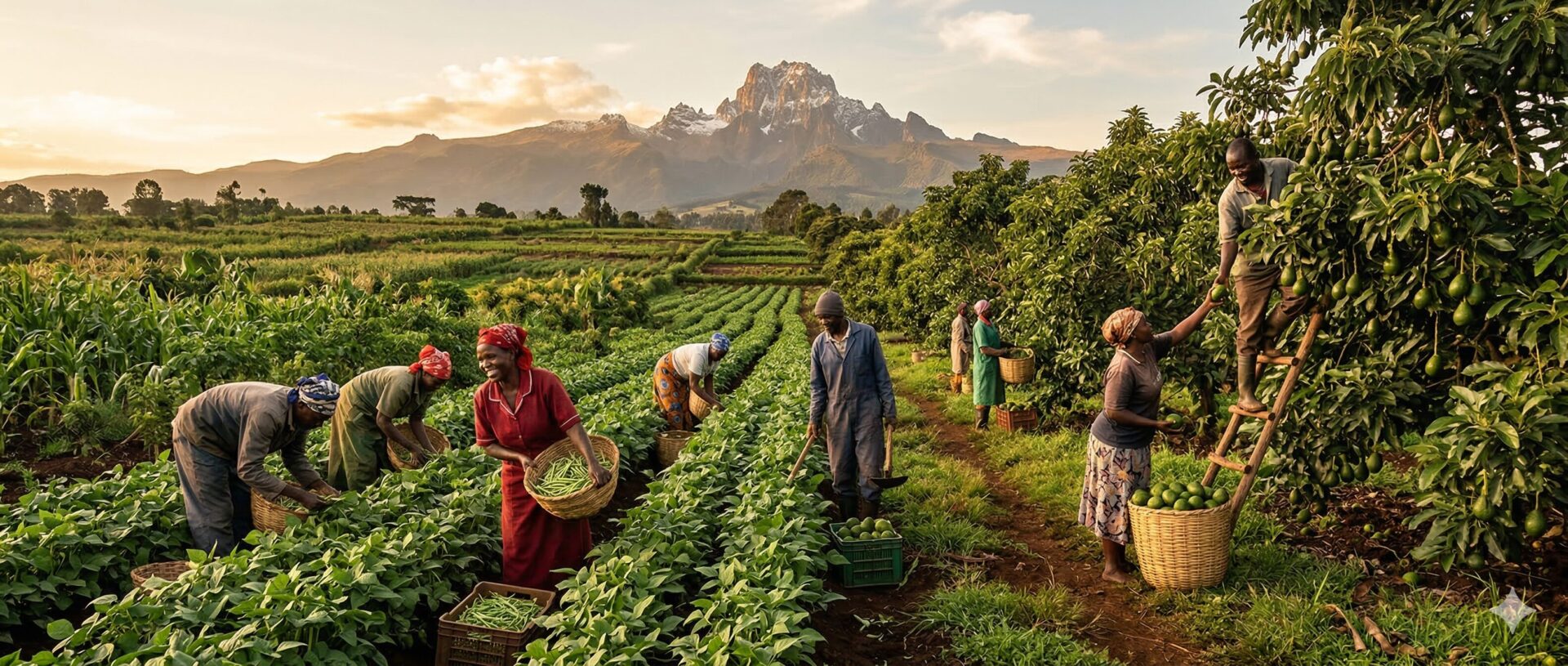
Kenya is now the world’s second largest avocado exporter, with Hass avocado production concentrated in Kiambu, Muranga, Nyeri, Meru, and Nakuru counties. The European market imports Kenyan avocados year-round with peak demand from March to August, when Kenyan production aligns with European supply gaps from other origins.
Certified Kenyan avocado farmers access export prices of KES 40 to KES 80 per kilogram — compared to KES 5 to KES 20 per kilogram through middlemen during peak season. GLOBALG.A.P certification, dry matter testing protocol implementation, and EU MRL-compliant pesticide management are the three core requirements for avocado export market access.
🫘 French Bean Export from Kenya
French beans are Kenya’s most established vegetable export crop, with production across Kiambu, Nakuru, Meru, Nyeri, and Central Kenya supplying UK and European supermarkets year-round. Kenya’s altitude zones allow continuous production without seasonal gaps — a significant competitive advantage over other origins.
French bean farmers with GLOBALG.A.P certification access direct export prices of KES 80 to KES 140 per kilogram compared to KES 20 to KES 40 per kilogram through domestic middlemen. GRASP social compliance assessment is required by most UK supermarket buyers in addition to GLOBALG.A.P.
🥭 Mango Export from Kenya
Kenya is East Africa’s leading mango producer, with Meru, Machakos, Embu, Kilifi, and Kwale counties supplying the majority of export volumes. Kenyan mango varieties — particularly Apple and Tommy Atkins — have strong demand in Middle Eastern and European markets. The Middle East is the most accessible initial export market for Kenyan mango farmers, with lower certification barriers and strong demand.
The primary technical challenge for mango export is the mango fruit fly phytosanitary requirement — requiring a documented season-long monitoring and management programme before European market access is possible. Certified mango farmers access export prices of KES 60 to KES 120 per kilogram versus KES 5 to KES 20 per kilogram at farm gate during peak season.
🌿 Passion Fruit Export from Kenya
Purple passion fruit is a growing Kenyan export with strong demand in European processing markets and increasing fresh market interest in the UK and Middle East. Kenya’s year-round production capability — driven by cultivation across multiple altitude zones — makes it an attractive supplier for buyers seeking continuous supply.
Passion fruit is one of the more accessible export crops for Kenyan smallholder farmers — with lower initial certification complexity than avocado or mango, and strong group certification potential through producer organisations. Certified passion fruit farmers access prices of KES 50 to KES 100 per kilogram for export-quality fruit.
GLOBALG.A.P Certification — The Gateway to Export Markets
GLOBALG.A.P is the world’s most widely adopted farm assurance standard — covering food safety, environmental sustainability, worker welfare, and traceability across more than 135 countries. For Kenyan farmers, GLOBALG.A.P certification is not optional — it is the non-negotiable minimum requirement for supplying virtually every European and UK buyer, and increasingly Middle Eastern buyers as well.
The GLOBALG.A.P Integrated Farm Assurance (IFA) standard covers eight core module areas: site management and history, worker health, safety and welfare, subcontractors, waste and pollution management, environment and conservation, complaints procedures, product recall and withdrawal, and crop-specific requirements including pesticide management, water management, harvesting, and post-harvest handling.
For Kenyan smallholder farmers, group certification under GLOBALG.A.P Option 2 is the most practical and cost-effective route to certification. Under Option 2, a registered producer organisation or cooperative implements a shared Quality Management System covering all member farms — with an internal audit system that verifies compliance across members and an external certification body audit of the QMS and a sample of member farms.
Group certification dramatically reduces the per-farmer cost of certification — from KES 150,000 to KES 350,000 for individual farm certification to KES 20,000 to KES 60,000 per farmer in a well-managed group — while providing the collective supply volumes that export buyers require from their supplier base.
→ Read the Complete GLOBALG.A.P Certification Guide for Kenya
International Markets for Kenyan Agricultural Products
European Union — The EU is the highest-value and most demanding export market for Kenyan agricultural produce. EU buyers require GLOBALG.A.P certification as a minimum, with many supermarket buyers additionally requiring GRASP social compliance assessment, Rainforest Alliance certification, or buyer-specific scheme compliance. EU MRL regulations for pesticides are the world’s strictest — requiring documented pesticide management programmes for all certified farms. The EU offers the highest prices for certified Kenyan produce and represents the primary long-term target market for most Kenyan export crops.
United Kingdom — The UK maintains its own agricultural import standards which broadly mirror EU requirements. UK supermarket buyers — including Tesco, Sainsbury’s, Marks and Spencer, and Waitrose — are among the world’s most demanding in their supplier requirements, often requiring buyer-specific scheme compliance on top of GLOBALG.A.P. The UK is Kenya’s largest single-country export market for fresh vegetables including French beans, mangetout, and baby vegetables.
Middle East — The UAE, Saudi Arabia, Qatar, and other Gulf markets are Kenya’s fastest-growing export destinations for fruit crops including avocado and mango. Middle Eastern buyers generally have lower certification barriers than European buyers — making the Middle East the recommended first export market for crops like mango where European phytosanitary requirements add significant complexity.
Step-by-Step: How to Become Export-Ready
Step 1 — Farm Audit Gap Assessment. The starting point for any export readiness journey is a thorough assessment of your farm’s current compliance status against GLOBALG.A.P requirements. A professional pre-audit gap assessment identifies every area requiring improvement and prioritises corrective actions by severity. Download our Kenya Farm Audit Checklist to begin your self-assessment.
Step 2 — Compliance System Development. Based on the gap assessment findings, your farm needs a documented compliance system covering all GLOBALG.A.P requirements — including pesticide management records, water quality testing records, worker training records, site history documentation, and traceability systems. For group certification, a Quality Management System covering all member farms is required.
Step 3 — Pesticide Programme Review. EU MRL compliance for pesticides is one of the most technically complex aspects of export certification. Every pesticide applied on the farm must be reviewed against the EU MRL database for the target crop — with non-compliant products removed from the programme and alternative products identified.
Step 4 — Worker Welfare Implementation. GLOBALG.A.P requires documented worker welfare provisions including health and safety training records, protective equipment provision, first aid facilities, sanitation facilities, and clear worker rights information.
Step 5 — Internal Audit. Before the external certification audit, a formal internal audit against all GLOBALG.A.P requirements is conducted — identifying any remaining non-conformances and verifying that corrective actions from the gap assessment have been implemented.
Step 6 — Certification Body Audit. An accredited GLOBALG.A.P certification body conducts the formal external audit of your farm or group QMS. Successfully completing this audit results in GLOBALG.A.P certification — valid for one year with an annual renewal audit required.
Step 7 — Market Linkage. With certification achieved, the next step is identifying and approaching appropriate buyers for your crop and target market. Agrosocial Services provides market linkage support connecting certified Kenyan producers with active international buyers.
Get the Complete Export Readiness Package
The Agrosocial Starter Kit covers every step of the export readiness journey in a single downloadable package including:
- Farm audit checklist covering all 8 GLOBALG.A.P areas
- Step-by-step certification preparation guide
- Farm record templates for pesticide, water and worker records
- Export market access guide for Europe, UK and Middle East
- Agricultural funding proposal templates
Agricultural Consultants Across Kenya
Agrosocial Services Limited provides professional agricultural export consulting services throughout Kenya — with on-site consulting available in all major agricultural producing counties. Our consultants provide pre-audit gap assessments, GLOBALG.A.P certification preparation support, group certification QMS development, pesticide programme review, market linkage support, and agricultural funding proposal writing.
🌍 Agricultural Consultant Nairobi — Farm audit and certification services for Nairobi-based agribusinesses and farms. Nairobi is our headquarters and the base for all Kenya-wide consulting operations.
🌍 Agricultural Consultant Kiambu — Specialist GLOBALG.A.P certification support for Kiambu avocado and French bean farmers. Kiambu is one of Kenya’s most important avocado and French bean export production counties.
🌍 Agricultural Consultant Nakuru — Farm audit and export readiness support for Nakuru vegetable, French bean, and cut flower producers across the Rift Valley.
🌍 Agricultural Consultant Meru — Specialist mango export certification and macadamia compliance support for Meru County — Kenya’s most important mango producing region.
🌍 Agricultural Consultant Machakos — Mango and vegetable export certification support for Machakos County — a strategically located production region with strong Nairobi logistics access.
Agricultural Funding and Support
Accessing agricultural funding is a critical enabler for Kenyan farmers and cooperatives pursuing export certification and market access. Key funding sources accessible to Kenyan farmers and cooperatives include the Agricultural Finance Corporation (AFC), the Kenya Climate Smart Agriculture Project (KCSA), county government agricultural support programmes, EU development funding through programmes including AECF and AGRA, and private foundation grants from organisations active in Kenyan agricultural development.
Agrosocial Services Limited has prepared successful funding proposals for agricultural organisations across Kenya. Our proposal writing service covers the full development process from project design through to submission — and our Agricultural Proposal Writing Template provides a complete self-service framework for organisations preparing applications independently.
About Agrosocial Services Limited
Agrosocial Services Limited is a Kenyan agricultural consulting company specialising in export certification, compliance systems, and international market access for farmers and agribusinesses.
Our consultants support producers across Kenya including Nairobi, Kiambu, Nakuru, Meru, and Machakos counties. Our clients include Del Monte Kenya, Cargill, Taita Taveta County Government, and a growing portfolio of smallholder cooperatives and individual farms across Kenya.
We assist farms with:
- GLOBALG.A.P certification preparation
- Export readiness audits
- Pesticide compliance programmes
- Traceability system design
- Market linkage with international buyers
Frequently Asked Questions
What certification do I need to export agricultural products from Kenya?
GLOBALG.A.P certification is the primary requirement for exporting fresh produce from Kenya to European and UK buyers. Some buyers additionally require GRASP social compliance assessment, Rainforest Alliance certification, or buyer-specific scheme compliance. See our complete GLOBALG.A.P certification guide for full details.
How long does it take to become export-ready as a Kenyan farmer?
Most farms complete the certification preparation process within 4 to 6 months with professional support. Mango farms require longer — typically 6 to 12 months — due to the fruit fly monitoring programme requirement. Farms that begin with a thorough pre-audit gap assessment and implement corrective actions systematically consistently achieve first-time certification success.
How much does GLOBALG.A.P certification cost in Kenya?
Individual farm certification typically costs KES 150,000 to KES 350,000 for the first year including consulting support and certification body fees. Group certification through a producer organisation reduces the per-farmer cost to KES 20,000 to KES 60,000 per member. Contact Agrosocial Services for a specific quotation.
Can smallholder farmers in Kenya access export markets directly?
Yes — through group certification under GLOBALG.A.P Option 2. A registered producer organisation or cooperative implements a shared Quality Management System covering all member farms, allowing individual smallholder farmers to achieve certification at a fraction of the individual farm cost while providing collective supply volumes that export buyers require.
Which crops have the best export potential from Kenya?
Hass avocado currently offers the strongest combination of volume, price premium, and market growth. French beans offer the most established supply chain with the lowest barriers to entry. Mango offers the largest volume opportunity with the Middle East as an accessible first market. Passion fruit offers growing demand with relatively lower certification complexity. See our individual crop guides: avocado, French beans, mango, passion fruit.
How do I find export buyers for my certified Kenyan farm?
Market linkage support is a core service of Agrosocial Services Limited. Once your farm achieves GLOBALG.A.P certification, we support you in developing a professional supplier profile and approaching appropriate buyers in the UK, Netherlands, France, Germany, and Middle Eastern markets. Contact us on WhatsApp at 0725042234.
Explore Our Agricultural Export Guides
Start Your Agricultural Export Journey Today
Speak directly with our consultants about your farm’s export readiness, certification requirements, and market access opportunities. We respond to all enquiries within 24 hours and can mobilise for on-site farm visits within 48 to 72 hours.
📲 WhatsApp Us Now
Download Farm Audit Checklist — $35
Download Complete Starter Kit