GLOBALG.A.P Certification in Kenya — Complete Guide to Costs, Process & Requirements
🌍 Standard: GLOBALG.A.P IFA | 📦 Crops: Avocado, French Beans, Mango, Passion Fruit & more | ✅ Valid: 1 Year (Annual Renewal) | 💰 From: KES 15,000/farmer (group)
In This Guide
GLOBALG.A.P certification is the most widely recognised agricultural certification standard in the world — and the primary market access requirement for Kenyan farms supplying fresh produce to European buyers. Over 200,000 producers in more than 135 countries hold GLOBALG.A.P certification. In Kenya, GLOBALG.A.P certified farms supply supermarket chains across the UK, Netherlands, Germany, France, and beyond — accessing export prices that are consistently two to four times higher than domestic market prices for the same produce.
Yet despite the clear commercial benefits, GLOBALG.A.P certification remains out of reach for the majority of Kenyan farmers — not because their farms cannot meet the requirements, but because the certification process is complex, the documentation requirements are demanding, and professional guidance through the process is not always accessible.
This guide covers everything a Kenyan farmer, cooperative, or agribusiness needs to know about GLOBALG.A.P certification — what it requires, how long it takes, what it costs, and how to achieve it successfully.
This guide covers GLOBALG.A.P requirements for all major Kenyan export crops. For crop-specific export guides see: avocado export from Kenya, French bean export from Kenya, mango export from Kenya, and passion fruit export from Kenya.
What is GLOBALG.A.P Certification?
GLOBALG.A.P — Global Good Agricultural Practice — is an internationally recognised certification standard developed by a global partnership of retailers, producers, and other food supply chain stakeholders. The standard defines requirements for safe, sustainable, and responsible agricultural production covering food safety, worker welfare, environmental protection, and animal welfare.
GLOBALG.A.P certification is issued by independent accredited certification bodies after a physical audit of the farm against the GLOBALG.A.P Integrated Farm Assurance standard. Certified producers receive a unique GGN — GLOBALG.A.P Number — that identifies them in the global GLOBALG.A.P database and can be verified by buyers anywhere in the world.
The standard covers a wide range of agricultural products including fresh fruits and vegetables, flowers and ornamentals, combinable crops, livestock, aquaculture, and plant propagation material. In Kenya, the most commonly certified products are fresh vegetables — particularly French beans, snow peas, and baby vegetables — fresh fruits including avocados, mangoes, and passion fruit, and cut flowers.
Why Kenyan Farms Need GLOBALG.A.P Certification
For Kenyan farms targeting European export markets, GLOBALG.A.P certification is not optional — it is the non-negotiable baseline requirement for supply chain entry. Every major European supermarket retailer — including Tesco, Waitrose, Sainsbury’s, Carrefour, Metro, Lidl, and Aldi — requires GLOBALG.A.P certification from every farm in their fresh produce supply chain. Without certification, a Kenyan farm cannot supply these buyers regardless of fruit or vegetable quality, price competitiveness, or relationship history.
Beyond European supermarket supply, GLOBALG.A.P certification is increasingly required by Middle Eastern importers, Asian buyers, and domestic premium retailers who recognise it as the global benchmark for farm food safety and sustainability management. Kenyan farms that achieve GLOBALG.A.P certification position themselves to access a global market of buyers rather than being limited to domestic or informal export channels.
The commercial return on GLOBALG.A.P certification investment is consistently positive for Kenyan farms that achieve certification and establish direct export relationships. Price premiums of KES 40 to KES 100 per kilogram above middlemen prices are typical for certified Kenyan fresh produce — returns that recover the certification investment within one to two export seasons for most farms.
GLOBALG.A.P Requirements for Kenyan Farms
The GLOBALG.A.P Integrated Farm Assurance standard covers eight main areas. Every area contains a mix of Major Must, Minor Must, and Recommended requirements. All Major Must requirements must be fully met. At least 95 percent of Minor Must requirements must be met. Recommended requirements carry no compliance obligation but represent best practice.
Site Management
Farms must maintain documented records of their farming history, risk assessments for the production site, maps showing field locations and boundaries, and evidence that the site is suitable for the crops being produced. Contamination risks from neighbouring land uses, previous land use, and environmental hazards must be assessed and managed.
Worker Health, Safety and Welfare
GLOBALG.A.P requires comprehensive worker welfare provisions covering trained first aid personnel, accessible first aid kits, adequate sanitation facilities including toilets and handwashing stations in or near every field, personal protective equipment for all chemical handling activities, documented worker training records, and a functioning grievance procedure. Worker welfare is one of the most frequently cited areas of non-conformance in Kenyan farm audits.
Pesticide Management
Pesticide management is the most critical compliance area for Kenyan export farms. Requirements cover pesticide storage in a secure, ventilated, bunded chemical store, complete application records for every spray event, operator training and competency evidence, calibrated spray equipment, Maximum Residue Limit compliance for the target export market, and disposal of empty containers and surplus pesticides.
Produce Handling and Storage
Post-harvest handling facilities must meet food safety hygiene requirements including cleanable surfaces, pest control programmes, temperature management, foreign body prevention measures, and documented cleaning and sanitation records. Produce must be handled to prevent contamination and maintain quality from harvest through to dispatch.
Environmental Management
Farms must assess and manage their environmental impact — covering water use efficiency, waste management, soil health, biodiversity, and energy use. Environmental management does not require significant investment but does require documented assessments and a commitment to continuous improvement.
Traceability
Every farm must operate a traceability system capable of tracing any lot of produce from the consumer back to the specific farm and field within four hours. This requires consistent field coding, documented harvest records linking lot numbers to specific fields and dates, and records of produce flow from farm through post-harvest handling to dispatch.
📊 Start Your Gap Assessment Today
The first step to GLOBALG.A.P certification is understanding exactly where your farm stands against the standard requirements.
Our Kenya Farm Audit Checklist covers:
- All 8 GLOBALG.A.P audit areas
- Critical, Major & Minor compliance checks
- Pesticide record templates
- Traceability system templates
- Corrective action planning sheet
Step-by-Step GLOBALG.A.P Certification Process in Kenya
Step 1 — Pre-Audit Gap Assessment
Conduct a comprehensive assessment of your farm against the full GLOBALG.A.P checklist. Identify every compliance gap — missing records, infrastructure deficiencies, pesticide management weaknesses, worker welfare gaps. Prioritise corrective actions by compliance category — Major Must gaps must be resolved before certification is possible. Our Kenya Farm Audit Checklist is designed specifically for this step.
Step 2 — Corrective Action Implementation
Address all identified gaps systematically. Commission water quality testing from an accredited laboratory — allow three to four weeks for results. Establish your pesticide record system. Upgrade chemical storage if required. Implement worker welfare provisions. Build your site management documentation. This phase typically takes two to four months depending on the farm’s starting compliance level.
Step 3 — Record System Establishment
Establish and begin operating all required record systems — pesticide applications, fertiliser applications, irrigation water use, worker training, equipment maintenance, and harvest records. Records must be in operation before the certification audit — a farm with good infrastructure but no records will fail certification.
Step 4 — Internal Audit
Conduct a full internal audit against the GLOBALG.A.P checklist before applying for the external certification audit. Verify all corrective actions are complete. Test your traceability system. Prepare your complete document file. An internal audit conducted honestly and rigorously is the single most effective preparation for external audit success.
Step 5 — Certification Body Selection and Application
Select an accredited GLOBALG.A.P certification body operating in Kenya. Submit your certification application. The certification body will schedule your audit — typically within four to six weeks of application. Confirm your preferred audit dates and ensure your farm and all documentation are fully prepared before the audit day.
Step 6 — External Certification Audit
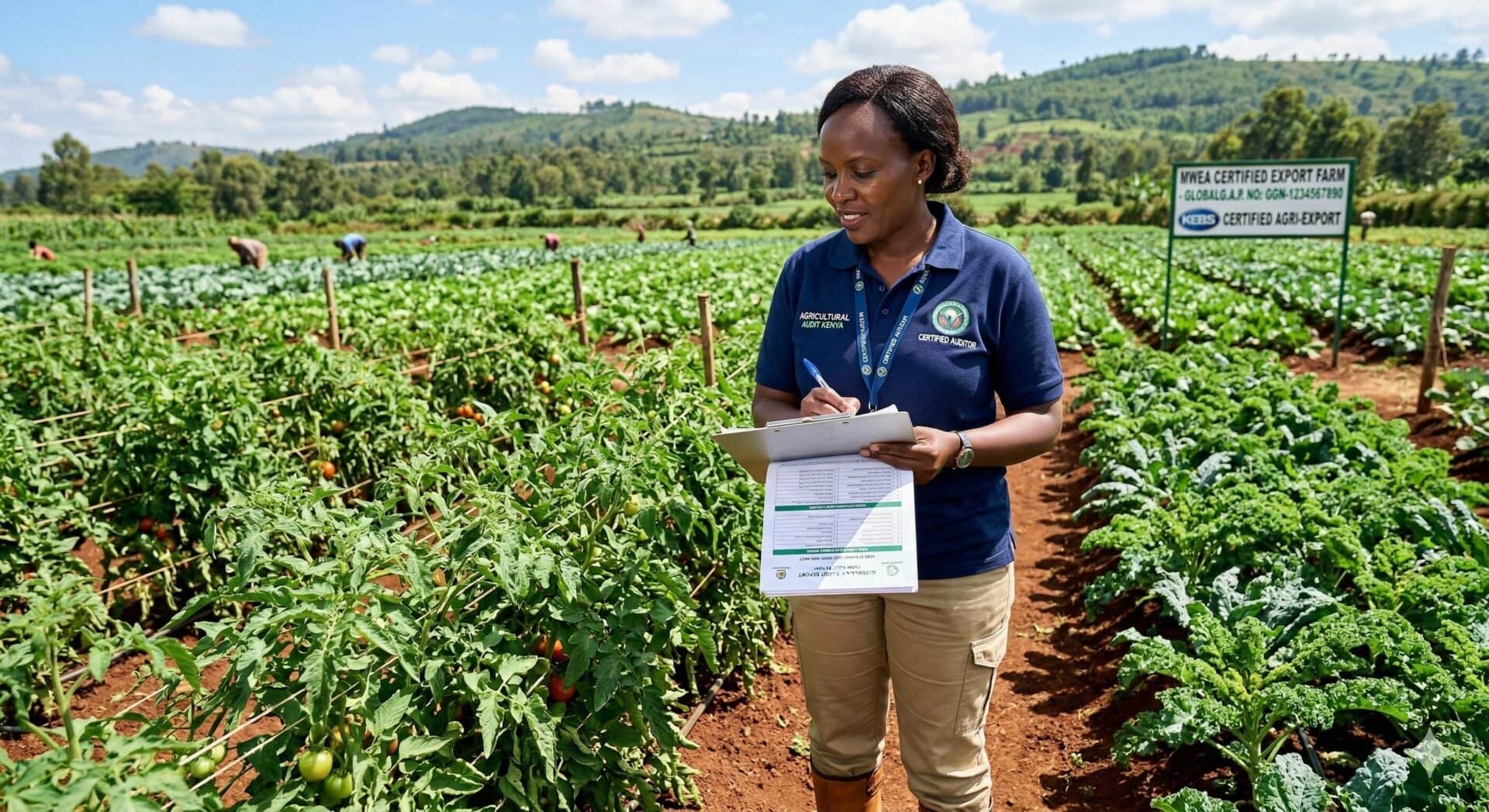
The certification body auditor conducts a physical inspection of your farm and facilities, reviews all required documentation, and conducts private interviews with a sample of workers. The audit typically takes one to two days for individual farms. Any non-conformances identified during the audit must be addressed before certification is granted.
Step 7 — Certification and GGN Issuance
Once all non-conformances are resolved and the certification body confirms compliance, your GLOBALG.A.P certificate is issued and your farm is listed in the global GLOBALG.A.P database. You receive your GGN producer number — include this in all commercial communications with buyers. Certification must be renewed annually through a re-audit.
Need the Complete Certification Package?
The Agrosocial Starter Kit contains everything needed to prepare a farm for certification including:
- Farm audit checklist
- Certification preparation guide
- Farm record templates
- Export market access guide
- Funding proposal templates
GLOBALG.A.P Certification Costs in Kenya
The total first-year investment for GLOBALG.A.P certification for a Kenyan smallholder or medium-scale farm typically ranges from KES 150,000 to KES 500,000 depending on farm size, crop type, starting compliance level, and whether professional consultancy support is used.
Pre-audit preparation and consultancy support from Agrosocial Services typically costs KES 80,000 to KES 200,000 depending on farm size and the extent of compliance gaps identified. This investment consistently delivers the highest return — farms that invest in professional preparation achieve first-time certification success and avoid costly repeat audit fees.
The certification body audit fee for individual farms ranges from KES 45,000 to KES 150,000 depending on the certification body selected, farm size, and crop type. Laboratory testing — water quality, soil analysis, produce residue testing — adds KES 20,000 to KES 60,000. The annual GLOBALG.A.P registration fee is approximately USD 100 to USD 200 per farm.
For group certification through a producer organisation, per-farmer costs are significantly lower — typically KES 15,000 to KES 50,000 per member farmer in the first year covering all preparation, system development, and audit costs. Annual renewal costs in subsequent years are substantially lower than first-year costs.
Accredited GLOBALG.A.P Certification Bodies in Kenya
Several internationally accredited certification bodies operate in Kenya and conduct GLOBALG.A.P audits for fresh produce farms. The main certification bodies active in Kenya include SGS Kenya, Bureau Veritas Kenya, Kiwa, and Intertek. Each certification body operates under the same GLOBALG.A.P standard and issues equivalent certificates — the choice of certification body does not affect market access.
Certification body fees vary — it is worth obtaining quotes from at least two bodies before committing. Response times, audit scheduling flexibility, and quality of auditor expertise can differ between certification bodies and are worth considering alongside fee levels. Agrosocial Services can advise on certification body selection based on your crop type, location, and target markets. Our consultants support farms across Kenya including Nairobi, Kiambu, Nakuru, Meru, and Machakos counties.
GLOBALG.A.P Group Certification for Kenyan Cooperatives
GLOBALG.A.P Option 2 group certification allows producer organisations — cooperatives, farmer groups, and outgrower schemes — to achieve certification on behalf of all member farmers under a single Quality Management System. The producer organisation implements internal inspection and management systems covering all member farms, and the certification body audits a representative sample.
Group certification is the standard and most cost-effective route for Kenyan smallholder farmers. It reduces per-farmer certification costs by 60 to 80 percent compared to individual farm certification while providing the collective supply volumes that export buyers require. Group certification is widely used by Kenyan cooperatives growing avocados, French beans, mangoes, and passion fruit for export.
Frequently Asked Questions
How long is GLOBALG.A.P certification valid in Kenya?
GLOBALG.A.P certification is valid for one year from the date of issue. Annual re-certification requires a full re-audit by the certification body. Farms must maintain their compliance systems and records throughout the year to ensure successful annual renewal. Certification can be suspended or withdrawn if a farm is found to be non-compliant between annual audits.
Can a Kenyan farm lose GLOBALG.A.P certification?
Yes. GLOBALG.A.P certification can be suspended or withdrawn if a certified farm fails to maintain compliance with the standard requirements — for example if a pesticide MRL exceedance is detected on exported produce, if a surveillance audit reveals major non-conformances, or if the farm fails its annual re-audit. Maintaining compliance systems and records throughout the year is essential for sustained certification.
Does GLOBALG.A.P certification guarantee a buyer will purchase my produce?
GLOBALG.A.P certification is a market access requirement — it is the door into the export market, not a guarantee of sales. Certified farms still need to identify appropriate buyers, develop supplier profiles, make commercial approaches, and negotiate supply agreements. Agrosocial Services provides market linkage support to help certified Kenyan farms connect with international buyers.
Is GLOBALG.A.P certification the same as organic certification?
No. GLOBALG.A.P certification and organic certification are different standards with different requirements. GLOBALG.A.P certifies that a farm follows Good Agricultural Practices covering food safety, worker welfare, and environmental management — it does not prohibit the use of synthetic pesticides or fertilisers. Organic certification additionally requires the elimination of synthetic inputs and a conversion period. Some buyers require both GLOBALG.A.P and organic certification for organic market supply.
What crops can be GLOBALG.A.P certified in Kenya?
GLOBALG.A.P certification covers a wide range of crop types grown in Kenya including fresh vegetables such as French beans, snow peas, and baby vegetables; fresh fruits including avocados, mangoes, passion fruit, and citrus; cut flowers and ornamentals; and combinable crops. Read our crop-specific guides for avocado, French beans, mango, and passion fruit for crop-specific certification guidance.
How do I verify if a Kenyan farm is GLOBALG.A.P certified?
Any farm’s GLOBALG.A.P certification status can be verified through the GLOBALG.A.P database at database.globalgap.org using the farm’s GGN producer number. Buyers routinely verify certification status before placing orders — ensuring your GGN is accurate and your certificate is current is essential for maintaining buyer confidence.
How Agrosocial Services Supports GLOBALG.A.P Certification in Kenya
Agrosocial Services Limited is Kenya’s specialist agricultural consultancy for GLOBALG.A.P certification support. Our team has supported farms and producer organisations across Kenya through individual and group GLOBALG.A.P certification for avocados, French beans, mangoes, passion fruit, and other export crops. We provide on-site certification support throughout Kenya including Nairobi, Kiambu, Nakuru, Meru, and Machakos counties.
Our GLOBALG.A.P certification support service covers pre-audit gap assessment using our Kenya Farm Audit Checklist, compliance system development, pesticide management programme design, water quality testing coordination, worker welfare system implementation, record system design and training, internal audit preparation, and certification body liaison.
We also provide market linkage support for certified farms — connecting GLOBALG.A.P certified Kenyan producers with buyers in the UK, Netherlands, and other European markets through our network of established importer and trader relationships.
Contact Agrosocial Services Limited on WhatsApp at 0725042234 or email info@agrosocialservices.co.ke to discuss your farm’s GLOBALG.A.P certification goals and receive a specific proposal for your situation.
Start Your GLOBALG.A.P Certification Journey Today
Download our Kenya Farm Audit Checklist — the exact tool our consultants use to prepare Kenyan farms for GLOBALG.A.P certification audits. Or speak directly with our certification advisors on WhatsApp.