GLOBALG.A.P Group Certification for Kenyan Cooperatives — Complete Step-by-Step Guide
👥 Certification Type: Group (Option 2) | 🤝 Target: Cooperatives & Farmer Groups | 💰 Cost: KES 15k–25k per member | 🌍 Standard: GLOBALG.A.P
In This Guide
Most Kenyan smallholder farmers understand that GLOBALG.A.P certification opens the door to European export markets. What fewer farmers understand is that individual certification — while achievable — is not the only route, and for smallholder cooperatives and producer organisations, it is rarely the most practical or cost-effective one.
GLOBALG.A.P group certification under Option 2 allows an entire producer organisation to achieve certification under a single audit, with costs shared across all member farmers. For Kenyan cooperatives with 20, 50, or even 200 member farmers, this model transforms certification from an expensive individual investment into an affordable collective achievement.
This guide covers exactly how GLOBALG.A.P group certification works for Kenyan cooperatives — the requirements, the process, the costs, and the common mistakes that cause group certification attempts to fail.
See our complete crop-specific export guides for avocado export from Kenya, French bean export from Kenya, mango export from Kenya, and passion fruit export from Kenya. For the full individual certification process see our complete GLOBALG.A.P certification guide.
What Is GLOBALG.A.P Group Certification?
GLOBALG.A.P Option 2 group certification allows a producer organisation — a cooperative, farmer group, or other legally registered entity — to achieve certification on behalf of its member farmers under a single Quality Management System (QMS). Rather than each farmer undergoing an individual audit, the certification body audits the producer organisation’s management system and inspects a representative sample of member farms.
The producer organisation takes legal responsibility for the compliance of all member farms. It implements a Quality Management System — a documented set of procedures, records, and oversight mechanisms — that governs how every member farm operates. Internal inspectors employed or contracted by the producer organisation conduct annual inspections of every member farm against GLOBALG.A.P requirements before the external certification audit.
Every certified member farmer receives their own individual GLOBALG.A.P GGN number — the same producer identification number issued to individually certified farms. From a buyer’s perspective, a farmer certified through group Option 2 certification is indistinguishable from an individually certified farmer.
Who Qualifies for GLOBALG.A.P Group Certification in Kenya?
Any legally registered producer organisation in Kenya can pursue GLOBALG.A.P Option 2 group certification. This includes registered cooperatives under the Cooperative Societies Act, farmer groups registered with county governments, company-managed outgrower schemes, and non-governmental organisation managed farmer groups with documented membership structures.
The producer organisation must have a clear governance structure, documented membership with signed member agreements, a designated Quality Management System manager, and the capacity to employ or contract qualified internal inspectors. Minimum group size is not specified by GLOBALG.A.P, but practically, groups of fewer than 15 farmers rarely achieve cost savings over individual certification that justify the additional management overhead.
The 6 Requirements for GLOBALG.A.P Group Certification
1. Legal Registration and Governance
The producer organisation must be legally registered and have documented governance structures including a constitution or bylaws, elected leadership, documented decision-making processes, and a clear membership register with signed member agreements. The member agreements must include each farmer’s commitment to comply with GLOBALG.A.P requirements and acceptance of the producer organisation’s authority to conduct internal inspections and suspend non-compliant members.
2. Quality Management System
The Quality Management System is the operational backbone of group certification. It documents every procedure the producer organisation follows to ensure member farm compliance — how internal inspections are conducted, how non-conformances are managed, how corrective actions are tracked, how new members are onboarded, and how the organisation responds to buyer complaints or product recalls. The QMS must be documented, implemented, and demonstrably followed — not just written and filed.
3. Internal Inspection Programme
Every member farm must be internally inspected against the full GLOBALG.A.P checklist at least once per year before the external certification audit. Internal inspectors must be trained and competent — they do not need to be GLOBALG.A.P certified auditors but must demonstrate sufficient knowledge to conduct credible assessments. Internal inspection records must be retained and available for review by the certification body auditor.
📊 Equip Your Internal Inspectors
A group certification fails if the internal inspections are not rigorous enough. Internal inspectors need the exact same checklist the official auditor uses.
Our Kenya Farm Audit Checklist is the exact tool internal inspectors need to assess member farms against GLOBALG.A.P requirements effectively before the external auditor arrives.
- All 8 GLOBALG.A.P audit areas
- Critical, Major & Minor compliance checks
- Pesticide record and traceability templates
- Corrective action planning sheet
4. Corrective Action Management
Every non-conformance identified during internal inspections must be documented, assigned a corrective action, and tracked to completion before the external audit. The producer organisation must demonstrate that it has an effective system for identifying compliance gaps and ensuring they are resolved — not simply recorded and ignored. Farms with open critical non-conformances at the time of the external audit will fail certification.
5. Member Farm Compliance
Every member farm must meet GLOBALG.A.P compliance requirements. All Major Must requirements must be fully met. At least 95 percent of Minor Must requirements must be met across the group. The certification body will inspect a random sample of member farms during the external audit — typically the square root of the total group size, with a minimum of 10 percent. If the sample reveals significant non-compliance, the entire group fails certification.
6. Traceability System
The group must operate a traceability system that can trace any lot of produce from the packhouse or collection point back to the specific member farm and field within four hours. This requires consistent farm and field coding, harvest lot numbers linked to specific farms and harvest dates, and documented produce flow from farm through collection to packhouse.
Step-by-Step Process for Group Certification
Step 1 — Organisational Assessment (Month 1). Assess your producer organisation’s current governance structures, membership documentation, and management capacity against group certification requirements. Identify gaps in legal registration, governance documentation, and management capacity. Confirm that sufficient member farms are interested and committed to proceeding with certification.
Step 2 — QMS Development (Months 1–2). Develop your Quality Management System documentation — all required procedures, forms, and records. This is the most technically demanding step and where professional consultancy support delivers the most value. A well-designed QMS covers all GLOBALG.A.P requirements without creating unnecessary administrative burden for member farmers or the producer organisation management team.
Step 3 — Member Farm Preparation (Months 2–4). Conduct pre-audit assessments of all member farms. Identify compliance gaps on each farm. Develop farm-specific corrective action plans. Support farmers to implement required changes — pesticide storage upgrades, record system establishment, worker welfare improvements, infrastructure fixes. This step requires the most time and should not be rushed.
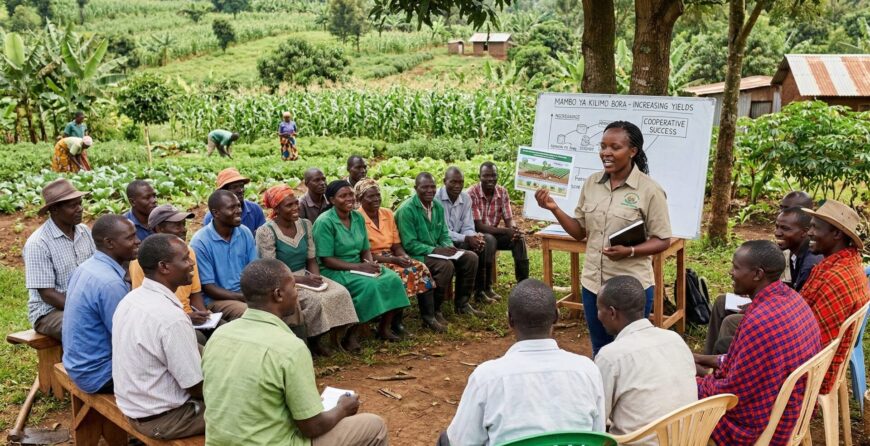
Step 4 — Internal Inspector Training (Months 2–3). Train your internal inspectors on the GLOBALG.A.P checklist and internal inspection process. Internal inspectors must understand what each requirement means in practice and be able to make consistent compliance judgements across different farms. Practical training on real farms is more effective than classroom-only training.
Step 5 — Internal Inspections (Months 4–5). Conduct formal internal inspections of all member farms. Document all findings. Issue non-conformance reports for every compliance gap. Track corrective action implementation to completion. Prepare internal inspection report files for each member farm — these will be reviewed by the certification body auditor.
Step 6 — External Certification Audit (Month 5–6). Submit your certification application to an accredited certification body. The external audit covers a review of your QMS documentation, interviews with producer organisation management, and on-farm inspections of a random sample of member farms. Allow two to four days for the external audit process depending on group size.
Step 7 — Certification and Market Access (Month 6+). Once certification is granted, every member farmer receives their GGN number. The producer organisation is listed in the GLOBALG.A.P database. Begin approaching export buyers with your certified group’s supplier profile — collective supply volumes from a certified group are significantly more attractive to buyers than individual farm volumes.
Get the Complete Certification Package for Your Cooperative
The Agrosocial Starter Kit gives your cooperative everything needed for a successful group certification journey including:
- Farm audit checklist covering all 8 GLOBALG.A.P areas
- Step-by-step certification preparation guide
- Farm record templates for pesticide, water and worker records
- Export market access guide covering Europe, UK and Middle East
- Agricultural funding proposal templates
How Much Does Group Certification Cost for a Kenyan Cooperative?
The total first-year cost for GLOBALG.A.P group certification for a Kenyan cooperative of 30 to 50 member farmers typically ranges from KES 400,000 to KES 750,000 covering all preparation, QMS development, internal inspector training, member farm preparation support, laboratory testing, and the external certification audit fee.
On a per-farmer basis this represents KES 15,000 to KES 25,000 per member — a modest investment against the price premiums available to certified exporters. A French bean farmer receiving KES 100 per kilogram as a certified exporter versus KES 35 per kilogram through a middleman recovers the entire certification investment within weeks of their first export shipment.
Annual renewal costs in subsequent years are significantly lower than first-year costs — typically KES 200,000 to KES 400,000 for a group of 30 to 50 farmers covering internal inspection programme costs and the annual re-certification audit fee.
Common Reasons Group Certification Attempts Fail
The most common reason group certification fails is inadequate QMS implementation. Many producer organisations develop QMS documentation but do not actually implement it — procedures exist on paper but are not followed in practice. Certification body auditors are experienced at identifying the difference between documented systems and implemented ones.
The second most common reason is insufficient internal inspection quality. Internal inspectors who lack adequate training produce inspection records that do not stand up to scrutiny during the external audit. Investing in proper internal inspector training is not optional — it is the foundation of the entire group certification model.
Third is poor corrective action follow-through. Producer organisations that identify compliance gaps during internal inspections but do not enforce corrective action completion arrive at the external audit with open non-conformances across multiple member farms. A certification body auditor who finds the same non-conformances on multiple farms that were identified in internal inspections but not resolved will fail the entire group.
Fourth is member dropout during the preparation process. Group certification requires sustained commitment from all member farmers. Producer organisations that begin certification preparation with 50 members and arrive at the external audit with 25 committed members face both a compliance challenge and a commercial viability question.
How Agrosocial Services Supports Kenyan Cooperatives Through Group Certification
Agrosocial Services Limited has extensive experience supporting Kenyan producer organisations through GLOBALG.A.P group certification. Our group certification support service covers organisational assessment and governance strengthening, Quality Management System development, member farm pre-audit assessments, internal inspector training, corrective action management support, and external audit preparation.
We provide group certification support across Kenya including Kiambu, Nakuru, Meru, Machakos, and Nairobi. Contact Agrosocial Services Limited on WhatsApp at 0725042234 or email info@agrosocialservices.co.ke to discuss your cooperative’s group certification goals.
Agricultural Export Resources from Agrosocial Services
Our complete library of export certification resources covers every aspect of the Kenyan agricultural export journey. Crop-specific export guides are available for avocado export from Kenya, French bean export from Kenya, mango export from Kenya, and passion fruit export from Kenya. For the full certification process see our complete GLOBALG.A.P certification guide. For our broader export hub see our complete agricultural export guide for Kenya.
We provide on-site consulting services across Kenya including Nairobi, Kiambu, Nakuru, Meru, and Machakos.
Ready to Start Your Cooperative’s Certification Journey?
Download our Kenya Farm Audit Checklist — the tool used by internal inspectors to assess member farms against GLOBALG.A.P requirements. Or speak directly with our group certification advisors on WhatsApp.
Download Audit Checklist — $35
Download Complete Starter Kit
📲 WhatsApp Us