Organic French Beans in Kenya: Certification, Pest Management & EU Export Guide
⚠️ KENYA IS LOSING EU FRENCH BEAN MARKET SHARE — AND ORGANIC CERTIFICATION IS THE CLEAREST ROUTE OUT
EU Regulation 2021/2246 mandates 10% documentary checks on all Kenyan bean shipments at EU borders — one of the highest scrutiny rates of any origin — because of Kenya’s recurring history of pesticide MRL exceedances. Kenya’s EU green bean export volumes have dropped 18% per year in recent years as a direct consequence. Every conventional Kenyan French bean exporter is one poorly-observed pre-harvest interval away from a RASFF notification. Organic certification removes that risk entirely — not by avoiding the inspection, but by making chemical residue a non-issue. The farms winning EU supply contracts right now are the ones where organic status means the 10% check is a formality, not a threat. Talk to Agrosocial about your organic certification path →
Of every crop a Kenyan farmer could take organic, French beans are the hardest. That’s not a reason to avoid them — it’s the reason organic French beans command such a strong premium. This guide is honest about the difficulty, because pretending otherwise would set you up to fail: it covers why this crop is uniquely challenging, how organic growers manage pests without the chemical safety net conventional farmers lean on, which certification route fits, what it costs, and what the EU market actually rewards.
This sits alongside our broader guides — for the general standards landscape see Organic Certification in Kenya; for the general market and logistics side of this crop, see French Beans Export from Kenya. This article is the crop-specific organic deep-dive that sits between them.
Agrosocial is an independent certification consultancy. We prepare French bean growers and cooperatives for organic and export certification — the certificate itself is issued by an accredited certification body, not by us.
⚡ Key Facts — Organic French Beans
- 🌍 Kenya is the 2nd-largest exporter of snap/French beans to the EU, grown by an estimated 50,000 smallholder farmers.
- 📊 French beans make up roughly a quarter of Kenya’s vegetable export volume by weight.
- ⚠️ Under EU Regulation 2021/2246, 10% of all Kenyan bean shipments are checked for pesticide residue at EU borders — one of the highest scrutiny rates of any origin.
- 🇪🇺 Peak EU demand runs September to March — Europe’s winter, when it cannot grow its own.
- 💰 Organic French beans are cited among Kenya’s most profitable organic export crops, alongside herbs, baby vegetables and Hass avocado.
Sources: CBI (Netherlands Enterprise Agency) EU market intelligence; peer-reviewed snap bean export research (MDPI Sustainability); EU Regulation 2021/2246. Verified July 2026.
In This Guide
📩 Free: Organic French Bean Certification Checklist 2026 — straight to your inbox
IPM programme requirements, EU 2018/848 organic standards for French beans, group certification steps, KEPHIS phytosanitary requirements, and cost comparison by route. Free, instant delivery.
Agrosocial supports French bean organic certification across Kenya’s main growing areas: Kiambu · Nakuru (Naivasha) · Kirinyaga · Meru · Murang’a · Machakos. General French bean export guide: French Beans Export from Kenya.
The Honest Starting Point
Why French Beans Are Kenya’s Hardest Organic Crop
Here’s the uncomfortable truth most guides skip: French beans are flagged by the EU as a high-risk product for excessive pesticide residues, and Kenyan shipments face one of the toughest inspection regimes of any origin — 10% of every consignment checked at the border under EU Regulation 2021/2246. Kenya has even previously lost access to the US market over exactly this kind of phytosanitary and technical non-compliance. The reason conventional growers lean so heavily on chemical intervention is that French beans are genuinely pest-prone — whitefly, leafminers and bollworm attack readily, and a light touch with chemicals often means a rejected shipment.
Going organic removes that safety net entirely. There is no fallback spray when pest pressure spikes — only the discipline of Integrated Pest Management, applied consistently, season after season. This is precisely why organic French beans are the hardest crop in this cluster to certify — and precisely why buyers pay a real premium for growers who can prove they’ve mastered it.
Why Bother
The Market Opportunity
The European Union is Kenya’s dominant market for French beans, and the trade pattern favours Kenyan growers directly: Europe’s own bean production stops in winter, and Kenya’s high-demand export season runs September through March — precisely when European buyers have no domestic alternative and must import. During the long-rains low season (June–September), Kenyan supply floods the domestic and lower-value markets instead, and prices soften.
Within that structure, organic French beans occupy a genuine premium niche — cited as one of Kenya’s most profitable organic export crops, alongside herbs, baby vegetables and Hass avocado. Buyers actively building organic and low-residue supply chains — exporters like FrutPlanet, who already ship French beans alongside avocado and herbs to EU, Middle East and Asian markets — are exactly the kind of multi-crop buyer relationship an organic-certified grower or cooperative can plug into.
What Mastering IPM Is Actually Worth — the Premium That Makes the Difficulty Pay
Conventional French beans — middlemen price: KES 25–40/kg.
GLOBALG.A.P. certified direct export: KES 80–140/kg.
Organic certified, EU winter supply window: a further premium on top of that.
The hardest crop to certify organically is the one buyers pay the most to secure.
The premium logic is direct: EU buyers are building organic and low-residue supply chains precisely because conventional Kenyan beans have a documented residue problem. A supplier who can prove organic status is not just selling a bean — they are selling a solution to the buyer’s single biggest supply-chain risk. Organic certification does not simply add a premium to an existing price. It repositions the farm in the buyer’s risk framework entirely. A farm with a fully documented IPM programme, an organic certificate, and a KEPHIS phytosanitary clearance is a buyer’s dream in a market where most competing farms represent a RASFF notification risk. Sources: CBI EU market intelligence; Agrosocial field data 2025/26.
The Technical Core
Organic Pest Management — Without the Safety Net
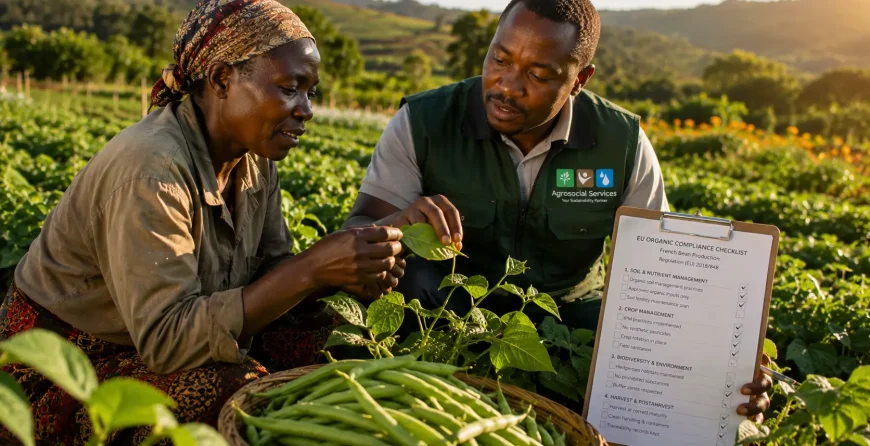
The three pests that cause the most quarantine interceptions and quality rejections on Kenyan beans are well documented: whitefly (Bemisia tabaci), leafminers (Liriomyza spp.), and bollworm (Helicoverpa armigera). An organic grower manages all three through Integrated Pest Management (IPM) — not a single trick, but a system of overlapping practices:
- Crop rotation away from other legumes. Since French beans belong to the Fabaceae family, rotating with non-legume crops breaks pest and disease cycles that build up in continuous bean cultivation.
- Resistant varieties. Choosing varieties bred for tolerance to rust, anthracnose and common bean mosaic virus reduces the disease pressure you have to manage organically in the first place.
- Diversified cropping. Intercropping and border planting support the natural predators that keep whitefly and leafminer populations in check.
- Biological and plant-based controls. Approved organic inputs — insecticidal soaps, microbial pesticides, pheromone traps, beneficial predators and parasitoids — replace synthetic chemistry.
- Frequent, disciplined field monitoring. Because there’s no chemical rescue option, catching pest pressure early — before it becomes an infestation — is what separates a successful organic crop from a failed one.
📌 Be realistic about the learning curve. IPM for French beans is a skill built over seasons, not a checklist you complete once. Growers who succeed treat the first year or two as a learning investment — expect more losses early on, and budget accordingly, rather than assuming immediate parity with conventional yields.
The EU’s 10% Inspection Rate — Why It’s the Best Argument for Going Organic
10% of all Kenyan bean shipments are checked at EU borders.
That means 90% of conventional Kenyan exporters pass — until the one time they don’t.
A single RASFF notification: full shipment rejected, buyer relationship ended, KEPHIS investigation opened.
Organic certification makes the 10% check irrelevant. There are no synthetic residues to find.
Conventional exporters treat the 10% check as a lottery they mostly win. Organic exporters have removed themselves from that lottery entirely. The inspection rate was triggered by Kenya’s history of pesticide exceedances — which means it is entirely within the power of individual farmers to change. An organic-certified farm is not subject to MRL enforcement in the same way because the inputs that create MRL risk are not permitted under organic rules. That structural advantage — not a premium sticker, but genuine removal from the residue-risk category — is the deepest commercial argument for organic French bean production in Kenya. Sources: EU Regulation 2021/2246; CBI EU market intelligence; KEPHIS phytosanitary data 2024/25.
Free Download
Know the 25 gaps that fail Kenyan export audits
Pesticide records and pest-management documentation are among the most common failure points for high-scrutiny crops like French beans. Get the checklist auditors actually use.
Building the Foundation
Soil & Fertility for Organic French Beans
French beans thrive in well-drained, slightly acidic soils rich in organic matter, at altitudes of roughly 1,500–2,100 metres, with 900–1,200mm of well-distributed rainfall (or equivalent irrigation) — they are notably sensitive to waterlogging, so drainage matters as much as fertility. Organic fertility management here follows the same core principles as any organic crop: well-composted manure, green manuring, and — usefully for this particular crop — the rotation away from other legumes doubles as both a pest-management tool and a soil-management one, since it prevents the same nutrient demands and disease organisms building up season after season in the same ground.
The Decision
Which Certification Route Fits
With an estimated 50,000 smallholders growing French beans for export, individual third-party certification is rarely economic for most growers — the realistic route for the vast majority is organic group certification, where a cooperative certifies all members together under one certificate and a shared Internal Control System, cutting the per-farmer cost dramatically. If you’re weighing your options:
- Exporting to the EU? You need EU Regulation 2018/848 compliance — almost always via group certification, backed by a properly run Internal Control System.
- Selling locally or building toward export? PGS through KOAN is a low-cost entry point that can build the organisational discipline you’ll need later.
- Already GLOBALG.A.P certified? That covers food safety and traceability, but organic is a stricter, additional layer — it doesn’t automatically follow from GLOBALG.A.P status. For full details on how they relate, see our GLOBALG.A.P. Certification Kenya guide.
Beyond the Farm Gate
Getting to Export-Ready
Organic certification is necessary but not sufficient — every Kenyan export still requires a KEPHIS phytosanitary certificate confirming the consignment is free of regulated pests and diseases, alongside strict hygiene standards through washing, grading and packing. Because French beans are highly perishable, they move almost exclusively by air freight via JKIA to reach European buyers within a day or two of harvest — fast, but a meaningfully higher cost per kilogram than sea freight used for hardier crops.
A registered, KEPHIS-approved packhouse with proper cold chain is non-negotiable — breaking the cold chain is one of the most common causes of rejected or downgraded consignments, organic or not.
The Money
Cost & Realistic Expectations
| Route | Typical annual cost |
|---|---|
| Individual third-party certification | ~KES 30,000–80,000/year |
| Group certification (per farmer) | ~KES 3,000–10,000/year |
| PGS (domestic market) | ~KES 2,000–8,000/year |
These figures cover certification only — budget separately for the conversion period (typically two years for an annual crop like French beans under EU rules), the IPM inputs and monitoring labour, and the realistic yield dip while your soil and pest-management system mature. For the full organic cost breakdown across standards, see our dedicated cost guide.
Agrosocial Services
Ready to See Where Your French Bean Operation Stands?
We help French bean growers and cooperatives assess pest-management readiness, plan the right organic certification route, and prepare for audit — before the auditor finds the gaps. Start with a readiness assessment to see exactly where you stand.
Quick Answers
Frequently Asked Questions
Is organic French bean farming profitable in Kenya?
Yes — organic French beans are cited among Kenya’s most profitable organic export crops, alongside herbs, baby vegetables and Hass avocado. The premium comes from strong EU demand during their winter import season and from buyers actively seeking suppliers who can prove low or zero pesticide residue, a chronic weak point for conventional Kenyan beans.
What pests affect organic French beans and how are they controlled without chemicals?
The main pressure comes from whitefly (Bemisia tabaci), leafminers (Liriomyza spp.), and bollworm (Helicoverpa armigera). Without synthetic pesticides, organic growers rely on Integrated Pest Management: crop rotation away from other legumes, resistant varieties, diversified cropping to support natural predators, biological and plant-based control, and frequent field monitoring to catch problems early.
Can I export organic French beans to the EU?
Yes, provided you hold recognised organic certification such as EU Regulation 2018/848 compliance (individually or through a certified group), alongside the standard KEPHIS phytosanitary certificate every Kenyan export requires. Organic status does not replace phytosanitary requirements — both are needed.
How is organic certification different from GLOBALG.A.P for French beans?
GLOBALG.A.P certifies good agricultural practice, food safety and traceability, and allows carefully controlled, approved pesticide use within maximum residue limits. Organic certification is stricter: it prohibits synthetic pesticides and fertilisers entirely. Many EU buyers require GLOBALG.A.P as a baseline for all French beans and treat organic as an additional, premium-market layer on top of it. Full GLOBALG.A.P guide: GLOBALG.A.P. Certification Kenya.
Key Takeaways — Organic French Beans Kenya
- French beans face the EU’s toughest residue scrutiny of any Kenyan export crop — 10% inspection rate under EU Reg 2021/2246. Organic certification removes your farm from that risk entirely.
- Organic removes the chemical safety net entirely — success depends on disciplined Integrated Pest Management across whitefly, leafminer and bollworm, built over multiple seasons.
- The market rewards this difficulty: organic French beans are among Kenya’s most profitable organic export crops. The hardest crop to certify is the one buyers pay the most to secure.
- With ~50,000 smallholder growers, group certification under EU 2018/848 is the realistic and affordable route — KES 3,000–10,000 per farmer versus KES 30,000–80,000 individually.
- Organic certification and KEPHIS phytosanitary requirements are separate — you need both to export. Organic status does not replace the phytosanitary certificate.
- GLOBALG.A.P. and organic are complementary, not interchangeable. Many EU buyers require GLOBALG.A.P. as the food-safety baseline and treat organic as an additional premium layer on top.
Ready to Take Your French Bean Farm Organic?
Get the free audit checklist, book a readiness assessment to see exactly where your operation stands, or WhatsApp us to discuss which organic certification route fits your cooperative.
Contact Agrosocial Services — Organic French Bean Certification Kenya
For organic certification route planning, IPM system review, group certification preparation, or farm readiness assessment for French bean organic certification — we respond within 24 hours and mobilise on-site within 48–72 hours across all major Kenyan French bean growing areas. Email: info@agrosocialservices.co.ke
Organic French Beans Kenya — Related Guides & Resources
Organic Certification
Organic Certification in Kenya (pillar)
Organic Group Certification
Building an ICS
PGS — Local Market Route
The Organic Conversion Period
Agrosocial Services Limited — Organic French Bean Certification Kenya
Kenya Agricultural Certification & Export Market Consultancy — Established 2018
Agrosocial Services Limited prepares Kenyan French bean farmers and cooperatives for organic certification — EU 2018/848 group certification, ICS design, IPM system review, and audit readiness. We are an independent certification consultancy; we do not issue organic certificates. Market and compliance data in this guide is drawn from CBI (Netherlands Enterprise Agency) EU market intelligence, peer-reviewed snap bean export research (MDPI Sustainability), and EU Regulation 2021/2246. Residue limits, inspection rates and buyer requirements change — confirm current figures before making commercial decisions. Last reviewed: July 2026.
📧 info@agrosocialservices.co.ke · 📲 WhatsApp +254 725 042 234 · 📅 Last reviewed: July 2026
Services for French bean growers:
✅ Organic group cert — EU 2018/848
✅ ICS design for French bean cooperatives
✅ IPM system review & documentation
✅ Farm readiness assessment
✅ KEPHIS registration support
✅ Kiambu · Nakuru · Kirinyaga
✅ Meru · Murang’a · Machakos