PGS Explained: Participatory Guarantee Systems for Organic Certification in Kenya
⚡ THE LOCAL ORGANIC PREMIUM WINDOW IS OPEN RIGHT NOW — AND IT REWARDS GROUPS WITH A RECOGNISED MARK
Urban demand for certified organic produce in Nairobi and secondary towns is growing faster than supply. Nairobi supermarkets — Carrefour, Naivas, Quickmart — are actively sourcing organic and “naturally grown” produce with a recognised mark. School feeding programmes run by county governments and NGOs are beginning to require food-safety verification. Groups without a recognised mark are selling the same produce at the same price as uncertified neighbours. Groups with the Kilimohai Organic Mark are capturing premium contracts that uncertified groups cannot access regardless of how well they farm. The window to enter this market with PGS is open now — and it takes several months from training to certification. Start the process today, not after the contract opportunity arrives. Talk to Agrosocial about which route is right for your group →
Not every organic farmer is trying to reach Rotterdam or Brussels. Many are trying to reach the supermarket in Nairobi, the school feeding programme down the road, or a farmers’ market that pays a fair premium for produce buyers can trust. For that goal, there’s a route that costs a fraction of third-party certification: the Participatory Guarantee System (PGS). This guide explains what PGS is, how Kenya’s version works through KOAN and the Kilimohai mark, the real step-by-step process, and — just as importantly — when PGS is not the right choice.
This article sits alongside our guides to organic group certification and building an Internal Control System — those cover the third-party, export-recognised route. This one covers the peer-based, local-market route. They solve different problems; read on to see which fits your goal.
Agrosocial is an independent certification consultancy. PGS groups in Kenya are coordinated directly through KOAN; our role is helping farmers and cooperatives decide which route — PGS, third-party group certification, or both in sequence — fits their market goals, and preparing them for whichever standard they pursue.
⚡ Key Facts — PGS in Kenya
- 🤝 PGS verifies farmers through peer review — farmers, buyers and stakeholders inspecting each other — instead of paying an external auditor.
- 🏛️ KOAN (Kenya Organic Agriculture Network), custodian of the East African Organic Products Standards, governs PGS and awards the Kilimohai Organic Mark.
- 💰 Designed to be low-cost or free to join — built specifically to avoid the fees that put third-party certification out of reach for smallholders.
- 📈 Adoption is growing steadily — new PGS groups are being formed across counties including Murang’a, Kiambu, Kirinyaga and Machakos.
- 🌍 Recognised for local and domestic East African markets — not for EU, US or UK export. That still requires third-party certification.
Sources: Kenya Organic Agriculture Network (KOAN); Kilimo Hai Kenya; Knowledge Hub for Organic Agriculture and Agroecology in Eastern Africa (KCOA). Verified July 2026.
In This Guide
📩 Free: PGS vs Export Certification Decision Guide — straight to your inbox
Which route is right for your group, what KOAN requires for PGS, what export-grade group certification requires, and how to plan the sequence from local market to EU/US export. Free, instant delivery.
Agrosocial supports farmer groups on their certification pathway across Kenya: Murang’a · Kiambu · Kirinyaga · Embu · Machakos · Meru. Start here: Which Certification Do You Need? — 60-second quiz.
The Basics
What a Participatory Guarantee System Actually Is
A Participatory Guarantee System is exactly what its name says: a guarantee of organic integrity built through participation rather than external inspection. Farmers, buyers and other local stakeholders — sometimes consumers, sometimes extension officers — form a group and take turns verifying that each member is genuinely farming organically. It runs on transparency and trust: everyone knows everyone, everyone’s farm gets visited by peers, and the group collectively stands behind the claim that its produce is organic.
This is fundamentally different from the third-party model, where a farmer pays an accredited, external certification body to send an independent auditor. PGS deliberately trades some of that independence for accessibility — the internal procedures are lighter and less costly, which is precisely what makes it usable for smallholder groups who could never afford annual certification-body fees.
The Key Decision
PGS vs Third-Party Certification
This is the single most important table on this page — it’s the decision that determines everything else about your certification journey.
| Aspect | PGS (Kilimohai) | Third-Party / Group Certification |
|---|---|---|
| Who verifies | Peers — fellow farmers, buyers, local stakeholders | An accredited external certification body |
| Cost | Low or free through KOAN | Certification body fees + ongoing ICS costs |
| Market recognition | Local & domestic East African markets | Export markets — EU, US, UK |
| Governing body in Kenya | KOAN (custodian of EAOPS) | Accredited certification bodies (e.g. Ecocert, Africert, Control Union) |
| Best for | Farmers selling into local/domestic markets who need a trust mark without heavy cost | Farmers and cooperatives targeting EU/US/UK export buyers |
📌 Not sure which fits you? The honest answer starts with one question: where do you actually sell? If it’s Kenyan supermarkets, local markets or school programmes — PGS is likely the right, affordable starting point. If it’s a buyer in Europe or the US — you need the third-party route, and PGS alone won’t get you there.
Who’s In Charge
Who Governs PGS in Kenya
In Kenya, PGS is not an informal free-for-all — it operates under a defined national structure. The Kenya Organic Agriculture Network (KOAN), as custodian of the East African Organic Products Standards (EAOPS), sets the rules that PGS groups must follow and is the body that ultimately approves and certifies groups. Successful groups are awarded the Kilimohai Organic Mark — the trust label consumers and buyers recognise as meaning EAOPS-compliant organic production.
Importantly, the Kilimohai mark itself is awarded through either route — PGS or third-party certification — so the mark on a product doesn’t tell you which path the farmer took. What it does tell you is that the produce meets the EAOPS organic standard, verified one way or the other.
The Practical Path
How to Get PGS Certified — Step by Step
1 · Form a group. Bring together farmers with a shared interest in organic production, in reasonable proximity to one another.
2 · Research & learn. Explore organic agriculture practices and speak with farmers already in the system.
3 · Join KOAN (a voluntary step) and attend organic-agriculture training — delivered through KOAN’s partner institutions such as KIOF, SACDEP and Baraka College.
4 · Get coaching from KOAN on the organic standards and what certification requires.
5 · Develop & implement an organic farm management plan — putting organic principles and practices into action on every member’s plot.
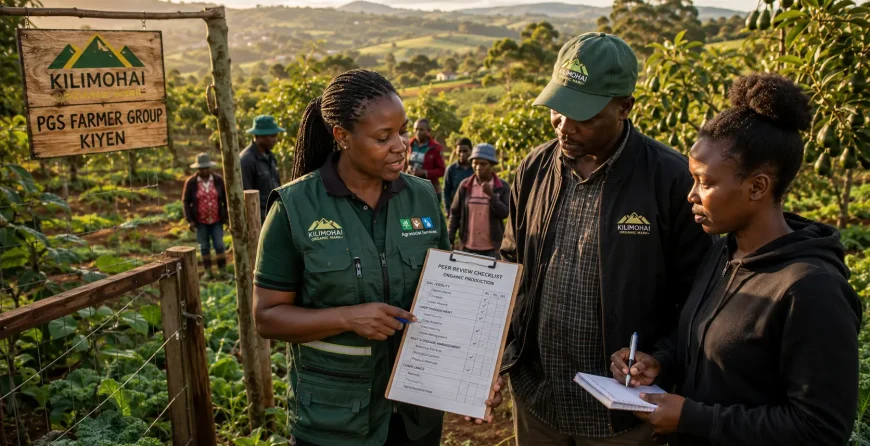
6 · Peer review. Group members carry out the internal peer-review process — visiting and assessing one another’s farms.
7 · KOAN on-farm assessment & decision. KOAN carries out its own assessment on a sample of trained farmers to confirm eligibility, then issues the certification decision.
In practice, this whole cycle — from first training to a certification decision — typically runs several months, as the real Kiambu example below shows.
Not Sure Which Route Fits?
Find your certification path in 2 minutes
Whether local-market PGS, export-grade group certification, or both in sequence is right for you depends on your goals, crop and buyers. Our quiz points you to the right path in minutes.
Proof It Works
Real PGS Groups in Kenya
PGS isn’t theoretical — it’s actively growing across several Kenyan counties, with real farmers reaching real buyers because of it.
Murang’a: from PGS certification to contract farming
In Ithanga Ward, Gatanga Sub-County, three farmer groups — Busara PGS Group, Githaku Gia Kambi Mawe PGS Group and Triple G PGS Group — earned PGS certification under the Kilimohai Organic label in 2025. That certification formally recognised their organic compliance and opened the door to premium, structured markets: the groups moved into contract chilli farming, giving members assured market access and predictable pricing they didn’t have as individual, uncertified growers.
What the Kilimohai Mark Actually Does for a Kenyan Farmer Group
Uncertified organic farmer: sells at the same price as a conventional neighbour.
Kilimohai-certified group: enters contract markets, premium buyers, school feeding programmes.
The mark is not paperwork — it is market access.
The three Murang’a groups above did not get a premium by growing better chillies. They already grew good chillies. They got the premium by becoming verifiably, recognisably organic — which is what the Kilimohai mark delivers. Contract buyers and premium market programmes cannot take an uncertified farmer’s word that their produce is organic. They can take a Kilimohai mark. That difference — between a claim and a verified certification — is the commercial value PGS creates for local-market farmers. It is also why uncertified farmers selling “organic” at the same gate price as certified neighbours are leaving money on the table every single season. Source: KOAN Murang’a PGS Programme data 2025; Agrosocial Services field observation.
Kiambu: the full pipeline in action
A Kiambu County group shows the realistic timeline. Seventy-four farmers were trained in September 2025 under a donor-supported programme; the group then completed its internal peer-review process and submitted a report to KOAN. In February 2026, KOAN conducted its own on-farm assessment on a sample of the trained farmers to verify eligibility — with the group then awaiting KOAN’s certification decision. From first training to assessment: roughly five months.
Beyond Kenya, the same model is expanding regionally — Uganda’s organic movement (NOGAMU) recognises the Kilimohai mark, and a five-country initiative spanning Kenya, Uganda, Rwanda, Tanzania and Madagascar has supported PGS groups across East and Central Africa, pointing to PGS as a genuinely regional, not just national, growth story.
The Right Fit
Who PGS Is Right For
- Smallholders selling locally — Kenyan supermarkets, farmers’ markets, school feeding programmes, local processors — who need a recognised trust mark without third-party fees.
- New organic groups not yet ready for the cost or documentation load of a full Internal Control System.
- Farmers wanting a genuine community-verification model — peer accountability, shared learning, and local market trust.
- Groups building toward export who want a lower-cost first step while they develop the organisational capacity for third-party certification later.
Be Honest With Yourself
What PGS Cannot Do
This is the part every farmer needs to hear clearly before investing time in PGS: PGS and the Kilimohai mark are not recognised for exporting to the EU, US or UK. Those markets require organic certification from an accredited third-party body against a recognised standard — EU Regulation 2018/848 or USDA NOP — which for smallholders usually means the Group of Operators route with a certified Internal Control System.
If your goal is a European or American organic buyer, PGS on its own will not get you there — no matter how well-run your group is. It’s the wrong tool for that specific job, even though it’s an excellent tool for the local-market job.
Playing the Long Game
Using PGS as a Stepping Stone to Export
Many successful Kenyan organic groups don’t treat this as an either/or choice — they use PGS as the first stage. Running a PGS group builds exactly the organisational muscle a future Group of Operators needs: a functioning member register, farmers used to being inspected and following organic practices, and a group used to operating under shared rules. When the group later pursues third-party certification for export, much of that discipline already exists — it just needs to be formalised into a certified Internal Control System and audited by an accredited body.
If that’s your trajectory — local market income now, export market access later — it’s worth planning the sequence deliberately rather than starting the export-grade paperwork from zero when the time comes.
Why the PGS Stepping Stone Strategy Works — The Time and Cost Advantage
Groups transitioning from PGS to export-grade group certification complete their ICS build in 30–40% less time than groups starting from zero.
They already have member registers, farm maps, and farmers used to organic inspection.
The PGS season is not a delay — it is preparation that you get paid for.
The most common failure mode for groups attempting export-grade organic certification is trying to build organisational discipline and formal compliance systems at the same time. PGS separates those two tasks: the discipline comes first, through low-pressure peer review, while the group earns local-market premium income. The formal compliance comes second, with an organisation that already knows how to operate under shared rules. Groups that follow this sequence reach their first external audit with half the corrective actions of groups starting from zero — and pass it in a shorter timeframe. Agrosocial field observation across PGS-to-export group transitions 2024–26.
Agrosocial Services — Organic Certification Pathway Kenya
Planning the Path from Local Market to Export?
We help farmer groups map the route from PGS to export-grade certification — and prepare for whichever standard your buyers require. Tell us your crop, your current market, and where you want to be in 3 years, and we’ll give you the exact sequence.
Quick Answers
Frequently Asked Questions
What is a Participatory Guarantee System (PGS)?
A PGS is a locally-focused organic quality-assurance system where farmers, buyers and other stakeholders verify each other’s compliance through peer review, rather than paying an external certification body to inspect. It’s built on trust, transparency and shared knowledge, and designed to be accessible to smallholders who cannot afford third-party certification fees.
Who governs PGS in Kenya?
The Kenya Organic Agriculture Network (KOAN) governs PGS in Kenya. As custodian of the East African Organic Products Standards (EAOPS), KOAN sets the rules for PGS groups and awards the Kilimohai Organic Mark to groups that complete the process successfully.
Can I export my produce with only PGS certification?
Generally, no. PGS and the Kilimohai mark are recognised for local and domestic East African markets, not for exporting to the EU, US or UK. Exporting organic produce to those markets requires third-party certification under a recognised standard such as EU Regulation 2018/848 or USDA NOP, typically through group certification with a certified Internal Control System. See our guide: Organic Group Certification in Kenya.
How much does PGS cost compared to third-party certification?
PGS is designed to be low-cost or free to join through KOAN, which is what makes it accessible to smallholders. Third-party certification involves certification body audit fees and, for group certification, the ongoing cost of running an Internal Control System — a materially higher investment, but one that opens export markets PGS cannot.
Key Takeaways — PGS Certification Kenya
- PGS certifies through peer review, not paid external audits — low-cost and accessible to smallholders through KOAN.
- KOAN governs PGS in Kenya and awards the Kilimohai Organic Mark — the same mark awarded through both PGS and third-party routes.
- PGS is for local and domestic markets — Nairobi supermarkets, farmers’ markets, school feeding programmes. It does not open EU, US or UK export access.
- Real groups in Murang’a and Kiambu show the model working — PGS opened contract chilli farming and premium market access that uncertified neighbours could not access.
- The PGS stepping stone strategy works. Groups transitioning from PGS to export-grade certification complete their ICS build 30–40% faster than groups starting from zero — because peer-review discipline is already built in.
- The local organic premium window is open now. Urban demand is ahead of certified supply. Groups without a recognised mark are selling at commodity prices. Groups with Kilimohai are accessing contracts.
Ready to Start Your PGS Journey — or Plan the Route to Export?
Take the 2-minute certification quiz to find your path, book a certification assessment, or WhatsApp us to discuss which route fits your group’s goals and timeline.
Contact Agrosocial Services — PGS & Organic Certification Pathway Kenya
For advice on whether PGS or export-grade group certification is right for your group, planning the PGS-to-export sequence, or preparing for any stage of the organic certification journey — we respond within 24 hours. Email: info@agrosocialservices.co.ke
PGS Organic Certification Kenya — Complete Resource Hub
Agrosocial Services Limited — Organic Certification & PGS Kenya
Kenya Agricultural Certification & Export Market Consultancy — Established 2018
Agrosocial Services Limited is Kenya’s specialist agricultural certification consultancy. We help farmer groups assess whether PGS or export-grade group certification is the right route, and prepare them for whichever standard their market requires — from organic farm management planning and KOAN PGS preparation through to full ICS design and audit readiness for EU 2018/848 group certification. We do not administer PGS groups or issue organic certificates — PGS certification is issued through KOAN, and third-party certification through accredited certification bodies. PGS and Kilimohai information in this guide is drawn from KOAN, Kilimo Hai Kenya, and KCOA. PGS group processes and market recognition can vary — confirm current requirements directly with KOAN before making commercial decisions. Last reviewed: July 2026.
📧 info@agrosocialservices.co.ke · 📲 WhatsApp +254 725 042 234 · 📅 Last reviewed: July 2026
What we cover:
✅ PGS vs export route assessment
✅ PGS-to-export pathway planning
✅ Organic farm management plan
✅ ICS design for EU 2018/848 group cert
✅ Organic certification funding proposals
✅ Murang’a · Kiambu · Kirinyaga · Embu
✅ Machakos · Meru · all growing counties