How to Build an Internal Control System (ICS) for Group Certification in Kenya — and Why Most ICS Audits Fail
⚠️ URGENT: EU 2018/848 GROUP OF OPERATORS RULES TIGHTENED IN JANUARY 2025 — YOUR ICS MAY NEED RESTRUCTURING
Since January 2025, the EU Group of Operators rules under Regulation 2018/848 are stricter in three ways that directly affect ICS requirements. The external certification body must now inspect at least 5% of members annually (previously lower), the group must have legal personality with a joint marketing system, and the ICS must be documented to a higher standard of independence and record-completeness. Industry analysis suggests around 70% of existing Kenyan producer groups need to restructure their ICS, legal form, or both. Groups that have not reviewed their ICS against the 2025 rules face suspension at their next annual audit. Book a 30-minute ICS Risk Call — find out now if your group will fail the next EU audit →
When a cooperative certifies its members as a group, one thing decides whether it passes or fails the external audit — and it isn’t the farming. It’s the Internal Control System (ICS). The ICS is the group’s own machinery for inspecting and policing every member, and a strong one is what lets an external certifier trust the group and inspect only a sample. A weak one can sink the entire group’s certificate overnight. This guide is the practical how-to: the team, the manual, the member register, the internal inspections, the sanctions, and exactly what the certification body will check.
If you’re still deciding whether the group route fits your cooperative — who qualifies, the Group of Operators rules, the 2,000-member cap — start with our guide to organic group certification. This article picks up where that leaves off: building the ICS itself.
The stakes are not abstract. An exporter in the UK or Netherlands who receives word that your group’s certificate has been suspended does not wait for an explanation. They switch supplier within the week. The income your 150 farmers depend on — income that took years of certification preparation to unlock — can be lost in days because an ICS manager approved a family member’s farm or a set of inspection reports never left the office. That is the real cost of a weak ICS. This guide exists so you build one that holds.
Agrosocial is an independent certification consultancy. We help cooperatives design, build and run their ICS and prepare for the external audit — the certificate itself is issued by an accredited certification body, not by us.
⚡ Key Facts — The ICS
- 🛡️ A functioning ICS is mandatory for group certification under EU 2018/848 and GLOBALG.A.P Option 2 — no ICS, no group certificate.
- 🔎 The ICS must internally inspect every member at least once a year against the standard.
- 👤 The ICS manager must be independent of internal inspectors and free of conflicts of interest — no approving family or associates.
- 🔍 The external body then inspects at least 5% of members and samples 2% for residue testing each year.
- ⚖️ Mass balance — you can never sell more as certified than your members could realistically have produced.
Sources: EU Regulation 2018/848 & 2021/279; IFOAM – Organics International and FiBL ICS guidance; GLOBALG.A.P Option 2 QMS rules. Verified July 2026.
In This Guide
📩 Free: ICS Setup Checklist for Kenyan Cooperatives 2026 — straight to your inbox
The complete ICS component checklist — manual sections, member register fields, inspection form requirements, sanction procedure template, mass balance tracking format, and EU 2018/848 compliance points. Free, instant delivery.
💬 Or Ask: “Will my ICS pass the next EU audit?” — instant WhatsApp reply →
Agrosocial builds ICS systems for cooperatives across Kenya’s major growing zones: Kiambu · Meru · Embu · Nakuru · Kirinyaga · Murang’a. Starting point: Register a Cooperative for Export Kenya — the legal prerequisite before building an ICS.
Start Here
What an ICS Is — in One Minute
An Internal Control System is the group’s own documented system for inspecting, approving and, where necessary, sanctioning its members, so that certification integrity is guaranteed from the inside. Instead of an external certifier visiting all several-hundred member farms every year, the group’s ICS inspects them internally — and the certifier audits the ICS and re-inspects a representative sample. That delegation is the entire reason group certification is affordable for smallholders.
The practical consequence is important: your certificate lives or dies on the credibility of your ICS. Auditors know that a group is only as trustworthy as its internal controls, so they scrutinise the system itself — the competence of inspectors, the completeness of records, the soundness of approval decisions — as much as the fields. Build the ICS well and the external audit becomes a confirmation, not a gamble.
The People
The ICS Team — and Why Independence Matters
A credible ICS needs clearly separated roles. Blur them, and the external auditor will flag it immediately.
- ICS manager. Runs the whole system — trains inspectors, maintains records, oversees approvals. Must understand the standard, quality control and documentation. Crucially, the manager cannot also be an internal inspector, must have no conflict of interest, and must never approve or sanction their own family or business associates.
- Internal inspectors. Visit and inspect each member farm. They must be trained on the standard and independent of the members they inspect — an inspector cannot inspect their own farm or a close relative’s.
- Approval / sanction body. A person or committee that reviews inspection findings and decides each member’s status: approved, approved with conditions, or sanctioned. Keeping this decision separate from the inspection protects objectivity.
📌 Conflict of interest is the silent killer. In small rural groups everyone is related or connected, so it’s tempting to let the manager also inspect and approve. Auditors know this and probe it hard. Design independence in from day one — even if it means bringing in an inspector from a neighbouring area.
The Rulebook
The ICS Manual — What Goes In It
The ICS manual is the documented heart of the system — the rulebook the whole group runs on. A complete manual typically contains:
- A description of the group, its structure and an organisation chart of ICS roles.
- The internal standard — the certification rules translated into clear do’s and don’ts for members.
- The member entry procedure and a signed member commitment/agreement to follow the standard.
- The internal inspection procedure and the inspection checklist.
- The approval and sanction procedure, including a defined sanctions list.
- The conflict-of-interest policy.
- The member register format and farm-mapping requirements.
- The traceability and product-flow procedure (mass balance).
- A training plan for members, inspectors and staff, and document-control rules.
A good manual isn’t a document you write once for the auditor and file away — it’s the operating system the group actually uses. If your practice on the ground doesn’t match the manual, the audit will find the gap.
Free Download
Know what auditors check before they arrive
Our free guide — the Top 25 Audit Fail Points in Kenya — shows the exact gaps that sink certifications, and how to fix each one. Many of them are ICS gaps.
📋 Get the 25 ICS Fail Points — Know Before the Auditor Arrives →
Know Every Member
The Member Register & Farm Mapping
You cannot control what you cannot list. The member register is the master record of every farmer in the group, and it must be complete and current. For each member it typically captures:
- Member name, ID and location.
- Each plot, its area, and the crops grown.
- Conversion status and the date organic management began.
- Farm maps or GPS coordinates for every plot.
- Internal inspection date and approval status.
- Estimated yield per crop (the basis for mass balance).
Farm mapping is doing double duty in 2026: the same plot geolocation that underpins your ICS also feeds EUDR traceability for coffee and other in-scope crops. Capturing it once, cleanly, serves both.
The Core Activity
Internal Inspections — the Annual Procedure
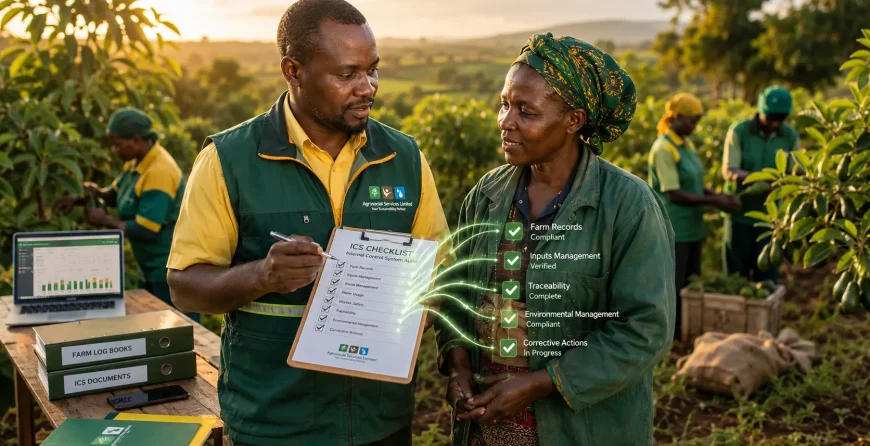
This is the work that makes an ICS real. Every member must be internally inspected at least once a year — 100% internal coverage — by a trained inspector who is independent of that member. A sound inspection round runs like this:
- The inspector visits the farm and works through a standardised checklist covering inputs, practices, records, storage and boundaries.
- Findings — compliant and non-compliant — are recorded in a dated internal inspection report signed by inspector and member.
- The report goes to the approval body, which decides the member’s status.
- The member register is updated with the inspection date and decision.
The golden rule: an uninspected member cannot sell as certified. If the ICS hasn’t inspected and approved a farmer this cycle, their produce stays out of the certified stream — no exceptions.
The Cost of Getting Your ICS Wrong — vs the Cost of Getting It Right
A failed first audit: repeat audit fee (KES 80,000–200,000) + 3–6 months delay + lost export income on every consignment that can’t be certified in the gap.
Professional ICS build: KES 40,000–120,000 — recovered from the premium on a single certified export shipment.
The economics are clear. A cooperative that builds its ICS properly — correct role separation, 100% member inspection, complete records, functioning mass balance — passes its first external audit and starts earning certified premiums immediately. A cooperative with a paper ICS fails the audit, pays repeat fees, delays certification by half a year, and loses the premium income on every consignment in the intervening months. The total cost of a failed audit for a 100-farmer cooperative typically exceeds the cost of professional ICS design by a factor of five or more. Getting the ICS right the first time is not optional — it is the highest-ROI decision the group will make. Source: Agrosocial Services field data 2025/26.
When Things Go Wrong
Non-Conformities & Sanctions
An ICS that never sanctions anyone isn’t credible — auditors read it as a system that isn’t really looking. A working ICS has a clear, graduated response to non-conformities:
| Severity | Typical response |
|---|---|
| Minor non-conformity | Corrective action within a set time; re-check at next inspection. |
| Major non-conformity | Member suspended from selling as certified until resolved; targeted re-inspection. |
| Serious breach (e.g. prohibited input) | Product de-certified; plot’s conversion clock affected; possible expulsion. |
Every decision must be documented — the finding, the sanction, and the follow-up. Those sanction records are among the first things a good external auditor asks to see, because they prove the ICS has teeth.
The Numbers Must Add Up
Traceability & Mass Balance
This is where ICS audit failures related to fraud are most commonly detected — auditors test mass balance carefully because it is the one area where documentary manipulation leaves a mathematical trail. Mass balance means the quantity you sell as certified can never exceed what your approved members could realistically have produced, based on their registered area and expected yields. If a 200-member group with a known certified area suddenly sells double the plausible volume, the certifier will assume uncertified product has been mixed in — and act on it.
To hold mass balance, the ICS tracks product from each member’s plot, through collection and bulking, to the lot that leaves for the buyer — with quantities recorded at each step. Keeping certified and non-certified produce physically separate, and never letting an uninspected member’s harvest into the certified stream, is what protects the whole group’s integrity.
The Outside Check
What the External Certification Body Checks
Once your ICS is running, the certification body does two things. First it audits the ICS itself — the manual, the inspectors’ competence, the member records, the sanction decisions, the traceability. Then it re-inspects a sample of members to confirm the ICS’s findings hold up in the field. Under EU 2018/848 these checks are demanding:
- The body inspects at least 5% of members each year.
- It takes residue samples from at least 2% of members each year.
- The group undergoes an annual on-the-spot audit.
If the certifier concludes the ICS is weak — records that don’t reconcile, inspectors who miss issues, members who shouldn’t qualify — it can suspend or withdraw the whole group’s certificate. That collective risk is exactly why the ICS deserves real investment.
Consider what suspension means at the human level. A 150-farmer cooperative has spent 18 months preparing for certification, investing time, money, and trust. The certificate is issued. Buyers sign supply agreements. Farmers begin receiving premium prices. Then the annual audit finds an ICS with fake inspection records — and the certificate is suspended. Every farmer in the group loses premium income the same day. Not the manager who allowed the fake records. Every farmer. That is the collective risk of group certification, and it is why the ICS cannot be a formality.
What the 5% Rule Means in Practice — a Worked Example
150-farmer cooperative under EU 2018/848:
ICS must internally inspect all 150 members — 100% every year.
External CB inspects at least 8 of those 150 (5%) — and must not find gaps the ICS missed.
If the CB finds non-conformities your ICS should have caught: the whole group is at risk.
The logic of group certification is elegant but unforgiving. The external certifier audits only a sample because the ICS has already done the work. If the CB’s 8 sampled inspections reveal problems that the ICS’s 150 internal inspections missed — prohibited inputs, missing records, boundary violations — the certifier’s conclusion is not that 8 farms have problems. The conclusion is that the ICS cannot be trusted, and the entire group’s certificate is at risk. This is why training internal inspectors properly, eliminating conflicts of interest, and running genuine inspections (not paper ones) is not bureaucracy — it is the entire protection for every farmer in the group. Source: EU Regulation 2018/848 Art. 36; Agrosocial Services ICS field experience 2025/26.
Putting It on a Calendar
The Annual ICS Cycle
1 · Registration & renewal. Confirm the member list, sign member commitments, and update the register and maps for any changes.
2 · Internal inspections. Inspect 100% of members, record findings, and route reports to the approval body.
3 · Approval & sanctions. Decide each member’s status; apply and document any sanctions; finalise the approved-member list.
4 · External audit. The certification body audits the ICS and inspects its sample of members.
5 · Certification & ongoing control. Certificate issued or renewed — then traceability and record-keeping continue right through the season until the cycle begins again.
The Hard Truth
Why Most Kenyan ICS Systems Are Fundamentally Broken — and Why Auditors Know It
Here is something certification bodies will not say publicly but know from experience: the majority of ICS documents submitted by Kenyan cooperatives are not genuine control systems. They are paper exercises. The manual exists. The inspection forms are filled out. The member register has names in it. And when the external auditor arrives and looks underneath — at the actual inspection reports, the approval decisions, the sanction records, the mass balance — the system falls apart.
Experienced auditors know what a genuine ICS looks and feels like, and they know what a paper one looks and feels like. They have seen both hundreds of times. A paper ICS fails audits not because the farmer grew anything wrong — but because the system that was supposed to verify the farming cannot be trusted. One failed audit doesn’t just delay certification. It signals to every buyer in your value chain that your group’s quality assurance cannot be relied upon. That reputational damage outlasts the delay by months.
The 70% problem — and whether your group is in it
Industry analysis suggests around 70% of existing Kenyan producer groups need to restructure their ICS to meet the EU 2018/848 rules as tightened in January 2025. If your group certified before 2024 and has not had its ICS reviewed against the new requirements, the probability is high that it falls in the 70%. The question is not whether your ICS has a problem — the question is whether you find out from Agrosocial before the audit or from the certification body during it. Find out which side you’re on — book the free ICS Risk Call →
The specific failure modes are consistent enough that we see the same seven patterns across almost every ICS that fails an external audit in Kenya:
- A “paper” ICS. Manuals exist, but members aren’t genuinely inspected — the fastest way to fail. Auditors spot it immediately: inspection reports with identical wording, identical dates, signed by the same person who was supposed to be in the field.
- Conflicts of interest. The ICS manager inspecting or approving family and close associates. In small rural cooperatives, everyone is connected — which is exactly why independence must be designed in structurally, not assumed.
- Incomplete register or missing maps. Members or plots undocumented; no yield basis for mass balance. If the register doesn’t match the farms, nothing downstream can be trusted.
- Undertrained inspectors. Inspections that miss real problems the external auditor then finds — which tells the CB the ICS is not doing its job.
- No mass-balance control. Selling more as certified than members could have grown. This is the pattern that triggers fraud suspicion — and the CB responds accordingly.
- No sanction records. An ICS that has never sanctioned a single member in three years of operation is not running genuine inspections. Auditors know this.
- Ineligible members. Farms included in the certified group that do not meet the group’s own entry rules — sometimes because pressure was applied to include a committee member’s relative.
Agrosocial Services — ICS Design & Group Certification Preparation Kenya
Build an ICS That Passes the First Time
We help Kenyan cooperatives design and build a compliant ICS, train internal inspectors, establish mass balance systems, and get audit-ready — so your group earns its certificate without a costly failed audit. Start with a readiness assessment to see exactly where your ICS stands.
Our ICS Services — Three Clear Packages, One Goal: Your Group Passes
Most consultancies sell “ICS support.” That is vague and unaccountable. We sell defined outcomes at defined prices — so you know exactly what you are buying and what you get at the end of it.
Tier 1
ICS Risk Audit
KES 15,000–30,000
- Full review of your existing ICS against EU 2018/848 and GLOBALG.A.P. Option 2
- Gap analysis across all 6 ICS components
- Pass probability score — before the certification body arrives
- Written report with prioritised corrective actions
Best for: Groups that have an ICS but aren’t sure it will pass the next EU audit. Know your risk before your renewal date.
Most Popular
Tier 2
Full ICS Build
KES 80,000–150,000
- Complete ICS manual designed and written for your standard
- Member register and farm mapping to certification body requirements
- Internal inspection forms and sanction procedure
- Mass balance and traceability system setup
- Internal inspector training — your team, on your farms
- One full internal inspection round supervised by Agrosocial
- Audit-ready document pack for external certification body
Best for: Groups starting from scratch or rebuilding a failed ICS. Everything you need to pass your first — or next — external audit.
Tier 3
Audit Pass Programme
KES 150,000–280,000
- Everything in Tier 2, plus:
- We prepare your group until you pass — not just until the audit date
- Mock external audit by Agrosocial before the real one
- Corrective action support between mock and real audit
- On-site presence on audit day
- Post-audit debrief and non-conformity closure support
- 12 months of ICS management advisory access
Best for: Groups that cannot afford to fail — where losing the certificate means losing the buyer. We stay with you until you pass.
Not sure which tier fits your group? Start with the 30-minute ICS Risk Call — free. We assess your current position and tell you exactly which package you need and what it will cost. No obligation. Book it on WhatsApp now →
Quick Answers
Frequently Asked Questions
What is an Internal Control System (ICS)?
It’s the group’s own documented quality system that inspects and approves every member farm each year against the standard. Because the group polices itself internally, the external certification body only audits the ICS and re-inspects a sample of members — which is what makes group certification affordable for smallholders.
Who can be the ICS manager?
Someone who understands the standard, quality control and record-keeping — and who is independent. The ICS manager cannot also be an internal inspector, must have no conflict of interest, and cannot approve or sanction their own family or business associates. Independence is one of the first things an external auditor checks.
How often must members be inspected?
Every member must be internally inspected by the ICS at least once a year. On top of that, the external certification body inspects at least 5% of members each year and samples 2% for residue testing, under EU 2018/848. A member who isn’t inspected can’t sell as certified.
Why do ICSs fail external audits?
Usually a “paper” ICS that doesn’t genuinely inspect members, conflicts of interest in approvals, an incomplete member register or missing maps, undertrained inspectors, and no mass-balance control — letting more product be sold as certified than members could have produced. A weak ICS can lead to suspension or withdrawal of the whole group’s certificate.
Key Takeaways — Building an ICS for Group Certification in Kenya
- The ICS — not the farming — decides whether a group passes its audit.
- Separate the roles: an independent ICS manager, trained inspectors, and a distinct approval body, all free of conflicts of interest.
- Inspect 100% of members every year — uninspected members cannot sell as certified.
- Hold mass balance — never sell more as certified than members could have grown.
- The external body inspects ≥5% of members and samples 2% — and can withdraw the whole group’s certificate for a weak ICS.
- The EU 2018/848 Group of Operators rules tightened in January 2025 — review your ICS against the new requirements before your next annual audit.
- A failed first audit costs 5× more than building the ICS properly. Professional ICS design is the highest-ROI investment a cooperative will make.
Ready to Build Your ICS and Pass First Time?
Get the free audit guide to see the 25 fail points, book a readiness assessment to understand exactly where your ICS stands, or WhatsApp us to start designing your ICS with professional support.
Contact Agrosocial Services for ICS Design & Group Certification Support
For ICS design, internal inspector training, member register setup, mass balance system design, or audit readiness preparation for organic or GLOBALG.A.P. group certification — we respond within 24 hours and mobilise on-site within 48–72 hours across all major Kenyan growing counties. Email: info@agrosocialservices.co.ke
📲 Book the 30-Min ICS Risk Call — Free
Get My ICS Risk Score
ICS Group Certification Kenya — Complete Resource Hub
Agrosocial Services Limited — ICS & Group Certification Kenya
Kenya Agricultural Certification & Export Market Consultancy — Established 2018
Agrosocial Services Limited designs and builds Internal Control Systems for Kenyan cooperatives pursuing organic group certification under EU Regulation 2018/848 and GLOBALG.A.P. Option 2 — including member register design, internal inspector training, sanction procedure development, traceability and mass balance system design, and full audit readiness preparation. We are an independent certification consultancy; we do not issue certification. ICS requirements in this guide are drawn from EU Regulation 2018/848 and 2021/279, IFOAM/FiBL group-certification guidance, and GLOBALG.A.P. Option 2 rules. Specific requirements vary by standard and certification body — confirm current rules with your chosen body before making commercial decisions. Last reviewed: July 2026.
📧 info@agrosocialservices.co.ke · 📲 WhatsApp +254 725 042 234 · 📅 Last reviewed: July 2026
ICS services we provide:
✅ ICS manual design — organic & GLOBALG.A.P.
✅ Member register & farm mapping
✅ Internal inspector training
✅ Sanction procedure development
✅ Mass balance & traceability systems
✅ ICS audit readiness assessment
✅ EU 2018/848 Group of Operators compliance
✅ All major Kenyan growing counties