How to Export Tea from Kenya — Grades, the Mombasa Auction, Certification & Global Buyers (2026)
⚠️ TWO URGENT DEVELOPMENTS FOR KENYAN TEA EXPORTERS IN 2026
Rainforest Alliance certification is back — and compulsory for premium buyers. The Kenyan government suspended RA audits for tea factories in May 2025 over cost concerns, then lifted the suspension in November 2025 following a cost review. UK and EU buyers (PG Tips, Yorkshire Tea, Tetley, Twinings) continued to require RA throughout the suspension. Factories that allowed their certificates to lapse during the suspension must now re-certify urgently or risk losing premium buyer relationships. · Global shipping disruptions are stranding Kenyan tea at Mombasa. Red Sea disruptions and route instability left around 8 million kilograms of tea stuck in Mombasa warehouses in early 2026, tying up cash for factories and farmers for weeks. Robust freight relationships and buyer diversification are not optional risk-management — they are commercial survival tools. Contact Agrosocial to assess your certification and market position →
Tea is Kenya’s single largest export earner and the country’s most globally recognised crop. Kenya is the world’s largest exporter of black tea and the third-largest tea producer after China and India — yet for all that scale, most Kenyan tea still leaves the country as a bulk commodity, capturing only a fraction of the value it could. This guide explains exactly how tea is exported from Kenya: who produces it, the grades, the Mombasa auction, the certifications that unlock premium markets, the AFA Tea Directorate licensing every exporter needs, the documents each consignment requires, the logistics realities — and where the real money is moving next.
⚡ Key Facts — Kenya Tea Export 2026
- 🌍 World’s largest black-tea exporter — and the 3rd-largest tea producer globally, after China and India (TBK).
- 💰 Kenya exported about 652.8 million kg of tea in 2025, earning roughly KES 186.9 billion (USD 1.44 billion) — up 2.87% on 2024, even as auction prices softened to an average of USD 2.15/kg (KNBS).
- 📦 Tea is around 16% of Kenya’s total exports — the highest share of any single product — and reached 96 countries.
- 🫖 About 99% of exports are CTC black tea; specialty and orthodox teas are barely 1% — the country’s biggest untapped value opportunity.
- 👩🏾🌾 KTDA represents around 600,000 smallholder farmers across 16 counties and manages roughly 69 factories — about 60% of national output. Large estates (KTGA) and independents (ITPAK) supply the rest.
- 🏷️ Pakistan (≈35%) and Egypt are the largest buyers — and they generally don’t require certification. The premium EU/UK/US markets do.
- 🌱 Tea is NOT covered by the EU Deforestation Regulation (EUDR) — unlike coffee. But Rainforest Alliance certification is the key to premium European and North American buyers.
Sources: Kenya National Bureau of Statistics (KNBS); Tea Board of Kenya (TBK); East Africa Tea Trade Association (EATTA); AFA Tea Directorate. Verified June 2026.
In This Guide
Who Produces Kenya’s Tea
Kenyan Tea Grades Explained
The Two Export Routes
The Mombasa Tea Auction
Certification & Premium Markets
AFA Licensing & the Tea Act 2020
Export Documentation
Logistics & the Mombasa Gateway
Top Markets & Buyers
Where Tea Grows in Kenya
Challenges & Reforms
The Value-Addition Opportunity
Frequently Asked Questions
📩 Free Download
Kenya Tea Export & Certification Compliance Checklist 2026
AFA Tea Directorate registration steps, the export documents every consignment needs, the Rainforest Alliance and Fairtrade requirements buyers ask for, and the auction-vs-direct decision — straight to your inbox, free.
Market Context
Why Kenyan Tea Leads the World
Kenya’s tea is grown in the highlands between roughly 1,500 and 2,700 metres above sea level, where volcanic soils, equatorial sunshine and reliable rainfall produce the bright, brisk, full-bodied black tea that blenders prize. Because the climate allows year-round plucking, Kenya offers something most origins cannot: consistent, reliable supply twelve months a year, with no four-month winter gap like India. That reliability — combined with competitive pricing — is why Kenyan CTC tea is the backbone of tea-bag blends from the UK to Pakistan, and why “Mombasa” prices act as an informal global benchmark for black tea.
The scale is enormous. In 2025 Kenya exported roughly 652.8 million kilograms of tea, earning about KES 186.9 billion (USD 1.44 billion) — an increase of 2.87% on the previous year, achieved despite softer auction prices that averaged USD 2.15 per kilogram. Tea accounts for around 16% of all Kenyan exports, the largest share of any single product, and the industry supports the livelihoods of millions of Kenyans across the value chain.
Kenya Tea Export Performance — Verified KNBS + TBK Data
2025 exports: 652.8 million kg · earnings KES 186.9 billion (USD 1.44B), up 2.87%.
Average auction price 2025: USD 2.15/kg (from USD 2.19 in 2024).
Tea = roughly 16% of Kenya’s total exports, shipped to 96 countries.
But there is a catch hidden in those numbers, and it is the single most important fact for any exporter to understand: about 99% of Kenya’s tea is sold as bulk CTC black tea, and specialty teas make up barely 1% of shipments. Kenya is a volume champion that captures very little of the higher margins available further up the value chain. Average prices have been drifting down even as volumes rise. The opportunity — and the entire direction of government policy — is to move from selling raw bulk tea toward certified, traceable, value-added and specialty tea that commands a premium. Certification and quality positioning are central to that shift, and they are exactly where a producer can move the needle on price.
The Industry Structure
Who Produces Kenya’s Tea — KTDA, Estates & Independents
Understanding who grows and processes Kenya’s tea tells you a great deal about how to buy it, sell it, and get it certified. The sector has three pillars.
1. Smallholders under KTDA — the majority
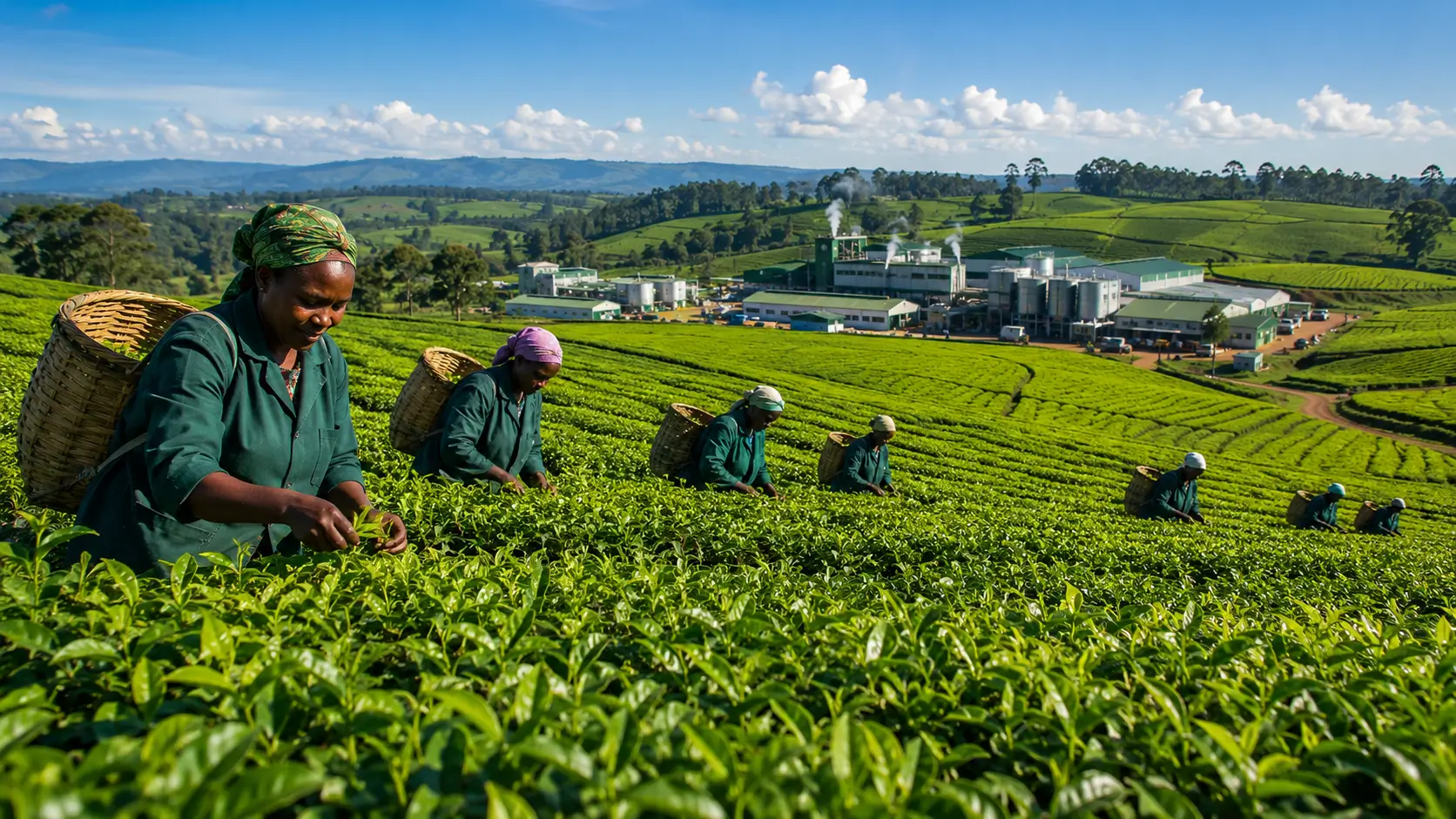
The Kenya Tea Development Agency (KTDA) is the world’s largest smallholder tea organisation. It is owned by around 600,000 smallholder farmers — individual shareholders in 54 factory companies, which together operate roughly 69 factories (including satellite factories) across 16 tea-growing counties — and accounts for about 60% of national production. Farmers deliver freshly plucked green leaf to local buying centres; it is trucked to the factory, processed within hours through withering, rolling, oxidation, drying and sorting, and sold as made tea. Farmers receive a monthly payment per kilo of green leaf plus an annual bonus after factory accounts are audited — a model the government is reviewing to allow more frequent bonus payments. KTDA’s subsidiaries handle the rest of the chain, including Chai Trading (warehousing, blending and trading), Ketepa — Kenya Tea Packers (value-added packing), and Greenland Fedha (farmer microfinance).
2. Large private estates — KTGA
Big plantation companies — members of the Kenya Tea Growers Association (KTGA), such as Williamson Tea, Browns Plantations East Africa and Sasini, along with the historic Kericho estates — grow tea on their own land and run their own factories. Estates often have the scale and capital to pursue certification, value addition and direct export more readily than individual smallholder factories.
3. Independent factories — ITPAK
A growing number of private, independent tea factories operate outside the KTDA system, represented by the Independent Tea Producers Association of Kenya (ITPAK). In 2025, independent and private factories increased output even as some large estates faced weather challenges — making them an increasingly important source of supply for buyers.
Understanding Quality Grades
Kenyan Tea Grades Explained — BP1, PF1, PD & Dust
Over 90% of Kenyan tea is manufactured by the CTC (Crush–Tear–Curl) method, which produces small, uniform granules that brew quickly and strongly — ideal for tea bags. After processing, factories sort the made tea mechanically over vibrating screens into standardised grades by particle size. Your grade determines your price and your market, so understanding the grading system is essential before you sell.
| Grade | Particle / Type | Share & Price Position | Character & Typical Markets |
|---|---|---|---|
| BP1 Broken Pekoe 1 | Largest CTC granules | ~13–15% of manufacture · highest CTC prices | Bold leaf, smooth, brisk liquor. Favoured in premium and loose-leaf segments — Central Asia, the Gulf and Europe. |
| PF1 Pekoe Fannings 1 | Medium particles | Bulk of output · most-traded · mid-range | Brisk, quick-infusing — the workhorse base for tea bags worldwide (Pakistan, Egypt, UK, Europe). |
| PD Pekoe Dust | Small, dense particles | Smaller share · strong value-for-strength | Bold, strong, fast-brewing. Sought after in Egypt and the Middle East (e.g. Yemen) for strong blends. |
| Dust 1 (D1) | Finest particles | Small share · lowest price | Strongest liquor and colour. Preferred in strong-brew markets such as Egypt and Sudan, and for instant/low-cost bags. |
| Orthodox & Specialty OPA, Pekoe, purple, green, white | Whole/large leaf & specialty | ~1% of exports · highest margins | Premium loose-leaf and niche teas — including Kenya’s distinctive purple tea. The focus of Kenya’s value-addition push. |
⚡ The fastest way to lift your average price. BP1 tends to command the highest CTC prices and the various dust grades the lowest, with PF1 — the most-traded grade — in between. Because price tracks grade so closely, the single highest-return investment a factory can make is disciplined plucking and sorting: more two-leaves-and-a-bud fine plucking, cleaner sorting, and tighter quality control at reception. Better leaf in means a higher proportion of premium grades out — and a higher average price for the same volume.
How Season and Flush Shape Your Grades
Kenya plucks tea all year, but the grade mix and quality shift with the seasons. The first flush — the fresh growth that follows a dry spell — tends to yield a higher proportion of premium grades such as BP1 and orthodox OPA, with brighter, more flavoursome liquors. Later flushes often produce a larger share of PF1 and PD. Rainfall, temperature and the time since the last dry period all feed through into the cup, so the prices a single factory achieves can vary noticeably across the year. Experienced buyers time their purchases around these patterns — and the sharpest factories plan their fine-plucking and quality push to capture the premium-grade windows rather than letting them pass.
Two Export Pathways
The Two Export Routes — Auction vs Direct Sales
There are two principal ways Kenyan tea reaches international buyers. Most exporters use the first; the value is increasingly in the second.
Route 1 · Primary
The Mombasa Tea Auction
Factories send made tea to Mombasa, where licensed brokers prepare samples and catalogue lots. Licensed buyers taste and bid; the highest bid wins. Transparent price discovery, payment security, and access to the world’s biggest pool of black-tea buyers.
Best for: reliable sale of bulk CTC volume at market price.
Route 2 · Highest value
Direct Sales & Value Addition
Selling directly to overseas buyers, blenders and retailers — often packed, branded or as specialty/orthodox tea. Higher margins, direct relationships and premiums for traceability and certification, but it demands buyer relationships, consistent quality and the right licences.
Best for: certified producers and value-added/specialty tea chasing premium prices.
Government policy is actively pushing producers toward the second route. In September 2025 Kenya introduced orthodox tea into the auction system and launched a dedicated Specialty Tea Auction, making it easier for Gulf and Central-Asian buyers to source high-quality orthodox and purple teas without competing with bulk buyers — an important step toward better price discovery for premium tea. The lesson from Kenya’s coffee sector is instructive: there, direct sales have fetched substantial premiums over the auction average, and tea is on the same journey.
Primary Export Channel
The Mombasa Tea Auction — How It Works
The Mombasa Tea Auction, run by the East Africa Tea Trade Association (EATTA), is the largest black tea auction in the world. It handles teas not only from Kenya but from across the region — Uganda, Tanzania, Rwanda, Burundi and beyond — and the prices set there ripple through to retail shelves from Cairo to London. Under the Tea Act 2020, auction organisers must run an electronic trading platform, and the sale now operates digitally. Here is the flow from factory to ship:
1 · Made tea to Mombasa & warehousing. The factory ships sorted, graded tea to a licensed broker’s bonded warehouse in Mombasa, where it is weighed and stored ahead of the sale.
2 · Cataloguing & sample distribution. The broker catalogues each lot by grade and weight, assigns a lot number, publishes the catalogue to buyers, and draws 50–100g tasting samples from every lot for distribution ahead of the sale.
3 · Pre-sale tasting & valuation. Buyers’ tea tasters cup hundreds of teas in the days before the auction — assessing strength, colour, brightness and briskness — and set the maximum price they will bid for each lot.
4 · The auction — competitive bidding in USD. Lots are offered in sequence on the electronic platform; licensed buyers bid and the highest bid wins. Prices are in US dollars per kilogram, and detailed results are published after each sale.
5 · Settlement, documentation & shipment. The buyer takes ownership and pays through the banking system; export documentation is completed — including the AFA Tea Directorate export release order — and the tea is containerised and shipped through Mombasa port.
How the Mombasa Price Is Set — and What Moves It
Why does the auction persist even as direct trade grows? Because it provides transparent price discovery: thousands of buyers and sellers establishing a fair market value in the open, an alternative to opaque bilateral deals. The result is the “Mombasa benchmark” — an informal global baseline for CTC black tea, roughly what Brent crude is to oil. Because Kenya supplies a very large share of the CTC that goes into European and Middle-Eastern tea bags, Mombasa prices feed directly through to retail shelves in markets like the UK, Egypt and Pakistan.
Several forces push that benchmark up and down, and understanding them helps a producer read the market:
- Demand in the big markets. An economic squeeze in the UK or Europe shifts buyers toward cheaper blends; political or economic instability in Pakistan or Egypt — which together take roughly half of Kenya’s tea — can soften demand for the bulk grades and pull prices down.
- Currency. A weaker Kenyan shilling makes tea cheaper for dollar and euro buyers, supporting export demand and prices even when local supply is high.
- Weather expectations. Forecasts of drought can trigger pre-emptive buying ahead of a feared shortage — a self-fulfilling spike — while abundant rain and heavy crops can weigh on prices.
- Geopolitics and logistics. Disruption to shipping routes — Red Sea attacks, the Sudan conflict, tensions in the Gulf — raises freight costs and stalls buying, as Kenya saw when millions of kilograms were stranded in Mombasa in early 2026.
None of these are within an individual factory’s control — but quality, certification and a diversified set of buyers are exactly what insulate a producer when the benchmark turns against them.
The Premium-Market Gateway
Certification & Premium Markets — Where the Real Money Is
This is the part of the tea trade that separates commodity sellers from premium suppliers — and it is where most producers leave money on the table. The honest picture matters, so let’s be precise about who needs certification and who doesn’t.
Kenya’s two largest markets — Pakistan (around 35% of exports) and Egypt — generally do not require sustainability certification. Between them they take roughly half of all Kenyan tea. By contrast, the EU accounts for only a small share of volume (around 4.5% in 2024). So certification is not a blanket requirement to export tea. What certification does is unlock the premium markets — the UK, Germany, the wider EU and the US, where consumers and retailers pay more for traceable, responsibly produced tea, and where the major brands make certification a condition of supply.
What Rainforest Alliance Certification Is Actually Worth to a Kenyan Tea Factory
Bulk CTC at auction: USD 2.15/kg average (2025 Mombasa benchmark).
Rainforest Alliance-certified direct supply to UK/EU buyers: USD 3.50–5.00/kg.
That is a 60–130% price premium — on the same tea, from the same factory.
The USD 2.15/kg auction average is the price a factory receives after selling undifferentiated bulk CTC to whoever bids at Mombasa. A Rainforest Alliance-certified factory supplying PG Tips, Yorkshire Tea, Tetley or Twinings under a direct supply agreement earns substantially more — because certified, traceable tea from a named, audited origin is a different product to commodity bulk, and the buyer pays accordingly. The Rainforest Alliance certification cost (USD 2,900–3,200/year plus 0.5–1.5% of certified sales) is recovered from a price premium that starts on the very first certified shipment. Sources: KNBS 2025; EATTA auction data; Agrosocial field data 2025/26.
Rainforest Alliance — the dominant tea certification
For Kenyan tea, Rainforest Alliance (RA) is the key certification. It is so widely adopted that essentially all KTDA-managed factories have pursued it, and the major UK tea brands — PG Tips, Yorkshire Tea, Tetley and Twinings — require it, as do many buyers in Germany, the rest of the EU and the US. RA verifies sustainable farming, worker welfare, environmental management and traceability. For a Kenyan tea factory or cooperative, RA certification is effectively the entry ticket to the premium European and North American shelf. A Kenyan tea cooperative typically scopes certification to include both its member farmers and the cooperative-owned factory, since the factory itself must meet RA requirements for worker welfare, energy and environmental management.
📌 The 2025 suspension — what happened. In May 2025 the Kenyan government suspended Rainforest Alliance certification and audits for all tea factories, arguing the cost (reported at roughly USD 2,900–3,200 per factory per year, plus a licence fee of about 0.5–1.5% of certified sales) was being unfairly passed on to farmers. After a cost review, the suspension was lifted in November 2025, and factories have been working to restore and maintain certification — because premium buyers in Germany, the UK and the US continued to demand it throughout. The episode is a reminder that certification readiness is not a one-off event but an ongoing management discipline.
Fairtrade, ISO & dual certification
Many Kenyan tea cooperatives also hold Fairtrade certification (which adds a guaranteed minimum price and a social premium for the community), and all KTDA factories are certified to ISO 22000 (food safety) and ISO 9001 (quality management). Because Rainforest Alliance and Fairtrade share substantial requirements — particularly worker welfare, environmental management and record-keeping — building a single management system that satisfies both standards at once is far more efficient and affordable than pursuing them one after another. A cooperative holding both can access the widest possible buyer base, from sustainability-led blenders to Fairtrade-labelled retail brands.
| Rainforest Alliance | Fairtrade | |
|---|---|---|
| Core focus | Sustainable farming, environment, worker welfare, traceability | Fairer trading terms — a price floor and a community premium |
| Price mechanism | No fixed price premium — it delivers market access to premium buyers | Guaranteed Fairtrade Minimum Price plus a Fairtrade Premium paid to the cooperative |
| Who requires it | Major UK/EU/US brands (PG Tips, Yorkshire Tea, Tetley, Twinings) | Fairtrade-labelled retail brands and ethical retailers |
| In Kenyan tea | Adopted by essentially all KTDA-managed factories | Held by a portion of KTDA factories |
In short: Rainforest Alliance opens the door to premium buyers; Fairtrade adds a guaranteed price and a community premium. They are complementary, not alternatives — which is why dual certification is so common in Kenyan tea.
The Living-Wage Hurdle — the Gap That Trips Most Factories
If there is one requirement that most often catches Kenyan producers out on the road to Rainforest Alliance certification, it is the living-wage documentation requirement. The standard does not simply ask whether you pay the legal minimum — it asks you to benchmark current wages against a credible living-wage estimate for your area, identify any gap, and present a realistic plan to close it over time. Factories that leave this to the last minute scramble; those that document their wage structure early and build a credible improvement plan clear the audit far more smoothly. This is exactly the kind of gap a readiness assessment surfaces before an auditor ever sets foot on site.
🌱 A factual note on EUDR: unlike coffee, tea is not covered by the EU Deforestation Regulation. EUDR applies to seven commodities — cattle, cocoa, coffee, oil palm, rubber, soy and wood — and tea is not among them. Kenyan tea exporters do not need to file EUDR due-diligence statements or geolocate plots for EUDR. If anyone tells you your tea needs “EUDR compliance,” they are mistaken. Read more on what EUDR actually covers →
Get Certification-Ready
Preparing your factory or cooperative for Rainforest Alliance or Fairtrade?
We are an independent certification consultancy that prepares Kenyan tea cooperatives and factories for Rainforest Alliance, Fairtrade and ISO audits — and connects certified producers to premium buyers. Start with a Farm Readiness Assessment to see exactly where you stand.
Regulation & Compliance
AFA Licensing & the Tea Act 2020 — What Exporters Need
Kenya’s tea trade is regulated by the Agriculture and Food Authority (AFA) — Tea Directorate (the body that took over the functions of the former Tea Board of Kenya) under the Tea Act 2020 and its supporting regulations. No one may manufacture, buy, broker or export tea for sale without the appropriate licence or registration. The essentials:
- Manufacturing licence — a person may not manufacture tea for sale without a manufacturing licence from the Board; this licence also covers packing and blending.
- Tea buyer/exporter registration — every prospective buyer or exporter must register with the AFA Tea Directorate, providing a business plan, evidence of capacity and experience, company documents (including the CR12), and a demonstrated ability to undertake tea value addition. Registration lapses if the holder does not commence operations within one year.
- Export declaration & release order — exporters must declare each consignment to the Authority and obtain an export release order before shipping; all tea for export must conform to Kenya Tea Standards on quality, food safety and SPS requirements.
- Broker registration — brokers must be registered, and broker commission is capped by regulation (around 0.55% of gross sales under the 2024 rules).
- Auction organiser registration — auction organisers must be registered and must run an electronic trading platform.
- Monthly returns — buyers, exporters and brokers must file monthly returns to the Authority (by the 14th of each month) detailing teas bought and their source and destination.
Source: Tea Act 2020 (No. 23 of 2020) and the Crops (Tea Industry) / Tea Registration & Licensing Regulations, AFA Tea Directorate & Tea Board of Kenya. Confirm current forms and fees directly with the AFA Tea Directorate before applying.
Paperwork That Moves the Tea
Export Documentation — What Every Tea Consignment Needs
Whether tea is sold at auction or directly, the export consignment needs a standard documentation pack. Missing or incorrect paperwork is one of the most common causes of delay at the port. The core documents are:
- AFA Tea Directorate export release order — the regulator’s clearance that the consignment may be exported (tea-specific).
- Commercial invoice and packing list — describing the tea, grade, quantity, value and packing.
- Certificate of origin — confirming Kenyan origin (and supporting preferential tariff access where applicable).
- Phytosanitary / quality & food-safety documentation — confirming the tea conforms to Kenya Tea Standards on quality, hygiene and SPS requirements.
- Bill of lading (sea) or airway bill (air) — the transport document/contract of carriage.
- Certification documents — Rainforest Alliance / Fairtrade transaction certificates and traceability records, where the buyer requires them.
📌 Confirm the exact pack with your clearing agent and the AFA Tea Directorate for your specific market — destination countries (and certified-tea buyers) may require additional certificates. Getting the documentation right the first time avoids demurrage and storage costs at Mombasa.
Getting It to Market
Logistics & the Mombasa Gateway
Almost all Kenyan tea leaves the country by sea through the Port of Mombasa, the gateway for the entire East African tea trade. Tea is typically warehoused in Mombasa (the auction and most blending/packing happen there), then containerised for shipment. Air freight via Jomo Kenyatta International Airport is used only for urgent or high-value specialty consignments.
Logistics is also where the sector is most exposed to shocks. Global shipping disruptions — Red Sea attacks, the Sudan conflict and tensions in the Gulf — have repeatedly hit Kenyan tea: in early 2026, around eight million kilograms of tea were reported stuck in Mombasa warehouses for weeks as shipping routes were disrupted, tying up cash for factories and farmers. For exporters, this underlines the value of reliable freight relationships, realistic lead times, and buyers who understand the route — and it is another reason diversifying beyond a few distant markets matters.
Who Buys Kenyan Tea
Top Markets & Buyers for Kenyan Tea
Kenyan tea reaches 96 countries, but a handful of markets dominate. The concentration is both a strength and a risk — which is why diversification and premium-market access matter so much.
| Market | 2024 Volume | Notes |
|---|---|---|
| Pakistan | 206.3M kg (≈34.7%) | By far the largest buyer. Strong, brisk CTC for milk tea. Certification generally not required. |
| Egypt | 86.9M kg | Bold dust and PD grades for strong blends. Certification generally not required. |
| United Kingdom | 57.4M kg | Premium market. Major brands require Rainforest Alliance. Higher prices for certified, traceable tea. |
| UAE | 30.5M kg | Re-export hub and growing market for specialty/orthodox and purple tea. |
| Russia | 28.5M kg | Established bulk market. Logistics sensitive to global disruptions. |
Other significant buyers include India, Saudi Arabia, Yemen, Iran and China, with emerging demand in Germany, Poland, Switzerland and Oman — particularly for premium, blended and private-label teas. Source: Tea Board of Kenya, 2024 performance data.
Where It Comes From
Where Tea Grows in Kenya
Tea is grown across 16 counties on both sides of the Rift Valley, with the major producing areas being Kericho, Bomet, Nandi, Kisii, Nyamira, Murang’a, Kiambu, Meru, Embu and Nyeri. West-of-Rift teas (Kericho, Bomet, Nandi, Kisii) and East-of-Rift teas (Murang’a, Kiambu, Embu, Meru, Nyeri) have subtly different profiles that buyers recognise.
Whether you are a smallholder factory or a large estate, our consultants support tea-growing regions across Kenya: Kisii · Nakuru · Murang’a · Meru · Embu · Kiambu
The Realities to Plan For
The Challenges Every Tea Exporter Should Understand
Kenya’s tea sector is a genuine global leader, but it would be dishonest to present it without its pressures — and understanding them is part of exporting wisely. Four stand out.
- Soft and stagnant prices. Despite record volumes, average auction prices have been drifting down — to USD 2.15/kg in 2025 from USD 2.19 the year before — because Kenya sells overwhelmingly as undifferentiated bulk CTC. Volume growth alone has not lifted earnings.
- Thin farmer and worker incomes. A study by the Fairtrade Foundation found that only about one in five tea workers and farmers in Kenya earn enough each month to support their families, with rising production costs squeezing margins further. This is both a livelihoods issue and, increasingly, a market-access one — premium buyers ask about it.
- Climate change. KTDA’s own Climate Risk Mapping warns that climate change could reduce tea yields by up to 20% in the coming decades unless farmers’ resilience is strengthened through agroforestry, soil health and climate-smart practices — the very practices certification rewards.
- Concentration and logistics risk. Heavy reliance on Pakistan and Egypt leaves earnings exposed to those economies, and global shipping disruptions repeatedly strand tea at Mombasa. Diversification and premium-market access are the structural answers.
The policy response is pulling in one direction: up the value chain. The government is targeting roughly KES 100 per kilogram of green leaf by 2027, reviewing the bonus-payment model so farmers are paid more frequently, pushing value addition toward 200,000 tonnes of specialty tea by 2030, and opening the new Specialty Tea Auction. For an individual producer, the throughline is clear and practical: quality, traceability and certification are the levers that improve farmer welfare and price at the same time — which is precisely the work we help tea cooperatives and factories do.
The Strategic Opportunity
The Value-Addition Opportunity
Here is the strategic heart of Kenya’s tea story. The country exports enormous volumes of raw bulk tea but captures little of the value added when tea is blended, branded, packed and sold to consumers. With specialty teas at barely 1% of exports, the upside is huge — and the government has set ambitious targets, including raising specialty output toward 200,000 tonnes by 2030 and lifting smallholder green-leaf earnings toward KES 100 per kilogram by 2027.
The 99% vs 1% Problem — and the Scale of the Opportunity
99% of Kenya’s tea exports are bulk CTC at USD 2.15/kg average.
1% is specialty, orthodox and purple tea — at USD 8–25/kg.
Government target: 200,000 tonnes of specialty tea by 2030.
The arithmetic is stark. Bulk CTC PF1 clearing at the Mombasa auction in 2025 averaged USD 2.15/kg. Premium orthodox and purple teas from Kenya sell at USD 8–25/kg depending on grade, provenance and certification. Specialty teas are currently under 1% of export volumes — which means there is essentially no upper ceiling on the upside for producers who transition part of their output. The September 2025 launch of the Kenya Specialty Tea Auction removes the last structural barrier by giving specialty teas their own price discovery mechanism, separate from bulk CTC pricing. Sources: KNBS 2025; EATTA 2025; Tea Board of Kenya 2025.
Packed and branded tea
Selling tea in consumer-ready packaging captures far more value than selling it in bulk. KTDA’s own value-addition arms lead the way: Ketepa (Kenya Tea Packers) blends and packs tea for the domestic and regional retail market — its Fahari brand is a household name in Kenya — while Chai Trading Company handles warehousing, blending and trading further down the chain. A wave of independent Kenyan brands is also building branded consumer products, and innovation is broadening the category: producers have launched instant teas with milk and sugar already added, and health-led herbal and wellness infusions aimed at changing consumer tastes. The most-cited practical constraint is access to high-grade packaging material that meets international shelf-life, branding and food-safety standards — a hurdle worth planning for early rather than discovering late.
Specialty, orthodox & purple tea
Beyond CTC, Kenya produces orthodox (whole-leaf) teas and a growing range of specialty teas — green, white, yellow and the distinctive purple tea. Purple tea is a genuine origin differentiator: it comes from a cultivar (TRFK 306/1) developed locally by Kenya’s Tea Research Institute under KALRO at Kericho, and its leaves are rich in anthocyanins — the same antioxidant pigments found in blueberries — which gives it a natural health-and-wellness story that premium and Gulf buyers value. Orthodox and specialty teas command far higher prices per kilo than bulk CTC, and for a cooperative or estate with quality leaf and the right processing, they are one of the clearest routes to lifting the average price of the crop.
The new Specialty Tea Auction
Until recently, the Mombasa auction was reserved for CTC black tea, which left specialty and orthodox producers without a transparent marketplace. That changed in September 2025, when Kenya introduced orthodox tea into the auction system and launched a dedicated Specialty Tea Auction. The change matters because it lets buyers in the UAE and the CIS region source high-quality orthodox and purple teas without having to compete against bulk CTC buyers — improving price discovery for premium tea and giving specialty producers a clearer route to market. It is a concrete signal of where government and industry want the sector to go: up the value chain, not just out in volume.
Every one of those routes — higher grades, certification, specialty teas, packed and branded product — depends on quality systems, traceability and certification: the same foundations that get you audit-ready. That is precisely the work we help Kenyan tea producers do.
Answers to Common Questions
Frequently Asked Questions
Does Kenyan tea need certification to export?
It depends on the market. Kenya’s largest buyers — Pakistan and Egypt — generally don’t require sustainability certification, and together they take roughly half of all exports. Premium buyers in the UK, Germany, the wider EU and the US (brands such as PG Tips, Yorkshire Tea, Tetley and Twinings) require Rainforest Alliance certification, and often Fairtrade. Certification is the gateway to premium markets and better prices, not a blanket requirement for all tea exports.
Is Kenyan tea covered by the EU Deforestation Regulation (EUDR)?
No. The EUDR covers seven commodities — cattle, cocoa, coffee, oil palm, rubber, soy and wood — and tea is not among them. Kenyan tea exporters do not currently face EUDR obligations, unlike coffee exporters. The EU may review the regulation’s scope in future, but as of 2026 tea is out of scope.
What does Rainforest Alliance certification cost a Kenyan tea factory?
For a factory processing 5 to 15 million kilograms of green leaf, annual Rainforest Alliance compliance costs have been reported at roughly USD 2,900 to USD 3,200, plus a licence fee of about 0.5% to 1.5% of certified sales. The Kenyan government suspended tea-factory certification in May 2025 over these costs and lifted the suspension in November 2025 following a cost review.
How is most Kenyan tea sold for export?
Most Kenyan tea is sold through the Mombasa Tea Auction, the largest black tea auction in the world, operated by the East Africa Tea Trade Association (EATTA). A growing share is sold through direct sales to international buyers. About 99% of Kenya’s tea is CTC (crush-tear-curl) black tea, with specialty teas making up around 1%.
Key Takeaways — Kenya Tea Export 2026
- Kenya is the world’s largest black-tea exporter, but ~99% leaves as bulk CTC — the value lies in certification, quality and specialty.
- Pakistan and Egypt (≈half of exports) don’t require certification; the premium UK/EU/US markets require Rainforest Alliance, and often Fairtrade. Rainforest Alliance-certified direct supply earns 60–130% more than the Mombasa auction average.
- Tea is not an EUDR commodity — don’t let anyone tell you otherwise.
- Every exporter needs AFA Tea Directorate registration and an export release order under the Tea Act 2020, plus a complete documentation pack for the port.
- The Rainforest Alliance suspension was lifted in November 2025 — factories that allowed certification to lapse must re-certify now or risk losing premium buyer relationships.
- The September 2025 Specialty Tea Auction is a structural breakthrough for orthodox and purple tea — specialty commands USD 8–25/kg vs USD 2.15/kg for bulk CTC.
- Getting certified — and audit-ready — is the single highest-leverage step toward premium prices and long-term buyer relationships.
Take Your Tea from Bulk Commodity to Certified Premium Supply
We prepare Kenyan tea factories and cooperatives for Rainforest Alliance, Fairtrade and ISO certification — and connect certified producers to premium buyers. Start with a Readiness Assessment or talk to us directly on WhatsApp.
Contact Agrosocial Services for Tea Certification & Export Support
For Rainforest Alliance, Fairtrade or ISO 22000 preparation, living wage benchmarking, ICS design, audit readiness assessments, or market linkage to premium UK and EU tea buyers — we respond within 24 hours and mobilise on-site within 48–72 hours across all major Kenyan tea-growing counties. Email: info@agrosocialservices.co.ke
Tea Export Kenya — Complete Resource Hub
Agrosocial Services Limited — Tea Export & Certification Kenya
Kenya Agricultural Certification & Export Market Consultancy — Established 2018
Agrosocial Services Limited prepares Kenyan tea factories and cooperatives for Rainforest Alliance, Fairtrade and ISO 22000 certification — including living wage benchmarking, Internal Control System design, and audit readiness assessments. Active across Kisii, Nakuru, Murang’a, Meru, Embu, Kiambu, and all major Kenyan tea-growing counties. This guide reflects tea industry data and export regulations as understood in June 2026. Figures are drawn from the Kenya National Bureau of Statistics (KNBS), Tea Board of Kenya (TBK), AFA Tea Directorate, EATTA, and Rainforest Alliance. Tea-sector data and regulations change — confirm current figures, forms and fees with the AFA Tea Directorate before making commercial decisions. Agrosocial Services is an independent certification-preparation consultancy; we are not a certification body. Last reviewed: June 2026.
📧 info@agrosocialservices.co.ke · 📲 WhatsApp +254 713 935 361 · 📅 Last reviewed: June 2026
What we cover:
✅ Rainforest Alliance preparation — tea factories
✅ Fairtrade certification preparation
✅ ISO 22000 & 9001 preparation
✅ Living wage benchmarking & ICS design
✅ Dual-standard (RA + Fairtrade) systems
✅ Audit readiness assessments
✅ Premium buyer market linkage
✅ Kisii · Murang’a · Meru · Embu · Kiambu