
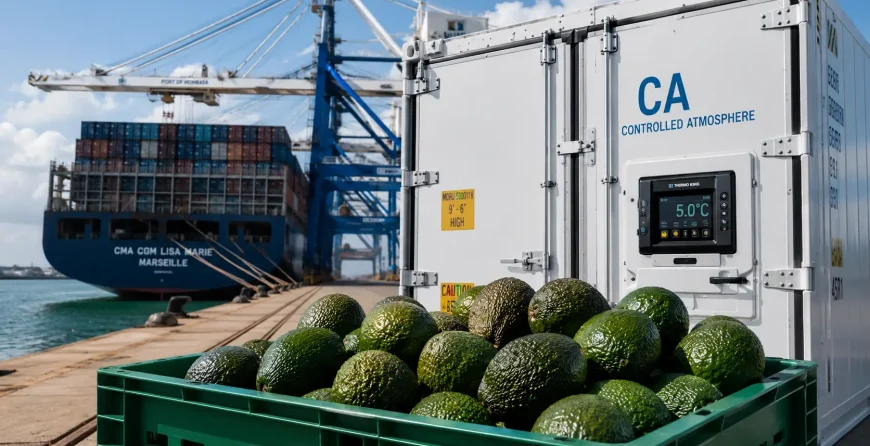
Kenya Avocado Sea Freight 2026 — AFA Compliance, Cold Chain Management & Surviving Extended Transit Times
🚢 AFA Season: Open from April 2, 2026 | 🌍 Routing: Cape of Good Hope (35–42 days EU) | 🥑 Min. DM: 22% practical floor for EU | 📋 Applies to: All Kenyan Avocado Exporters & Packhouses | 📖 Read time: 22 minutes | 📅 Last reviewed: May 2026
In This Guide
- Key Facts — 2026 Season at a Glance
- AFA’s 2026 Rules — Complete Breakdown
- Red Sea Crisis & Cape of Good Hope Impact
- County Cold Chain Logistics
- Dry Matter Testing — Complete Technical Guide
- Cold Chain — Harvest to Container
- CA Reefer Container Management
- EU · Middle East · China Market Requirements
- Mombasa Port — Booking & Carriers
- AFA Rejection Recovery Protocol
- Sea Freight Cost Calculator 2026
- Pre-Shipment Readiness Checklist
- Frequently Asked Questions
⚡ Key Facts — Kenya Avocado Sea Freight 2026
- AFA 2026 season opened April 2, 2026. Mandatory packhouse inspections from April 7. HPMA registry closed March 30. Oil processing start: April 30. One failed inspection does not just lose that batch — it triggers heightened surveillance on all subsequent batches and risks licence revocation on repetition.
- Cape of Good Hope routing is the 2026 operational reality. Mombasa to Rotterdam: 35–42 days. Maersk reversed a brief Red Sea return in March 2026. Plan every shipment around Cape routing — do not build logistics around a Suez reopening that may not materialise this season.
- 22% dry matter is the practical 2026 floor for EU shipments — not the regulatory 21% minimum. AFA’s 21% threshold was calibrated for a 21–24 day Suez transit. Cape routing adds 14–18 days. Fruit at exactly 21% DM does not have the maturity reserve to survive a 40-day voyage in saleable condition.
- A failed load on arrival wipes out the margin of 3–5 clean loads. A 40ft CA reefer carrying 20 tonnes of avocados earning USD 1.80/kg FOB represents approximately USD 36,000 in cargo value. A single rejected load costs more than the entire dry matter testing infrastructure needed to prevent it.
- China sea freight: 28–34 days Mombasa to Shanghai via Cape. Kenya gained duty-free avocado access to China in 2024. This is now a commercially viable third sea freight market — and the shorter transit makes it accessible for fruit at 21–22% DM that would be marginal for the longer EU voyage.
- GLOBALG.A.P. IFA v6 certification is the most effective AFA inspection preparation tool available. Certified farms’ record-keeping systems directly satisfy AFA inspection requirements. If you are not certified, use AFA preparation as the foundation for your GLOBALG.A.P. engagement.
Kenya’s 2026 avocado export season opened under the most demanding regulatory and logistical conditions the sector has ever faced simultaneously. On one side: a reinvigorated AFA enforcement framework following a disruptive 2025 season that saw sea exports suspended for immature fruit. On the other: an ongoing Red Sea crisis forcing shipments onto Cape of Good Hope routes that extend Mombasa-to-Rotterdam transit times from a historical average of 21–24 days to 35–42 days.
The USDA Foreign Agricultural Service projects Kenya’s 2026 avocado exports to reach 130,000 metric tonnes — a 7.4% increase — driven by resumed sea shipments and new market access. Kenya remains Africa’s largest avocado exporter, with over 60% of exports destined for the EU and Middle East, and China emerging as a fast-growing third market since the 2024 duty-free arrangement.
But that growth projection only materialises if exporters can navigate both the regulatory gauntlet and the cold chain challenge. Fruit that passes AFA inspection but deteriorates in a poorly managed 40-day reefer voyage is a commercial write-off. Fruit that fails AFA inspection never reaches the ship. This guide gives you the technical and operational knowledge to prevent both outcomes.
Who this guide is for
Licensed avocado exporters, packhouse managers, cooperative export coordinators, sourcing agents (HPMAs), and logistics managers planning 2026 sea shipments from the Port of Mombasa to European, Middle Eastern, and Chinese markets. If you are a Kenyan avocado farmer pursuing GLOBALG.A.P. IFA v6 certification, the AFA compliance requirements in this guide directly mirror the audit trail your certification will require.
📩 Free: 2026 Sea Freight Readiness Checklist — printable PDF, straight to your inbox
Every AFA, KEPHIS, dry matter, cold chain, and container booking step for a compliant Mombasa sea export — formatted as a print-and-use inspection checklist. Free, instant delivery.
The Commercial Mathematics of a Rejected Avocado Load
One rejected load = the margin of 3–5 clean loads gone.
40ft CA reefer × 20 tonnes × USD 1.80/kg = USD 36,000 cargo value.
Dry matter testing equipment: KES 40,000–120,000. One load.
A single 40ft container of 20-tonne Hass avocado cargo rejected on arrival in Rotterdam because it peaked prematurely at sea destroys more value than the entire season’s investment in the equipment and protocols that prevent it. AFA compliance and cold chain integrity are not cost centres — they are the most commercially leveraged capital expenditure an avocado exporter can make.
📖 Also read: How to Export Avocados from Kenya — Complete Certification & Compliance Guide · Avocado Buyers Kenya 2026 — Specific Buyer Names, Volumes & Prices
AFA’s 2026 Avocado Export Rules — The Complete Breakdown
Following the October 2025 suspension of sea exports — triggered by a nationwide maturity survey finding that insufficient volumes had reached harvestable indices — AFA conducted follow-up surveys from March 1–6, 2026. Those surveys found continued insufficient maturity in most zones, prompting an extension. A final survey confirmed improved maturity across major production zones, leading AFA Acting Director General Calistus Kundu to announce the 2025/2026 season opening on March 27, 2026, with harvesting commencing April 2 and packhouse inspections mandatory from April 7.
Rule 1 — Mandatory Packhouse Inspections (Effective April 7, 2026)
All fresh avocados destined for export are subject to physical inspection by AFA-HCD inspectors before shipment clearance. Exporters must apply for inspection at least 72 hours (3 full working days) before the scheduled shipment date, have all batch documentation ready, and receive a signed AFA export clearance certificate before any container can be loaded or booked for Mombasa. Packhouse registration will be revoked if immature fruit is found during inspection — no warning, immediate action.
Practical implication: Plan your packing schedule backward from your container booking date. Container booking → minus 3 days = AFA inspection application deadline. Inspection result → packing → dispatch to Mombasa. Any delay in the inspection chain will cause you to miss the vessel sailing.
Rule 2 — Crate-Only Transport (Open Vehicles Banned)
The era of transporting avocados in open pick-up trucks, Probox vehicles, or bulk sacks from farm to packhouse is officially over. AFA’s enforcement language is unambiguous: “Any exporter or agent found using open trucks, pickups, or Probox vehicles in violation of regulations risks revocation of their registration or export licence.” Well-ventilated plastic crates for all field-to-packhouse transport, stacked on pallets or in enclosed truck bodies, with crate identification numbers traceable through the packhouse system to the packed carton.
Rule 3 — HPMA Registry Submission & Sourcing Accountability
All exporters were required to submit their verified list of Horticultural Produce Marketing Agents (HPMAs) and contracted suppliers by March 30, 2026. Purchasing from unregistered brokers or agents not on your submitted HPMA list is a direct compliance violation. Traceability from specific farm block → specific HPMA → specific packhouse batch must be documentable for every AFA inspection. Note: GLOBALG.A.P. IFA v6 block-level traceability records satisfy this requirement directly.
Rule 4 — Oil Processing Season (April 30, 2026 Start Date)
Avocados destined for oil processing require higher maturity indices than fresh export fruit — minimum 25%+ dry matter vs the 21% minimum for fresh Hass sea export. AFA specified April 30, 2026 as the start date for oil processing harvesting. The optimal oil processing dry matter range is 26–30% — late-season fruit only.
⚠️ What Happens If You Fail an AFA Packhouse Inspection
A failed inspection — typically triggered by fruit below dry matter threshold, open-vehicle transport evidence, or traceability documentation gaps — results in:
- Rejection of the specific batch — no clearance certificate issued, container cannot be booked or stuffed.
- Immediate packhouse surveillance — AFA inspectors placed on heightened monitoring of all subsequent batches.
- Repeat violations — packhouse registration and export licence revocation. No warning period. Permanent.
- If your GLOBALG.A.P. certification is linked to your HCD registration, a licence revocation also triggers a GLOBALG.A.P. compliance review with your certification body.
📖 AFA compliance linked to farm certification: How to Pass a Farm Audit in Kenya — 12-Week Preparation Guide · Farm Record Keeping for GLOBALG.A.P. Certification
The Red Sea Crisis & What It Means for Your Avocado Shipment in 2026
Since November 2023, Houthi attacks on commercial shipping in the Red Sea have made the Suez Canal route effectively unusable for most carriers. As of May 2026, Maersk — which briefly attempted a return to Red Sea transits in February 2026 — reversed course in March and returned to Cape of Good Hope routing. The Suez Canal reopening timeline pushed to the second half of 2026 is now considered optimistic by most shipping analysts.
For Kenyan avocado exporters, this means your 2026 season shipments will almost certainly travel around the Cape of Good Hope. Plan accordingly — do not build a logistics strategy around a Suez reopening that may not materialise during the season.
Transit Time Comparison: Suez vs Cape of Good Hope
| Route | Mombasa → Rotterdam | Mombasa → Dubai | Mombasa → Shanghai | Freight Premium |
|---|---|---|---|---|
| Suez (pre-crisis) | 21–24 days | 7–10 days | 18–22 days | Baseline |
| Cape of Good Hope (2026) | 35–42 days | 22–28 days | 28–34 days | +25–40% |
| Suez (if reopened mid-2026) | 24–28 days (congestion buffer) | 9–13 days | 21–25 days | Possible spike on reopening |
📖 Also read: Agricultural Export from Kenya — The Complete Operational Guide 2026 · China Duty-Free Access for Kenyan Farmers 2026
County-by-County Cold Chain Logistics — Farm Gate to Mombasa Container
Every hour between harvest and container loading matters for a 40-day Cape voyage. The distance and road time from your production zone to the Port of Mombasa — or to the Nairobi Inland Container Depot (ICD) for SGR routing — directly determines the pre-cooling and cold storage protocol your operation needs.
The SGR Routing Option Every Upcountry Packhouse Manager Should Know
Nairobi ICD to Mombasa port via SGR: 4.5–5 hours.
Road Nairobi to Mombasa: 8–10 hours (A109).
For Murang’a, Kirinyaga, Meru — SGR via Nairobi ICD halves the Mombasa transit time.
The Standard Gauge Railway (SGR) Nairobi-Mombasa freight service is one of the most underutilised cold chain assets for upcountry Kenyan avocado exporters. For production counties more than 3 hours from Mombasa, routing pre-cooled, palletised avocados to the Nairobi ICD and then onto the SGR refrigerated container service eliminates 4–5 hours of road heat exposure versus direct road transport to Mombasa.
| Production County | Road to Nairobi | Road to Mombasa | Cold Chain Protocol Required | SGR Option? |
|---|---|---|---|---|
| Murang’a | 60–90 min | 9–11 hrs | Pre-cool at packhouse to 5°C. Cold transport to Mombasa or Nairobi ICD + SGR. | Yes — via Nairobi ICD |
| Kiambu | 45–75 min | 9–10 hrs | Pre-cool at packhouse. Excellent access to Nairobi ICD cold stores pre-SGR dispatch. | Yes — shortest route |
| Kirinyaga | 2.5–3.5 hrs | 11–14 hrs | Must pre-cool before departure. Refrigerated truck essential. SGR via Nairobi ICD recommended for large volumes. | Recommended |
| Embu | 3–4 hrs | 12–15 hrs | Refrigerated truck mandatory. Pre-cool at Embu packhouse to 5°C before road departure. | Recommended |
| Meru | 4–5 hrs | 13–16 hrs | Refrigerated truck mandatory. SGR strongly recommended. Time harvest to arrive Nairobi ICD in morning. | Strongly advised |
| Nakuru (Naivasha) | 1.5–2.5 hrs | 10–12 hrs | Strong packhouse infrastructure. Pre-cool then refrigerated truck or Nairobi ICD + SGR. | Optional |
📖 County-specific logistics and certification: Agricultural Consultant Murang’a · Agricultural Consultant Kirinyaga · Agricultural Consultant Embu · Agricultural Consultant Meru
Dry Matter Testing — The Complete Technical Guide for Kenyan Avocado Farms
Dry matter content is the only scientifically reliable indicator of avocado maturity for sea export. Visual harvest cues — skin colour, fruit drop, ease of seed removal — are insufficient for the extended transit periods that Cape of Good Hope routing demands. A fruit that looks and feels mature but tests at 19% dry matter will not ripen correctly after a 35-day voyage.
Mandatory Dry Matter Thresholds by Variety and Destination
| Variety / Use | AFA Min. DM | Practical 2026 Floor | Optimal (35–42 Days) | Notes |
|---|---|---|---|---|
| Hass — EU/UK Sea Export | 21.0% | 22.0% (Cape routing) | 22.0–23.5% | 21% = AFA minimum but insufficient for 40-day Cape voyage. |
| Fuerte — Early Season | 20.0% | 21.0% | 21.0–22.0% | Size code 20 (184g min) until open window. |
| Hass — Middle East (22–28 days) | 21.0% | 21.0% acceptable | 21.0–22.5% | Route lower-DM batches here. Shorter voyage allows lower threshold. |
| Hass — China (28–34 days) | 21.0% | 21.5% (Cape routing) | 22.0–23.0% | GACC registration required. Intermediate transit. |
| Avocado Oil Processing | 25.0%+ | 25.0% (AFA minimum) | 26.0–30.0% | Harvest before April 30, 2026 prohibited. Late-season fruit only. |
⚠️ The 2026 Sea Freight Dry Matter Correction — Read This Before Loading
AFA’s minimum thresholds (21% Hass) were originally calibrated for a 21–24 day Suez Canal transit. With Cape of Good Hope routing adding 14–18 days, Agrosocial strongly advises targeting a practical minimum of 22% dry matter for EU-destined Hass shipments and not loading any fruit below 21.5% into containers bound for Europe. When in doubt about whether a batch meets the 2026 practical floor — route it to the Middle East (22–28 days) where the lower transit time provides adequate margin for 21–21.5% DM fruit.
How to Conduct a Farm-Level Dry Matter Test — Step by Step
Step 1 — Sample selection: Collect 6–10 representative fruits per block from different quadrants of the tree canopy — upper, mid, and lower positions, from multiple trees. A representative sample must reflect the full range of fruit on the tree. AFA inspectors test independently — your sample must mirror theirs.
Step 2 — Prepare the pulp sample: Cut the fruit in half, remove the seed and seed coat completely. Take a uniform slice from the equatorial section (widest part) of the fruit. Finely grate the pulp, discarding any skin or seed-coat tissue. Weigh exactly 100 grams of wet pulp. Record this as W₁.
Step 3 — Dehydrate to constant weight: Place the sample in a calibrated food dehydrator set to 60–70°C. Dry until constant weight — weigh every 30 minutes until two consecutive readings are within 0.5g. Do not use high heat above 80°C as this causes inaccurate readings. Record the final dried weight as W₂.
Step 4 — Calculate: The dry matter percentage is:
Dry Matter % = (W₂ ÷ W₁) × 100
Record result per field block with date, tester name, and block identifier. These records must be available for AFA inspection — and are also required as GLOBALG.A.P. IFA v6 harvest readiness records. If any block tests below the 2026 practical floor, suspend harvesting from that block immediately and retest in 7–10 days.
📖 Dry matter as part of your certification records: Farm Record Keeping for GLOBALG.A.P. Certification in Kenya — dry matter test records are a Major Must requirement under IFA v6 for avocado farms.
Cold Chain Management — From Harvest to Container Loading
Avocados are climacteric fruit — they continue to respire and produce ethylene gas after harvest. Every hour of unmanaged field heat accelerates the internal ripening clock. For a 40-day voyage, this clock must be slowed to near-zero from the moment of harvest. The cold chain is a continuous, interlocking sequence where a failure at any point cascades through the entire shipment.
Stage 1 — The harvest-to-shade rule: 2 hours maximum
Harvested fruit must move from the orchard to a shaded holding station within 2 hours. In Kenyan highland conditions at 1,200–1,800m elevation (Murang’a, Kiambu, Embu), midday temperatures of 25–30°C create intense field heat. Every additional hour in the sun accelerates respiration by approximately 2–3% per degree above 15°C. If your farm blocks are more than 45 minutes from the packhouse, you need a shaded field collection point with natural ventilation.
Stage 2 — Forced-air pre-cooling: 5°C within 8 hours of harvest
Standard static cold rooms cannot achieve the rapid heat extraction required for sea freight integrity. You need a forced-air pre-cooling system — a pulling wall or tunnel that drives cold air through the fruit at velocity. Without this, the internal pulp temperature of a bin of Hass avocados will remain above 15°C for 8–12 hours even inside a cold room set at 5°C. Target: internal pulp temperature to 5°C within 8–12 hours from harvest. Verify with a calibrated probe thermometer — check 3 fruits per bin at the geometric centre. Log all temperature readings by batch and bin number.
Stage 3 — Cold store holding: maximum 2–3 days
Pre-cooled fruit should not be held in cold store for more than 2–3 days before container loading. Extended cold store holding at 5°C without controlled atmosphere accelerates dehydration and increases chilling injury risk. If your container booking is more than 3 days away, do not harvest yet — keep the fruit on the tree where it continues to accumulate dry matter.
Stage 4 — 1-MCP Ethylene Inhibitor: The Advanced Sea Freight Tool
1-methylcyclopropene (1-MCP) — commercially available as SmartFresh (AgroFresh) — is an ethylene action inhibitor that, when applied to avocados in a sealed chamber before container loading, blocks ethylene receptors and significantly extends the ripening delay period. Applied correctly, 1-MCP can extend the commercial life of a CA reefer avocado shipment by 5–10 additional days — providing critical buffer for extended Cape routing. Important: 1-MCP is not a substitute for adequate dry matter at harvest. It works best on fruit at 22%+ DM that is already in excellent cold chain condition.
📖 Also read: How to Manage Pesticide Residues and MRL Compliance on Kenyan Export Farms — pesticide spray records and EU MRL compliance documentation are reviewed at the same AFA packhouse inspection as dry matter and cold chain records.
Reefer Container Settings for Extended Cape of Good Hope Voyages
A Controlled Atmosphere (CA) reefer container actively modifies the atmospheric composition inside to suppress respiration, inhibit ethylene production, and suppress fungal pathogens. For a 40-day voyage, correct CA parameter settings from the moment of loading are the single most important factor determining whether your cargo arrives in saleable condition.
Recommended CA Reefer Parameters by Dry Matter Level
| Fruit DM at Loading | Temperature | O₂ | CO₂ | Max Transit Days |
|---|---|---|---|---|
| Below 21% (DO NOT SHIP) | N/A | N/A | N/A | AFA rejection |
| 21.0–21.5% (AFA minimum) | 5.0°C | 3–4% | 5–6% | Route to Middle East only (max 28 days) |
| 22.0–22.5% (EU recommended) | 4.5°C | 3% | 5% | EU routing — up to 40 days |
| 23.0–24.0% (optimal) | 4.5°C | 2–3% | 4–5% | EU routing — reliable to 42+ days |
| Above 24.0% (late season) | 5.5°C | 2% | 4% | Raise temp to prevent chilling injury in high-DM fruit |
Chilling injury: Grey pulp discolouration and vascular browning occur when high dry matter fruit (above 23%) is held below 4.5°C for extended periods. This is invisible from the outside and only discovered by the buyer on cutting. For late-season fruit with DM above 24%, raise the set temperature to 5.0–5.5°C and reduce O₂ to 2%.
IoT telemetry: Insist on a reefer container with live IoT telemetry — real-time temperature and gas data accessible via the carrier portal (Maersk Remote Container Management or equivalent). If parameters drift during a 40-day voyage, you need to know before the ship arrives, not after.
EU, Middle East & China Sea Freight — Market-Specific Requirements in 2026
China — The Third Sea Freight Market That Changes the 2026 Season Calculations
Mombasa to Shanghai: 28–34 days. Duty-free since 2024.
GACC packhouse registration required.
China absorbs April–July fruit when EU demand is peaking — year-round revenue.
Before 2024, Kenyan avocado exporters had two sea freight markets: EU (35–42 days, highest price, strictest standards) and Middle East (22–28 days, good price, lower barriers). China’s 2024 duty-free access adds a third channel with a transit time intermediate between the two and a consumer market of 1.4 billion people. Full guide: China Duty-Free Access for Kenyan Farmers 2026.
European Union — The Premium Sea Freight Market
The Netherlands (Rotterdam) is the primary EU entry port for Kenyan sea freight avocados. Key EU sea freight requirements for 2026: GLOBALG.A.P. IFA v6 certification (mandatory for all EU buyers); EU MRL compliance for all pesticides applied on farm; KEPHIS phytosanitary certificate (apply 3–5 days before vessel departure); and for UK buyers specifically, GRASP v2 social compliance assessment is mandatory for Tesco, Sainsbury’s, M&S, Waitrose, and Asda supply chains.
China — GACC Registration and the Duty-Free Opportunity
Since Kenya gained duty-free avocado access to China in 2024, Chinese buyers have become one of the fastest-growing channels for Kenyan certified Hass avocado. Key China sea freight requirements: GACC (General Administration of Customs China) packhouse registration through the KEPHIS-GACC bilateral arrangement; GLOBALG.A.P. IFA v6 certification (required by serious Chinese buyers); KEPHIS phytosanitary certificate; and China-specific labelling including origin, GACC registration number, and variety name in both English and Chinese characters on the outer carton.
📖 Also read: China Duty-Free Access for Kenyan Farmers — Avocado, Coffee & Macadamia 2026 · GRASP v2 Kenya — UK Supermarket Social Compliance Guide
Mombasa Port — Container Booking, Cold Stores & Carrier Contacts for 2026
The Port of Mombasa is Kenya’s primary export gateway for sea freight avocados. Extended Cape of Good Hope routing has created tighter CA container availability on some services — book early and confirm CA reefer container availability with your shipping line at least 10–14 days before your planned stuffing date.
Booking lead times: CA reefer container — 10–14 days before stuffing (CA equipment is limited on East Africa services in peak season). Standard reefer — 7–10 days before stuffing. KEPHIS phytosanitary inspection — apply 3–5 days before vessel departure. AFA export clearance — apply minimum 3 working days before shipment. HCD export licence — must be in place before any commercial shipment.
Major carriers — Mombasa to Europe, Middle East & China: Maersk Kenya (Cape routing, East Africa service — Mombasa, Dar es Salaam, Durban, Rotterdam); MSC Kenya (Mombasa to Antwerp, Rotterdam, Hamburg); CMA CGM Kenya (service to Le Havre, Rotterdam, Antwerp); COSCO / Evergreen (Mombasa to Shanghai via Cape — primary China freight routing).
What to Do if Your Batch Is Rejected by AFA — The Recovery Protocol
An AFA inspection rejection is not the end of the season for your operation — but it requires an immediate, structured response to prevent the rejection cascading into licence revocation.
Step 1 — Identify the specific reason for rejection
Request the written rejection notice from the AFA inspector and identify the specific non-conformity: dry matter below threshold; evidence of open-vehicle transport; traceability gap; suspected MRL exceedance; or documentation error. The corrective action is completely different for each of these.
Step 2 — For dry matter rejections: hold and retest in 7–10 days
If rejection was for dry matter below threshold, hold the unharvested fruit on the tree for 7–10 days. Avocados continue to accumulate dry matter while on the tree — a block at 20.2% DM today can be at 21.5%+ in 10 days. Retest on day 8 and submit for a fresh AFA inspection only after confirming you have crossed the practical 2026 floor.
Step 3 — For documentation rejections: correct and resubmit within 48 hours
Documentation gaps can be corrected quickly. Do not let a documentation rejection sit. Immediately retrieve or recreate the missing documentation from your farm records system. GLOBALG.A.P.-certified farms recover faster — their records are already structured correctly. Resubmit for inspection with the corrected documentation within 48 hours to minimise container booking disruption.
Step 4 — For suspected MRL exceedance: pause, test, do not reship without confirmation
If rejection involved suspected pesticide MRL exceedance, do not resubmit the same batch for export. Send samples to an accredited laboratory (SGS Kenya, Intertek Kenya, or KEPHIS laboratory) for MRL analysis. If MRL exceedance is confirmed, the batch cannot be exported to EU markets. Review your full spray records for the season to identify the non-compliant application. See our MRL Compliance Guide.
📖 Prevent rejections before they happen: 7 Farm Audit Mistakes That Cost Kenyan Farms Their Certification — the same documentation and traceability gaps that fail GLOBALG.A.P. audits are the same gaps that fail AFA inspections.
What Does a Kenyan Avocado Sea Freight Shipment Cost in 2026?
Cape of Good Hope routing has materially increased the cost of sea freight for Kenyan avocados. Below are realistic 2026 cost ranges for a standard 40ft CA reefer container from Mombasa to Rotterdam.
| Cost Component | Pre-Crisis (Suez) | 2026 Cape Route | Increase |
|---|---|---|---|
| Base freight (40ft CA reefer, Mombasa–Rotterdam) | USD 3,200–4,500 | USD 4,500–6,200 | +25–40% |
| CA equipment surcharge | USD 300–500 | USD 400–700 | +20–40% |
| Bunker adjustment / fuel surcharge | USD 200–400 | USD 400–800 | +100% |
| Marine cargo insurance (per container) | USD 150–300 | USD 200–450 | +50% |
| KEPHIS phytosanitary certificate | KES 8,000–15,000 | KES 8,000–15,000 | Unchanged |
| TOTAL estimated (40ft CA, Mombasa–Rotterdam) | ~USD 4,200–5,800 | ~USD 5,700–8,200 | +25–40% |
Margin management note: At a typical container load of 18–22 metric tonnes, an additional USD 2,000–3,000 in freight cost represents approximately USD 0.10–0.17 per kg. For Hass avocados earning USD 1.50–2.50/kg FOB Mombasa, this is commercially manageable — but only if load rejections are zero. Investment in dry matter testing equipment (KES 40,000–120,000), forced-air pre-cooling (KES 200,000–800,000), and CA reefer containers is the highest-return cost reduction available to any Kenyan avocado exporter operating in 2026.
Agrosocial’s 2026 Sea Freight Readiness Checklist
Use this checklist for every sea export batch. Every item must be confirmed before your AFA inspection application is submitted. A fail on any item = potential inspection rejection.
□
HPMA credentials verified against AFA registered list
Every sourcing agent and broker cross-referenced against your submitted HPMA list. No purchases from unregistered agents.
□
Crate-only transport confirmed — driver logs available
Signed driver logs showing crate use for every farm-to-packhouse delivery. Reject any delivery arriving via open vehicle.
□
Dry matter records archived per field block — 2026 practical floor confirmed
Hass: 22%+ for EU, 21.5%+ for China, 21%+ for Middle East. Records signed, dated, block-identified.
□
Pesticide and EU MRL log reviewed for all harvested blocks
All spray records reviewed against EU MRL limits. Pre-harvest intervals observed and documented.
□
Forced-air pre-cooling completed — temperature records logged
Internal pulp at 5°C within 8–12 hours of harvest. Temperature probe readings logged per bin.
□
AFA inspection application submitted 72 hours before shipment
Applied via AFA portal. All batch documentation prepared for inspector. AFA clearance certificate received before container is stuffed.
□
CA reefer container confirmed, calibrated, and IoT telemetry active
Shipping line confirmed CA reefer availability. Container pre-cooled before stuffing. IoT telemetry active and portal access confirmed.
□
KEPHIS phytosanitary inspection booked and certificate received
KEPHIS inspection applied for 3–5 days before vessel departure.
□
For China shipments: GACC packhouse registration confirmed
GACC registration number on outer cartons. China-specific labelling (English + Chinese characters) applied.
📦 Farm Certification Tools for AFA-Compliant Kenyan Avocado Farms
The Farm Audit Checklist covers all GLOBALG.A.P. IFA v6 requirements including avocado dry matter testing protocol, block-level harvest records, and water quality documentation — the same documents AFA inspectors review at packhouse inspection. The Farm Records Pack includes harvest record and dry matter test templates ready to fill and archive.
Agrosocial Services — Export Compliance Support for Kenyan Avocado Exporters
End-to-End AFA Compliance & GLOBALG.A.P. Certification Support
From AFA inspection preparation and dry matter testing protocol setup to GLOBALG.A.P. IFA v6 certification that protects your export licence. We work with Kenyan avocado exporters across Murang’a, Kiambu, Embu, Meru, Kirinyaga, and all major avocado producing counties.
Kenya Avocado Sea Freight 2026 — Frequently Asked Questions
When did AFA open the 2026 avocado sea export season?
AFA announced the opening on March 27, 2026, with avocado harvesting for sea export commencing April 2, 2026. Mandatory packhouse inspections took effect from April 7, 2026. The temporary closure ran from approximately October 2025 and was triggered by field surveys finding insufficient fruit maturity volumes. A follow-up survey in early March 2026 extended the restriction before the final assessment confirmed sufficient maturity across major production zones.
What is the minimum dry matter for Hass avocado sea export from Kenya in 2026?
AFA mandated minimum: 21.0% for Hass fresh sea export. Agrosocial’s 2026 practical recommendation: 22.0% minimum for EU-destined shipments given Cape routing adds 14–18 days. 21.5% minimum for China (28–34 days). 21.0% acceptable for Middle East (22–28 days) where shorter transit provides adequate margin. The 21% AFA threshold was calibrated for Suez Canal transit — fruit at exactly 21% does not have sufficient maturity reserve for the extended Cape voyage.
Is the Red Sea route open for Kenya avocado shipments in 2026?
No. As of May 2026, the majority of carriers including Maersk are routing East Africa shipments via Cape of Good Hope. Maersk reversed a brief Red Sea return in March 2026. Most analysts regard a full Red Sea return during the 2026 season as unlikely. Plan all shipments around Cape routing: Rotterdam 35–42 days, Dubai 22–28 days, Shanghai 28–34 days.
What happens if my avocados fail the AFA packhouse inspection?
Batch rejected — no clearance certificate, container cannot be stuffed. Packhouse placed under heightened surveillance for all subsequent batches. Repeat violations: packhouse registration and export licence revocation — permanent, no warning period. Recovery: identify specific rejection reason, hold DM-rejected fruit 7–10 days, correct documentation gaps within 48 hours, pause and MRL-test if pesticide exceedance suspected. Do not reship without confirming the correction.
Do I need a CA reefer or will a standard reefer work for 40-day voyages?
CA reefer is strongly recommended for EU routing (35–42 days). Standard reefer maintains temperature but does not suppress ethylene or respiration — the fruit ripens faster and arrives at or past peak. For Middle East routing (22–28 days), well-managed standard reefer is adequate for 21%+ DM Hass but CA still preferred. For China (28–34 days), CA reefer strongly recommended.
Can Kenya avocado be exported to China by sea freight in 2026?
Yes — and it is one of the most commercially significant developments for Kenya’s avocado sector since 2024. Mombasa to Shanghai: 28–34 days via Cape. Kenya duty-free since 2024. GLOBALG.A.P. IFA v6 certification required. GACC packhouse registration required (apply through KEPHIS). China-specific labelling on outer cartons. Full guide: China Duty-Free Access for Kenyan Farmers 2026.
What is the 2026 size restriction on early season avocado exports?
At season opening (April 2, 2026), Fuerte and Hass varieties restricted to size code 20 — minimum 184 grams per fruit — until the full open export window commences. This prevents export of small, immature fruit that meets the minimum DM threshold technically but lacks adequate flesh-to-seed ratio for international market acceptance. Monitor AFA notices for the open window announcement.
How does GLOBALG.A.P. certification affect AFA export compliance?
GLOBALG.A.P.-certified farms have significantly fewer AFA inspection failures because their record-keeping systems — block-level harvest traceability, dry matter records, pesticide spray records, water quality documentation — directly satisfy AFA’s inspection requirements. AFA’s traceability chain maps directly onto GLOBALG.A.P. IFA v6 traceability control points. Full certification guide: GLOBALG.A.P. Certification Kenya.
Key Takeaways — Kenya Avocado Sea Freight 2026
- AFA’s 2026 enforcement is stricter than any previous season. Four rule areas: mandatory packhouse inspection (72-hour lead time); crate-only transport (open vehicle = licence revocation); HPMA registry closed for the season; oil processing from April 30 only.
- Cape of Good Hope is the 2026 reality. Rotterdam: 35–42 days. Dubai: 22–28 days. Shanghai: 28–34 days. Plan every shipment around Cape routing — treat any Suez reopening as a bonus, not a plan.
- The practical 2026 dry matter floor is 22% for EU, not 21%. AFA’s 21% threshold was designed for Suez. Cape adds 14–18 days. Route 21–21.5% DM batches to Middle East or China. Reserve 22%+ for EU.
- One rejected load = the margin of 3–5 clean loads. At USD 36,000 cargo value per container, the investment in dry matter equipment and forced-air pre-cooling pays for itself with a single rejection prevented.
- China is now a viable third sea freight channel. 28–34 days, duty-free since 2024, 1.4 billion consumers, GACC registration required. This route changes the season economics for April–July fruit.
- GLOBALG.A.P. IFA v6 certification is the most effective AFA inspection prevention tool available. The block-level traceability, DM records, pesticide spray log, and water quality documentation that IFA v6 requires are exactly what AFA inspectors review.
- SGR Nairobi ICD to Mombasa (4.5 hours) vs road (8–10 hours) cuts cold chain exposure time in half for upcountry producers in Meru, Embu, Kirinyaga, and northern Murang’a. One of the most underutilised logistics assets in Kenya’s avocado export sector.
- 1-MCP (SmartFresh) ethylene inhibitor extends commercial voyage life by 5–10 days when applied correctly at packhouse level. Not a substitute for adequate dry matter — but a powerful tool for the 40-day Cape voyage.
Need Export Compliance Support for the 2026 Season?
AFA inspection preparation, dry matter testing protocol, GLOBALG.A.P. IFA v6 certification, MRL compliance programme, or cold chain audit support — we respond within 24 hours.
Related Resources — Kenya Avocado Sea Freight & Export Compliance
AFA & compliance: Avocado Export Kenya — Complete Guide · GLOBALG.A.P. Certification Kenya · How to Pass a Farm Audit Kenya · MRL Compliance Guide
Market access: China Duty-Free Access 2026 · GRASP v2 Kenya — UK Supermarkets · Avocado Buyers Kenya 2026 · Agricultural Export Kenya — Complete Guide 2026
Farm records & audit preparation: Farm Record Keeping for GLOBALG.A.P. · 7 Farm Audit Mistakes Kenya · Farm Manager Audit Guide
Downloads: Complete Starter Kit (KES 6,000) · Farm Records Pack (KES 500) · Farm Audit Checklist (KES 3,500) · Proposal Writing Template (KES 2,000)
County-specific consulting: Murang’a · Kiambu · Nakuru · Meru · Embu · Kirinyaga · Machakos
Agrosocial Services Limited — Kenya Agricultural Export & Certification Consultancy
AFA Compliance, GLOBALG.A.P. IFA v6 & Avocado Export Market Specialists — Kenya
This guide is produced by Agrosocial Services Limited, Kenya’s specialist agricultural certification and export market consultancy. Our consultants provide AFA inspection preparation, GLOBALG.A.P. IFA v6 certification, EU MRL compliance programme design, avocado dry matter testing protocol implementation, cold chain audit, and sea freight readiness support for avocado exporters, packhouses, and cooperatives across Murang’a, Kiambu, Embu, Kirinyaga, Meru, Nakuru, and all major Kenyan avocado producing counties.
📧 info@agrosocialservices.co.ke · 📲 WhatsApp +254 713 935 361 · 📅 Published & verified: May 2026
Sources & verification:
📋 AFA Official Notices — March/April 2026
📊 USDA FAS Kenya Avocado Report 2026
🚢 Maersk Route Advisories — March 2026
🌡 GLOBALG.A.P. IFA v6 Standard (Jan 2024)
🏛 AFA-HCD Packhouse Regulations 2026
📦 Mombasa Port shipping data 2026
🔬 Industry CA reefer parameters — verified