
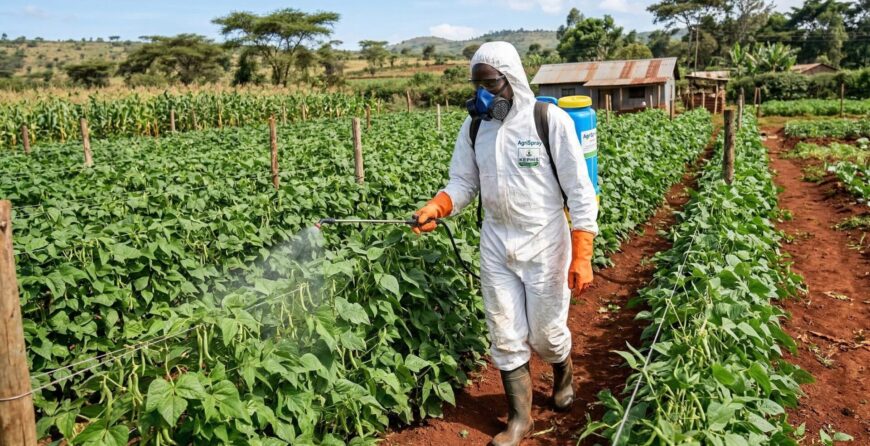
MRL Compliance for Kenyan Export Farms 2026 — Pesticide Residue Limits, Banned Compounds and the Complete Compliance Guide
⚗️ Topic: MRL Compliance | 🌍 Markets: EU, UK, China, Middle East | 🌿 Applies to: All Kenyan Certified Export Farms | 📅 Updated: May 2026 | ⏱ Read time: 16 minutes
In This Guide
- Key Facts — What You Cannot Afford to Miss
- What Is an MRL and How Is It Set?
- Consequences of MRL Violations — Real Costs
- EU and UK MRL Framework
- China MRL Framework
- Avocado — High-Risk Compounds
- French Beans — The Strictest Scrutiny
- Mango — Post-Harvest Risk Area
- Passion Fruit — Fungicide MRL Risks
- Cut Flowers — Ornamental MRL Standards
- Building Your Approved Pesticides List
- IPM — Reducing Spray Frequency Reduces Risk
- Pre-Export Residue Testing — When and How
- Rainforest Alliance Banned Substances
- Your 6-Step MRL Compliance Action Plan
- Frequently Asked Questions
⚡ Key Facts — What You Cannot Afford to Miss
- One MRL violation costs KES 500,000–5 million in detention fees, destruction costs, contract penalties, and replacement shipments. Prevention costs a fraction of this.
- Dimethoate is effectively banned on all Kenyan export crops for EU and UK markets — EU MRL of 0.01 mg/kg (lowest detectable limit). If you are still using dimethoate on any export crop, this must change before your next shipment.
- Chlorpyrifos has been banned in the EU since 2020 — EU MRL 0.01 mg/kg on most crops. Widely used in Kenya, frequently detected at EU ports. Remove from all export crop programmes immediately.
- EU and China MRL limits are different for many compounds — verify compliance separately for each target market. Do not assume EU compliance equals China compliance.
- Under IFA v6, an Approved Pesticides List is mandatory for all GLOBALG.A.P certified farms. Using any product not on your list is a Major Must non-conformance.
- MRL limits change regularly — EU reviews limits annually. Always verify the current limit before each export season. A compound compliant last year may have a reduced limit this year.
Every Kenyan export farm that has ever received a RASFF (Rapid Alert System for Food and Feed) notification from the European Commission — or lost a consignment at a UK or Chinese port — knows that MRL compliance is not a paperwork issue. It is a commercial survival issue. A single MRL exceedance on a French bean consignment from Kiambu or Nakuru does not just destroy that consignment — it triggers increased border inspection frequencies for all Kenyan French bean exports, damages Kenya’s reputation as an origin country, and puts the responsible cooperative’s export contract at immediate risk.
For farms pursuing GLOBALG.A.P certification, MRL compliance is not just a regulatory requirement — it is a mandatory certification requirement. Under IFA v6, an Approved Pesticides List verified against target market MRL limits is a Major Must requirement. A documented IPM programme with resistance rotation schedules is also required. Rainforest Alliance certification additionally requires compliance with a banned substances list that is more extensive than the EU’s. Meeting these requirements simultaneously — and maintaining them year-round — is what this guide is designed to enable.
This article explains exactly what MRL limits are and how they are set, which compounds pose the greatest risk for each Kenyan export crop, how to build and maintain an approved pesticides programme, and what pre-export testing to commission and when. It covers EU, UK, and China markets separately — because the limits differ and treating them as the same creates compliance gaps.
📩 Get our free MRL Compliance Checklist for Kenyan Export Farms — delivered instantly
A one-page reference card listing the most commonly violated MRL compounds by Kenyan crop — with EU, UK, and China limits side by side. Free, instant delivery.
The Commercial Reality of MRL Violations
Kenya has received RASFF notifications for pesticide residues
in horticultural exports in multiple consecutive years.
Each notification triggers increased border inspection frequencies
that affect every Kenyan exporter of that commodity.
The consequences of MRL violations extend far beyond the farm that caused them. A single non-compliant consignment can result in 10–50% inspection rates for all Kenyan exports of that commodity — increasing costs and delays for certified exporters who had nothing to do with the original violation.
What Is an MRL and How Is It Set?
A Maximum Residue Level (MRL) is the maximum concentration of a pesticide residue — measured in milligrams of pesticide per kilogram of food product (mg/kg) — that is legally permitted in or on food or agricultural products when they are offered for sale to consumers. MRLs are set by the regulatory authority of the importing country — not by Kenya.
How MRLs are set in the EU: The European Food Safety Authority (EFSA) conducts toxicological assessments of each active ingredient, assesses dietary exposure across different consumer groups (including children), and recommends MRL limits to the European Commission. The Commission establishes MRLs in EU Regulation 396/2005. Where no specific MRL has been set for a particular pesticide-crop combination, a default limit of 0.01 mg/kg applies automatically — effectively zero tolerance. This default limit is why “not specifically listed” does not mean “permitted” — unlisted compound-crop combinations default to 0.01 mg/kg.
The difference between PCPB registration and MRL compliance: A pesticide product that is legally registered by the Pesticides Control and Products Board (PCPB) in Kenya for use on a specific crop may still have MRL limits in the EU, UK, or China that make its use on export crops commercially impossible. PCPB registration governs what is legal to use in Kenya. MRL limits govern what is permitted in the importing country. These are separate regulatory systems — and PCPB registration does not imply MRL compliance in export markets.
Consequences of MRL Violations — The Real Costs Kenyan Farms Face
Understanding the cascade of consequences that flows from a single MRL violation helps Kenyan farm managers and cooperative leaders make the right investment decisions in prevention. The costs are not limited to the affected consignment.
Immediate consignment-level consequences
- Detention at Border Control Post (BCP): The consignment is placed under official control and cannot be released to the buyer while testing is completed. Detention can last 5–15 working days. Cold storage fees at European ports are significant.
- Consignment destruction or re-export: A consignment confirmed to exceed MRL limits is either destroyed at the BCP (most common) or returned to the origin country. Destruction costs and re-export logistics are borne by the importer — and typically recovered from the Kenyan exporter through contractual deductions.
- Replacement shipment cost: The buyer expects their contracted volume. The Kenyan exporter is typically contractually obligated to replace the consignment — at their cost — or pay a shortfall penalty.
RASFF notification and its ripple effects
Every consignment found to exceed an MRL limit at an EU BCP triggers a mandatory RASFF (Rapid Alert System for Food and Feed) notification submitted by the detecting member state to the European Commission within 24 hours. RASFF notifications are publicly disclosed on the RASFF portal — searchable by product, origin country, compound, and date. The notification identifies Kenya as the origin country and specifies the product and compound.
The cascading frequency increase: When Kenya accumulates RASFF notifications for a specific commodity, the European Commission may impose increased Border Control Post inspection frequencies on all Kenyan consignments of that commodity. This means every Kenyan exporter of that product — including certified cooperatives that had nothing to do with the original violation — faces increased detention risk, higher testing costs, and longer lead times at EU ports.
⚠️ Kenya’s RASFF History — What It Means for Your Farm
Kenya has received multiple RASFF notifications in recent years for pesticide residues — particularly on French beans (dimethoate, omethoate, organophosphates), avocado (post-harvest fungicides), and some horticultural products. Each notification damages Kenya’s overall reputation as an origin country and justifies EU-imposed increased inspection frequencies. Kenyan certified farms that maintain compliant pesticide programmes are commercially penalised by the behaviour of non-certified farms shipping through the same trade routes. The best individual response is proactive pre-export testing and a rigorously managed approved pesticides programme.
EU and UK MRL Framework — What Kenyan Farms Must Understand
The EU and UK operate separate but largely aligned MRL frameworks following Brexit. Both must be verified separately for Kenyan farms supplying both markets.
EU MRL Framework
EU MRL limits are set under Regulation (EC) 396/2005 and are maintained in the EU Pesticides Database at ec.europa.eu/food/plant/pesticides/eu-pesticides-database. This is your primary reference. Key principles for Kenyan exporters:
- Default MRL of 0.01 mg/kg applies to any compound-crop combination not specifically listed — not “no limit applies.”
- Limits change regularly — the EU reviews MRLs annually and reduces limits as new toxicological data becomes available. Verify limits at the start of each export season.
- Several compounds banned in the EU since 2020 remain legally registered and in use in Kenya — including chlorpyrifos, chlorpyrifos-methyl, and dimethoate. EU MRL 0.01 mg/kg (effectively zero).
- Companion standards matter: Even where the EU MRL is met, UK supermarket buyers may apply their own internal product specifications that are stricter than the regulatory MRL — particularly for high-profile compounds.
UK MRL Framework Post-Brexit
Following Brexit, the UK maintains its own MRL database at the Health and Safety Executive (HSE) MRL database: hse.gov.uk/mrl. UK limits are currently largely aligned with EU limits — the UK adopted EU MRL levels at the point of Brexit and has been managing them independently since. However, divergence is occurring as the EU introduces new limits and the UK reviews its own independently. For Kenyan farms supplying both EU and UK markets, verify compliance against both databases separately.
📖 Also read: MRL compliance is one of the 7 most common certification audit failures on Kenyan farms. See our 7 farm audit mistakes that cost Kenyan farms their certification for the full list and how to avoid each one.
China MRL Framework — Different Rules, Different Risks
China’s MRL limits are set under the Chinese National Standard GB 2763 — updated periodically by the National Health Commission and other relevant Chinese regulatory bodies. Following Kenya’s duty-free access to China from May 2026, Chinese MRL compliance is now a direct operational requirement for Kenyan farms pursuing that market.
Key differences between EU and China MRL limits relevant to Kenyan farms:
| Active Ingredient | EU MRL (Avocado) | China MRL (Avocado) | Kenya Risk Note |
|---|---|---|---|
| Dimethoate | 0.01 mg/kg | 0.05 mg/kg | EU standard is stricter. Remove from programme entirely for EU-facing farms. China allows marginally more but still very low. |
| Chlorpyrifos | 0.01 mg/kg | 0.05–0.1 mg/kg | Banned in EU. China has higher limit but Kenyan farms should remove it from all export programmes to avoid cross-contamination risk. |
| Imazalil (post-harvest fungicide) | 2 mg/kg | 0.5 mg/kg | China is stricter than EU. Kenyan avocado farms using imazalil post-harvest must verify the China limit is not exceeded if targeting Chinese buyers. |
| Thiabendazole (post-harvest) | 5 mg/kg | 0.1 mg/kg | China is significantly stricter than EU. Common post-harvest treatment in Kenyan packhouses. High risk for China-destined avocado. |
| Cypermethrin | Varies by isomer | 0.2 mg/kg | Widely used in Kenya. Verify specific limit for your crop-market combination against both databases. |
Critical insight for Kenyan avocado farms targeting China: Post-harvest fungicide treatments — imazalil, thiabendazole, prochloraz — which are commonly applied in Kenyan packhouses to prevent post-harvest decay during the 20–28 day sea freight transit to China — have significantly stricter MRL limits in China than in the EU. This is an area where EU compliance does not equal China compliance. Review your packhouse’s post-harvest treatment programme against Chinese GB 2763 limits specifically before the first China-bound shipment.
Avocado — High-Risk MRL Compounds for Kenyan Export
Kenyan avocado exports have triggered several RASFF notifications in recent years — primarily for organophosphate residues and post-harvest fungicide exceedances. Here are the specific risk areas for avocado farms in Kiambu, Embu, Meru, and Muranga.
⚠️ Highest-Risk Compounds on Kenyan Avocado
- Dimethoate / omethoate: EU MRL 0.01 mg/kg. Remove from programme entirely. No application at any timing is safe for EU-destined avocado.
- Chlorpyrifos: EU MRL 0.01 mg/kg (banned in EU since 2020). Remove from programme. Still PCPB-registered in Kenya but cannot be used on EU-destined crops.
- Post-harvest fungicides (imazalil, thiabendazole, prochloraz): EU limits are generally workable but China limits are significantly stricter. If targeting both EU and China — use the China limit as your compliance benchmark.
- Bifenthrin: EU MRL 0.01 mg/kg on avocado. Commonly used in Kenya for various soil and foliar pest management. Effective alternative: spirotetramat or abamectin (verify MRL for each).
📖 Also read: For the complete avocado export compliance guide — covering GLOBALG.A.P certification, KEPHIS registration, dry matter standards, and buyer requirements — see our avocado export guide for Kenya. For avocado cooperative group certification covering QMS design and member farm compliance see our group certification guide.
French Beans — The Strictest MRL Scrutiny of Any Kenyan Export Crop
French beans face the strictest MRL scrutiny of any Kenyan export crop at EU and UK border control points. The EU classifies French beans as a high-risk fresh vegetable category — meaning they are subject to increased border testing frequency and more comprehensive compound screening than most other Kenyan export commodities. Kenya has received multiple RASFF notifications for pesticide residues on French beans, which has historically resulted in elevated checking frequencies at EU BCPs.
⚠️ Critical Risk Compounds on Kenyan French Beans
- Dimethoate / omethoate: EU MRL 0.01 mg/kg. MOST COMMONLY DETECTED compound on Kenyan French beans. Has caused the most RASFF notifications. Must be completely removed from French bean programmes — no exceptions.
- Chlorpyrifos: EU MRL 0.01 mg/kg. Frequently used in Kenya for cutworms and soil pests on beans. Must be removed. Replace with chlorpyrifos-free alternatives for soil pest management.
- Acephate: EU MRL 0.01 mg/kg (default — not specifically listed for French beans). Remove from programme.
- Methamidophos: EU MRL 0.01 mg/kg. Has been used in Kenya for bean thrips. Remove from programme and replace with spinosad or other approved alternatives.
- Procymidone: EU MRL 0.02 mg/kg on beans. Used in Kenya for grey mould management. Restricted but not zero tolerance — verify current limit and strictly observe PHI.
- Methomyl: EU MRL 0.1 mg/kg on beans. Used for pod borers. Manageable with strict PHI compliance — but verify current EU limit before each season.
The French bean programme redesign requirement: Most Kenyan French bean farms that have been using a locally-advised spray programme without reference to EU MRL limits will need a comprehensive programme redesign before their first certified export season. This is not a minor adjustment — it involves identifying every high-risk compound, finding compliant alternatives, recalibrating application rates, and establishing strict PHI management protocols. This redesign is best done with professional agronomic and certification support. WhatsApp us to book a pesticide programme review for your French bean farm.
Mango — Post-Harvest and Fruit Fly Treatment MRL Risks
Kenyan mango export — primarily from Machakos, Embu, and Meru — faces two specific MRL risk areas that require dedicated management.
Fruit fly cover spray MRL risk
Fruit fly management is mandatory for mango export certification and typically involves both bait station trapping (pheromone attractants — no MRL risk) and cover sprays for high-population events. The insecticides used in cover sprays — typically malathion-based baits or spinosad — have specific EU and China MRL limits that must be verified and pre-harvest intervals strictly observed. Malathion has an EU MRL of 0.02 mg/kg on mango — workable but requires strict PHI compliance. Spinosad is generally safer from an MRL perspective.
Post-harvest fungicide risk for long-haul shipments
Post-harvest fungicide treatments to prevent stem-end rot and anthracnose during transit are standard in mango export operations. Prochloraz and imazalil are commonly used in Kenyan mango packhouses. Both have EU MRL limits that are manageable with correct application rates. However, for China-destined mango, check these compounds against GB 2763 — as noted in the China section, imazalil has a significantly stricter China MRL (0.5 mg/kg) than EU (2 mg/kg).
Passion Fruit — Fungicide MRL Risks for Export
Kenyan passion fruit faces a specific MRL challenge that most farmers are not aware of until they are preparing for their first export season. Several fungicides commonly used in Kenya for Fusarium wilt and Phytophthora root rot management have very low EU MRL limits on passion fruit — making them effectively prohibited for export crops.
Key Passion Fruit Fungicide MRL Issues
- Metalaxyl / mefenoxam: EU MRL on passion fruit 0.05 mg/kg. Widely used in Kenya for Phytophthora management in passion fruit. Restrict to early season applications well before fruit set — verify PHI strictly.
- Carbendazim (MBC fungicides): EU MRL 0.1 mg/kg. Used for Fusarium management. Manageable with correct PHI but requires careful spray timing relative to harvest.
- Mancozeb: EU MRL varies. EBDC (ethylene bisdithiocarbamate) group — EU limits have been significantly reduced in recent years. Verify the current limit annually before each season.
- Thiram: EU MRL 0.1 mg/kg on passion fruit. Used for various fungal diseases. Verify current limit and apply only early season.
Action for passion fruit farms: Switch to biological fungicide alternatives for in-season disease management where EU MRL limits make chemical options problematic. Trichoderma-based biocontrol products, potassium bicarbonate, and copper-based fungicides (with carefully verified MRL limits) can replace higher-risk compounds for in-season use. Reserve conventional fungicides for early establishment programmes well before harvest periods. Cooperatives in Kisii pursuing passion fruit export certification should conduct a full pesticide programme review before beginning the certification process.
Cut Flowers — Ornamental MRL Standards and Aalsmeer Requirements
MRL limits for cut flowers are governed differently from edible crops — because flowers are not consumed, the regulatory framework focuses on environmental and worker exposure rather than dietary risk. However, the Aalsmeer flower auction and major European florist buyers have established their own pesticide residue standards for ornamental imports that go beyond regulatory MRL requirements for food crops.
MPS-GAP and buyer residue standards: Many Kenyan cut flower farms in Nakuru hold MPS-GAP certification alongside GLOBALG.A.P and Rainforest Alliance. MPS-GAP maintains a specific pesticide residue standard for ornamental crops sold through Aalsmeer — updated annually. The Kenyan Flower Council (KFC) provides guidance to member farms on current MPS-GAP pesticide requirements.
Key risk areas for Kenyan flower farms: Neonicotinoid insecticides (imidacloprid, thiamethoxam) — banned in EU outdoor use but still used in Kenyan greenhouses — have raised buyer concern in recent years following EU pollinator protection policy changes. Major EU flower buyers are increasingly requesting documentation that neonicotinoids are not used on Kenyan supply farms. Review your insecticide programme for neonicotinoid exposure risk and document your programme in your farm records.
Building Your Approved Pesticides List — The Most Important MRL Compliance Tool
An Approved Pesticides List (APL) is the single most effective structural tool for maintaining MRL compliance year-round. Under GLOBALG.A.P IFA v6, maintaining and applying only products on your APL is a Major Must requirement. It is also the best commercial protection against MRL violations — because it makes non-compliant spray decisions structurally impossible if the list is correctly managed.
What your Approved Pesticides List must document for each product
| Field | What to Record | Why It Matters |
|---|---|---|
| Commercial product name | Exact name on the label | Links APL entry to pesticide application records |
| Active ingredient(s) | Chemical name of all active ingredients | The compound checked against MRL databases |
| PCPB registration number | PCPB registration for this crop | Confirms legal registration in Kenya for this crop |
| EU MRL (per crop) | Current EU MRL from EU Pesticides Database | Compliance benchmark for EU-destined produce |
| UK MRL (per crop) | Current UK MRL from HSE database | Compliance benchmark for UK-destined produce |
| China MRL (if targeting China) | Current China MRL from GB 2763 | Separate verification required — China limits differ |
| Pre-harvest interval (PHI) | PHI from product label (days) | Critical safety buffer between last spray and harvest |
| IRAC/FRAC mode of action group | Mode of action classification | Enables resistance rotation scheduling (IFA v6 requirement) |
| RA banned substances status | Listed or not listed on RA banned substances list | Required if farm holds or is pursuing RA certification |
| Verification date | Date the MRL limit was last verified | Demonstrates the list is actively maintained — not static |
Critically important — update the APL before every export season: MRL limits change regularly. The EU reviews limits annually. A compound on your APL that was compliant last season may have had its limit reduced. Every Approved Pesticides List must be reviewed and re-verified against current MRL databases at the start of each export season — not once at certification and left unchanged. Our Kenya Farm Audit Checklist includes an integrated Approved Pesticides List template aligned to IFA v6 requirements.
IPM — How Reducing Spray Frequency Reduces MRL Risk
Integrated Pest Management (IPM) is both a GLOBALG.A.P IFA v6 requirement and the most effective structural tool for reducing MRL violation risk over time. The connection is direct: fewer spray applications mean fewer residue events mean lower cumulative residue levels at harvest.
The five IPM elements required by IFA v6:
- Pest monitoring: Regular scouting of crops to assess actual pest and disease pressure. Records of monitoring observations — what was found, at what level, on which date and field — demonstrate that spray decisions are evidence-based rather than calendar-based.
- Economic thresholds: Documented decision thresholds — the pest population level at which spray intervention is economically justified. Spraying before threshold is reached is wasteful and increases unnecessary residue accumulation risk.
- Non-chemical controls first: Documented use of biological controls, physical controls, cultural practices, and resistant varieties before resorting to chemical pesticide intervention. Not every pest event requires a chemical response.
- Targeted chemical intervention: When chemical intervention is necessary, use the most specific and least persistent active ingredient available that is effective against the target pest — minimising residue accumulation and environmental impact.
- Resistance management: Documented rotation of active ingredients by mode of action (IRAC for insecticides, FRAC for fungicides) to prevent resistance development. A farm that uses the same active ingredient class every spray cycle is both developing resistance and accumulating residue from a single compound class.
📖 Also read: IPM documentation requirements under IFA v6 are explained in detail in our IFA v6 Transition Guide for Kenyan Farms. For the complete farm record keeping system that captures IPM monitoring data in the format GLOBALG.A.P auditors require, see our Farm Records guide.
Pre-Export Residue Testing — When, How, and Which Laboratory to Use
Pre-export residue testing is the last line of defence before a consignment leaves Kenya — and the most cost-effective insurance against the financial consequences of a RASFF notification. A comprehensive residue test costs KES 8,000–25,000 depending on the number of compounds screened. A single MRL violation at an EU port costs KES 500,000–5,000,000. The ROI on pre-export testing is unambiguous.
When to commission pre-export residue testing
- Before the first export shipment of each season — every season, regardless of previous results. Seasonal changes in pest pressure lead to changes in spray decisions which may introduce new compound risks.
- After any change to the pesticide programme — if a new product is introduced or an application rate is changed, test before the next export shipment.
- When a spray operator error is discovered — if a wrong product was accidentally applied or a PHI was not properly observed, test before the next shipment from that field.
- At the buyer’s specified frequency — most UK and EU supermarket buyers specify a testing frequency in their supplier technical requirements. Comply with this frequency as a minimum.
- When targeting a new market — if adding China to your market portfolio for the first time, test against Chinese GB 2763 limits before the first China-bound shipment, not during it.
Which laboratory to use in Kenya
For pre-export residue testing, use a laboratory that is accredited by the Kenya Bureau of Standards (KEBS) under ISO/IEC 17025 and specifically accredited for pesticide residue analysis in the commodity you are testing. The primary accredited laboratories for pesticide residue testing in Kenya include:
- KEPHIS Pesticide Residue Laboratory (Nairobi): The primary government laboratory for pesticide residue analysis. KEBS and internationally accredited. Turnaround: 5–15 working days depending on compound panel. Cost: KES 8,000–20,000 per sample depending on compound panel.
- Intertek Kenya: International accredited testing laboratory with ISO 17025 accreditation for pesticide residues. Faster turnaround for time-sensitive pre-export samples.
- SGS Kenya: International accredited testing laboratory. Pre-shipment testing services with internationally recognised certificates accepted by EU and UK buyers.
What compound panel to test: For EU export, request a comprehensive multi-residue screen covering at minimum 100+ active ingredients — not a targeted panel of only the compounds you applied. Unexpected residue sources include drift from neighbouring farms, contaminated irrigation water, and compounds applied by previous farm operators. A comprehensive screen identifies risks that a targeted panel would miss. For China export, specifically request a panel that includes the compounds with stricter Chinese limits identified in this guide.
📋 Verify Your Farm’s Full MRL Compliance Status — Before the Auditor Does
Our Kenya Farm Audit Checklist — built on the IFA v6 P&C framework — includes a complete pesticide management section covering Approved Pesticides List requirements, IPM documentation, resistance rotation records, PHI compliance, and MRL verification. 200+ checklist items across all 8 audit areas. Identify your MRL compliance gaps before you spend anything on certification preparation. Instant download, M-Pesa accepted.
Download Audit Checklist — KES 3,500 →
Complete Starter Kit — KES 6,000
Rainforest Alliance Banned Substances — Beyond MRL Limits
For Kenyan farms pursuing Rainforest Alliance certification, the pesticide compliance standard goes beyond MRL limits. Rainforest Alliance maintains a Prohibited and Restricted Substances List (PRSL) — a list of active ingredients that are either completely prohibited or subject to restrictions on RA-certified farms, regardless of MRL limits in the destination market.
The RA PRSL is available at ra.org/sacc and is updated annually. Key categories of RA-prohibited substances relevant to Kenyan farms:
- WHO Class Ia and Ib highly hazardous pesticides: Completely prohibited on RA-certified farms. Many of these are already PCPB-restricted in Kenya but some remain in use. Verify every product on your programme against the WHO hazard classification.
- Persistent organic pollutants (POPs): Including older organochlorine compounds that may still be present in soil on some Kenyan farms from historical use. If your site history reveals previous organochlorine use, a soil test for persistent residues is required.
- Several compounds with acceptable EU MRL limits are on the RA PRSL because of environmental or chronic toxicity concerns — meaning EU MRL compliance does not guarantee RA compliance. Farms pursuing dual GLOBALG.A.P and RA certification must check every compound against both MRL limits AND the RA PRSL.
Your 6-Step MRL Compliance Action Plan — Starting Today
Step 1 — Identify your target markets and pull their current MRL limits (this week)
EU: ec.europa.eu/food/plant/pesticides/eu-pesticides-database. UK: hse.gov.uk/mrl. China (if applicable): GB 2763. List every active ingredient you currently use on each export crop. Look up the MRL for each compound in each target market. Flag every compound at or near its MRL limit as high risk.
Step 2 — Remove all prohibited and zero-tolerance compounds immediately
Dimethoate, omethoate, chlorpyrifos, and any other compound with an EU MRL of 0.01 mg/kg on your export crop must be removed from your programme before the next export shipment. Do not phase them out — remove them now. Identify approved alternatives for every pest problem currently addressed by the prohibited compounds. Contact Agrosocial Services if you need agronomic support identifying compliant alternatives.
Step 3 — Build your Approved Pesticides List
Create your APL document using the template described in this article. Include every product you plan to use this season — verified as PCPB-registered for your crop and MRL-compliant for all your target markets. Date the document, sign it, and make it available to every spray operator. This is a Major Must requirement under IFA v6.
Step 4 — Implement documented IPM and resistance rotation
Write your IPM plan documenting monitoring frequency, decision thresholds, and resistance rotation schedule by IRAC/FRAC mode of action group. Brief all spray operators on the new programme. Begin documenting pest monitoring observations — even simple scouting records from this week onwards satisfy the IFA v6 requirement for evidence-based spray decisions.
Step 5 — Set up rigorous PHI management for every field
After every spray application, calculate the earliest permitted harvest date for that field (application date + PHI in days) and record it on your pesticide application records. Brief harvest supervisors on the PHI system. A visible PHI calendar in the farm office — showing earliest harvest dates for each field after each spray event — is a simple, effective management tool.
Step 6 — Commission pre-export residue testing before the first shipment
Commission a comprehensive multi-residue screen (100+ compounds) from KEPHIS laboratory or an accredited private laboratory before your first export shipment of the season. Allow 5–15 working days for results. If any result is at or above 70% of an MRL limit, investigate the source before shipping and retest before the next consignment. Keep all laboratory certificates in your compliance file for a minimum of 5 years.
Book a Pesticide Programme Review — Protect Your Export Contracts
Agrosocial Services conducts pesticide programme reviews for Kenyan export farms and cooperatives — identifying all high-risk compounds, recommending compliant alternatives, building Approved Pesticides Lists aligned to EU, UK, and China MRL limits, and designing IPM programmes that satisfy IFA v6 requirements. We cover farms across Kiambu, Nakuru, Meru, Embu, Machakos, and Kisii.
Frequently Asked Questions
What is an MRL and why does it matter for Kenyan export farms?
An MRL — Maximum Residue Level — is the maximum concentration of a pesticide active ingredient legally permitted in food or agricultural products at the point of sale. A consignment exceeding an MRL limit is detained, rejected, and destroyed at the exporter’s expense. The financial cost of a single MRL violation ranges from KES 500,000 to KES 5 million. RASFF notifications publicly disclose violations and trigger increased inspection frequencies for all Kenyan exports of the affected commodity. MRL compliance is not optional — it is a commercial and certification survival requirement.
Which pesticides are banned for French beans exported to Europe from Kenya?
The most critical compounds to remove from Kenyan French bean programmes for EU and UK export: dimethoate (EU MRL 0.01 mg/kg — most commonly detected on Kenyan beans), omethoate (0.01 mg/kg), chlorpyrifos (0.01 mg/kg — banned in EU since 2020), acephate (0.01 mg/kg default), and methamidophos (0.01 mg/kg). Removing these compounds is non-negotiable for any French bean cooperative targeting EU or UK markets. A full programme review by an agronomic consultant familiar with EU MRL limits is strongly recommended before the first export season. Contact us for a programme review.
How do I check EU MRL limits for my specific pesticide and crop?
The EU Pesticides Database at ec.europa.eu/food/plant/pesticides/eu-pesticides-database is the authoritative reference. Search by active substance and commodity. Remember: if a compound-crop combination is not specifically listed, the default MRL of 0.01 mg/kg applies — not “no limit.” UK limits are at hse.gov.uk/mrl. China limits are in GB 2763. Always verify the current limit before each export season — MRL limits change annually.
What happens if a Kenyan farm fails an MRL test at a European port?
Immediate consequences: (1) consignment detained — cannot be released to buyer; (2) consignment destroyed or re-exported at importer’s expense (typically recovered from Kenyan exporter); (3) RASFF notification within 24 hours — publicly disclosed; (4) Kenya may face increased BCP inspection frequencies for that commodity. Commercial consequences: contract penalties, replacement shipment cost, potential contract loss, and reputational damage that affects all Kenyan exporters of that commodity. The only effective protection is pre-export testing, a managed Approved Pesticides List, and strict PHI compliance year-round.
How often should Kenyan export farms conduct pesticide residue testing?
As a minimum: before the first export shipment of each season, after any change to the pesticide programme, and at the frequency specified by your buyer’s technical requirements. High-risk crops (French beans, snow peas) should test more frequently. Low-risk crops with stable programmes (avocado) test annually as a minimum. Commission a comprehensive multi-residue screen of 100+ compounds — not a targeted panel. KEPHIS laboratory, Intertek Kenya, and SGS Kenya all provide accredited residue testing services. Cost: KES 8,000–25,000 per sample depending on compound panel.
Is dimethoate still allowed on Kenyan avocados for EU export?
No. Dimethoate has an EU MRL of 0.01 mg/kg on avocado — the lowest detectable limit, effectively zero tolerance. It must be completely removed from the pesticide programme of any Kenyan avocado farm targeting EU markets. No application timing or pre-harvest interval makes dimethoate safe for EU-destined avocado. Remove it from your Approved Pesticides List and switch to approved alternatives — imidacloprid, spirotetramat, or other approved systemic insecticides with verifiable compliant MRL limits. Check China limits for any alternatives as China limits differ from EU limits.
Do EU and China have the same MRL limits for Kenyan export produce?
No — they differ for many compounds and crops. In some areas China is stricter than the EU (post-harvest fungicides imazalil and thiabendazole on avocado have significantly lower limits in China). In other areas the EU is stricter (dimethoate, chlorpyrifos). For farms exporting to both EU and China, use the stricter of the two limits as your compliance benchmark for each compound. Verify each active ingredient separately against both databases — never assume EU compliance equals China compliance. China limits are in GB 2763, updated periodically.
What is an Approved Pesticides List and why does GLOBALG.A.P require it?
An Approved Pesticides List is a documented list of all pesticide products approved for use on a specific farm — verified as PCPB-registered for the crop, MRL-compliant for all target markets, and applied within PHI limits. GLOBALG.A.P IFA v6 requires every certified farm to maintain an APL and to apply only products on that list. Using any product not on the APL is a Major Must non-conformance. The list must be reviewed and updated at the start of each export season. Our Kenya Farm Audit Checklist (KES 3,500) includes an integrated APL template covering all required fields.
Key Takeaways — Share With Your Farm Manager, Spray Operators and Cooperative Committee
- One MRL violation costs KES 500,000–5 million. Pre-export testing costs KES 8,000–25,000. The investment in prevention is obvious.
- Dimethoate, omethoate, and chlorpyrifos must be removed from all Kenyan export crop programmes targeting EU and UK markets. EU MRL 0.01 mg/kg — effectively zero tolerance.
- EU and China MRL limits differ — particularly for post-harvest fungicides on avocado. Verify separately for each market. Never assume EU compliance equals China compliance.
- The EU default MRL of 0.01 mg/kg applies to any compound-crop combination not specifically listed. “Not listed” does not mean “no limit.”
- An Approved Pesticides List is a GLOBALG.A.P IFA v6 Major Must requirement. Build it now. Review it every season.
- IPM reduces spray frequency which reduces residue accumulation risk. Document monitoring, thresholds, and resistance rotation — satisfies IFA v6 and reduces MRL violation risk simultaneously.
- Commission pre-export residue testing before the first shipment of every season. A comprehensive multi-residue screen from an accredited laboratory is your last line of defence before commercial consequences become unavoidable.
- For a full pesticide programme review for your farm or cooperative, WhatsApp Agrosocial Services →
Is Your Farm’s Pesticide Programme MRL-Compliant?
Agrosocial Services conducts pesticide programme reviews and builds Approved Pesticides Lists aligned to EU, UK, and China MRL limits for Kenyan farms and cooperatives across Kiambu, Nakuru, Meru, Embu, Machakos, and Kisii.
Related Resources from Agrosocial Services
Certification and compliance: GLOBALG.A.P Certification Kenya · IFA v6 Transition Guide · Farm Record Keeping Guide · 7 Audit Mistakes to Avoid · Rainforest Alliance Kenya
Crop export guides: Avocado Export Kenya · French Bean Export Kenya · Mango Export Kenya · Passion Fruit Export Kenya · Rose Export Kenya
Certification costs and funding: Certification Cost Guide Kenya · Certification Budget Planning 2026 · Agricultural Funding Sources 2026
County consultants: Nairobi · Kiambu · Nakuru · Meru · Machakos · Embu · Kisii
Agrosocial Services Limited is Kenya’s specialist agricultural certification and export market consultancy, serving farms, cooperatives, and agri-exporters across 12 counties since 2018. Our consultants have conducted pesticide programme reviews and MRL compliance assessments for Kenyan farms across avocado, French bean, mango, passion fruit, and cut flower value chains. For a pesticide programme review or Approved Pesticides List development, contact us at info@agrosocialservices.co.ke or WhatsApp +254 713 935 361. Last reviewed: May 2026.
Sources: EU Pesticides Database — Regulation (EC) 396/2005 (ec.europa.eu/food/plant/pesticides/eu-pesticides-database); UK HSE MRL Database (hse.gov.uk/mrl); Chinese National Standard GB 2763 — Maximum Residue Limits for Pesticides in Food; RASFF (EU Rapid Alert System for Food and Feed) portal — historical Kenya notifications; Rainforest Alliance Prohibited and Restricted Substances List (ra.org/sacc); GLOBALG.A.P IFA v6 Principles and Criteria — Pesticide Management module. All MRL values are indicative — verify against primary databases before each export season as limits change annually.