How to Find International Buyers for Kenyan Agricultural Products 2026 — The Complete Guide
🌍 Markets: EU, UK, China, Middle East | 🌿 Crops: All certified export crops | ✅ Prerequisite: GLOBALG.A.P or RA certification | 📅 Updated: May 2026 | ⏱ Read time: 15 minutes
In This Guide
- Key Facts — Before You Approach Any Buyer
- The Non-Negotiable Prerequisite
- Understanding the 5 Buyer Types
- FPEAK and KEPROBA — Your First Calls
- The GLOBALG.A.P Supply Chain Portal
- Trade Fairs — The Highest-Value Channel
- Direct Outreach — How to Do It Right
- Digital Platforms — B2B and Trade Portals
- EU and UK Buyer Channel Guide
- China Buyer Channel Guide
- Middle East Buyer Channel Guide
- Writing Your Supplier Profile
- Converting Buyer Interest to First Shipment
- Realistic Timeline to First Export Sale
- Frequently Asked Questions
⚡ Key Facts — Read This Before Approaching Any Buyer
- Certification must come first. GLOBALG.A.P certification (or Rainforest Alliance for coffee/tea) is the minimum entry requirement for EU, UK, and Chinese premium buyers. Without a live GGN in the Supply Chain Portal, buyer conversations will not advance beyond the first email.
- FPEAK membership is the highest-ROI investment a newly certified Kenyan cooperative can make for market access — KES 15,000–25,000 per year for access to verified buyer databases and matching services.
- The GLOBALG.A.P Supply Chain Portal is where EU and UK buyers verify your certification status in real time. Appearing correctly in it is not optional — it is a commercial prerequisite.
- China opened to Kenyan produce duty-free in May 2026 — the fastest-growing new buyer market for Kenyan certified avocado, macadamia, and coffee. KEPHIS registration is required before any China shipment.
- Your supplier profile document is your commercial CV. A professional, complete two-page document separates serious suppliers from the hundreds of enquiry emails buyers receive each month.
- Response rates to cold outreach are 5–15%. Persistence and professional documentation quality — not volume of emails sent — determine success in buyer outreach.
Achieving GLOBALG.A.P certification opens the door to international buyers. Walking through that door — and converting it into a commercial supply relationship — requires a different set of skills and channels. This is the guide that bridges those two steps.
Kenyan certified farms that fail to find buyers consistently make the same mistakes: approaching buyers before certification is confirmed, sending generic emails without a professional supplier profile, targeting buyer types that require volumes the cooperative cannot supply, or waiting passively for buyers to find them in the Supply Chain Portal. This guide tells you exactly what to do instead — with specific channels, specific outreach approaches, and specific tools that convert certification into commercial export relationships for Kenyan farms.
This article covers buyer-finding strategy across all major Kenyan export crops — avocado, French beans, mango, passion fruit, coffee, tea, and cut flowers — across all major markets: EU, UK, China, and Middle East. For crop-specific buyer channel detail on avocado, see our dedicated avocado buyers Kenya 2026 guide. For China market entry in detail, see our Kenya-China duty-free guide for farmers.
📩 Get our free Kenya Export Buyer Channel Directory — delivered instantly
A one-page reference listing the primary buyer access channels for each major Kenyan export crop across EU, UK, China, and Middle East markets. Free, instant delivery.
The Market Reality for Kenyan Certified Exporters in 2026
International buyers are actively searching for certified Kenyan suppliers.
The GLOBALG.A.P Supply Chain Portal, FPEAK matching events, and
trade fairs bring buyers to you — if you prepare correctly.
The window to establish first-mover relationships in the China market is open now. Kenya’s duty-free access from May 2026 means Chinese buyers are actively qualifying new Kenyan suppliers this season. The cooperatives that move first will capture the most durable commercial advantages.
The Non-Negotiable Prerequisite — Certification First
Every channel in this guide — trade fairs, FPEAK matching, Supply Chain Portal discovery, direct outreach — requires that your certification is confirmed and verifiable before buyer conversations can progress. This is not a formality. It is the commercial reality of how international agricultural supply chains work in 2026.
A buyer who receives your supplier profile and finds no live GGN in the GLOBALG.A.P Supply Chain Portal will not invest further time in the relationship — regardless of how well-written your profile is or how good your product is. Their compliance and quality teams have a simple verification process: does this GGN exist and is it current? If no — next supplier.
What you need confirmed before approaching any buyer:
- For EU and UK fresh produce buyers: Current GLOBALG.A.P certificate under IFA v6 Smart, GGN live in the Supply Chain Portal, KEPHIS phytosanitary certification for each consignment.
- For UK supermarket buyers: All of the above plus GRASP v2 social compliance assessment.
- For Chinese buyers: KEPHIS farm registration for China export (27–93 day process), GACC-registered packhouse.
- For coffee and tea buyers (EU/UK): Rainforest Alliance certification under SAS 2020.
- For Middle East buyers: KEPHIS phytosanitary certification; GLOBALG.A.P increasingly preferred for larger volumes.
If your certification is in progress, you can begin preparing your supplier profile, researching target buyers, and attending industry events — but close no supply agreements until your certificate is issued and your GGN is live. For detailed certification cost and process information, see our GLOBALG.A.P certification cost guide for Kenya and our certification budget planning guide.
🤝 Aggregating smallholders? If you’re a cooperative pooling many small farms rather than selling as a single farm, the mechanics differ — outgrower models, MOUs, collective quality management and payment governance. See How to Link Farmers to Buyers and Exporters in Kenya.
Understanding the 5 Buyer Types — Matching Your Volume to the Right Buyer
Not every buyer is right for every Kenyan cooperative. The most common reason newly certified cooperatives fail to convert buyer interest into supply contracts is a mismatch between what the buyer needs and what the cooperative can supply. Identify your buyer type before beginning outreach.
| Buyer Type | What They Buy | Min. Volume | Certification Required | Right Cooperative Size |
|---|---|---|---|---|
| EU Import Distributor (Dutch, Belgian) | Avocado, beans, mango, passion fruit, flowers | 50–200 MT/season | GLOBALG.A.P IFA v6 | 30–80 certified members |
| UK Supermarket Buyer (via importer) | Avocado, fine beans, flowers | 100–300 MT/season | GLOBALG.A.P + GRASP v2 | 60–150 certified members |
| Specialty / Organic Importer (Germany, Switzerland) | Organic avocado, FairTrade coffee, RA produce | 20–100 MT/season | GLOBALG.A.P + RA or Organic + FairTrade | 20–60 certified members |
| Chinese Importer (e-commerce, supermarkets) | Avocado, macadamia, coffee | 5–50 MT/shipment | KEPHIS + GACC packhouse; GLOBALG.A.P preferred | 20–60 certified members |
| Middle East Importer (UAE, Saudi, Qatar) | Avocado, mango, beans, vegetables | 5–20 MT/shipment | KEPHIS; GLOBALG.A.P increasingly preferred | 10–30 certified members |
📌 The Volume Matching Rule — the Most Important Decision Before Buyer Outreach
Before approaching any buyer, calculate your cooperative’s realistic collective certified production volume for the coming season. If your volume does not match the buyer type’s minimum requirement, do not approach that buyer type yet — invest in growing your certified member base first. A buyer who receives a promising approach from a cooperative that cannot supply the required volume will not return when that cooperative eventually reaches the right scale. Save the relationship for when you are ready. See our group certification guide for how to grow a cooperative’s certified member base efficiently.
FPEAK and KEPROBA — Make These Your First Two Calls
Two Kenyan government-linked organisations offer buyer access services that every newly certified cooperative should use immediately. These are not peripheral activities — they are the fastest, most cost-effective routes to verified international buyer contacts available to Kenyan exporters.
FPEAK — Fresh Produce Exporters Association of Kenya
FPEAK is Kenya’s primary fresh produce industry body and your most direct access point to international buyers. FPEAK’s specific services for certified Kenyan exporters include:
- Verified buyer database: FPEAK maintains contact details for EU, UK, Middle East, and Chinese buyers who have expressed active interest in sourcing from Kenya. This database is the most valuable single resource available to Kenyan exporters — and it is only accessible to FPEAK members.
- Buyer matching events: FPEAK organises virtual and in-person buyer-seller events where certified Kenyan cooperatives present directly to pre-qualified international buyers. The in-person events — particularly those where EU buyers visit Kenya — are exceptionally high value because buyers can visit certified farms directly.
- Trade fair coordination: FPEAK coordinates Kenya’s participation at Fruit Logistica (Berlin) and other key fairs. FPEAK members receive subsidised exhibition space and logistical support. FPEAK can brief you on which buyers to approach at each fair.
- Market intelligence: Current export price data, buyer requirements updates, and market access changes — including the latest on China duty-free, EUDR, and EU inspection frequency changes.
FPEAK membership cost: KES 15,000–25,000 per year for cooperatives. This is the single highest-ROI investment a newly certified Kenyan cooperative can make for market access. Contact FPEAK at their Nairobi office on Lower Kabete Road — or through their website at fpeak.org.
KEPROBA — Kenya Export Promotion and Branding Agency
KEPROBA is the Kenyan government agency mandated to promote and develop Kenya’s export trade. For agricultural exporters, KEPROBA provides:
- National pavilion coordination at international trade fairs — Fruit Logistica, CIIE (China), Gulfood (Dubai), and others. KEPROBA subsidises exhibition costs for Kenyan companies.
- Commercial attaché network: Kenya’s commercial attachés in Nairobi, Beijing, Guangzhou, Dubai, Brussels, and London can facilitate introductions to verified buyers in those markets. Contact KEPROBA to access this network.
- Export documentation and certification: KEPROBA provides advisory services on export documentation, certificate of origin issuance, and regulatory requirements for different destination markets.
- New market entry support: For cooperatives targeting China for the first time, KEPROBA’s Beijing and Guangzhou commercial offices can arrange introductory meetings with Chinese importers — a service that is particularly valuable given the language and cultural barriers of direct China outreach.
The GLOBALG.A.P Supply Chain Portal — Let Buyers Find You
The GLOBALG.A.P Supply Chain Portal — launched in 2025 and replacing the previous GLOBALG.A.P database — is the primary tool EU and UK buyers use to verify certified supplier status and discover new Kenyan supply sources. When a Dutch importer searches for certified Kenyan avocado suppliers, the Supply Chain Portal is where they search. When a UK supermarket buyer’s compliance team verifies a potential supplier’s certificate, this is where they check.
What appearing correctly in the portal means for your cooperative:
- Your cooperative is discoverable by buyers searching for certified Kenyan supply of your specific crop.
- Your GGN producer numbers are verifiable — buyers can confirm certification status in under 60 seconds.
- Your certificate expiry date is visible — buyers planning seasonal supply can see whether your certification is current through their buying season.
Action required after receiving your certificate: Ask your certification body to confirm that your GGN is correctly registered in the Supply Chain Portal. Then verify it yourself — go to globalgap.org, click the Supply Chain Portal search, and search for your GGN number. Confirm that your cooperative name, country, crop, and certification status all appear correctly. If anything is incorrect, contact your certification body immediately — every week with an incorrect or missing listing is a week of lost buyer discoverability.
📖 Also read: Understanding the IFA v6 standard that governs your certification — and what buyers see when they verify your GGN — is covered in our IFA v6 Transition Guide for Kenyan Farms. For the complete cost and ROI of achieving the certification that makes you discoverable in the portal, see our GLOBALG.A.P ROI guide for Kenya 2026.
Trade Fairs — The Highest-Value Buyer Access Channel
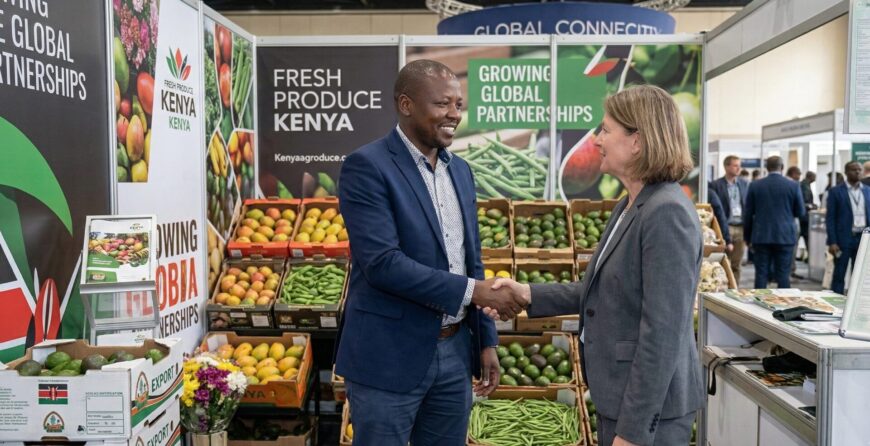
Trade fair attendance is the single highest-value buyer access channel available to Kenyan certified exporters. At a trade fair, you meet 20–50 qualified buyers in person over two days — more buyer contact than a year of email outreach achieves. Buyers who meet you in person, taste your product, review your certification documents, and walk away with your supplier profile are ten times more likely to follow up than buyers who receive a cold email. The investment — exhibition fees, travel, accommodation, sample costs — is significant. The commercial return is disproportionately high if preparation is excellent.
The 2026–2027 Trade Fair Calendar for Kenyan Agricultural Exporters
| Trade Fair | Location | Dates | Best For | How to Attend |
|---|---|---|---|---|
| Fruit Logistica | Berlin, Germany | February 2027 | Avocado, French beans, mango, flowers — EU and UK buyers | KEPROBA / FPEAK pavilion |
| Gulfood | Dubai, UAE | February 2027 | All crops — Middle East buyers (UAE, Saudi, Qatar) | KEPROBA pavilion |
| Canton Fair | Guangzhou, China | April and October 2026/2027 | Avocado, macadamia, coffee — Chinese buyers | KEPROBA pavilion |
| CIIE | Shanghai, China | November 2026 | All crops — Chinese buyers sourcing globally | KEPROBA / independent |
| Salon du Végétal | Nantes, France | September 2026 | Cut flowers and ornamentals — French and EU buyers | FPEAK / KFC coordination |
| World Tea Expo | Las Vegas, USA | June 2026 | Kenyan tea — specialty US and international buyers | Independent / KEPROBA |
| SCAA / SCA Coffee Expo | USA (rotates) | April 2027 | Kenyan specialty coffee — North American and EU roasters | Nairobi Coffee Exchange / KEPROBA |
How to maximise your trade fair return
- Prepare your sample pack before arrival. Bring 5–10 high-quality samples of your product — avocados at correct sizing and dry matter, beans at specification, coffee in sealed sample bags. Buyers who taste your product at a trade stand are far more likely to follow up.
- Prepare 50+ printed copies of your supplier profile. Professional printing — not photocopied on A4 — signals commercial seriousness. Include a QR code linking to your GLOBALG.A.P GGN verification page.
- Research attending buyers before the event. FPEAK and KEPROBA provide attendee lists for coordinated Kenya pavilion events. Identify your top 20 target buyers by name before you arrive. Seek them out — do not wait at your stand for them to find you.
- Follow up within 48 hours of the event with a personalised email to every buyer you spoke with. Reference the specific conversation you had — what you discussed, what sample they tasted, what they asked about. Personalised follow-ups convert at 5x the rate of generic “nice to meet you” emails.
Direct Outreach — How to Do It Right and What Most Farms Do Wrong
Direct outreach — sending your supplier profile directly to identified buyers — has a 5–15% response rate when done correctly. Most Kenyan farms achieve far less because they make avoidable mistakes that experienced buyers screen out in 10 seconds.
The outreach mistakes that kill response rates
- Sending before certification is confirmed. “We are in the process of certifying” is a conversation-ender for buyers with current supply commitments. Wait until your GGN is live.
- Generic “we have good quality avocados” emails with no specific information. Buyers receive hundreds of these. They need volume (exact metric tonnes), variety (Hass vs Fuerte), season (March–August), grade (A, B), packhouse location, and GGN number in the first paragraph.
- No supplier profile document attached. A text email without a professional supplier profile attached is incomplete. Every outreach email must have the supplier profile PDF attached.
- Approaching buyers who need volumes you cannot supply. A cooperative producing 20 metric tonnes per season emailing Tesco’s fresh produce buying team is wasting their opportunity. Research minimum volume requirements before selecting outreach targets.
- Following up too aggressively or not at all. One follow-up at one week after initial contact is appropriate. No response after two contacts — wait 3 months and approach again with updated information. Never send more than two unsolicited contacts to the same buyer in a month.
The outreach email formula that works
Subject: Certified Kenyan Hass Avocado — GLOBALG.A.P IFA v6 — [Your Cooperative Name] — Available March–August 2026
Dear [Buyer Name],
[Cooperative Name] is a GLOBALG.A.P-certified avocado cooperative of [X] member farmers in [County], Kenya. Our GGN number is [GGN] — verifiable at globalgap.org/supply-chain-portal.
We are offering [X] metric tonnes of Grade A Hass avocado for the 2026 main season (March–August), from certified farms at 1,600–1,900 metres altitude in [sub-county]. FOB Mombasa price range: KES [X]–[X]/kg. Available in 4kg and 6-count retail packs or bulk 18kg cartons.
Our packhouse holds [name and GACC number if applicable]. We have been exporting since [year] and can provide buyer references on request.
Please find our full supplier profile attached. I would welcome a 20-minute call to discuss your requirements. My WhatsApp is +254 [number].
Sincerely,
[Name], [Title]
[Cooperative Name]
This template is specific, immediately verifiable, action-oriented, and provides every piece of information a buyer needs to decide whether to respond. Adapt it with your actual numbers before sending.
Digital Platforms — B2B Trade Portals and How to Use Them
Digital B2B platforms are not the primary route to major buyer relationships — trade fairs and FPEAK matching events deliver higher-quality connections. But digital platforms serve a valuable complementary role: they make your cooperative discoverable to mid-size and specialty buyers who are actively searching online, and they provide a credible digital presence that buyers find when they Google your cooperative name after receiving your supplier profile.
Platform 1 — Alibaba International (alibaba.com)
The world’s largest B2B trade platform with significant usage by Chinese importers searching for agricultural supply from African and Asian origins. Create a verified supplier profile with your KEPHIS registration number, GLOBALG.A.P GGN, available crops and seasonal volumes, product photos, and packhouse details. A Mandarin-language product description significantly increases visibility to Chinese buyers. Premium “Gold Supplier” verification is worth the annual fee for Kenyan cooperatives specifically targeting the Chinese market — it signals vetted supplier status.
Platform 2 — Fresh Plaza (freshplaza.com)
Fresh Plaza is the primary online trade media and B2B directory for the fresh produce industry — read daily by EU and UK importers, distributors, and retailers. A paid company profile on Fresh Plaza provides visibility to European buyers who research potential new suppliers online. Fresh Plaza also publishes market price data and supply news that helps you understand buyer market conditions before making outreach contact.
Platform 3 — LinkedIn (for direct professional outreach)
LinkedIn is where EU and UK supermarket fresh produce buyers, sustainability managers, and procurement officers spend professional time. A cooperative chairman or export manager with a professional LinkedIn profile — including cooperative name, location, certifications held, and crops available — provides a credible professional presence that validates cold email outreach. LinkedIn messages to identified buyers as a follow-up to email outreach increase response rates by 2–3x compared to email alone.
Platform 4 — Global Sources (globalsources.com)
Global Sources is a B2B platform with strong presence among Chinese buyers and Hong Kong-based import trading companies. A verified supplier profile covering your KEPHIS registration, GLOBALG.A.P GGN, and available products makes your cooperative discoverable to Chinese buyers using this platform for sourcing research.
EU and UK Buyer Channel Guide — Step by Step
The EU and UK are Kenya’s most established export markets for certified fresh produce and the highest-value relationships for avocado, French beans, passion fruit, cut flowers, and Rainforest Alliance coffee and tea. The access route depends on your volume and buyer type.
Step 1 — Join FPEAK and request buyer matching
Within the first week of certification confirmation. FPEAK’s buyer database is your most direct route to verified EU buyer contacts. Request buyer matching for your specific crop and volume at your first FPEAK member consultation.
Step 2 — Identify target buyers from EU import directory sources
Use Fresh Plaza’s company directory, the Fresh Info directory, and FPEAK’s buyer list to identify 10–20 target EU importers who are known to source from Kenya or who are actively growing their African sourcing portfolio. Research each company before outreach — understanding what they currently buy makes your approach more targeted.
Step 3 — Send your supplier profile with a specific, personalised covering note
Use the outreach template above. Personalise to each company — mention a specific product they are known to buy, a recent trade article about their company, or a mutual contact (FPEAK, KEPROBA). Never send a generic mass email to a buyer list.
Step 4 — Register for and attend Fruit Logistica 2027
Apply to KEPROBA and FPEAK for the Kenya pavilion at Fruit Logistica 2027 (February). Applications typically open 8–10 months before the event. This is the highest-leverage single investment you can make in EU buyer relationship building after FPEAK membership.
China Buyer Channel Guide — The New Opportunity
China represents the most significant new market opportunity for Kenyan certified exporters in 2026. The duty-free access from May 2026 has made Kenyan avocado, macadamia, and coffee price-competitive in the world’s fastest-growing agricultural import market. But China buyer outreach requires different tactics than EU outreach — language barriers, platform preferences, and business culture all differ significantly.
Prerequisite — KEPHIS registration for China export (begin immediately)
KEPHIS registration takes 27–93 days. Begin this process before beginning any China buyer outreach. A Chinese buyer who asks for your KEPHIS registration number and finds you do not have one will not wait — they will source from a competitor who is ready. See our complete China duty-free guide for the full KEPHIS and GACC registration process.
Channel 1 — KEPROBA Beijing and Guangzhou commercial offices
KEPROBA’s commercial attachés in Beijing and Guangzhou maintain buyer contacts and can arrange introductory meetings for KEPHIS-registered Kenyan exporters. This is the fastest route to verified Chinese buyer introductions and avoids the cold outreach language barrier. Contact KEPROBA in Nairobi to access this service.
Channel 2 — Canton Fair and CIIE trade fair attendance
The Canton Fair (Guangzhou, April and October) and CIIE (Shanghai, November) are the two most important events for meeting Chinese buyers in person. Apply through KEPROBA for the Kenya pavilion at both events. Bring physical Hass avocado or macadamia samples — Chinese buyers make decisions based on quality experience, not just documentation.
Channel 3 — Alibaba International verified supplier profile
Create a verified Alibaba International supplier profile with KEPHIS registration number, GLOBALG.A.P GGN, Mandarin product description, seasonal volume data, and high-quality product photographs. Chinese buyers use Alibaba as a primary sourcing research tool. A verified Gold Supplier profile makes your cooperative appear in relevant search results.
Middle East Buyer Channel Guide — The Most Accessible First Market
The Middle East is the most accessible international market for Kenyan cooperatives with 10–30 certified members and 10–50 metric tonnes of certified production per season. Lower minimum volume requirements, airfreight availability from Nairobi, and year-round demand make UAE, Saudi Arabia, and Qatar the right first international market for smaller cooperatives before they have the volumes to access EU distributor relationships.
Channel 1 — Gulfood (Dubai, February)
The Gulf region’s largest food trade fair, attended by buyers from UAE, Saudi Arabia, Qatar, Kuwait, and Bahrain. KEPROBA coordinates a Kenya national pavilion. Buyers actively seek new certified suppliers from Africa. Apply for Gulfood 2027 through KEPROBA 8–10 months before the event.
Channel 2 — Direct outreach to UAE fresh produce importers
Al Maya Group, Choithrams, and West Zone Fresh are established UAE importers that source East African produce. Contact their purchasing departments directly with your supplier profile. UAE buyers are more responsive to cold outreach than EU buyers because of their smaller team sizes and more direct decision-making. Airfreight from Nairobi to Dubai takes 6–8 hours — enabling small, frequent test shipments before committing to sea freight volumes.
Channel 3 — Kenyan exporters with Middle East distribution
Several licensed Kenyan exporters have established Middle East distribution relationships and accept certified cooperative supply for their existing buyer accounts. Working through an established exporter for your first Middle East shipments eliminates buyer acquisition costs and logistics risk while you build your own market presence. FPEAK can provide introductions to active Kenyan exporters in this market.
Writing Your Supplier Profile — The Document That Opens Doors
Your supplier profile is the most important commercial document your cooperative can produce. It is the first thing an international buyer sees when they decide whether to invest time in your supply relationship. A professional, complete, specific supplier profile converts buyer interest into conversations. A generic, incomplete, or poorly formatted profile does not.
The 8 sections every supplier profile must include
- Organisation header: Full cooperative name, county and sub-county location, year established, registration number, legal structure, and number of certified member farmers. Include your cooperative logo if you have one.
- Certification status: GLOBALG.A.P certificate number, GGN producer number(s), certification body name, certificate issue date and expiry. GRASP v2 status. Rainforest Alliance certificate number if held. Any other certifications. State clearly: “Certificate verifiable at globalgap.org/supply-chain-portal” — with your GGN as a hyperlink if sending digitally.
- Products available: Crop name, variety (e.g. Hass avocado), available size grades (160–360g), quality specification (Grade A — European standard), minimum dry matter percentage (avocado), and product form (fresh, dried, processed).
- Annual supply volumes and seasonal calendar: Total certified production in metric tonnes per season, monthly availability showing peak and lean periods. Kenya’s Hass main season is March–August. Be specific — “approximately 80 MT” not “large volumes available.”
- Packhouse details: Packhouse name, location, capacity (cartons per day), cold storage capacity (metric tonnes), GACC registration number if applicable, and pack format options (retail cartons, bulk export cartons).
- Logistics and cold chain: Port of export (Mombasa), typical transit times by destination (Netherlands: 22 days, Dubai: 12 days, Shanghai: 26 days), container options (reefer 20-foot, reefer 40-foot), airfreight availability (for Middle East).
- Food safety and quality assurance: Annual residue testing frequency, accredited laboratory used, farm record system (aligned to GLOBALG.A.P IFA v6), traceability from farm to packhouse, pre-shipment quality inspection available.
- Contact details: Cooperative chairperson name and title, WhatsApp number, email address, physical address. Always include a WhatsApp number — EU, Middle East, and Chinese buyers all use WhatsApp for supply chain communication. A QR code linking to your Supply Chain Portal GGN verification is a professional touch that makes immediate verification effortless for the buyer.
Format: Maximum 2 pages. Professional layout — not handwritten or typed in a basic Word document without formatting. Include 3–5 high-quality photographs: close-up of your avocado or crop, packed produce, and packhouse exterior. PDF format for email attachments — not editable Word documents. Print on quality paper for trade fair distribution.
📦 The Complete Toolkit for Kenyan Certified Exporters
The Agrosocial Starter Kit includes our Kenya export market guide covering EU, UK, China, and Middle East buyer channels with specific buyer names and contact approaches, the Kenya Farm Audit Checklist (IFA v6 aligned), farm record templates for all 7 record categories, and the agricultural funding proposal template. Everything your cooperative needs from certification to first export relationship — instant download, M-Pesa accepted.
Download Starter Kit — KES 6,000 →
Audit Checklist Only — KES 3,500
Converting Buyer Interest Into First Shipment — The Critical Execution Steps
When a buyer responds positively to your outreach — or approaches you through FPEAK or the Supply Chain Portal — the next steps determine whether this becomes a sustained commercial relationship or a one-time interaction. First shipment execution is everything.
1. Agree terms in writing before booking logistics
A purchase order or formal email confirming price (FOB or CIF), volume, grade specification, packaging format, payment terms (Letter of Credit or 30-day), and documentation requirements must be in place before you book freight or begin packing. Do not ship on a verbal agreement. A trial shipment purchase order also commits the buyer to the relationship — which protects you if they later try to change terms after you have packed and shipped.
2. Commission pre-shipment quality inspection
Engage SGS Kenya or Bureau Veritas Kenya for an independent pre-shipment quality inspection covering grade compliance, dry matter content (avocado), pest and disease status, packing quality, and container pre-cooling. The inspection certificate protects you in any arrival quality dispute. Cost: KES 15,000–35,000. Do this for every first shipment to a new buyer regardless of your confidence in the product quality.
3. Obtain KEPHIS phytosanitary certificate
Every export consignment requires a KEPHIS phytosanitary certificate. Allow 24–48 hours for processing. Your packhouse or freight forwarder typically coordinates this. Confirm the certificate references your KEPHIS farm registration number and specifies the destination country correctly. A phytosanitary certificate with incorrect information will cause delays at the BCP.
4. Dispatch documentation within 24 hours of vessel sailing
Send the complete documentation set — bill of lading, phytosanitary certificate, commercial invoice, packing list, certificate of origin, pre-shipment inspection certificate — to your buyer’s email within 24 hours of the vessel sailing. Buyers who receive complete documentation proactively (before they have to chase) rate their suppliers significantly higher on reliability assessments. Follow up with container tracking every 5–7 days during transit.
5. Follow up with arrival quality confirmation and next season planning
Contact your buyer 3–5 days after their confirmed arrival date to ask for arrival quality feedback. If the feedback is positive — build on it immediately by asking about their volume requirements for the next season. If there are quality issues — acknowledge them, explain the cause, and propose the corrective action. The buyer’s response to quality issues defines the relationship more than the issue itself. A supplier who responds professionally and with a credible correction plan keeps most buyer relationships intact.
Realistic Timeline From Certification to First Export Revenue
The timeline to first export revenue varies significantly by the strategy you employ and the market you target. Here are realistic expectations based on Agrosocial Services’ experience with Kenyan certified cooperatives across multiple crops and markets.
| Strategy | Time to First Enquiry | Time to First Shipment | Best For |
|---|---|---|---|
| Buyer co-financing (pre-certification) | During certification preparation | First certified season | Cooperatives with existing exporter relationship |
| FPEAK buyer matching (active) | 4–8 weeks post-certification | 2–4 months post-certification | All crops and markets |
| Direct outreach with professional profile | 4–12 weeks post-certification | 3–6 months post-certification | All markets |
| Trade fair attendance | At the fair (day 1–2) | 2–4 months post-fair | EU, China, Middle East |
| Supply Chain Portal passive discovery | 3–9 months post-certification | 5–12 months post-certification | EU buyers — slower but high quality leads |
The recommended combined approach: Use all active strategies simultaneously — FPEAK matching, direct outreach, and trade fair registration — rather than sequentially. Cooperatives that pursue all channels in parallel consistently close their first supply agreement within 3–4 months of certification. Those that pursue channels sequentially take 9–18 months. The fastest path to export revenue is active parallel engagement across every appropriate buyer channel from Day 1 of certification confirmation.
📖 Also read: For a detailed ROI calculation of what certified export income means for your cooperative members — with actual 2026 Kenya price data by crop — see our GLOBALG.A.P certification ROI guide for Kenya 2026. For avocado-specific buyer channels see our dedicated avocado buyers Kenya 2026 guide.
Frequently Asked Questions
What certification do I need before approaching international buyers for my Kenyan farm?
GLOBALG.A.P certification under IFA v6 Smart with your GGN live in the Supply Chain Portal is the minimum requirement for EU and UK fresh produce buyers. UK supermarket buyers additionally require GRASP v2. For China — KEPHIS farm registration and GACC-registered packhouse. For Rainforest Alliance coffee/tea — RA certification under SAS 2020. Without confirmed certification, approach buyers only to begin building awareness — do not seek commercial commitments before your GGN is live and verifiable.
Which trade shows should Kenyan agricultural exporters attend to meet buyers?
The five most important: Fruit Logistica (Berlin, February) for EU and UK fresh produce buyers; Gulfood (Dubai, February) for Middle East buyers; CIIE (Shanghai, November) for Chinese buyers sourcing globally; Canton Fair (Guangzhou, April and October) for Chinese buyers; and World Tea Expo for specialty tea. Kenya participates in EU trade fairs through KEPROBA and FPEAK national pavilions — apply through these organisations 8–10 months before each event. Trade fair attendance with physical product samples is the highest-value single buyer acquisition investment a Kenyan cooperative can make.
How do I write a supplier profile document for international buyers?
Maximum 2 pages in English covering: organisation details and registration, certification status with GGN number and verification link, products and varieties with grade specifications, annual supply volumes with seasonal availability calendar, packhouse details and logistics capabilities, food safety documentation available, and contact details including WhatsApp. Include 3–5 high-quality product photographs. Professional layout — not a basic Word document. PDF format for email. The Agrosocial Starter Kit (KES 6,000) includes a supplier profile template ready for your cooperative’s details.
Will international buyers visit my farm in Kenya before signing a supply contract?
For significant supply relationships (50+ MT/season), yes — most EU and UK buyers conduct supplier audits or farm visits before entering supply contracts. These are conducted by their technical teams or third-party auditors. For smaller initial relationships (5–20 MT), buyers typically rely on GLOBALG.A.P Supply Chain Portal verification plus a trial shipment quality assessment. Prepare your farm for potential buyer visits from the moment certification is achieved — professional farm presentation, organised records, briefed workers, and a meeting area all matter.
What is the GLOBALG.A.P Supply Chain Portal and how do buyers use it?
The GLOBALG.A.P Supply Chain Portal (launched 2025) is the online database where EU and UK buyers verify certified producer status in real time. Buyers search by GGN number, origin country, or crop to confirm certification is current and covers the specific commodity being supplied. After receiving your certificate, verify your GGN is correctly listed in the portal — search at globalgap.org. An incorrectly listed or missing GGN prevents buyer verification and closes commercial conversations. Ask your certification body to confirm correct registration.
How long does it take to find a buyer after achieving GLOBALG.A.P certification in Kenya?
With active strategies (FPEAK buyer matching, direct outreach, trade fair registration): first enquiries typically arrive within 4–12 weeks. First shipment within 2–6 months of certification. Passive strategy (Supply Chain Portal only): 3–9 months for first enquiry, 5–12 months for first shipment. The fastest route is buyer co-financing — where your supply relationship begins from the first certified season because the buyer was engaged during certification preparation. Cooperatives that pursue all active channels simultaneously consistently close their first supply agreement within 3–4 months of certification.
Can a Kenyan smallholder cooperative export directly to European supermarkets?
Yes — but most begin through established importers. Direct supermarket supply requires 100–300+ MT/season, GLOBALG.A.P plus GRASP v2, consistent quality across all shipments, and typically 2–3 seasons of supply track record with an established importer. Most Kenyan cooperatives begin with Dutch or UK importers who have existing supermarket relationships, then progress to direct relationships as volume and track record develop. Working through an established importer for the first 2 seasons is the strategically correct path — not a compromise.
What is FPEAK and how does it help Kenyan farms find export buyers?
FPEAK — Fresh Produce Exporters Association of Kenya — maintains a verified international buyer database, organises buyer-seller events (virtual and in-person), coordinates Kenya’s trade fair participation, and provides market intelligence. FPEAK membership costs KES 15,000–25,000 per year for cooperatives — the single highest-ROI investment for buyer market access. Contact FPEAK at fpeak.org or their Nairobi office on Lower Kabete Road. Join as your first action after certification is confirmed.
Key Takeaways — Share With Your Cooperative Export Committee
- Certification must come first. No GGN in the Supply Chain Portal means no buyer conversation advances. Confirm your listing immediately after certification is issued.
- FPEAK membership is the highest-ROI investment a newly certified cooperative can make for market access — KES 15,000–25,000/year.
- Match your volume to your buyer type before approaching anyone. Approaching buyers who need more than you can supply wastes your opportunity for that relationship.
- China is the fastest-growing new market for Kenyan certified avocado, macadamia, and coffee — duty-free from May 2026. KEPHIS registration (27–93 days) must begin before buyer outreach.
- Trade fairs deliver 10x more qualified buyer contact than email outreach for the same time investment. Apply to KEPROBA/FPEAK for Fruit Logistica and CIIE participation.
- Your supplier profile document determines whether buyers respond to your outreach. Specific, professional, certified — with GGN number, seasonal volumes, and packhouse details.
- Pursue all active channels simultaneously — FPEAK matching, direct outreach, digital platforms. Cooperatives that do this close their first supply agreement within 3–4 months of certification.
- For buyer strategy support and introductions, WhatsApp Agrosocial Services →
Need Help Finding Buyers for Your Certified Cooperative?
Agrosocial Services supports Kenyan certified cooperatives with buyer strategy, supplier profile development, FPEAK and KEPROBA introductions, and buyer outreach support across Kiambu, Meru, Embu, Nakuru, Machakos, and Kisii. We respond within 2 hours.
Related Resources from Agrosocial Services
Buyer guides by crop: Avocado Buyers Kenya 2026 · Avocado Export Guide · French Bean Export Guide · Mango Export Guide · Passion Fruit Export Guide · Rose Export Guide
Market access: Linking Farmers to Buyers & Exporters (for cooperatives) · China Duty-Free Guide 2026 · EUDR Kenya 2026
Certification guides: GLOBALG.A.P Certification Kenya · Certification Cost Guide · Group Certification for Cooperatives · IFA v6 Transition Guide · Rainforest Alliance Kenya
Funding: Agricultural Funding Sources 2026 · Certification Budget Planning 2026
County consultants: Nairobi · Kiambu · Nakuru · Meru · Machakos · Embu · Kisii
Agrosocial Services Limited is Kenya’s specialist agricultural certification and export market consultancy, serving farms, cooperatives, and agri-exporters across 12 counties since 2018. We have supported Kenyan cooperatives through GLOBALG.A.P group certification and into their first export buyer relationships in EU, UK, Middle East, and Chinese markets. For buyer strategy support, supplier profile development, or buyer introduction services, contact us at info@agrosocialservices.co.ke or WhatsApp +254 713 935 361. Last reviewed: May 2026.