How to Export French Beans from Kenya 2026 — GLOBALG.A.P, GRASP, EU MRL Compliance & Complete Market Guide
📦 Crop: French Beans (fine & extra fine) | 🌍 Top Markets: UK · Netherlands · France · Germany | ✅ Certification: GLOBALG.A.P. IFA v6 + GRASP | 📅 Season: Year-Round (irrigated) · Peak Sep–Mar | ⏱ Read time: 20 minutes | 📅 Updated: June 2026
⚠️ CRITICAL: KENYA FACES 100% EU BORDER CHECKS ON FRENCH BEANS — HERE IS WHY AND WHAT IT MEANS FOR YOUR FARM
EU Regulation 2021/2246 mandates 100% documentary checks on fresh beans from Kenya at all EU entry points — because of recurring RASFF notifications for pesticide MRL exceedances from Kenyan farms. Every non-compliant farm causes increased scrutiny for every Kenyan exporter. Kenya’s EU green bean export volumes have dropped 18% annually in recent years as a direct result. The farms that win in this environment are the ones with watertight GLOBALG.A.P. certification, a strictly enforced pesticide programme, and complete pre-shipment residue testing. This guide tells you exactly how to be one of them. Contact Agrosocial now to start your audit readiness →
In This Guide
- Kenya French Bean Market — Scale & the RASFF Problem
- Why Export Certification Is Non-Negotiable
- Export Varieties — Teresa, Amy & What Buyers Specify
- Export Seasons — High & Low Demand Windows
- 7 Export Requirements Every Farm Must Meet
- Step-by-Step Certification Process
- Export Markets — UK, Netherlands, France, Germany
- Full Certification Cost Breakdown
- 4 Mistakes That Cost Kenyan Farms Their Export Contracts
- How Agrosocial Services Helps Your Operation
- Frequently Asked Questions
⚡ Key Facts — French Bean Export Kenya 2026
- Kenya is the EU’s largest African supplier of green beans — 11,000 tonnes in 2024 — but is losing market share at 18% per year due to pesticide compliance failures and quality problems. Certified, compliant farms are winning the business that non-compliant farms are losing.
- The price gap between middlemen and direct export is 3–4×. Middlemen pay KES 25–40/kg. Certified direct export prices are KES 80–140/kg for the same produce. A farmer producing 500kg per month gains an extra KES 30,000–50,000 monthly by exporting directly — recovering full certification costs within the first export month.
- GLOBALG.A.P. IFA v6 is the mandatory baseline. Every major EU and UK supermarket requires it. GRASP is additionally required by most UK buyers (Tesco, M&S, Sainsbury’s, Waitrose). Both certifications are achieved in a single audit visit — but separate preparation is needed for each.
- EU Regulation 2021/2246 mandates 100% documentary checks on Kenyan beans — higher than most origins. Every RASFF notification from any Kenyan farm tightens this further. MRL compliance is not negotiable — it is existential for Kenya’s position as an EU supplier.
- Export varieties matter to buyers. Teresa and Amy are the dominant EU-specified varieties — straight pods, uniform diameter, long shelf life under cold chain. Farms growing unspecified varieties face rejection regardless of certification status.
- Year-round supply from irrigated farms commands programme supply contracts — the most valuable buyer relationship in fresh produce. Farms on irrigation schemes (Naivasha, Mwea, Machakos) have a structural commercial advantage over rain-fed farms limited to 1–2 seasons.
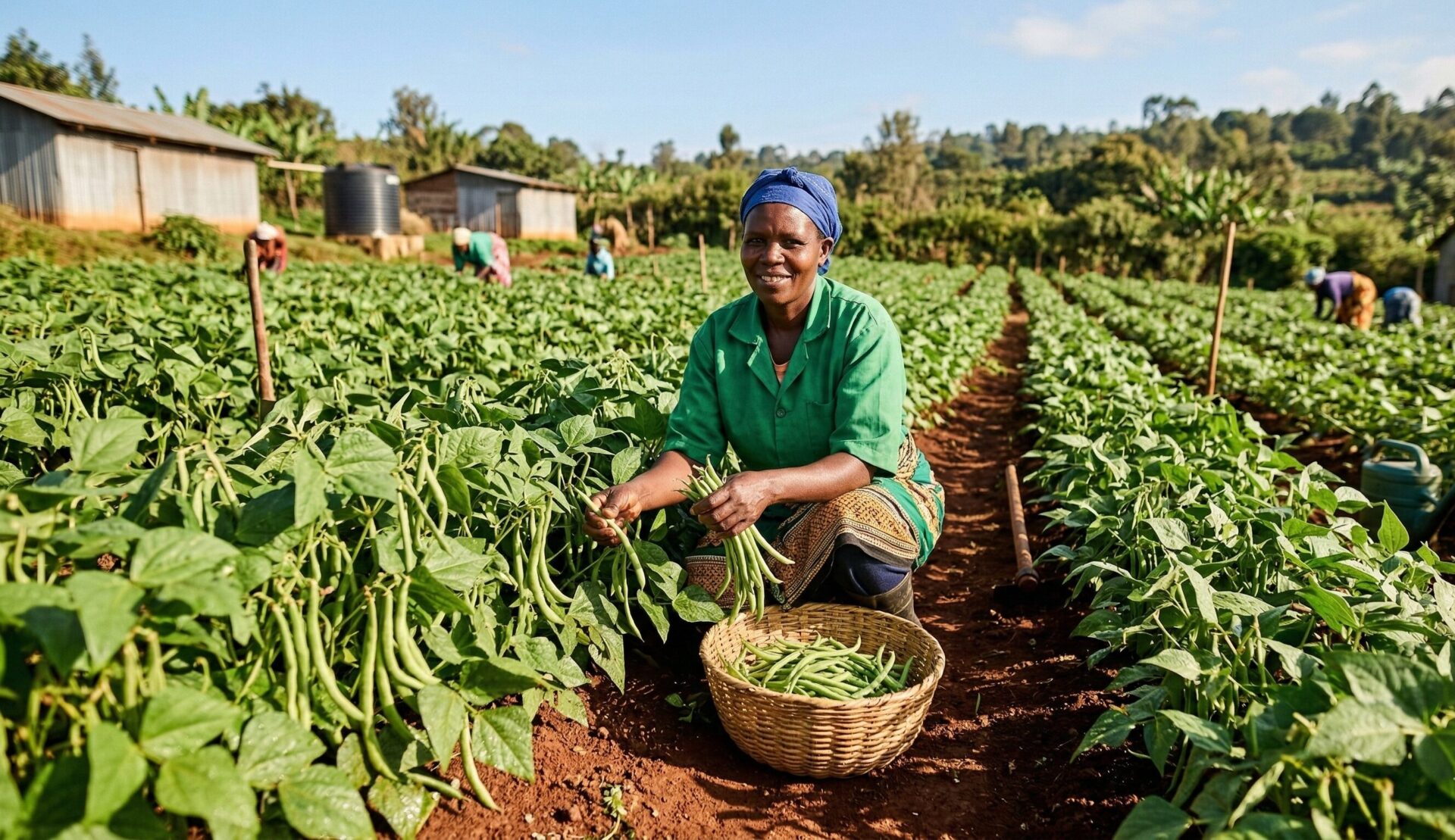
French beans are one of Kenya’s most important horticultural export crops and Kenya’s highest-volume fresh vegetable export to the EU — consistently among the top suppliers to the UK, Netherlands, France, and Germany. For smallholder farmers in Central Kenya, the Rift Valley, and Eastern Kenya, French bean farming represents one of the most accessible pathways into export agriculture: short growing cycles of 45–60 days, year-round demand from international buyers, and a price premium that transforms the economics of smallholder farming.
Yet despite this strong market position, the majority of Kenyan French bean farmers still sell to middlemen or large exporters at KES 25–40 per kilogram. Farmers and cooperatives that achieve GLOBALG.A.P. certification and access international buyers directly receive KES 80–140 per kilogram for the same produce. The gap between these two prices is not quality. It is certification, compliance, and market access knowledge.
This guide covers everything a Kenyan French bean farmer, cooperative, or exporter needs to know to access international markets directly — from GLOBALG.A.P. and GRASP certification requirements through export varieties, seasons, MRL compliance, and finding buyers.
Agrosocial provides French bean certification support across Kenya’s main growing zones: Kiambu · Nakuru (Naivasha) · Kirinyaga (Mwea) · Meru · Murang’a · Machakos. Full export overview: Agricultural Export Kenya — Complete Guide 2026.
📩 Free: Kenya French Bean Export Compliance Checklist — straight to your inbox
GLOBALG.A.P. IFA v6 requirements for French beans, GRASP checklist, EU MRL banned pesticide list, pre-shipment testing protocol, and export documentation checklist. Free, instant delivery.
Kenya French Bean Market 2026 — Scale, EU Position & the RASFF Problem Every Farm Must Understand
Kenya Is the EU’s Largest African Green Bean Supplier — and Losing Market Share to Non-Compliance
11,000 tonnes to the EU in 2024 — down from 13,000+ in 2022.
Kenya losing EU market share at 18% per year — due to quality failures.
EU Regulation 2021/2246: 100% documentary checks on Kenyan beans at all EU entry points.
Kenya remains the EU’s largest African green bean supplier — but it is losing ground every year. The cause is not competition from lower-cost origins. It is compliance failures: pesticide MRL exceedances from unregistered products and missed pre-harvest intervals, resulting in RASFF notifications that trigger enhanced border controls across all Kenyan shipments. EU Regulation 2021/2246 now mandates 100% documentary checks on fresh beans from Kenya at every EU entry point — a direct consequence of this notification history. The farms that are winning the business lost by non-compliant farms are the ones with current GLOBALG.A.P. IFA v6 certification, strictly enforced pesticide programmes, and pre-shipment residue testing as a standard operation. Sources: CBI Netherlands Market Intelligence 2024; EU RASFF Portal; EU Regulation 2021/2246.
Kenya cultivates French beans on approximately 29,000 hectares, with most farmers operating on plots averaging 0.75 hectares. Around 60% of Kenyan French bean farmers are aged 35 or younger — a young, commercially-oriented farming population with strong motivation to access export markets. The crop’s 45–60 day growing cycle means fast payback on investment and the ability to produce multiple crops per year on the same land.
The EU is the primary market, accounting for the overwhelming majority of Kenya’s French bean export volumes. The UK, Netherlands, France, and Germany are the top destination countries. The Netherlands acts as the primary entry point for continental European distribution — Dutch importers and wholesalers redistribute to retailers across Germany, France, Belgium, and Scandinavia.
Kenya’s competitive advantage is altitude and year-round production capability. Kenya’s growing zones at 1,200–2,100 metres produce French beans with the firm texture, bright colour, and shelf life that EU buyers require. Unlike European production (limited to summer months) and many competing African origins, irrigated Kenyan farms can supply consistently 52 weeks per year — a decisive advantage for programme supply buyers who sign annual supply contracts.
📖 Also read: Agricultural Export Kenya — Complete Guide 2026 — covers all Kenyan export crops, AFA/HCD licensing, KEPHIS registration, EU market entry, and cold chain requirements. · How to Register a Cooperative for Agricultural Export Kenya — the legal prerequisite before group GLOBALG.A.P. certification.
Why French Bean Export Certification Is Non-Negotiable in 2026
French beans are classified as a high-risk fresh produce category by European food safety authorities. They are consumed raw or lightly cooked, meaning any pesticide residues, microbial contamination, or food safety failure reaches the consumer directly. European buyers are more rigorous in their French bean supplier requirements than for almost any other fresh produce category.
GLOBALG.A.P. certification is the baseline requirement for all EU and UK buyers of Kenyan French beans — without exception. Without certification, a Kenyan farm or cooperative cannot access supermarket supply chains regardless of production volume or quality. Beyond GLOBALG.A.P., most UK buyers additionally require GRASP (the GLOBALG.A.P. Risk Assessment on Social Practice) covering worker welfare. Some buyers require SMETA audit for packhouses supplying Tesco, Sainsbury’s, and Marks & Spencer supply chains.
The Price Gap That Makes GLOBALG.A.P. Certification the Highest-ROI Investment in Kenyan Agriculture
KES 25–40/kg — middlemen, uncertified farm gate.
KES 80–140/kg — direct export, GLOBALG.A.P. certified.
A farmer producing 500kg/month gains KES 30,000–50,000 extra — every month.
The gap between uncertified and certified French bean prices in Kenya is not a marginal improvement — it is a fundamental business transformation. A cooperative of 30 farmers each producing 500 kilograms per month moves from KES 540,000 per month (at KES 36/kg average middleman price) to KES 1,800,000 per month (at KES 120/kg direct export price). That is KES 1.26 million in additional monthly income across the group — from the same land, the same crop, and the same growing season. The total first-year group certification investment of KES 400,000–750,000 is recovered within the first export month. Every month after that is pure premium. Sources: Agrosocial field data 2025/26; CBI Netherlands green bean market data 2024.
📖 Also read: GLOBALG.A.P. Certification Kenya — Complete Guide — the full guide to GLOBALG.A.P. IFA v6 requirements, certification process, group certification costs, and accredited bodies in Kenya. · GRASP Certification Kenya — the social add-on required by all UK supermarket French bean buyers.
Export Varieties — What EU and UK Buyers Actually Specify
Variety selection is non-negotiable for French bean export. EU and UK supermarket buyers specify varieties precisely — farms growing unspecified varieties face rejection at intake regardless of certification status. The most widely specified export varieties from Kenya are:
| Variety | Grade | Key Characteristics | Buyer Preference | Notes |
|---|---|---|---|---|
| Teresa | Fine / Extra Fine | Very straight pods, uniform diameter, high resistance to rust, long shelf life under cold chain | UK & EU supermarkets — most widely specified | Dominant export variety for pre-pack retail. Performs well in wet conditions. High yields. |
| Amy | Fine / Extra Fine | Uniform pods, excellent straightness, fits supermarket pre-pack guidelines precisely | UK supermarkets — major pre-pack programmes | Strong cold chain performance. Consistent diameter across the pod length — critical for pre-pack uniformity. |
| Paulista | Fine | Good yields, reasonable uniformity, performs well at higher altitudes | Continental EU buyers, Dutch importers | Second-tier for UK retail — good for continental wholesale markets where pod uniformity specification is slightly less strict. |
| Bobby / Climbing | Bobby (8mm+) | Larger diameter, higher yield per plant, thicker wall | Wholesale, catering, Middle East | Lower price per kg than fine grades. Suitable for catering and processing markets rather than retail pre-pack. |
Confirm variety specification with your buyer before planting
Different UK supermarkets specify different varieties — and these specifications can change seasonally. Confirm the required variety, grade specification, pod length range, and diameter tolerance with your buyer or their Kenyan agent before every planting cycle. Using the wrong variety is a rejection that cannot be recovered at the packhouse regardless of how compliant your farm is.
French Bean Export Seasons — High & Low Demand Windows and How Irrigation Changes the Game
Understanding Kenya’s French bean export seasons is critical for commercial planning, buyer negotiations, and determining whether your farm can command programme supply contracts — the highest-value buyer relationship in fresh produce.
🌱 High Demand Season — September to March
This is Kenya’s peak export window. European production is limited or zero from October to April — EU buyers are entirely import-dependent. Demand from UK and EU supermarkets is at its highest, prices are strongest, and airfreight slots fill quickly. Supply during this period comes primarily from irrigated farms in Naivasha, Mwea, and Machakos that can maintain consistent weekly volumes through the long dry season.
Price range: KES 100–140/kg direct export · Airfreight demand: Peak
🌧️ Lower Demand Season — June to September
European production is at its summer peak — French and Spanish beans compete with Kenyan supply. Import volumes naturally decline and prices soften as EU domestic supply increases. Rain-fed farms that can only supply during this window face higher competition and lower prices. However, certified Kenyan farms with strong buyer relationships maintain supply agreements year-round even through this period.
Price range: KES 80–100/kg direct export · Competition: Highest
Why irrigation transforms French bean export economics: Rain-fed farms in Kiambu, Murang’a, Nyeri, and Meru produce French beans across 1–2 growing seasons per year. Irrigated farms on the Naivasha schemes, Mwea Irrigation Scheme, and Machakos irrigation zones can produce 52 weeks per year. UK and EU supermarket programme buyers — who sign annual contracts with specified weekly volume commitments — exclusively work with farms that can deliver year-round. Programme supply contracts command the highest prices, the most stable income, and the deepest buyer relationships. For farms on irrigation schemes, GLOBALG.A.P. certification plus year-round supply capability is the most commercially powerful combination in Kenyan fresh produce export.
The 7 Export Requirements Every Kenyan French Bean Farm Must Meet
Meeting each of these requirements is non-negotiable for EU and UK market access. Missing any single one results in lost certification, failed audits, or rejected shipments. Each requirement must be in active operation — not just planned or partially implemented — before the certification audit.
1. HCD Farm Registration & KEPHIS Exporter Registration
Every farm supplying produce for export must be registered with the Horticultural Crops Directorate (HCD) under the AFA, and the exporting entity (cooperative or company) must hold a valid HCD Export Licence and KEPHIS exporter registration. KEPHIS phytosanitary certificates — required per shipment — are only issued to registered exporters. Unregistered farms and exporters cannot legally ship fresh produce from Kenya.
Governing body: HCD (AFA) + KEPHIS · Renewal: Annual
2. GLOBALG.A.P. IFA v6 Certification
GLOBALG.A.P. certification for French beans covers all stages of production: site history, soil management, water quality, pesticide management, worker health and safety, produce handling, environmental management, and traceability. French bean farms must achieve full compliance on all Major Must requirements and at least 95% on Minor Must requirements. For smallholder farmers, group certification under GLOBALG.A.P. Option 2 through a registered cooperative is the standard and most cost-effective route — reducing per-farmer costs by 60–80% compared to individual certification.
Standard: GLOBALG.A.P. IFA v6 · Renewal: Annual · Cost (group): KES 15,000–30,000/farmer
3. GRASP Social Assessment — Required by All UK Supermarkets
Most UK supermarket buyers — Tesco, Marks & Spencer, Sainsbury’s, and Waitrose — require GRASP alongside GLOBALG.A.P. for all Kenyan French bean suppliers. GRASP assesses worker welfare: wages at or above minimum wage, working hours compliance, freedom of association, grievance procedure, gender equality, and no child labour. GRASP is conducted as an add-on to the GLOBALG.A.P. audit visit — no separate audit trip — but requires specific records and worker interview preparation in advance. GRASP assessment results are published in the GLOBALG.A.P. database and visible to all buyers.
Required by: Tesco, M&S, Sainsbury’s, Waitrose · Added at: GLOBALG.A.P. audit visit · Additional fee: KES 15,000–30,000
4. ⚠️ Strict Pesticide Management & EU MRL Compliance — The Most Critical Area
Pesticide management is the single most critical compliance area for French bean export — and the most common reason for RASFF notifications and buyer delisting for Kenyan farms. The EU enforces Maximum Residue Limits for over 500 active ingredients on French beans, and limits for some ingredients are set at the limit of quantification (LOQ) — effectively zero tolerance. A single shipment exceeding an MRL causes a RASFF notification, rejection of the consignment, and suspension from the buyer’s approved supplier list.
Non-negotiable requirements: Use only pesticides registered for French beans in Kenya that are also within EU MRL limits. Strictly observe all pre-harvest intervals (PHIs). Maintain complete spray records for every application with 9 mandatory fields (date, product, active ingredient, dose, operator, equipment, field, pre-harvest interval, weather). Store all pesticides in a secure, ventilated, bunded chemical store. Commission residue testing at a KENAS-accredited laboratory before every major export shipment.
Most common RASFF cause: Organophosphates, certain fungicides, older chemistry insecticides — all registered in Kenya but exceeding EU MRLs. Check EU Pesticides Database before every application.
5. Water Quality Testing
Water used for irrigation and post-harvest washing must be tested for microbiological contamination — specifically E. coli and total coliforms — by a KENAS-accredited laboratory. Results must be within acceptable limits before certification is granted. For surface water sources (rivers, dams, canals — including Mwea and Naivasha scheme canals), testing frequency requirements are higher than for borehole or piped water. Allow 3–4 weeks for laboratory results when planning your certification timeline. Water quality records must be retained and updated at every retesting cycle.
Tested by: KENAS-accredited laboratory (KEBS, private labs) · Timeline: 3–4 weeks for results
6. Post-Harvest Handling, Packhouse & Cold Chain
French beans are highly perishable. Produce must be harvested in the early morning, transported to the packhouse within 4 hours of harvest, graded and packed in a clean hygienic facility, and pre-cooled below 8°C before loading into refrigerated containers. Cold chain failures after harvest are a leading cause of quality rejections at destination markets — and can terminate a supply relationship faster than any compliance failure. Packhouses must meet GLOBALG.A.P. hygiene requirements: cleanable floor and wall surfaces, separate areas for raw and packed produce, pest control programmes, foreign body prevention measures, and documented cleaning and sanitation records. Packhouses supplying Tesco, Sainsbury’s, and M&S supply chains typically also require SMETA (Sedex Members Ethical Trade Audit) or equivalent social audit.
Temperature target: below 8°C from packhouse to aircraft · Time from harvest to pack: 4 hours maximum
7. Export Documentation — Phytosanitary Certificate, CoO & Commercial Invoice
Every French bean export shipment from Kenya requires: a phytosanitary certificate issued by KEPHIS after physical inspection of the consignment (schedule at least 48 hours before departure); a certificate of origin; a packing list with box counts, weights, lot numbers, and variety details; a commercial invoice; and an airway bill or bill of lading. For EU shipments under the 100% documentary check regime, ensure all documentation is complete and consistent — discrepancies between documents cause shipment holds at EU borders that result in quality deterioration and buyer complaints.
KEPHIS inspection: Book 48 hours before departure · EU requirement: 100% documentary check — all documents must be consistent
📖 Also read: SMETA Audit Kenya — required by Tesco, Sainsbury’s, and M&S for all packhouses in their fresh produce supply chains, including French beans. · Farm Record Keeping for GLOBALG.A.P. Kenya — the exact spray records, harvest records, and traceability documentation required.