Passion Fruit Export from Kenya 2026 — The Complete Certification, Disease Management & Market Guide
🌿 Markets: EU · UK · Middle East · juice processors | 📅 Peak: Aug–Dec | ⚠️ Key barrier: woodiness virus | ✅ Gateway: GLOBALG.A.P + clean planting material | 📅 Last reviewed: June 2026
In This Guide
- Key Facts — Read This First
- Why Passion Fruit Export Pays
- Purple vs Yellow — The Strategic Choice
- The Woodiness Virus Barrier
- Growing Regions & Seasons
- Step-by-Step Export-Ready Process
- The 6 Export Requirements
- Export Markets — Fresh & Juice
- Certification Costs & Returns
- 5 Mistakes That Lose Contracts
- Frequently Asked Questions
⚡ Key Facts — Passion Fruit Export Kenya 2026
- Passion fruit is one of Kenya’s top three export fruits by value — behind mango and avocado — grown mainly by smallholders for both fresh and juice markets.
- Woodiness virus is the #1 barrier, causing yield losses of up to 100% and hard, unmarketable fruit. The market-preferred purple variety is the most susceptible.
- Purple vs yellow is a real strategic choice: purple = aromatic, fresh-export preferred, disease-prone; yellow = hardy, juicy, dominant in juice markets.
- The professional solution is grafting — a purple scion on a disease-tolerant yellow rootstock — plus clean certified seedlings and aphid control.
- GLOBALG.A.P + good agricultural practice has measurably cut EU rejections of Kenyan passion fruit. Certification overview →
- Two routes to market: fresh purple fruit to EU/UK/Middle East, and yellow fruit/pulp to juice processors — different requirements, choose before you plant.
- Group certification makes it affordable for smallholders at ~KES 15,000–25,000 per farmer. Group certification guide →
Passion fruit is one of Kenya’s most rewarding horticultural crops and, by foreign-exchange earnings, one of its top three export fruits behind mango and avocado. It is grown mainly by smallholders, prized for its high market value and short maturity period — a vine can return income within months. But passion fruit also carries a defining challenge that determines who succeeds in export and who loses a crop: woodiness virus disease. Get the variety choice, the planting material and the disease management right, and passion fruit is among the best returns on a small Kenyan farm. Get them wrong and certification alone will not save the crop. This guide covers both the compliance pathway and the agronomy that makes it work.
📩 Free: Kenya Passion Fruit Export Readiness Checklist 2026
The GLOBALG.A.P IFA v6 requirements for passion fruit, a clean-seedling sourcing checklist, the woodiness-management programme template and the EU MRL list — one pack, straight to your inbox. Free, instant delivery.
Why Passion Fruit Export Pays — and Where the Margin Comes From
Passion fruit rewards the export route for the same reason as Kenya’s other fruits: certified fruit sold to international buyers earns multiples of glut-season local prices, and demand — both for fresh fruit and for juice and pulp — keeps rising. The crop’s short cycle means a well-managed farm can reach paying volumes quickly, and its high per-kilo value makes even modest plots commercially meaningful. But passion fruit’s margin is unusually sensitive to disease: a woodiness outbreak does not just dent yield, it can erase a crop and the income with it. So the economics of passion fruit export are really the economics of disease-free production at scale — which is why variety, planting material and farm hygiene dominate this guide.
GLOBALG.A.P certification is the commercial gateway for EU and UK supermarket buyers, and good agricultural practice has a track record of reducing the EU rejections that have historically cost Kenyan passion fruit growers. Certification is necessary — but for this crop it is not sufficient on its own.
Purple vs Yellow Passion Fruit — The Strategic Choice
No decision shapes a passion fruit export venture more than variety, because the two main types serve different markets and carry very different disease risk.
| Trait | Purple (P. edulis) | Yellow (P. edulis flavicarpa) |
|---|---|---|
| Altitude / climate | Highlands, 1,500–2,000m, 18–25°C | Tropical lowlands, 25–30°C |
| Flavour / use | Aromatic, sweeter — preferred for fresh export | More juice, more acidic — dominant in juice markets |
| Disease risk | High — most susceptible to woodiness, Fusarium, brown spot | Tolerant of soil-borne disease; hardier |
| Best for | Fresh EU/UK/Middle East export | Juice/pulp processors; rootstock for grafting |
This is why experienced growers use a third option: grafting a purple scion onto a yellow rootstock. The result is the market-preferred aromatic purple fruit growing on disease-tolerant yellow roots — the best of both, and a meaningful reduction in chemical use and crop loss. Kenya is also commercialising newer research varieties (KALRO’s KPF 4, KPF 11 and KPF 12) bred over two decades for better disease tolerance and returns; these are worth tracking as certified planting material becomes available.
The Woodiness Virus Barrier — and How to Beat It
Passion fruit woodiness disease (PWD) is to passion fruit what fruit fly is to mango: the single factor that most determines export success. It is a virus complex caused by potyviruses spread by aphids, and it produces hardened, misshapen, thick-skinned fruit with little pulp — unsaleable for fresh export and reduced in juice yield. In the worst cases, losses reach 100%. Surveys in the coastal counties of Kwale and Kilifi found woodiness symptoms on every farm sampled, with disease incidence above 50%. The market-preferred purple variety is the most susceptible of all.
A practical woodiness-management programme
- Start with clean, certified planting material. Most infections trace back to virus-carrying seedlings. Source from reputable, disease-screened nurseries — never unknown vines.
- Graft purple onto yellow rootstock to combine market quality with disease tolerance and cut chemical dependence.
- Control aphids — the virus vector — through monitoring, targeted control and field hygiene, since stopping the vector slows spread.
- Practise strict farm hygiene: rogue out and destroy infected vines promptly, disinfect pruning tools, and avoid working wet, infected blocks.
- Consider lower-pressure regions: parts of Western Kenya such as Siaya have emerged as passion fruit areas precisely because they are less woodiness-prone.
- Rotate and rest soils to manage Fusarium wilt and brown spot, which compound losses alongside the virus.
A grower who masters this programme has solved the hardest part of passion fruit export. Everything that follows — certification, documentation, logistics — is the standard horticultural pathway.
Growing Regions & Export Seasons
Purple passion concentrates in the higher-altitude Central, Eastern and Rift Valley counties, with peak harvesting from August to December; yellow passion suits the warmer lowlands. Western Kenya (e.g. Siaya) is a newer, lower-disease-pressure area. Because purple and yellow occupy different altitudes, your location often points to which variety — and therefore which market — fits your farm.
| Region | Suited Variety | Notes |
|---|---|---|
| Central & Eastern highlands | Purple | Core fresh-export zone; manage woodiness carefully |
| Rift Valley | Purple | Good altitude; peak Aug–Dec |
| Western (Siaya, etc.) | Purple | Newer area; lower woodiness pressure |
| Coast & warm lowlands | Yellow | Juice market; hardier; higher coastal disease survey readings |
Step-by-Step Process to Get Your Passion Fruit Farm Export-Ready
Passion fruit rewards doing things in the right order — get planting material and disease management in place before chasing certification and buyers, because a clean crop is the precondition for everything else.
- Choose variety and channel — purple for fresh export, yellow for juice, or grafted purple-on-yellow for the best of both; let your altitude and target market decide.
- Source clean, certified seedlings from a reputable, virus-screened nursery — the single most important decision in the whole venture.
- Establish trellising and good spacing for airflow and easy management, which reduces disease pressure and eases spraying and harvesting.
- Run the disease programme from day one — aphid monitoring and control, roguing of infected vines, tool hygiene and soil management for Fusarium and brown spot.
- Register with HCD and KEPHIS; register your packhouse.
- Implement GLOBALG.A.P systems — records, hygiene, agrochemical store, worker welfare, traceability; individually or through a cooperative.
- Internal audit and corrective actions, then the certification audit to obtain your GGN.
- Line up your buyer — fresh or juice — and execute the first shipment with the full documentation set.
The 6 Export Requirements Every Kenyan Passion Fruit Farmer Must Meet
1. HCD & KEPHIS registration
Register your farm with the Horticultural Crops Directorate and on the KEPHIS e-certification system. KEPHIS issues the phytosanitary certificate every consignment needs; your farm and packhouse must be registered.
2. GLOBALG.A.P IFA v6 certification
The baseline for EU and UK buyers. Smallholders certify affordably through a cooperative under group certification. Begin with the how-to-get-certified guide.
3. ⚠️ Clean planting material & disease management — the decisive requirement
Certified virus-free seedlings, grafting where appropriate, and a documented woodiness/aphid programme. For passion fruit this is the requirement that decides whether you have an exportable crop at all.
4. Pesticide compliance & EU MRLs
Use only registered products within destination MRLs, observe pre-harvest intervals, and keep spray records. A single exceedance can trigger rejection and an RASFF notification. See the MRL compliance guide.
5. Harvest maturity, post-harvest handling & cold chain
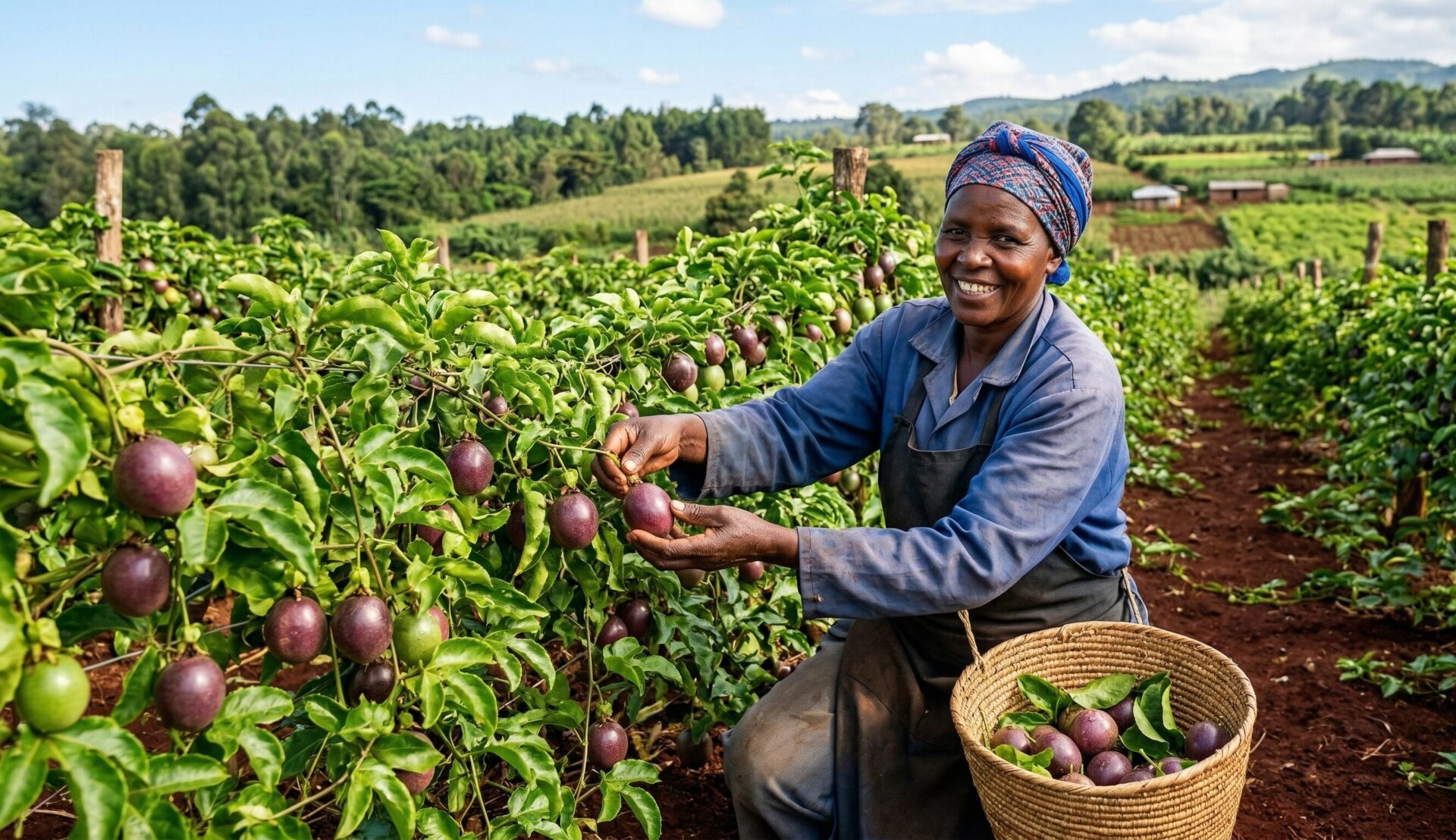
Harvest purple fruit as the skin colours toward deep purple and yellow fruit at deep golden; handle gently, grade by size and quality, and maintain the cold chain to preserve the short shelf life that fresh passion fruit demands.
6. Export documentation
Phytosanitary certificate, commercial invoice, packing list, certificate of origin, transport document and GLOBALG.A.P certificate/GGN. Consistent paperwork avoids holds at destination.
📋 Run Your Own Export-Readiness Gap Check
Assess your passion fruit farm against IFA v6, clean-seedling sourcing and disease management before spending on consultancy. Instant download, M-Pesa accepted.
Farm Audit Checklist — KES 3,500 →
Complete Starter Kit — KES 6,000
Export Markets — Fresh Fruit and Juice
Passion fruit has two distinct export channels, and they want different fruit:
| Channel | Preferred Product | Requirements |
|---|---|---|
| EU / UK fresh retail | Aromatic purple, well-graded | GLOBALG.A.P, MRL compliance, cold chain |
| Middle East fresh | Purple fresh | Often lighter than EU — useful entry market |
| Juice / pulp processors | Juicy yellow (and purple) | Volume and consistency; lower cosmetic bar |
The juice route deserves particular attention because demand is structural and growing: KALRO has partnered with major buyers including Coca-Cola to commercialise new high-quality passion fruit varieties (KPF 4, KPF 11 and KPF 12), a signal of how seriously processors take Kenyan supply. For a cooperative that can aggregate consistent volume, a processor offtake agreement can be a more stable foundation than spot fresh sales — and the disease-tolerant new varieties fit this channel well.
Decide your channel before planting, because it dictates variety, grading discipline and even region. To find and approach buyers, see How to Find International Buyers and the agricultural export pillar.
Certification Costs & Returns
📈 Why the short cycle matters — a worked view
Passion fruit can begin fruiting within roughly 8–12 months of planting and then crop continuously, which is what makes it attractive on a small plot: capital is recovered fast and income is recurring rather than once a season. A well-managed, disease-free quarter-acre of grafted purple can return meaningful monthly income at export prices — but the same plot hit by woodiness can collapse to near-zero within a season. That asymmetry is the whole game: the upside is strong and quick, the downside is total, and clean planting material plus disease management is what separates the two. Treat your seedling and aphid budget as the highest-priority spend on the farm.
GLOBALG.A.P certification runs roughly KES 150,000–490,000 for an individual farm, or KES 15,000–60,000 per farmer through a cooperative. But for passion fruit the decisive financial variable is not certification cost — it is disease loss avoided. A clean, grafted, well-managed crop can be highly profitable on a short cycle; a woodiness-infected one can return nothing despite a valid certificate. Invest in clean seedlings and disease management first; they protect every other shilling you spend. For the full ROI picture see the cost & ROI guide, and the funding sources guide for grants that offset setup costs.
5 Mistakes That Cost Kenyan Passion Fruit Exporters Their Contracts
Mistake 1 — Planting uncertified seedlings
Cheap, unscreened vines are the most common entry point for woodiness. Clean certified planting material is the cheapest insurance you can buy.
Mistake 2 — Choosing variety by habit, not by market
Planting purple for a juice contract, or yellow for an aromatic fresh-fruit buyer, wastes the crop. Match variety to channel — and consider grafting.
Mistake 3 — Ignoring aphids until symptoms appear
By the time woodiness is visible, the virus has spread. Control the vector and rogue infected vines early.
Mistake 4 — Breaking the cold chain on a short-shelf-life fruit
Fresh passion fruit is perishable. Gentle handling, prompt cooling and an unbroken cold chain are essential to arrive saleable.
Mistake 5 — Over-promising volume from disease-prone blocks
Yields swing with disease pressure. Commit to volumes your clean, managed blocks can actually sustain — aggregating through a cooperative if needed.
📩 Planning your passion fruit export?
Get the free Passion Fruit Export Readiness Checklist — IFA v6 requirements, clean-seedling sourcing, woodiness programme and EU MRL list. Free, instant delivery.
Frequently Asked Questions — Passion Fruit Export Kenya 2026
Which passion fruit variety is best for export — purple or yellow?
It is a trade-off. Purple is the aromatic, fresh-export-preferred type but highly disease-susceptible; yellow is hardier, juicier and dominant in juice markets. Many growers graft a purple scion onto a yellow rootstock to get market-preferred fruit on disease-tolerant roots.
What is passion fruit woodiness disease?
A virus complex spread by aphids that causes hard, misshapen, low-pulp fruit and yield losses of up to 100%. It is Kenya’s most damaging passion fruit disease, and purple passion is the most susceptible variety. Clean seedlings, grafting, aphid control and hygiene are the defence.
Do I need GLOBALG.A.P to export passion fruit?
For EU and UK supermarket buyers, yes. Good agricultural practice has measurably reduced EU rejections of Kenyan passion fruit. Juice processors and some Middle East buyers may have lighter requirements, useful as entry markets while you certify.
What markets buy Kenyan passion fruit?
It is one of Kenya’s top three export fruits by value. Fresh purple goes to the EU, UK and Middle East; yellow and pulp supply juice processors. The two routes have different requirements, so choose your channel early.
How much does certification cost and what can passion fruit earn?
GLOBALG.A.P runs ~KES 150,000–490,000 individually or ~KES 15,000–60,000 per farmer in a group. Passion fruit is high-value with a short cycle, but profit is dominated by disease control — woodiness can wipe out a crop regardless of certification.
Can smallholders export passion fruit?
Yes — most passion fruit is smallholder-grown. Group certification through a cooperative cuts per-farmer cost to ~KES 15,000–25,000 and aggregates volume; a shared clean-seedling and disease programme is as important as the certificate.
Key Takeaways
- Passion fruit is a top-three Kenyan export fruit — high value, short cycle, smallholder-friendly.
- Woodiness virus is the decisive barrier — up to 100% loss, and purple (the export-preferred type) is most susceptible.
- Variety is strategy — purple for fresh, yellow for juice, grafting to get both quality and disease tolerance.
- Clean certified seedlings + aphid control protect every other shilling you invest.
- GLOBALG.A.P is the gateway for EU/UK and has cut rejections — affordable via group certification.
- Choose fresh vs juice early — they want different fruit.
Agrosocial Services — Passion Fruit Export Support, Nationwide
From clean seedlings to certified export — we set your passion fruit farm up to win.
Agrosocial Services Limited helps Kenyan passion fruit growers and cooperatives choose the right variety, source clean planting material, build woodiness-management programmes, achieve GLOBALG.A.P, and connect to fresh and juice buyers. Since 2018 we’ve supported 150+ farms and cooperatives across 12 counties. We respond within 2 hours, Monday–Saturday, 7am–7pm EAT.
Related Guides from Agrosocial Services
Certification: GLOBALG.A.P Certification Kenya · Group Certification · MRL Compliance
Markets: Agricultural Export Pillar · Find International Buyers
Other crops: Avocado · Mango · French Beans · Macadamia
Agrosocial Services Export Team
Kenya Agricultural Export & Certification Consultancy — Since 2018
Agrosocial Services Limited prepares Kenyan farms and cooperatives for export — variety and planting-material advice, disease-management programmes, GLOBALG.A.P certification, KEPHIS and HCD registration, post-harvest and cold chain, documentation and buyer linkage. Since 2018 we’ve worked with 150+ farms and cooperatives across 12 counties.
📧 info@agrosocialservices.co.ke · 📲 WhatsApp +254 713 935 361 · 📅 Last reviewed: June 2026